


When something on your Ford Ranger breaks, your first thought might be to head to the dealership for a replacement part. But there's a whole world of "aftermarket" parts out there—components made by companies other than Ford—that are designed to fit and function just like the originals.
Often, these parts are a smart, cost-effective, and durable solution for the things that tend to wear out first, like door handles, side mirrors, and window regulators. Going with a high-quality aftermarket option doesn't just fix the problem; it can actually be an upgrade over the original factory design.
Why Choose Aftermarket Parts for Your Ford Ranger
Your Ranger is built tough, no doubt about it. But daily drives, heavy loads, and rough weather eventually take their toll. Sooner or later, original parts wear down and fail. This is exactly where a smart upgrade can make all the difference.
Think of it this way: the stock parts on your truck are like a decent pair of all-purpose sneakers. They work fine for a while. But a top-notch aftermarket part is more like a specialized hiking boot, specifically engineered to handle stress and last a whole lot longer. The best ones are designed to fix the known weak spots of the factory originals.
Addressing Common Failure Points
A lot of Ranger owners discover the aftermarket world because they're tired of dealing with the same recurring issues. The plastic in door handles gets brittle and snaps after years of use. The motor in a power window regulator burns out. Tailgate hardware gets bent or broken from loading and unloading cargo.
Instead of just replacing a busted part with another identical one that's likely to fail the same way, the aftermarket offers a better path. Here’s a quick look at why so many owners make the switch to aftermarket parts:
- Enhanced Durability: The best brands often use tougher materials. Think metal gears replacing flimsy plastic ones inside a window motor.
- Cost Savings: You can usually get performance that's just as good—or better—than the original, but without the dealership price tag.
- Innovation and Choice: The aftermarket is full of options, sometimes with improved features you can't even get from the factory.
This isn't just a niche market, either. The U.S. automotive aftermarket is huge and expected to hit USD 292.27 billion by 2031. Light trucks like the Ranger are a huge part of that, with the commercial segment projected to grow at a 7.05% CAGR. That's a lot of fleet trucks racking up high mileage and needing reliable replacement parts. You can read more about these automotive aftermarket trends and their impact on consumers.
Choosing the right aftermarket part isn't just about a quick fix. It's an investment in your truck's future reliability. A quality replacement gets you back on the road and gives you the peace of mind that you won't be fixing the same thing again in a year.
Making a Confident Choice
Diving into the world of aftermarket parts might feel a little overwhelming at first, but it doesn't have to be. Good, reputable suppliers guarantee their parts will fit your specific Ranger, which takes all the guesswork out of the equation.
When you stick with trusted brands that stand behind their products with solid warranties, you get the confidence of an OEM part without the steep cost. The key is knowing what to look for, and our guide on the best aftermarket auto parts can help you figure that out. Let's walk through everything you need to know.
Understanding OEM Versus Aftermarket Parts
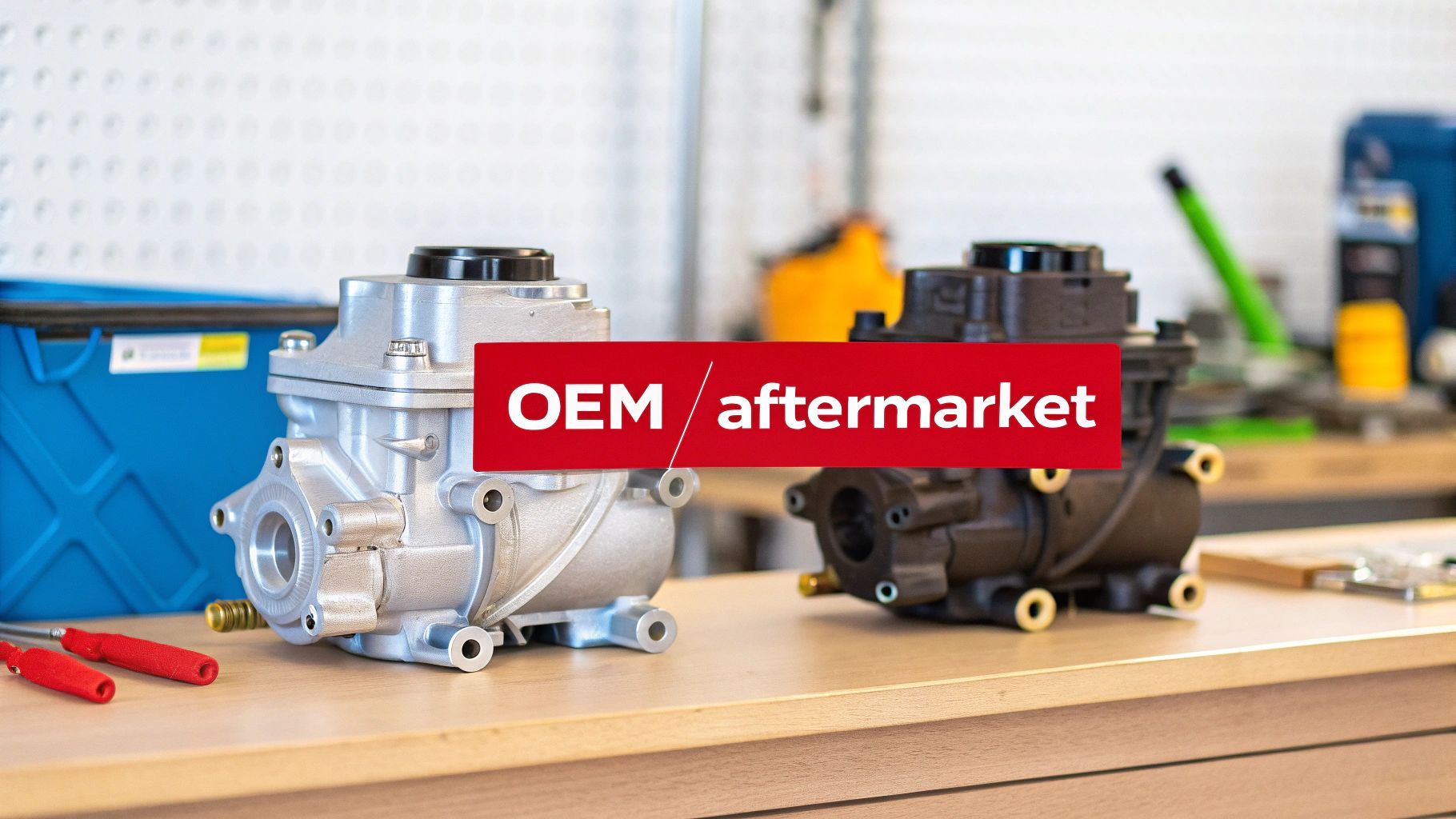
When you need a replacement part for your Ford Ranger, you'll run into two main categories: OEM and aftermarket. Picking the right one can feel a bit technical, but the idea is actually pretty straightforward.
Think of it like buying cereal at the grocery store. You have the famous national brand, and right next to it, the store's own version. Both are breakfast cereal, but they're made by different companies and come with very different price tags.
In the world of auto parts, OEM (Original Equipment Manufacturer) parts are the "national brand." These are the exact same parts Ford put in your Ranger when it rolled off the assembly line. They're made by Ford (or for Ford), come in a Ford box, and are what you'll typically find at a dealership.
Aftermarket parts are the "store brand." They're made by independent companies to serve the same purpose as the original part, but they don't come from the vehicle manufacturer.
The Tradeoffs: What You Need to Know
Your decision shouldn't just come down to the price tag. Each type of part has its own set of pros and cons, and knowing the real-world differences will help you make the best choice for your truck.
OEM parts have one big thing going for them: a guaranteed perfect fit. Since it's the same component your Ranger was built with, there are no surprises during installation. That peace of mind, however, comes at a cost. You’re paying a premium for the Ford logo and the dealership's overhead, which can make OEM parts significantly more expensive.
This is where aftermarket parts for Ford Ranger models really shine. Their biggest advantages are:
- Cost Savings: Aftermarket parts are almost always easier on the wallet. It's not uncommon to save 30-50%, sometimes even more, compared to the OEM price.
- Wider Selection: The aftermarket is a huge, competitive marketplace. This means you get a ton of options from various brands at different price points.
- Potential for Improvement: Here’s a big one. Many aftermarket companies find the weak spots in original parts and engineer their replacements to be better. Think of a plastic handle that always breaks being replaced with a tougher, reinforced metal version.
The main hesitation people have with aftermarket parts has always been the worry about quality. And while there are definitely cheap, low-quality options out there, the good brands have completely changed the game.
Bridging the Quality Gap with Reputable Brands
The old idea that all aftermarket parts are a step down is simply no longer true. These days, top-tier aftermarket manufacturers pour resources into engineering and quality control to create parts that meet—and often beat—OEM standards.
The best aftermarket suppliers don't just copy OEM parts; they improve upon them. By analyzing why original parts fail, they can reinforce weak points, use better materials, and create a replacement that is genuinely an upgrade for your Ranger.
A fantastic way to gauge quality is to look at the warranty. A dealership might offer a one-year warranty on an OEM part. In contrast, many premium aftermarket brands offer a lifetime warranty, especially on things like metal door handles or window regulators. That kind of guarantee tells you everything you need to know about their confidence in the part's durability.
Want to get deeper into the specifics? Check out our detailed comparison of OEM vs. aftermarket parts to see what it all means for your truck and your budget. When you choose a trusted aftermarket brand that guarantees fitment and backs it with a solid warranty, you get the confidence of an OEM part without the painful price tag.
The Most Common Ranger Parts That Need Replacing
Every truck has its weak spots, and the Ford Ranger is no different. After years of being put through its paces, some parts just give out. Knowing which ones tend to fail first means you can get ahead of problems and pick a replacement that’s not just a fix, but a real upgrade.
The great news is that these common high-wear parts are usually easy to swap out and have tons of support from the aftermarket. That’s a huge win for Ranger owners. In fact, pickup trucks are the heart and soul of the aftermarket scene. Parts and accessories for trucks rake in 31% of all specialty equipment sales, which is a massive $16 billion market every year. More than half of all late-model pickups on the road have aftermarket gear, with owners often looking for better solutions for things like flimsy exterior door handles or weak power window regulators that just couldn't hang. You can get the full scoop on these powerful truck and off-road market trends here.
So, let's get into the specific aftermarket parts for Ford Ranger that see the most action.
Door and Tailgate Handles
Think about it: you use your door and tailgate handles every single time you get in your truck or grab something from the bed. All that constant yanking, combined with baking in the sun and freezing in the winter, puts a serious strain on them.
The usual suspect here is plastic fatigue. The original handles are almost always molded plastic, and over time, that plastic gets brittle and weak. One chilly morning or one slightly-too-hard pull is all it takes for the handle to crack or snap right off in your hand.
When you're shopping for a new one, don't just grab another plastic handle that's doomed to the same fate.
- Look for Stronger Materials: The best aftermarket brands make handles with reinforced plastic composites or, even better, all-metal construction. They’re built to last.
- Check the Finish: A quality replacement will have a finish that perfectly matches the original factory texture and color, so it won’t look like an obvious, cheap repair.
- Confirm the Mechanism: The guts of the handle matter just as much as the part you pull. A good one will have a smooth, solid-feeling latching mechanism.
A well-made metal door handle is the perfect example of a smart aftermarket upgrade. It directly solves the original part's biggest flaw—weak material—and offers a permanent fix for a common headache.
Side Mirrors and Sensors
From a basic manual mirror to a high-tech unit with heaters, power-folding, and blind-spot sensors, your side mirrors are your eyes on the road. They are absolutely critical for safety.
Damage usually comes from the outside world—squeezing through a tight garage, clipping a tree branch on the trail, or a classic sideswipe in a parking lot. The plastic housing cracks, the glass shatters, and the delicate wiring for sensors and motors gets ripped apart.
When you’re replacing a mirror assembly, getting the details right is crucial.
- Match the Features: Make absolutely sure the replacement has all the same functions as the original, whether that’s power adjustment, heat, turn signals, or integrated cameras.
- Look for CAPA Certification: For critical safety parts like backup cameras or parking sensors, a CAPA (Certified Automotive Parts Association) seal is your guarantee. It means the part meets or even exceeds the performance and safety standards of the original factory part.
- Verify the Electrical Plug: The new part must have the exact same electrical connector as your factory wiring harness. This ensures a true plug-and-play install without any frustrating wire splicing.
Power Window Regulators and Motors
A window stuck open or shut is more than just annoying—it's a security risk. The power window regulator is the whole mechanical contraption that lifts and lowers the glass, and it’s a notorious failure point on almost any vehicle.
The system is a combination of a motor, gears, and either a set of cables or a scissor-like arm. The plastic gears inside the motor can strip out, the motor itself can burn out from the strain, or the steel cables can fray, kink, and eventually snap.
When you're hunting for a new window regulator, what you're really looking for is solid engineering.
- Motor Quality: The motor is the heart of the system. Look for replacements that have been tested for performance and longevity to make sure they can handle thousands of up-and-down cycles without giving up.
- Material Strength: The regulator assembly itself should be made from sturdy, corrosion-resistant metal. This keeps it from bending or warping under the weight of the heavy window glass.
- Precision Fit: A good aftermarket regulator is engineered to bolt up perfectly to the original factory holes inside the door panel. This guarantees a smooth, bind-free operation, just like new.
Picking the right aftermarket parts for your Ford Ranger really boils down to finding the original part's weak spot and choosing a replacement that was specifically designed to fix it. When you go for better materials and proven engineering, you're not just restoring your truck's function—you're gaining the confidence that your repair will last for years to come.
Getting the Right Part for Your Ranger the First Time
We’ve all been there. You order a part online, wait for it to arrive, spend half of Saturday taking your truck apart, and then… it doesn’t fit. It’s one of the biggest frustrations for anyone working on their own vehicle. When it comes to ordering aftermarket parts for Ford Ranger models, this happens more often than you'd think.
Why? Because a "Ford Ranger" isn't just one truck. It's a nameplate that has changed dramatically over decades of production.
Think of it like buying a case for an iPhone. You can't just ask for an "iPhone case." You have to know if it's for an iPhone 14, a 15 Pro, or an SE. The shape, button placement, and camera cutouts are all completely different. The same logic applies to your Ranger. A door handle from a 1995 model might look a lot like one from a 2005, but the mounting points or the internal guts could be totally incompatible.
Know Your Ranger's Generation
To avoid the headache of a return shipment, the very first step is figuring out which generation of Ranger you own. Each era brought major updates to the body, electronics, and mechanical bits, all of which directly affect which parts will actually fit your truck.
This timeline breaks down the key generations for the Ranger in the US market. Each one has its own distinct DNA.
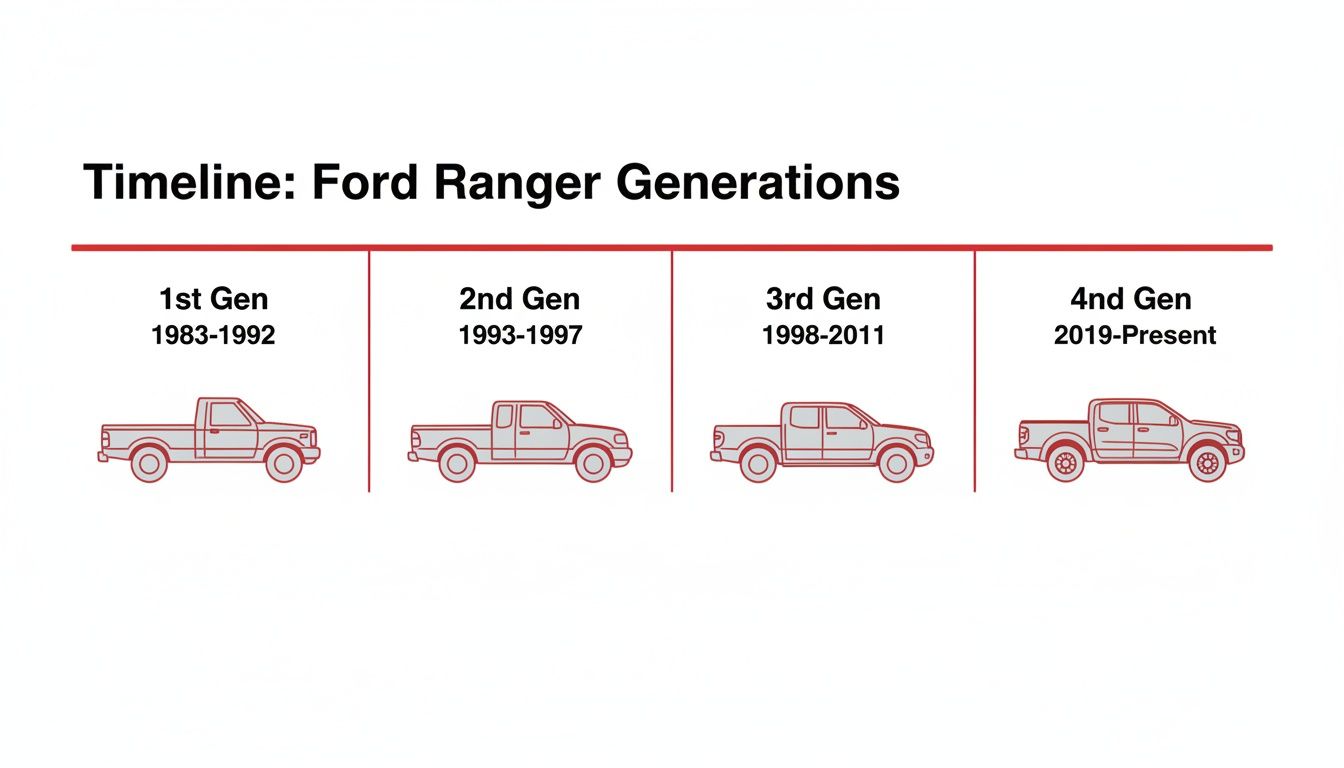
It's pretty simple: a part designed for a third-gen Ranger just won't work on a fourth-gen truck, and vice versa.
Here’s a quick look at how things changed and why it matters for the parts you’re buying:
- First Generation (1983-1992): These are the classic, boxy Rangers. Parts were simple and purely mechanical—think basic door handles, mirrors, and tailgate latches. No frills.
- Second Generation (1993-1997): Ford rounded off the edges for a more aerodynamic look. This wasn't just a facelift; the interior and exterior components were totally redesigned. A '92 handle won't fit a '93 door.
- Third Generation (1998-2012): This was a long-running and beefier generation that started adding more complex electronics. Side mirrors began featuring power adjustment and heating elements, which meant different wiring harnesses.
- Fourth Generation (2019-Present): The modern Ranger is loaded with tech. Mirrors now integrate cameras and blind-spot sensors. Even a "simple" tailgate handle might have a backup camera built right in.
Your VIN: The Ultimate Source of Truth
Knowing your Ranger’s generation gets you in the right ballpark, but your truck's Vehicle Identification Number (VIN) is what guarantees a perfect match.
Your VIN is like your truck's DNA. It's a unique 17-digit code that tells the whole story of how it was built—from the engine and transmission right down to the trim level and every factory-installed option.
When you use the vehicle selector tool on a reputable parts website, plugging in your VIN takes all the guesswork out of the equation. The system cross-references your truck’s specific build sheet with the part’s specs, confirming it’s the right one for you.
Think of your VIN as the master key for parts shopping. While year, make, and model are good, the VIN is the only thing that accounts for those weird mid-year production changes or special trim packages that can throw a wrench in your plans.
This level of precision is only getting more critical. As Ford expands the Ranger platform globally, like with the new 2025 Ranger Super Duty model for international markets, the need for exact-fit parts grows. This new beast, built for fleets with a 4500kg GVM and beefier axles, needs incredibly tough tailgate handles, hinges, and cables to match. You can read more about Ford's heavy-duty Ranger evolution here.
By combining your knowledge of the Ranger generations with the hard data from your VIN, you can shop with total confidence. You’ll save yourself a ton of time, skip the frustration of returns, and get your truck back on the road where it belongs.
What CAPA Certification Means for Your Parts
When you're shopping for aftermarket parts for your Ford Ranger, you'll probably see a small but crucial detail on certain products: a CAPA Certified seal. This isn't just marketing fluff. It's a stamp of approval that tells you the part has been seriously tested and meets a high standard.
Think of the Certified Automotive Parts Association (CAPA) as an independent, non-profit referee for the auto parts world. Their whole mission is to test aftermarket parts to ensure they fit, perform, and last just as well as the original factory part they're designed to replace—and sometimes even better.
It’s an independent, third-party guarantee that the part isn't just a cheap imitation. That CAPA seal means the component has gone through a tough, standardized testing process, giving you real confidence that your repair will be safe and reliable for the long haul.
Why CAPA Matters for Your Ranger
This certification is a big deal, especially for parts that are critical to your truck’s safety and everyday function. A non-certified piece of interior trim might just be a minor annoyance if it doesn't fit perfectly, but you can't afford to take chances with safety components.
Here are a few examples where a CAPA seal is really worth looking for:
- Backup Cameras: A certified camera ensures the picture is clear, the viewing angle is correct, and the parking guidelines are accurate—just like the one that came from the factory.
- Parking Sensors: You need these to be dead-on. Certification confirms the sensor’s range and response time are reliable, which can be the difference between a perfect park and a frustrating fender bender.
- Side Mirrors: If your mirrors have built-in turn signals or blind-spot warnings, CAPA testing verifies that all the electronics and reflective surfaces work exactly as they should.
CAPA certification takes the guesswork out of buying aftermarket. It's proof that an unbiased expert has already confirmed the part's quality, so you can install it and trust it to work.
Choosing a certified part means you're prioritizing proven quality over just the price. This is especially important for anyone managing a fleet of work trucks or running a repair shop, where a failed part can cost a ton in lost time, money, and reputation. If you want to get into the nitty-gritty, you can learn more about the benefits of CAPA Certified parts and see why so many pros rely on them.
At the end of the day, looking for that CAPA seal is one of the smartest moves you can make when buying safety-related parts for your Ranger. It’s a simple check that ensures you’re getting a part that fits right, works correctly, and keeps you safe on the road.
Your Checklist for Buying Aftermarket Ranger Parts
Alright, let's pull everything together. When you’re hunting for aftermarket parts for Ford Ranger models, a few simple checks can mean the difference between a perfect fit and a frustrating return. Think of this as your pre-purchase inspection—a quick run-through to make sure you get the right part on the first try.
Follow this straightforward guide, and you can hit that "buy" button with complete confidence.
First, Nail Down Your Ranger's Details
Before you even look at a single part, you need to know your truck inside and out. This one step prevents nearly every common buying mistake right from the get-go.
- Know Your Ranger's Year & Generation: Do you have a 3rd Gen (1998-2012) or the newer 4th Gen (2019-Present)? This is the first and most important filter for your search.
- Use Your VIN: Your Vehicle Identification Number is your secret weapon. Pop it into the seller’s vehicle selector tool to ensure what you're buying is an exact match for your specific trim level and factory options.
Your VIN is basically your truck's DNA. Using it is the single best way to avoid a part that almost fits, saving you a ton of time, money, and hassle.
Next, Judge the Part's Quality
Once you're sure a part will fit, it's time to size up its quality. You're looking for signs that it's built to last and will perform as well as—or better than—the original. A little digging here pays off big time down the road.
- Check the Materials: Does the new part improve on the stock version? A great example is finding a door handle with reinforced metal where the factory one was all plastic. That’s a smart upgrade.
- Look for CAPA Certification: For anything safety-related, like a backup camera or parking sensor, the CAPA Certified seal is a must-have. It's an independent stamp of approval that a part meets OEM standards for fit and function.
- Read Real-World Reviews: See what other Ranger owners have to say. Honest reviews are gold, often giving you the unvarnished truth about the installation and how the part performs long-term.
Finally, Check Out the Seller
A great part is only half the equation; the company behind it is the other. Don’t skip over the fine print on their policies—it tells you a lot about how much they stand behind their products.
- Warranty: Does the part come with a solid warranty? A lifetime guarantee, especially on metal components, shows the company believes in what they're selling.
- Return Policy: Look for a hassle-free return policy. Something like free 90-day returns gives you a safety net in case things don't go as planned.
- Shipping and Support: Make sure shipping costs are reasonable and that you can actually get ahold of a real person if you need help. Good support offers peace of mind you can't put a price on.
Your Top Ranger Parts Questions, Answered
Diving into the world of aftermarket parts can feel like a maze. You've got questions, and getting straight answers is the only way to feel good about what you're buying. Let's tackle the most common things Ranger owners ask, so you can make the right call for your truck.
Will an Aftermarket Part Really Void My Ranger's Warranty?
This is the big one, and thankfully, the answer is no. It’s a common myth, but your truck's warranty is protected.
In the U.S., the Magnuson-Moss Warranty Act is on your side. This law prevents a dealer or manufacturer from voiding your entire vehicle warranty just because you used a non-OEM part. For them to deny a warranty claim, they have to prove that the specific aftermarket part you installed was the direct cause of the failure.
Think about it: a new door handle or tailgate cable isn't going to cause your engine to fail. As long as you stick with quality parts from a trusted supplier, you’re in the clear.
Are Aftermarket Parts as Good as the Ones from the Factory?
Honestly, they can be even better. The quality all boils down to the manufacturer. While there are certainly cheap, low-grade options out there, the best aftermarket brands make it their business to improve on the original designs.
A smart aftermarket company will find the factory part's weakest link and re-engineer it. It’s common to see them swap out a flimsy plastic gear for a robust metal one, turning a known failure point into a source of strength.
The warranty tells a big part of the story. When you see a lifetime guarantee on a part like a window regulator, that manufacturer is standing behind their product in a way that often goes far beyond the standard one-year OEM warranty.
Can I Install These Ford Ranger Parts Myself?
You bet. Most of the common replacement parts we're talking about—handles, mirrors, tailgate components—are perfect for a DIY weekend project. If you have a basic set of tools and are comfortable turning a wrench, you can knock out most of these jobs in less than an hour.
Good sellers make it even easier. Look for companies that provide resources like step-by-step video guides or detailed instructions on their websites. This kind of support means you can confidently handle the repair yourself and save a bunch of money on labor costs.
At T1A Auto, we specialize in premium aftermarket parts engineered for durability and a perfect fit. From reinforced metal door handles to CAPA-certified cameras, find the reliable replacement your Ranger deserves at our official T1A Auto website.