


So, are aftermarket car parts any good? The answer is a definite yes, but with a crucial caveat: you have to know what you're looking for. It's a common myth that anything not from the original manufacturer is automatically a step down. The truth is, quality is what really matters, not the brand name on the box.
The Real Answer to the Aftermarket Parts Question
When your car needs a repair, walking into the world of replacement parts can feel overwhelming. The whole OEM vs. aftermarket debate often leaves drivers wondering if they're making the right call. Let’s clear things up with a simple analogy.
Think of it like grocery shopping. The OEM part is the big, national brand you’ve known for years—it's reliable, consistent, and usually carries a premium price tag. Aftermarket parts are everything else on the aisle. You’ve got the budget-friendly store brand, specialty organic options, and even gourmet versions that are better than the original.
The quality spectrum is incredibly wide. Some aftermarket parts are engineered for one thing only: to be the cheapest option available. Others, however, are specifically designed to outperform the factory component.
Beyond Just a Cheaper Alternative
The aftermarket industry is driven by more than just savings; it's about giving drivers choice and pushing for innovation. Many aftermarket companies make their name by spotting common weak points in OEM designs and engineering a better solution.
A perfect example is a window regulator with a plastic gear that's notorious for stripping out. A premium aftermarket company will see that flaw and redesign the part with a durable metal gear instead.
This is where the real value of a quality aftermarket part shines through. You're not just getting a component that fits and works like the original—you're getting one that's built to last longer. Companies like T1A Auto specialize in this, engineering parts that often improve on the factory design.
The goal isn't just to replace a broken part—it's to upgrade it. A high-quality aftermarket component can offer superior longevity and performance, providing a smarter, more cost-effective solution for your vehicle's long-term health.
Empowering Your Repair Decisions
Whether you're a seasoned mechanic working on a customer's Ford or a DIYer tackling a weekend project on your own Toyota, knowing how to spot quality is everything.
The rest of this guide will give you a clear roadmap for identifying top-tier parts. We’ll break down the most important factors—from material quality and certifications to warranties and real-world reviews—that separate the best from the rest.
By the end, you'll be able to make smart, confident choices, knowing you’re picking parts that deliver both performance and value. It’s all about looking beyond the OEM label to find the best possible fix for your vehicle.
What Aftermarket Actually Means for Your Vehicle
So, you're wondering if aftermarket parts are any good. To get a straight answer, we first have to be clear on what "aftermarket" really means. It’s actually pretty simple.
When your car or truck rolled off the assembly line, every single piece in it was an Original Equipment Manufacturer (OEM) part. These are components made either by the car company itself or by another company they hired to do the job. That hired company is called an Original Equipment Supplier (OES). The bottom line is, OEM and OES parts are what your vehicle was born with.
An aftermarket part is just any replacement part that wasn't made by that original manufacturer or their supplier. That's it. It’s not an "official" part, but that label alone doesn't tell you anything about its quality.
The Three Players in the Parts Game
It helps to think of the auto parts world as having three main tiers. Each one plays a different role in getting your vehicle back on the road.
-
OEM (Original Equipment Manufacturer): This is the part you'll find at the dealership parts counter. It's the exact same piece your car came with, logo and all—and it usually has a price tag to match.
-
OES (Original Equipment Supplier): This is the identical twin to the OEM part, but it comes in a plain box without the carmaker's branding. It was made by the same company on the same machines, but you're not paying extra for the logo.
-
Aftermarket: This is everyone else. It's a huge category, covering everything from budget-friendly replacements to high-performance upgrades specifically engineered to be better than the original factory part.
This is where you, the owner, get to make a choice. The aftermarket gives you options that go beyond what the dealership offers, letting you find a solution that fits your budget and your needs.
A Thriving Market Built on Options
The fact that the aftermarket is so massive tells you everything you need to know about its importance. This isn't some fringe industry; it's essential for keeping cars running affordably.
The global automotive aftermarket is already huge—estimated to be worth USD 860.08 billion in 2025 and projected to jump to USD 1,482.12 billion by 2035. That kind of growth doesn't happen unless drivers trust and depend on aftermarket parts for common repairs, like fixing a broken door handle or a faulty window regulator. You can dive deeper into the automotive aftermarket landscape and its future growth to see just how big it is.
The aftermarket isn't a shadowy corner of the auto industry; it's a competitive and innovative space that directly challenges OEM parts on price, availability, and often, quality. It forces improvement across the board.
For you, this competition is fantastic news. It means you aren't stuck paying dealership prices. Instead, you can find a part that truly fits what you need. That’s where a company like T1A Auto comes in. We act as curators in this vast market, zeroing in on common OEM weak spots—like plastic components that always seem to fail—and engineering better aftermarket solutions with durable metal upgrades. We take the guesswork out of the equation, so you get a part that's not just a replacement, but a real improvement.
How to Spot a High-Quality Aftermarket Part
Shopping for aftermarket parts doesn't have to feel like a roll of the dice. Yes, the options are endless and a little overwhelming, but a few key details can instantly tell you if you're looking at a premium part or a cheap knock-off. The real answer to "are aftermarket car parts good?" is knowing what to look for.
Think of yourself as a detective for your car. You just need to know which clues to follow. By checking for better materials, guaranteed fit, proper certifications, a solid warranty, and real-world reviews, you can confidently find a part that’s as good as—or even better than—the original.
Look for Smarter Materials and Better Designs
The heart of any good car part is the material it’s made from. The best aftermarket manufacturers aren't just copying factory parts; they're actively improving them by fixing common weak spots. This is where you can find some serious upgrades.
A perfect example is a door handle with a flimsy plastic piece inside that's notorious for snapping. A top-tier aftermarket company will see that flaw and re-engineer the part with reinforced metal, creating something fundamentally tougher than the part it's replacing.
When you're shopping, keep an eye out for these signs of quality:
- Metal Upgrades: Does the part swap a weak plastic OEM component for a stronger metal one?
- Clear Specs: Does the seller tell you exactly what materials are used, like high-grade steel or heat-resistant polymers?
- Smarter Engineering: Does the part clearly address a known factory flaw, like weak gears in a window motor?
Choosing a part with better materials isn't just about replacing what broke. It's about investing in a permanent fix so you don't have to deal with the same problem again down the road.
Insist on a Guaranteed Fit
A part that doesn't fit your car is just an expensive paperweight. While factory parts obviously have the home-field advantage here, the best aftermarket brands have closed that gap with serious investments in precision engineering. They guarantee their parts will fit and work just like the original, no questions asked.
This is about more than just avoiding installation headaches—it’s about safety. A poorly fitting part can cause a domino effect of problems:
- Wasted Time and Money: Your mechanic (or you) might have to fight with the part to get it installed, racking up labor costs.
- Compatibility Problems: An ill-fitting part can rattle against other components, causing damage or premature wear.
- Safety Hazards: Critical parts like mirrors or sensors need to line up perfectly to do their job and keep you safe.
When a seller guarantees a "direct-fit" or "OEM-spec," they're making a promise that the installation will be smooth and hassle-free. Always look for brands that offer a vehicle finder tool and have a clear return policy if the fit isn't perfect.
Check for Reputable Certifications
A certification from an independent organization is one of the strongest signals of quality you can find. It’s an unbiased stamp of approval, confirming a part has been put through the wringer and meets or exceeds factory standards for fit, durability, and performance.
The gold standard in the industry comes from the Certified Automotive Parts Association (CAPA). Earning a CAPA seal is no small feat. It means the part has survived a whole battery of tests to prove it performs just as well as the OEM version. For anyone still on the fence, a CAPA sticker is a clear and simple "yes." You can dive deeper into what this means in our guide to CAPA certified parts.
Demand a Rock-Solid Warranty
A warranty is more than just fine print; it's a window into how much a company believes in its own products. If a manufacturer only offers a 90-day warranty, they might be telling you they don't expect their part to last much longer.
On the other hand, a company offering a lifetime warranty is putting its money where its mouth is. They're standing behind their engineering for as long as you own your car. That kind of confidence is a sure sign you're buying a part that's built to last.
Read Verified Customer Reviews
Finally, never forget the power of real-world feedback. Honest reviews from people who drive the same car you do—whether it’s a Ford F-150 or a Toyota Tacoma—can give you priceless insight into how a part actually performs over time.
Look for patterns. Are people consistently saying how easy the installation was? Do they mention the part is still going strong after thousands of miles? This is the kind of firsthand evidence that can back up all the specs and promises, giving you that final piece of confidence to make a smart buy.
Choosing Between Aftermarket And OEM For Specific Repairs
Knowing what makes a good aftermarket part in theory is one thing, but it's a whole different ball game when you're under the hood with a broken component in your hand. The honest truth is, the "right" choice really depends on what you're replacing. The question isn't just "are aftermarket parts good?" but rather, "is an aftermarket part the best choice for this specific repair?"
Let's make this simple. Think of it like a traffic light: Green means go for it, Yellow means proceed with caution, and Red means you should probably stop and stick with the original manufacturer part.
Green Light: High-Wear And Cosmetic Parts
Some parts on your car are just meant to be replaced over time. This is where the aftermarket world truly shines. We're talking about the components that take a daily beating or are the first to show cosmetic dings and scratches.
Smart aftermarket companies focus on these common-failure items. They often redesign them with better materials, giving you a part that lasts longer than the original, all for a fraction of what you'd pay at the dealership.
Excellent Aftermarket Choices Include:
- Door Handles: A classic example. The original interior and exterior handles often have plastic pieces that get brittle and snap. You’ll find top-tier aftermarket handles with reinforced designs or even metal upgrades for far better durability.
- Window Regulators: The factory cables and plastic clips inside a window regulator are notorious failure points. Aftermarket versions frequently use stronger cables and tougher materials to keep you from facing the same repair down the road.
- Side Mirrors: A parking lot mishap can easily crack a mirror housing, or the motor might just give out. An aftermarket mirror assembly is a perfect, direct-fit replacement that won't break the bank. For a closer look at how these compare, our guide on OEM replacement parts has more details.
- Tailgate Components: If you own a truck, you know how much abuse things like tailgate handles, latches, and support cables endure. The aftermarket is full of heavy-duty options built for real-world work.
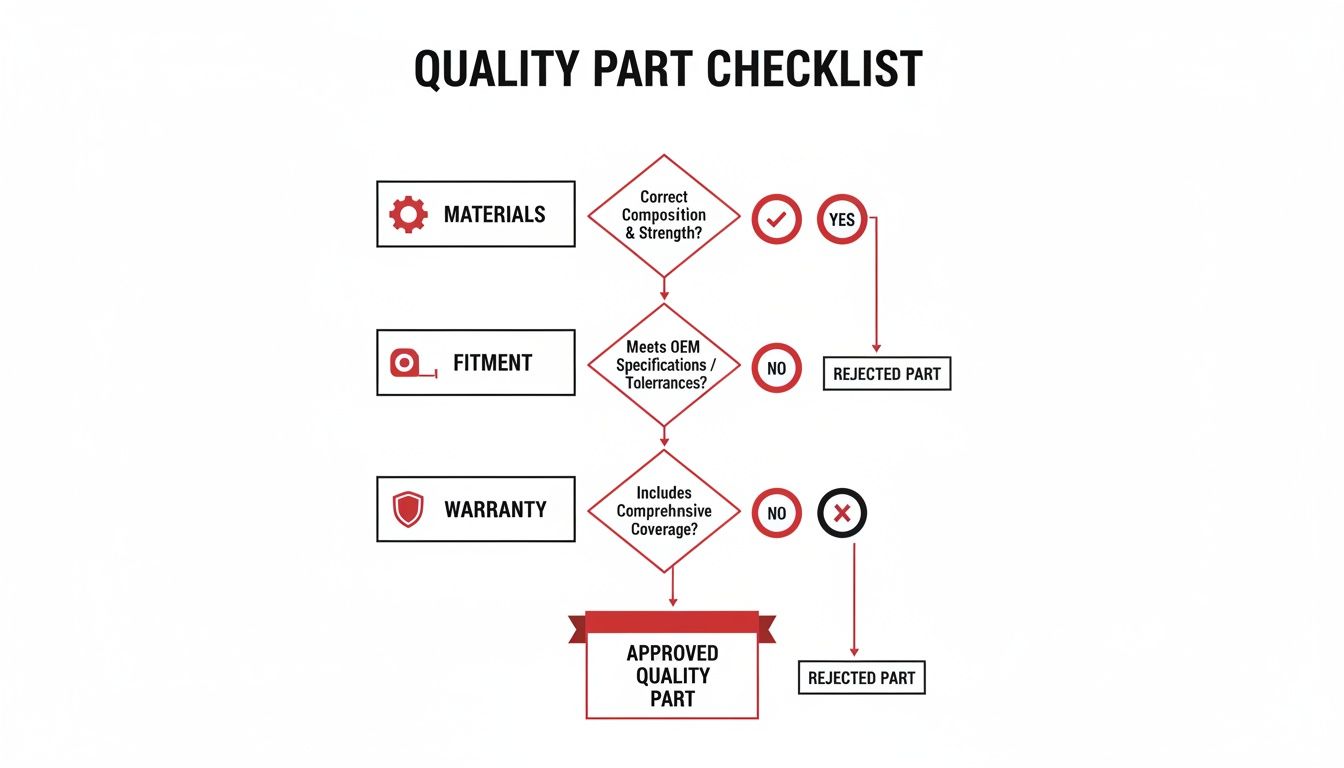
This kind of simple checklist—looking at materials, fitment, and warranty—is how you find a part that’s not just cheaper, but genuinely better.
Yellow Light: Parts Requiring Careful Selection
When you move into this category, you have to put on your savvy shopper hat. These are parts that are more complex or have a bigger impact on your car's performance. The quality gap between a great aftermarket brand and a cheap knock-off can be massive here.
For these components, doing your homework isn't just a suggestion; it's essential. This is where you really need to rely on that quality checklist. Zero in on brands that boast CAPA certifications, offer solid warranties, and have a long history of happy customers.
Proceed With Caution On These Parts:
- Sensors (Parking, Bumper): These need to be precise to work right. A CAPA-certified sensor is your best bet for ensuring it meets the same specs for accuracy and reliability as the original.
- Lighting Assemblies: Headlights and taillights aren't just for looks—they have to meet strict safety and legal standards. A certified part from a reputable brand ensures it will fit correctly, cast the right beam pattern, and last for years.
- Suspension Components: Parts like control arms and ball joints are absolutely critical for a safe, smooth ride. You'll want to stick with established brands known for their engineering and material strength.
When you're looking at a 'Yellow Light' part, the brand's reputation and its warranty become your most important guides. A lifetime warranty on a metal part is a huge vote of confidence from the manufacturer. It tells you they built it to last.
Red Light: Safety-Critical Systems
Finally, we get to the parts where the risk of failure is just too high to gamble on. These components are tied directly into your vehicle's core safety features and complex electronic systems. Even a tiny variation from the original specifications can lead to serious problems.
While a few high-end aftermarket options might exist, the peace of mind that comes from using a genuine OEM part for these specific repairs is almost always worth the extra money.
Strongly Consider OEM For:
- Airbag Modules and Sensors: This is your car's most important safety system. There is absolutely no room for error. OEM parts guarantee perfect compatibility with the deployment logic your car was designed with.
- Engine Control Units (ECU): The ECU is your car's brain, and it's programmed specifically for your make, model, and year. An OEM unit ensures it communicates flawlessly with every other system in the vehicle.
- Complex Transmission Components: Internal parts like solenoids or valve bodies are incredibly specialized. Using OEM parts here helps you avoid compatibility nightmares that could lead to a catastrophic transmission failure.
Aftermarket vs OEM Decision Guide for Common Repairs
To make it even clearer, here's a quick-reference table to guide your decision-making process for some common repairs.
| Component Type | Aftermarket Suitability | Key Considerations |
|---|---|---|
| Door Handles | Excellent | Look for metal or reinforced plastic upgrades. Aftermarket often improves upon weak OEM designs. |
| Window Regulators | Excellent | Seek out versions with stronger cables and more durable guide clips. A very common and safe aftermarket buy. |
| Side Mirrors | Excellent | A perfect cost-saving replacement for cosmetic damage. Ensure it includes features like heat or signals. |
| Suspension Parts | Good (with caution) | Brand reputation is everything. Stick to well-known manufacturers with strong warranties. |
| Sensors | Good (with caution) | CAPA certification is a must for ensuring accuracy and reliability. |
| Lighting Assemblies | Good (with caution) | Choose certified parts to guarantee legal compliance, proper beam pattern, and a moisture-proof seal. |
| Engine ECU | Poor | The risk of electronic incompatibility is too high. OEM is the safest bet. |
| Airbag Systems | Poor | Non-negotiable. Always use OEM for any component related to the airbag system for safety reasons. |
| Internal Transmission | Poor | These parts are highly specialized and sensitive. OEM prevents costly compatibility failures. |
This guide should give you the confidence to know when you can save money without sacrificing quality and when it's smartest to head to the dealership.
Smart Shopping and Installation Tips You Can Trust
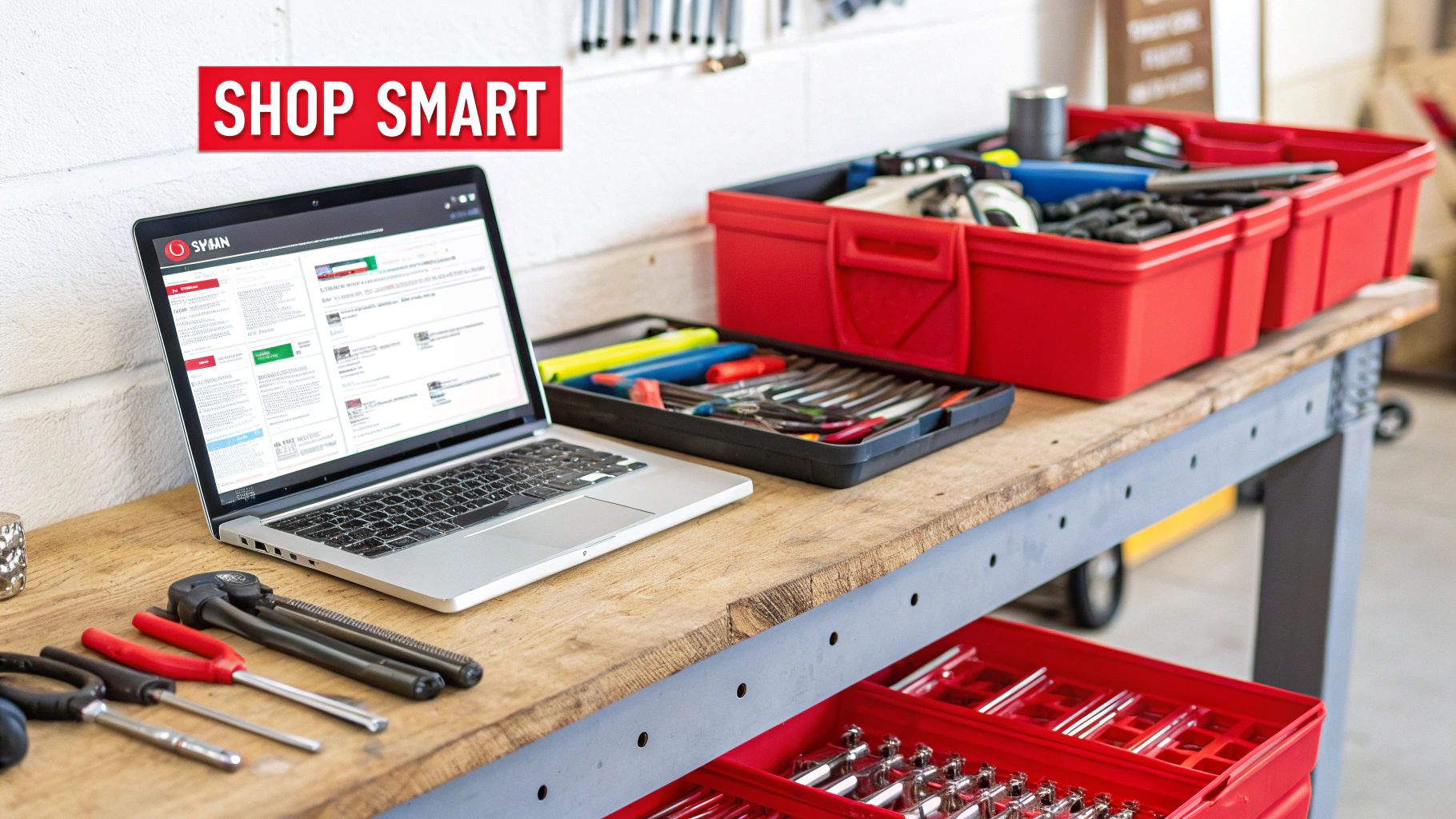
Knowing how to spot a quality aftermarket part is a great start, but a successful repair really comes down to the buying and installation process. It doesn't matter how good the part is if it doesn't fit or you can't get it on the vehicle correctly. This is where smart shopping and a bit of prep work pay off, turning a frustrating chore into a job well done.
Your repair journey begins long before you ever pick up a wrench. It starts with making absolutely sure you’re ordering the exact part for your specific vehicle. Trust me, the single biggest headache for any DIYer is getting halfway through a job only to realize the new part doesn't match the old one.
Smart Shopping for Guaranteed Success
The easiest way to avoid that nightmare is to take the guesswork out of the equation from the get-go. A good online retailer will give you the tools to confirm you’re buying the right part before you even click "add to cart."
Here’s what to look for when you're shopping online:
- Vehicle Finder Tools: This is a must-have. Always use a feature that lets you enter your car's year, make, and model. It should filter out everything that won't fit your ride.
- Clear Return Policies: Look for a flexible return window, like a 90-day policy. It’s your safety net in case something doesn't go as planned.
- Shipping Perks: Little things like free shipping on orders over $75 can add up, making online shopping a much more affordable option.
The online auto parts scene is blowing up. While brick-and-mortar stores are still a big piece of the pie, the online market is growing at a massive 8.88% CAGR. The entire U.S. aftermarket is on track to hit USD 94.53 billion by 2025, which just goes to show how many people are finding it easier and more reliable to shop online. You can explore the full automotive aftermarket report from Fortune Business Insights if you want to dig into the numbers.
DIY Installation Best Practices
Once that new part lands on your doorstep, a little planning will make the actual installation a breeze. Rushing into a repair without the right tools or a clear game plan is a classic recipe for a half-finished job and a lot of four-letter words.
A successful installation is 90% preparation and 10% execution. Taking a few minutes to get organized beforehand will save you hours of trouble later.
Before you start unbolting anything, run through this quick checklist:
- Gather the Right Tools: Find a good tutorial video for your specific repair. Jot down every single tool they use—from socket sizes to those pesky trim removal tools—and make sure you have them all within arm's reach.
- Follow Visual Guides: Written instructions are fine, but a video is better. Watching someone else do the job lets you see the whole process, pointing out tricky steps and showing you exactly how things come apart and go back together.
- Choose a Supportive Supplier: This is the real secret weapon. When you buy from a company with solid customer support, you have a lifeline if you get stuck. Having a team you can call for help is priceless.
So, are aftermarket parts a good choice? Absolutely, as long as you pair a quality component with a smart process. When you use vehicle finders to guarantee fitment and prep for the installation, you can tackle the job with total confidence. To find a supplier you can count on, take a look at our guide on choosing the best online auto parts retailer.
Why Quality Aftermarket Parts Are the Smart Choice
When it comes down to it, the real question isn't just "are aftermarket parts any good?" It's about finding the absolute best value for your vehicle. A truly smart choice isn't the cheapest part on the shelf—it's the one that gives you lasting reliability without the steep dealership price tag. It's the perfect blend of quality, precise fit, and a solid guarantee.
The trick is to change your mindset. Don't just think about replacing what's broken; think about upgrading your vehicle. When you pick a high-quality aftermarket component, you're often getting a part that was specifically engineered to fix the inherent weakness that caused the factory part to fail in the first place. That’s where the real genius of the aftermarket shines.
The True Meaning of Value
A great aftermarket part proves its worth by delivering on a few key promises. It turns a simple repair into a long-term investment in your car's health.
- Upgraded Durability: The best aftermarket brands pinpoint common failure points in OEM parts—like a plastic gear that always seems to strip—and re-engineer them with stronger materials like metal. This means you’re not just fixing a problem; you're making sure it doesn't happen again.
- Assured Quality: Look for independent seals of approval. Something like a CAPA certification is unbiased proof that a part meets or even beats the original's standards for fit, function, and safety. It takes the guesswork out of the equation.
- Peace of Mind: A good warranty is a manufacturer's vote of confidence in their own product. When you see a lifetime warranty on a metal part, you know they believe in their engineering, protecting you for as long as you own the car.
The smartest choice is a part that offers superior materials, certified performance, and a rock-solid guarantee. This combination ensures you get a reliable repair that provides exceptional value far beyond its initial cost savings.
Ultimately, choosing a premium aftermarket supplier puts you in the driver's seat. You get access to parts that are not only more affordable but are often better designed and more durable than what came from the factory. By focusing on the tangible signs of quality—materials, fitment guarantees, certifications, and warranties—you can confidently pick parts that will keep your vehicle running strong for years.
Armed with the right knowledge, you're ready to find the perfect components for your truck or car. You can move forward knowing you’ve found a superior, value-driven alternative to OEM that is genuinely built to last.
Frequently Asked Questions About Aftermarket Parts
Even after digging into the details, you might still have a few questions buzzing around. Let's tackle some of the most common ones head-on so you can make your next repair decision with total confidence.
Will Using Aftermarket Parts Void My Car Warranty?
This is probably the biggest myth in the auto repair world, but the answer is a firm no. A federal law in the United States, the Magnuson-Moss Warranty Act, is on your side here.
A car manufacturer can't legally deny your warranty claim just because you used an aftermarket part. To do so, they have to prove that the specific aftermarket part you installed was the direct cause of the failure you're trying to get fixed under warranty.
By choosing a high-quality, certified part from a trusted supplier, you’re not just getting a reliable component—you’re protecting your rights as a car owner.
Are Aftermarket Parts Always Cheaper Than OEM?
Most of the time, yes. A major benefit of the aftermarket is competitive pricing. You have multiple companies all vying for your business, which naturally keeps prices lower than the single-source OEM parts you find at the dealership.
But be careful—the cheapest part you can find is rarely the best one. An unusually low price is often a red flag for shoddy materials, poor manufacturing, or a fit that will give you a major headache during installation.
The real goal isn't just to find the cheapest part, but the best value. That means finding a component that matches or even improves upon OEM quality at a fair price, all backed by a solid warranty for your peace of mind.
What Does CAPA Certification Mean For Parts?
CAPA stands for the Certified Automotive Parts Association. It’s an independent, non-profit organization that has become the gold standard for quality in aftermarket collision parts.
Think of the CAPA seal as a trusted, third-party stamp of approval. When a part is CAPA certified, it’s been through a gauntlet of tests to ensure it stacks up against the original part in every important way:
- Fit and Finish: The part is guaranteed to line up perfectly with your vehicle's body panels and mounting points. No weird gaps or misalignments.
- Material Quality: The materials are just as strong and durable as what came from the factory.
- Performance: The part works exactly like it's supposed to, whether it's the crystal-clear image from a backup camera or the pinpoint accuracy of a parking sensor.
For any part where precision and safety are critical, seeing that CAPA seal gives you unbiased proof that you’re buying a top-tier, reliable product.
At T1A Auto, we're all about taking the guesswork out of finding premium aftermarket parts. With our easy-to-use vehicle finder, upgraded metal components, and a lifetime warranty on many of our parts, you can confidently choose a durable, high-value solution for your car or truck. Find the guaranteed-fit parts you need today at https://t1aauto.com.
