


Let’s be honest, the days of trudging down to the local parts counter are numbered. Who has the time to spend an afternoon trying to describe that one weird-looking sensor or waiting for a part to hopefully show up from a warehouse across the state? The best place to buy auto parts online isn't just a website; it’s a modern, digital garage that brings a massive marketplace right to your fingertips, offering a level of convenience and selection most brick-and-mortar stores just can't touch.
Why Your Next Car Part Should Come from an Online Store
This shift to buying parts online isn't just a small trend—it's completely changed the game for DIYers and professional mechanics alike. Today, a successful repair often starts with a click, not a trip across town. This evolution is all about putting you, the buyer, back in the driver's seat with more control and confidence than ever before.
And the numbers don't lie. The U.S. online auto parts market was recently valued at around $6.5 billion and is expected to hit $6.7 billion soon—a 3.1% jump in just one year. This is part of a bigger picture where the market has been growing at a steady 7.3% annually, proving that more and more people are ditching the old way of doing things. If you're curious, you can dig into the online auto parts market size and growth trends on IBISWorld.
The Real-World Perks of Buying Online
So, what’s the big deal about clicking "add to cart"? It comes down to a few core advantages that solve the classic headaches of sourcing parts. Instead of being stuck with whatever one store has on its shelves, you suddenly have access to a global inventory.
- Endless Aisles: Online stores offer a mind-boggling catalog. Whether you need a common door handle or a hard-to-find sensor for a vintage ride, you’ll probably find it.
- Better Prices: You can compare prices from dozens of retailers in minutes. No more haggling or wondering if you're getting a fair shake.
- Total Convenience: Order the exact part you need from your garage, workshop, or even your couch, 24/7. It just shows up at your door.
Buying online transforms a time-sucking errand into a smart, research-backed decision. You’re no longer just a customer at a counter; you're an empowered buyer with reviews, specs, and options right in front of you.
This is exactly the world T1A Auto was built for. We created our business from the ground up to serve the modern, online-first customer. By zeroing in on high-quality aftermarket parts, guaranteeing every part fits, and building policies around what customers actually need, we deliver an experience that’s not just easy, but one you can trust. We get that behind every order is a real person with a real project, and our job is to help you get it done right the first time.
The Four Pillars of a Great Online Parts Retailer
Shopping for auto parts online is about more than just finding the lowest price tag. It's really about finding a supplier you can trust to deliver quality and stand behind their products. Think of it like building a high-performance engine; you need four key components working together perfectly to create something powerful and, most importantly, reliable.
It's easy to get sidetracked by flashy websites and big discount banners. To cut through that noise, you need a solid way to evaluate who you're buying from. This simple checklist will help you look past the marketing hype and lock in on a supplier you can count on for the long haul.
This diagram breaks down the process of finding a top-tier online retailer, starting from your initial search and narrowing it down to a specialized, go-to source.
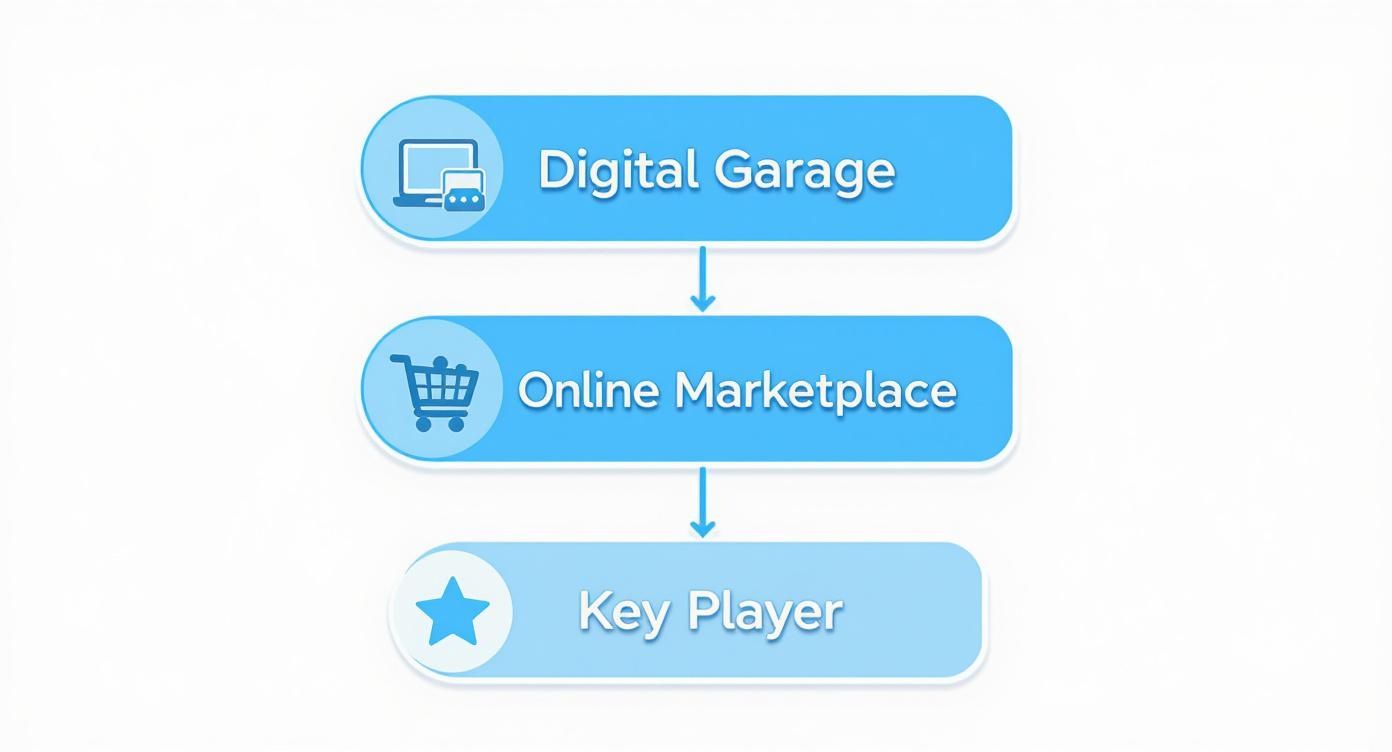
The real goal is to find that one retailer who becomes your trusted partner, making every future repair smoother and more confident.
Pillar 1: Proven Part Quality
First things first: the quality of the parts themselves. This is non-negotiable. A cheap part that fails prematurely isn't a bargain; it’s a ticking time bomb that can cause catastrophic damage, turning a simple weekend repair into a massive, expensive headache.
A great retailer is an open book about where their parts come from and how they’re made. They don't hide behind vague descriptions. Instead, look for clear signs of their commitment to quality:
- Detailed Specs: They should tell you what a part is made of, pointing out things like upgraded metals used to replace failure-prone plastics.
- Manufacturing Standards: Keep an eye out for mentions of ISO or CAPA certifications. These aren't just acronyms; they're proof that the parts are made according to strict industry benchmarks.
- Rigorous Testing: The best suppliers put their parts through the wringer, conducting extensive tests to ensure they meet—or beat—the performance of the original factory parts.
If you want to go deeper on this, check out our complete guide to identifying the best aftermarket auto parts and learn what separates premium components from the rest.
Pillar 2: Guaranteed Vehicle Fitment
There's nothing more frustrating than getting halfway through a job, covered in grease, only to find out the new part doesn't fit. Pillar number two, guaranteed fitment, is designed to prevent that exact nightmare scenario.
This isn't just a generic vehicle lookup tool. A real fitment guarantee is a promise from the retailer that the part they say fits your car actually will. If they get it wrong, they should take full responsibility by covering the return shipping and quickly getting the right component out to you. It turns a risky online guess into a confident purchase.
A fitment guarantee is the retailer’s way of saying, "We’ve done the homework for you." It’s a powerful signal that they value your time and your project’s success as much as you do.
Pillar 3: Customer-First Policies
You can tell a lot about a company by its policies. Are they written to protect the business or to support the customer? The third pillar is all about finding a retailer that builds its warranty, shipping, and return rules around your needs, giving you peace of mind long after you click "buy."
Below is a quick reference for what to look for when choosing a retailer. These four pillars are the foundation of a trustworthy relationship between you and your parts supplier.
Core Criteria for Evaluating Online Auto Parts Retailers
| Pillar | What to Look For | Why It Matters |
|---|---|---|
| Proven Part Quality | Details on materials, manufacturing standards (ISO/CAPA), and rigorous product testing. | Ensures you're getting a durable, reliable part that won't fail prematurely and cause bigger problems. |
| Guaranteed Vehicle Fitment | A clear promise that the part will fit, backed by free returns if the retailer makes a mistake. | Eliminates the risk and frustration of receiving the wrong part, saving you time and money. |
| Customer-First Policies | Generous warranties (lifetime is the gold standard), free and fast shipping, and a hassle-free return window (90 days or more). | Shows the company is confident in its products and values your business, protecting your investment. |
| Accessible Expert Support | Real, knowledgeable people available via phone or email who can help with technical questions. | Provides a critical safety net, ensuring help is available if you get stuck during your repair. |
Ultimately, policies that are clear, fair, and generous are a direct reflection of a company's confidence in what it sells. A confusing or restrictive return process is always a major red flag.
Pillar 4: Accessible Expert Support
Even with the best parts and the clearest instructions, you might run into a problem you didn't expect. That’s where the fourth pillar comes in: access to actual, knowledgeable human support.
When you’re stuck under your car, the last thing you want is an endless phone menu or an unhelpful chatbot. The best online retailers offer multiple ways to get help from people who genuinely understand cars. Whether it's a responsive phone line or a dedicated email support team, you want to know an expert is ready to help you solve a problem, not just read from a script.
How to Identify High-Quality Auto Parts Online
https://www.youtube.com/embed/yTLDU4j3XlM
Let's be honest, the single most important part of any repair is the quality of the component you're installing. We've all been tempted by a cheap part, but when that low-grade component fails, it can cause catastrophic damage. A simple weekend fix can quickly spiral into a nightmare of expensive repairs.
So, how do you find the best place to buy auto parts online? It starts with learning how to cut through the marketing noise and identify parts that are actually built to last.
First, you need to understand the lingo. The auto parts world really boils down to three main categories, and each one has its own set of pros and cons. Figuring out which type is right for your project is the key to a successful, long-lasting repair.
This has become more important than ever, especially with the online auto parts market seeing some serious growth. The industry is currently valued at a staggering $250.39 billion and is on track to hit $745.90 billion in the next ten years. With North America making up 33% of that market, more and more of us are clicking "add to cart" for our car parts. That makes knowing what to look for absolutely critical.
OEM vs. Aftermarket Parts
Original Equipment Manufacturer (OEM) parts are the real deal—they're the exact same components your car rolled off the factory floor with. Made by the car manufacturer (or a company they hired), they guarantee a perfect fit and original performance. The downside? They come with a hefty dealership price tag.
Original Equipment Supplier (OES) parts are almost identical to OEM. Think of it this way: the same company makes the part, but it's sold in a different box without the automaker's logo. You get the same quality as OEM, often for a little less money.
Aftermarket parts are where things get interesting. These are made by companies completely separate from the original manufacturer. The quality here can be a total crapshoot, ranging from cheap, unreliable junk to premium components that have been reverse-engineered to be even better than the original.
The goal isn't just to find a cheap part; it's to find a high-value aftermarket part. A premium aftermarket component offers the perfect balance of OEM-level quality and reliability without the dealership price.
If you want to dive deeper into the pros and cons of each, we broke it all down in our guide to OEM vs aftermarket parts.
Spotting the Signs of a Quality Part
So, how do you actually spot one of these top-tier aftermarket parts? It all comes down to looking for tangible proof of quality. Vague promises just don't cut it. You need to see real evidence that a retailer is serious about building durable, reliable components.
Look for sellers who give you the nitty-gritty details and aren't afraid to show you exactly what their parts are made of. That kind of transparency is a huge sign that they stand behind their products.
Here's what to keep an eye out for:
- Superior Materials: A quality-obsessed brand like T1A Auto will often highlight where they’ve made improvements. A great example is replacing a plastic gear in a window regulator—a common failure point—with a stronger, more durable metal one.
- Manufacturing Certifications: Check for certifications like ISO 9001, which is an international standard for quality control. For parts like cameras or lights, CAPA certification is the gold standard, ensuring the part performs exactly like the original.
- Rigorous Testing Protocols: The best suppliers don't just ship parts; they punish them first. Look for mentions of cycle testing (to simulate years of use), salt spray testing (to check for corrosion resistance), and real-world vehicle testing. This proves the part can handle the daily grind.
This level of detail is even more critical for specialized projects. For instance, any good classic car restoration guide will tell you that sourcing the right high-quality parts is the foundation of the entire build.
Whether you're working on a classic or just keeping your daily driver on the road, the principle is the same. At T1A Auto, we use a strict quality control process to make sure every single part we sell meets or exceeds the original specifications. It's how we give you confidence in every purchase.
Eliminating Guesswork with Guaranteed Fitment
We’ve all been there. You’re elbow-deep in the engine bay, tools everywhere, and after a good fight, the old part is finally out. You unbox the shiny new component you’ve been waiting for, only to discover… it’s the wrong one. It's a project-killing moment of pure frustration that turns a weekend fix into a logistical nightmare. This is exactly the problem a fitment guarantee is designed to solve.

This kind of technology is the backbone of any great online auto parts store. It takes you from hopeful guesswork to confident, precise purchasing. This is especially true for commonly replaced items like side mirrors, door handles, and bumper covers, where even small variations between models can make a huge difference.
How Modern Fitment Tools Work
Think of a good fitment tool as a digital matchmaker for your vehicle. It goes way beyond a generic search like "Ford F-150 taillight." Instead, these systems require a few key details to get it right.
You'll need to enter your vehicle’s exact information:
- Year: The specific model year of your car or truck.
- Make: The manufacturer (e.g., Toyota, Ford, Chevrolet).
- Model: The specific model name, like Camry, F-150, or Silverado.
- Trim or Submodel: This is critical. Details like XLT, LE, or Denali often dictate which part you actually need.
Once you plug that in, the system instantly cross-references your vehicle against a massive database, sometimes with millions of parts. It filters out everything that won't work, leaving you with only the components confirmed to be a direct-fit replacement for your ride.
The Critical Difference a Guarantee Makes
Here’s the thing: a simple vehicle lookup tool isn't the same as a fitment guarantee. The tool is just a filter; the guarantee is a promise. It’s a policy that completely shifts the risk from you, the buyer, over to the retailer.
A true fitment guarantee means the seller takes full financial responsibility if they send you the wrong part. If it doesn’t fit, they should cover return shipping and get the correct one out to you, no questions asked. This single policy turns an online purchase from a gamble into a sure thing.
This commitment is a dead giveaway that you’ve found a retailer who stands behind their data and, more importantly, values your time. It proves they've invested heavily in the accuracy of their catalog and are willing to put their money where their mouth is. Without that promise, you could be on the hook for shipping a heavy, bulky part back—a costly penalty for someone else's mistake.
Why Fitment Is a Pillar of Trust
At the end of the day, a guaranteed fitment policy is about more than just convenience; it’s a cornerstone of trust. It shows that the retailer understands the real-world headache of receiving the wrong part. They get that a mistake on their end can derail your entire project, eat up your weekend, and leave your vehicle stuck in the garage.
At T1A Auto, our entire business is built on this principle. We've poured countless hours into organizing our catalog to ensure that when our tool says a part fits your Toyota Tacoma or GMC Sierra, it absolutely will. Our fitment guarantee is our promise to get you the right part, right away.
This approach removes the anxiety from buying complex components online. It lets you focus on the job ahead, confident that the new part will slide into place just like the original. That level of assurance is what separates an average online store from a truly great one.
Understanding Warranties and Return Policies
A company’s real character isn't in its marketing—it's in its policies. When you’re shopping for auto parts online, the fine print on warranties and returns tells you everything about how much a retailer trusts its own products and values your business. A solid policy isn't just a safety net; it's a direct signal of quality.
This matters more than ever. The online auto parts market has exploded, recently valued at $92.72 billion and on track to hit a staggering $275.86 billion. With so many sellers flooding the space, knowing how to read their policies is your best defense against shoddy parts and frustrating service. You can dig into this incredible growth by checking out the global auto parts e-commerce market forecast on marketdataforecast.com.
The Real Meaning of a Warranty
Think of a warranty as a promise. It’s the company saying, "We built this to last, and we'll stand by it." But not all promises are the same, and the differences can be huge.
- Limited One-Year Warranty: This is the industry standard. It’ll cover defects from the factory for 12 months, but the list of what it doesn't cover is often long. Things like normal wear, a botched installation, or damage from another failing part are almost never included.
- Lifetime Warranty: Now this is a statement. A true lifetime warranty, like the one T1A Auto offers on many of our parts, covers the component for as long as you own the car. It’s a powerful sign of confidence that the part was engineered for the long haul.
Before you click "buy," taking a moment for inspecting warranty and service terms on the store’s website can save you a world of hurt later on.
Why Shipping and Returns Are So Important
A great warranty is one thing, but how a company handles shipping and returns directly affects your project's timeline and your wallet. A top-notch retailer gets that getting the right part to you fast—and making things right when there’s a problem—is what keeps you coming back.
On the flip side, a restrictive return policy is a massive red flag. If a company makes it a pain to send something back, it’s often because they’re banking on you not bothering to return their low-quality products.
For a good company, a customer-friendly return policy isn't a business cost—it's a loyalty builder. A retailer who makes returns easy is confident you won’t need to.
You want to see simple, clear terms that put you, the customer, first. It shows the business is built around your needs, not just protecting its own profits.
What a Great Policy Really Looks Like
So, what should you be looking for? A retailer that actually cares about its customers will have policies that are generous, straightforward, and easy to navigate. These aren’t just perks; they are the bedrock of a trustworthy online store.
Here’s a quick checklist of what separates the great from the mediocre:
- A Generous Return Window: Life happens. Look for at least 90 days to make a return. This gives you plenty of breathing room if your repair gets delayed. A tight 30-day window is a recipe for stress.
- Hassle-Free Returns: The best online stores make returns painless. They should offer a pre-paid shipping label, especially if the mistake was on their end (like sending the wrong part). For a perfect example of how it should be done, you can review the T1A Auto return policy.
- Fast, Fair Shipping: Free shipping is always great (we offer it on qualifying orders), but speed is just as crucial. A retailer that ships orders out the same or next day understands you’ve got a car in pieces waiting for that part.
At the end of the day, these policies are your best tool for judging a retailer’s integrity. Learn to read between the lines, and you'll find a company that has your back long after the package lands on your doorstep.
Your Checklist for Buying Car Parts Online with Confidence
Stepping into the world of online auto parts can feel like a minefield. With so many options, how do you know who to trust? The good news is, finding a reliable supplier isn't about guesswork. It’s about knowing what to look for.
Think of it like doing a pre-purchase inspection on a car. You wouldn't buy a vehicle without checking under the hood, and you shouldn't buy a part without inspecting the retailer. By focusing on a few critical areas—quality, fitment, and their customer policies—you can sidestep the headaches and get the right part the first time.
Your Four-Point Inspection Checklist
When you land on a new auto parts website, take a minute to run through this simple mental checklist. A solid, trustworthy retailer will have this information front and center. If you have to dig for it, that's often your first red flag.
- 1. Proven Part Quality: Do they actually talk about how their parts are made? Look for specifics, not just empty claims. They should mention things like manufacturing certifications (think ISO or CAPA) and show that they put their parts through serious testing.
- 2. Guaranteed Vehicle Fitment: A search bar isn't enough. The retailer needs to stand behind their fitment tool with a rock-solid guarantee. If their system says a part will fit and it doesn't, they should cover the return shipping, no questions asked. The responsibility should be on them, not you.
- 3. Customer-First Policies: What happens when something goes wrong? A company that believes in its products will offer a lifetime warranty and a generous return window—at least 90 days. Tight, restrictive policies are a sign they don't expect their parts to last.
- 4. Accessible Expert Support: Can you get a real human on the phone? When you’re stuck mid-repair, the last thing you want is an endless chatbot loop. Look for a phone number or a direct email to a support team that actually knows cars.
This checklist isn’t just a list; it’s a filter. It helps you quickly separate the legitimate partners from the risky sellers, turning you from a hopeful buyer into an informed one.
At the end of the day, finding the best place to buy auto parts online boils down to these fundamentals. Companies like T1A Auto build their entire business on this foundation, providing clear quality standards, an ironclad fitment promise, and policies that put you first. When you know what to look for, you can buy with the confidence to get the job done right.
Frequently Asked Questions
Shopping for auto parts online can feel like a maze. Let's clear up some of the most common questions that pop up, so you can feel confident you're making the right call for your vehicle.
Are Aftermarket Parts as Good as OEM Parts?
This is the big one, isn't it? The short answer is yes—a high-quality aftermarket part can absolutely be as good as, and sometimes even better than, the original (OEM) part.
Think about it this way: the best aftermarket manufacturers have the benefit of hindsight. They can take a factory component, see where it typically fails over time, and engineer a new version that fixes those original design flaws. The result is often a part that’s built to last longer than the one it’s replacing.
The trick, of course, is knowing you’re getting a premium part. You can definitely find cheap, poorly made aftermarket parts out there. That’s why you need to buy from a trusted source that’s transparent about its products.
A lifetime warranty is the ultimate tell. When a company is willing to guarantee a part for life, they’re not just making a promise—they’re showing you they have unshakable confidence in their own engineering and materials.
What Should I Do if an Online Part Does Not Fit My Car?
First thing's first: take a deep breath and double-check the details. Pop the hood or grab your registration and confirm the year, make, model, and even the specific trim of your vehicle. Sometimes a small detail you overlooked is the culprit.
If you’re positive you ordered for the right vehicle and the part is still wrong, it's time to contact customer service. This is where a retailer's true colors show. A reputable store with a fitment guarantee will make this a painless process. They should get you a return label and help you find the correct part without giving you the runaround. This is exactly why you should always check a store’s return and fitment policies before you click "buy."
How Can I Verify the Quality of an Online Auto Parts Store?
You don't have to guess. There are several clear signals that separate the great retailers from the ones just trying to make a quick sale.
- Check Out Their Product Pages: Do they get into the nitty-gritty? Look for details on materials used, manufacturing processes, and any industry standards they meet, like CAPA certification. Vague descriptions are a red flag.
- Read the Reviews (The Real Ones): Don't just rely on the reviews posted on their own site. Look at Google, Trustpilot, and other third-party platforms for a more complete picture of what actual customers are experiencing.
- Examine Their Policies: A lifetime warranty is a massive vote of confidence in their own products. When you see that paired with a fair return window, you know the company stands behind what they sell.
- Give Customer Support a Test: Can you actually find a phone number or an email address? A store with easy-to-reach, helpful support staff is a sign that they'll be there for you if something goes wrong.
At T1A Auto, we're here to be a partner in your repair, not just a parts store. See our full lineup of premium aftermarket parts with guaranteed fitment at the official T1A Auto website and get your car back on the road.
