


So, your car door handle just broke. Annoying, right? It’s one of those small parts you never think about until it fails, and then it becomes a major headache. The big question is: how much is this going to set you back?
The typical cost to replace a car door handle lands somewhere between $150 and $1,000, but most people end up paying about $350 for both the new part and the mechanic's time. The final price tag really depends on what you drive, local labor rates, and the kind of handle you need.
Your Quick Guide to Car Door Handle Costs
When a handle gives out, it's not just an inconvenience—it's a potential safety risk. Getting a handle on the costs upfront helps you plan and keeps you from getting sticker shock at the repair shop. The total bill really comes down to two things: the price of the handle itself and the cost of the professional labor to install it.
Don't let that wide price range scare you. For most everyday cars, that $350 figure is a pretty solid ballpark. The handle itself is often the cheapest part of the equation, with many standard replacements costing between $20 and $50. The real variable is the labor. Shops usually charge around $150 per hour, and this job can easily take one or two hours, sometimes more. For a deeper dive into what influences these costs, you can find some great insights on Jerry.ai.
Estimated Car Door Handle Replacement Cost at a Glance
To make it easier to visualize, here's a table that breaks down the likely costs. Think of it as a quick cheat sheet to see where your vehicle might fall.
This table gives you a general idea of what to expect based on your vehicle class. Remember, a simple mechanical handle on an older Honda will always be cheaper than a fancy smart handle on a new BMW with keyless entry sensors.
| Vehicle Type | Part Cost Range | Labor Cost Range (1-3 hours) | Total Estimated Cost |
|---|---|---|---|
| Economy/Compact Car | $20 - $75 | $100 - $300 | $120 - $375 |
| Standard Sedan/SUV | $30 - $150 | $150 - $450 | $180 - $600 |
| Luxury/Premium Vehicle | $150 - $400+ | $200 - $600 | $350 - $1,000+ |
| Truck/Heavy-Duty | $40 - $200 | $150 - $450 | $190 - $650 |
Ultimately, these numbers show how the complexity and technology built into your vehicle directly impact the repair bill. A basic truck might be straightforward, while a luxury car's handle could involve complex electronics and sensors, driving up both part and labor costs.
Decoding What Drives Your Final Repair Bill
Ever wondered why a quote to replace a car door handle can be all over the map? It’s not as simple as just swapping out a part. The final bill is a mix of your car's specific design, which part actually failed, and who you trust to do the work.
Think of it like this: a simple black coffee is always going to be cheaper than a fancy, custom latte with all the extras. In the same way, fixing a door handle on a basic 10-year-old sedan is a completely different ballgame than the same job on a new luxury SUV loaded with tech. The more complex the car, the more you can expect to pay.
Here’s a quick look at how a typical repair bill breaks down, showing what you're paying for in parts versus what you're paying for in labor.
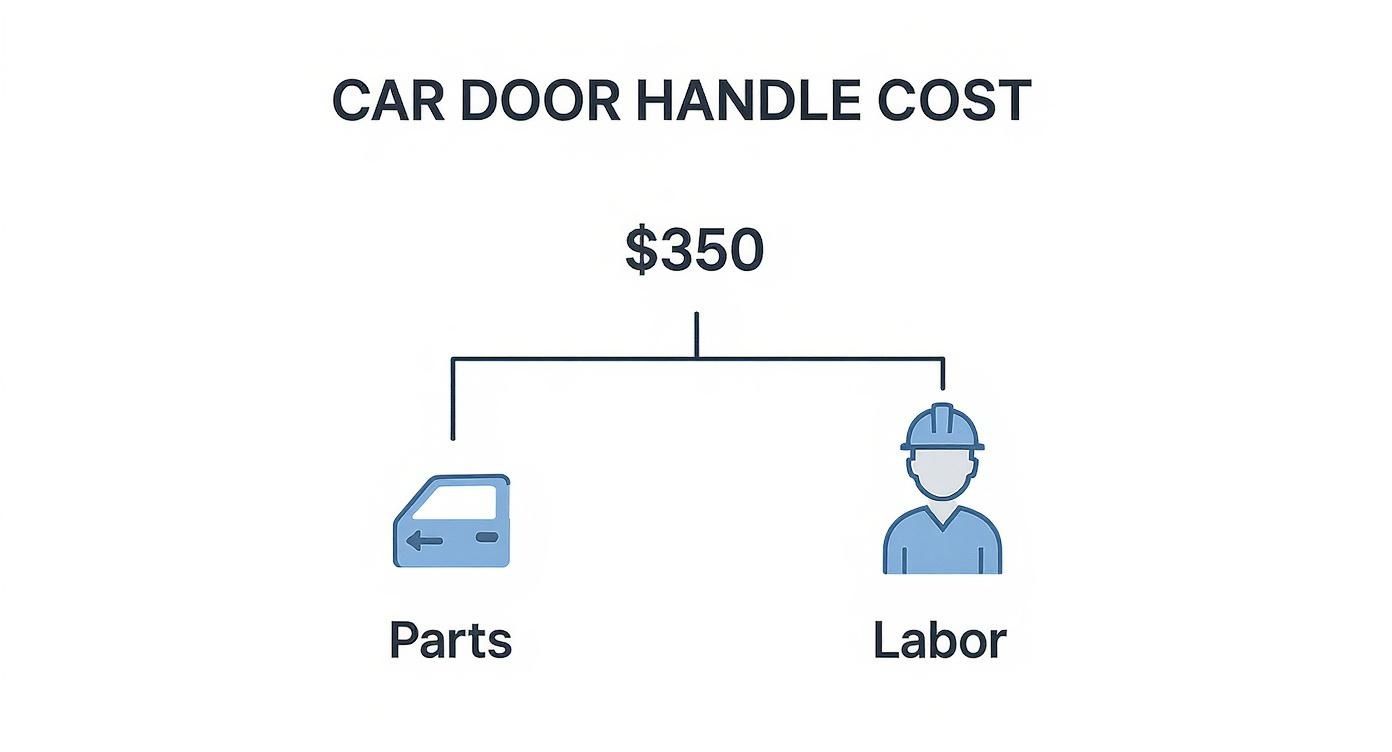
As you can see, labor is often the biggest piece of the pie. That’s why understanding what goes into the mechanic’s time is so important.
Vehicle Make and Model: The "Luxury Tax"
The single biggest factor that will move the price needle is the make and model of your vehicle. A door handle for a workhorse like a Ford F-150 is built for durability and is fairly straightforward. On the flip side, a handle for a Mercedes-Benz S-Class might have keyless entry sensors, little lights that shine on the ground, and chrome accents. That part is just naturally going to cost more.
This is what some of us in the industry call the "luxury tax." High-end brands like BMW, Audi, and Lexus build their cars with complex, interconnected systems. This means they require specialized parts and diagnostic tools, and mechanics need more training and time to work on them—all of which drives up the labor rate.
Here's the bottom line: The more technology crammed into your door handle—like touch sensors or fancy electronics—the more it's going to cost. A simple mechanical lever is an easy swap, but a modern "smart" handle is basically a small computer attached to your door.
This is why a handle replacement on a luxury car can easily sail past the $800 mark, while the same job on a common family car might stay under $250.
Interior vs. Exterior Handle Replacement
Where the broken handle is located also makes a big difference.
An exterior door handle lives a tough life. It’s constantly exposed to sun, rain, and physical abuse, making it more likely to wear out or get damaged. To make matters worse, it almost always needs to be painted to match your car's body color, which adds a separate charge for both the paint and the labor to get it right.
An interior door handle is usually a much simpler, unpainted plastic piece. While the part itself is often cheaper, the labor can be surprisingly similar. The mechanic still has to carefully take off the entire interior door panel just to get to the screws and release cable that hold it in place.
- Exterior Handle Factors: Often requires paint matching, gets beat up by the weather, and is more likely to house electronic sensors.
- Interior Handle Factors: The part is usually cheaper, but removing the door panel is still a labor-intensive job.
If you’re lucky, only one is broken. But if you’re having a really bad day and both need to be replaced, you’re looking at two related but separate repair jobs.
Is It the Handle Assembly or Just the Latch?
Sometimes, the part you touch isn't the real problem. Tucked away inside your door is a whole system of rods, cables, and a latch assembly that does the actual work of keeping the door shut and letting it open. If your handle feels floppy or pulls without anything happening, the culprit might just be a snapped cable or a worn-out latch.
Replacing that entire assembly is a much bigger—and more expensive—job than just swapping the handle. The part costs more, and the mechanic has to spend more time fishing around inside the tight confines of the door frame. This is why a good diagnosis is critical. You don't want to pay for a whole new handle when the real problem was a $15 cable.
The market for exterior door handle repairs reflects all these moving parts, with total costs typically falling between $80 to $350 per door. Labor rates, usually billed between $75 and $150 per hour, make up a huge chunk of that, as the job can take anywhere from one to three hours. You can see how these prices change based on vehicle type by checking out the detailed breakdowns on platforms like Coohom.com.
Choosing Your Parts: OEM vs. Aftermarket Handles
When a mechanic hands you a quote for a door handle replacement, the part itself often makes up a huge chunk of the final price. This is where you face a big decision that directly hits your wallet: do you go with an OEM part or an aftermarket one? Getting this right is the key to controlling your repair bill.
Think of it like being at the pharmacy. You can get the brand-name medicine or the generic version. Both do the same job, but they come from different companies and have very different price tags. Car parts work the same way.

This choice isn't just about the upfront cost, either. It plays a big role in how the new handle fits, looks, and how long it lasts—all things that add up to the real value of your repair.
What Are OEM Parts?
OEM stands for Original Equipment Manufacturer. Simply put, these are the exact same parts your car was built with, made by the vehicle’s manufacturer or one of their direct suppliers. If you take your Honda to a Honda dealership, they're going to use an OEM door handle.
The biggest plus here is the guaranteed quality and perfect fit. An OEM handle is a carbon copy of the one that broke, so you know it will match your car's color, feel, and specs down to the millimeter. No guesswork, no surprises.
- Pros: A perfect, guaranteed fit. The quality and appearance are identical to the original part. They usually come with a manufacturer's warranty.
- Cons: This is your most expensive option, often costing 50% or more than a comparable aftermarket part. You also typically have to get them straight from a dealership.
For a newer car, one still under lease, or especially a luxury model, sticking with OEM is usually the safest bet to protect the vehicle's value and warranty.
The World of Aftermarket Parts
Aftermarket parts, on the other hand, are made by independent companies. These manufacturers reverse-engineer the original part to produce their own version. This competition creates a massive market with a dizzying range of options, from ultra-cheap fixes to premium, high-performance upgrades.
The main draw for aftermarket handles is the cost savings. They are almost always less expensive than their OEM counterparts, which can dramatically lower the total cost to replace a car door handle. But here's the catch: the quality can be all over the place.
Don't assume aftermarket means inferior. In fact, reputable brands like T1A Auto often spot the weaknesses in an original design—like a flimsy plastic piece that always breaks—and improve upon it with more durable metal. The result is a part that can actually outlast the one from the factory.
This variability in quality is the single most important thing to keep in mind. A rock-bottom, no-name part might save you a few bucks today but could snap off in a few months, forcing you to pay for the same repair all over again. A premium aftermarket part, however, can deliver OEM-level quality (or better) for a much fairer price.
If you really want to get into the nitty-gritty, our detailed guide on OEM vs. aftermarket parts breaks down everything you need to know.
Making the Right Choice for Your Vehicle
So, which one is right for you? It really comes down to your car, your budget, and what matters most to you. Here’s a quick way to think about it.
Choose OEM if:
- Your vehicle is new or still under warranty. Using a non-OEM part could give the manufacturer an excuse to void your warranty on related components.
- You drive a luxury or classic car. Originality and a flawless match are key to preserving the car's value and look.
- The handle is complex. If your handle has built-in keyless entry sensors or other electronics, an OEM part ensures it communicates perfectly with your car's computer.
Choose Aftermarket if:
- You're focused on value. A high-quality aftermarket part from a trusted brand gives you the best blend of cost and reliability for most daily drivers.
- Your car is older. It just doesn't make financial sense to put a pricey OEM part on an older car with a lot of miles on it.
- You want something built to last. Many aftermarket specialists identify and fix common failure points, offering a tougher, more robust replacement part.
At the end of the day, the goal is to get your door working again with a part that fits right, works reliably, and doesn't empty your wallet. By weighing the pros and cons of OEM vs. aftermarket, you can make a smart choice and avoid overspending.
DIY Repair vs. Hiring a Professional Mechanic
https://www.youtube.com/embed/2eGbD_EADTo
So, you've got your new door handle picked out. Now you're at a crossroads: Do you roll up your sleeves and tackle this job yourself, or do you hand your keys over to a professional mechanic? The best choice really boils down to your budget, your comfort level with tools, and how you value your time.
Choosing the DIY route is a fantastic way to slash the final cost to replace a car door handle. Labor charges often make up 70% or more of the total bill, so doing it yourself can literally save you hundreds. But this path isn't for everyone—it requires some basic mechanical confidence, the right tools, and a healthy dose of patience.
On the other side of the coin, hiring a professional mechanic buys you peace of mind. An experienced tech has likely done this exact job countless times. They’ll diagnose the problem correctly, get the replacement done quickly, and stand behind their work with a warranty. That means no worrying about accidentally breaking a fragile plastic clip or messing up your window mechanism.
The Do-It-Yourself Approach
Going the DIY route on a handle replacement is a bit like assembling IKEA furniture—it looks straightforward in the instructions, but the little details can trip you up. The process usually involves carefully prying off the interior door panel, navigating a tight space filled with rods and electrical connectors, and unbolting the old handle before you can fit the new one. It's a totally manageable project for many, but it's not without its potential headaches.
The biggest hurdles are often the small, hidden parts. Modern door panels are held on by a bunch of plastic clips that can get brittle with age and snap if you look at them wrong. If your handle has electronic features like a keyless entry sensor, you’ll also be dealing with delicate wiring that has to be disconnected and reconnected just right.
For anyone ready to give it a shot, having the right tools is non-negotiable. You’ll generally need:
- A trim removal tool kit to safely pop the door panel off without scratching your paint.
- A socket and ratchet set for the bolts holding the handle assembly.
- A screwdriver set with both Phillips and flathead tips.
- Needle-nose pliers are a lifesaver for stubborn clips and connectors in tight spots.
Tackling the job yourself can turn a potential $400 professional repair into a $50 Saturday project. The savings are huge, but remember you're trading that money for your own time, effort, and the risk of making a costly mistake.
Hiring a Professional Mechanic
Opting for a professional is the "set it and forget it" solution. You drop off your car, and a couple of hours later, the problem is gone. The main thing you're paying for is expertise. A good mechanic can instantly tell if the issue is the handle, the latch mechanism, or just a disconnected rod, which could save you from buying parts you don't even need.
They also have all the specialized tools and experience to work efficiently and dodge common pitfalls. A job that might take a first-timer three frustrating hours can often be knocked out by a pro in about an hour. That speed and know-how are what make up the labor cost.
Plus, any reputable shop will offer a warranty on both the part and their labor. If the new handle fails because of a defect or a bad installation, they'll fix it for free. That kind of safety net is something you just don't get when you do the job yourself. If you want to see exactly what the pros do, our visual guide on how to replace a car door handle breaks down every step.
DIY vs Professional Replacement Comparison
To help you make the final call, it helps to see the two options laid out side-by-side. Think about what matters most to you—cost, time, or a hassle-free experience—and see which column aligns best with your priorities.
| Factor | DIY Replacement | Professional Mechanic |
|---|---|---|
| Total Cost | Low (Parts only, maybe a new tool) | High (Parts + Labor) |
| Time Investment | 2-4+ hours, depending on skill | 1-2 hours (shop time) |
| Required Skill | Moderate mechanical aptitude needed | None required from you |
| Risk Factor | Higher risk of damaging door panel/clips | Low risk, covered by warranty |
| Convenience | Less convenient; requires your time | Very convenient; drop-off service |
Ultimately, there’s no single right answer. If you're on a tight budget and genuinely enjoy working on your car, the DIY route offers massive savings and a great sense of accomplishment. But if you value your weekend, want a guaranteed outcome, or are dealing with a complex modern vehicle, the expertise of a professional is often worth every penny.
Why Your Door Handle Is Part of a Global Market
It’s easy to look at that little broken plastic handle on your car and think of it as just a small, annoying problem. But that one part is actually the final stop on a long journey that stretches across a massive, global supply chain. The replacement you're shopping for is a tiny gear in a complex, multi-billion-dollar industry connecting factories, distributors, and your local mechanic.
Thinking about this bigger picture helps explain why the cost to replace a car door handle can feel surprisingly high, especially on newer cars. It’s not just about a piece of plastic or metal. The price is shaped by international markets, new technology, and economic forces happening thousands of miles away.
The Sheer Scale of the Door Handle Market
The demand for car door handles is enormous and it's only getting bigger. The global automotive door handle market is already valued at around $5 billion and is expected to soar past $7 billion by 2033. That steady climb tells you just how many handles are being churned out for brand-new cars, not to mention all the replacements needed for cars already on the road, like yours. If you want to dive into the numbers, you can see a full market analysis over at PrecedenceResearch.com.
This isn't just a numbers game; it's a geography lesson. The Asia Pacific region, especially China, is the real engine of this market, manufacturing a huge chunk of the world's door handles. That means the part you pick up from an auto parts store in Ohio was most likely designed, molded, and shipped from the other side of the planet.
How Modern Car Trends Hit Your Wallet
Cars are changing fast, and door handles are right there with them. These new designs and technologies have a direct impact on how much you’ll have to pay to get yours fixed.
Two big trends are really shaking things up:
- Integrated Technology: So many new cars have handles with built-in keyless entry sensors, touch-activated locks, or even little puddle lights. These "smart handles" aren't just simple levers anymore; they're electronic gadgets that have to talk to the car’s main computer.
- Electric Vehicle (EV) Designs: The boom in EVs has made those sleek, pop-out door handles really popular. They retract into the door to make the car more aerodynamic, which looks cool, but they rely on little motors and complex mechanisms that are far more expensive to make and fix.
A handle is no longer just a handle. In modern vehicles, it's an integrated part of the car's electronic and aerodynamic systems. When one of these advanced handles fails, you're not just replacing a piece of plastic—you're replacing a piece of technology.
This jump in complexity is a huge reason why replacing a handle on a 2023 model costs so much more than on a 2003 model. The intricate parts are pricier to manufacture, and a mechanic might need more time (and specialized knowledge) to install them properly, driving up your final labor bill. Suddenly, your simple repair job is tied directly to these global trends in car design.
Practical Tips to Lower Your Repair Costs
Knowledge is power, especially when you're trying to save a few bucks on car repairs. A busted door handle is a pain, but it doesn't have to drain your wallet. With a couple of smart moves, you can slash the cost to replace a car door handle without compromising on a quality, safe repair.
It all boils down to doing a little homework before you pick up the phone to call a mechanic. Arming yourself with the right info puts you in the driver's seat and gives you control over that final bill. Let's walk through some real-world tips that will help you handle this repair like a seasoned pro.
Properly Diagnose the Problem First
Hold on before you jump online and order a whole new handle assembly. You need to be sure the handle is actually the problem. More often than you'd think, a "broken" handle is just a symptom of a much smaller, and cheaper, issue lurking inside the door.
A perfect example is the tiny plastic clip connecting the handle to the door latch rod. These little things are notorious for becoming brittle and snapping. When that happens, the handle goes limp and won't open the door, but the handle itself is totally fine. Swapping out a $5 clip is a whole lot better than forking over $250 for a full handle replacement.
Spend a few minutes on YouTube or a vehicle-specific forum for your car. A quick diagnostic video might show you that the real fix is something you can do yourself with a basic toolset and a bit of patience.
Source High-Quality Aftermarket Parts
One of the easiest ways to save cash is to buy the part yourself. As we've covered, shops almost always mark up the parts they provide. By purchasing a premium aftermarket handle directly, you skip that markup and just pay the retail price.
The trick is to buy from a trusted seller who stands behind their stuff. Here's what to look for:
- A strong warranty: A lifetime warranty isn't just a promise; it's a statement of quality.
- Upgraded materials: Companies like T1A Auto often re-engineer parts to be better than the factory version, using metal to replace flimsy plastic components that were designed to fail.
- Guaranteed fitment: The seller should have a clear system to make sure the part is a perfect match for your vehicle's year, make, and model.
Taking the time to find the https://www.t1aauto.com/blogs/t1-auto-blogs/best-online-auto-parts-retailer can make a huge impact on both your initial cost and how long the new handle lasts.
Get Multiple Quotes from Mechanics
Whatever you do, don't just go with the first quote you receive. You'd be amazed how much prices for the exact same job can swing from one shop to the next. Make it a rule to call at least three different independent shops in your area.
When you call, be specific. Tell them your car's details and the exact repair you need. Ask for a clear breakdown: one cost for the part and a separate cost for labor. This forces them to be transparent and helps you spot if someone is trying to overcharge you. It's also a good idea to ask for their hourly labor rate right at the start.
Ask About Labor Rates and Potential Discounts
Labor is usually the biggest chunk of the repair bill, so finding a shop with a fair rate is key. While you're on the phone getting quotes, don't be afraid to ask about any deals they might have running. Keep an eye out for mechanical repair coupons online or in local mailers, too.
Here's another pro tip: you can often lower the labor cost by doing some of the simple prep work yourself. If you're comfortable with it, taking off the interior door panel before dropping the car off can easily shave 30-45 minutes off the mechanic's time. That's real money back in your pocket.
Got a Few More Questions?
It's totally normal to still have a few things on your mind, even after breaking down all the costs and options. Let's tackle some of the most common questions we hear from car owners about fixing their door handles.
Think of this as a quick-and-dirty guide to clear up any last-minute confusion.
Can I Just Drive with a Broken Door Handle?
You could, but it's a really bad idea. If it's an outside handle that's busted, you can probably still get in by opening it from the inside, which is a pain but seems manageable. But here's the kicker: a broken interior handle is a massive safety risk. In an emergency, you might not be able to get out of your car.
On top of the safety issues, a non-working door handle can earn you a ticket in many places. Between the law and your own safety, getting it fixed right away is always the smart move.
How Long Does This Job Actually Take?
This really comes down to who's doing the work. A seasoned mechanic at a shop can usually knock this out in 1 to 2 hours. They've seen it all and have the right tools to pop off the door panel and get to the guts of the door without any trouble.
If you're tackling this yourself in the driveway, be a bit more generous with your time. Plan on 2 to 4 hours, and don't be surprised if it takes longer, especially if you're dealing with a car loaded with electronics or if it's your first time doing this kind of project.
Will I Need to Get the New Handle Painted?
For an exterior handle, the answer is almost always yes. Most replacements you buy will show up in a standard black or a gray primer coat. To make it look right, you’ll need to have a body shop paint it to match your car's color, which adds to the final bill.
Now, some sellers do offer pre-painted handles for popular cars, which is a great time-saver. As for interior handles, you're in luck—they typically come molded in the correct color, so no painting is needed.
Is a Broken Door Handle Covered by Car Insurance?
Probably not, if it just broke from normal use. Insurance companies see that as a regular maintenance issue, something that's on you to fix as the car's owner.
The big exception here is if the damage was part of a bigger problem. If someone tried to break into your car, vandalized it, or if it was damaged in an accident, your comprehensive or collision coverage should step in. You'll just have to pay your deductible first.
When you're ready to fix it for good, don't just grab another part that's going to break down the road. At T1A Auto, we build our door handles with better materials and stand behind them with a lifetime warranty. We're all about offering a permanent solution, not just a quick fix. Find the guaranteed-fit handle for your vehicle today at https://t1aauto.com.
