


When you're faced with a car repair, one of the first decisions you'll make is what kind of replacement part to use. The choice really comes down to two main camps: OEM or aftermarket. At its core, the difference is simple: who made the part?
OEM (Original Equipment Manufacturer) parts are the same components your car was assembled with at the factory. They are made either by the car manufacturer itself or by a company contracted to produce them to the manufacturer's exact specifications. On the other hand, aftermarket parts are made by independent companies that aren't tied to the original car brand, creating a massive marketplace with a huge range of quality and pricing.
OEM vs Aftermarket Parts A Clear Definition
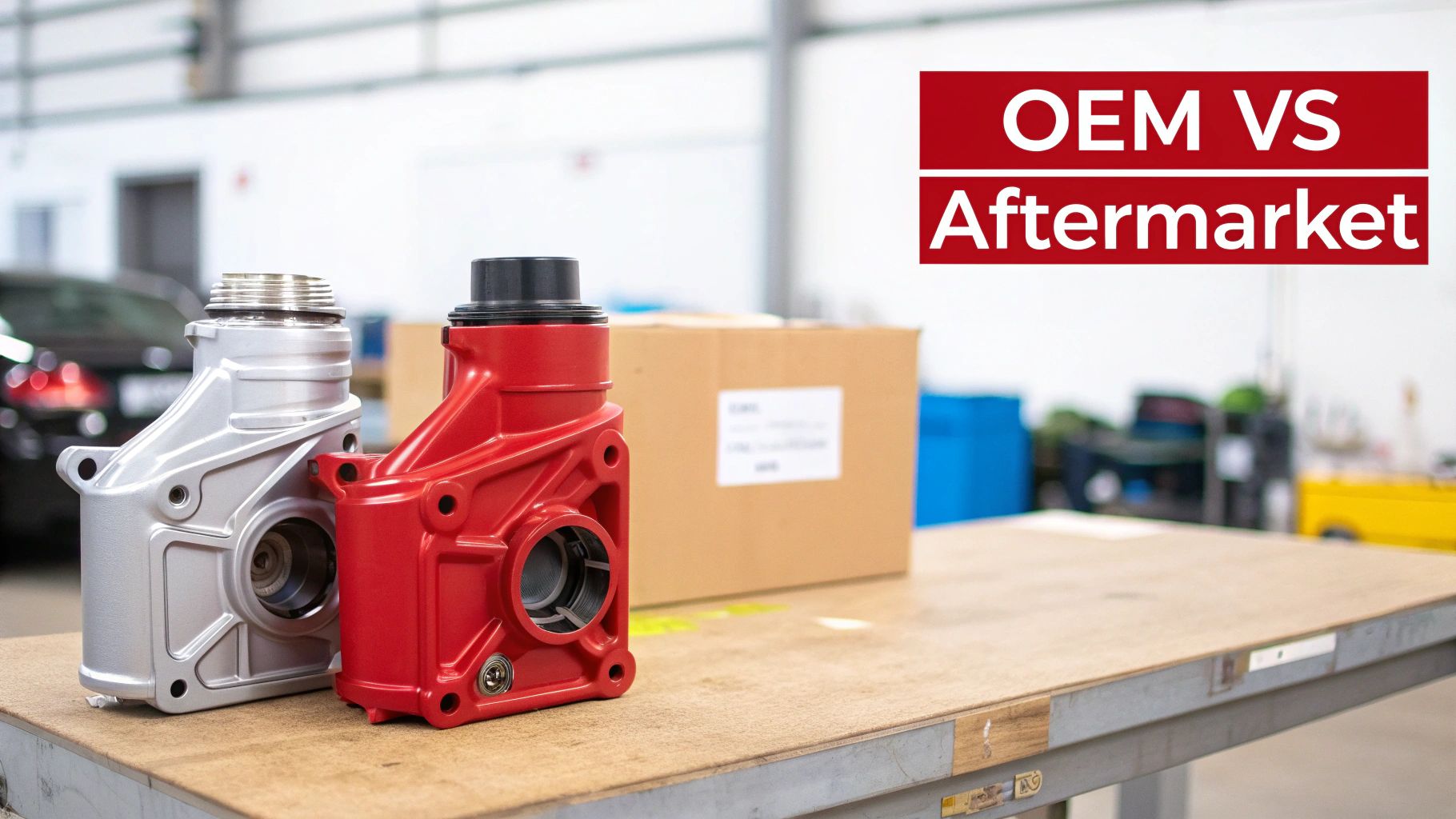
When something on your vehicle breaks, picking the right replacement part is a critical decision. It directly affects how much you'll spend, how your car performs, and its reliability down the road. Let's break down exactly what each option means so you can make a confident choice.
Understanding OEM Parts
An OEM part is a carbon copy of the component that was on your car when it first rolled off the assembly line. Because it's designed by the vehicle manufacturer, you get a guaranteed match for fit, form, and function. There's no guesswork involved. For a broader look at this concept, this guide on understanding OEM in manufacturing offers some great context.
Key Takeaway: Going with an OEM part is like getting the exact same piece from the factory floor. It ensures perfect compatibility but usually comes with a higher price tag and is typically only sold through authorized dealerships.
Understanding Aftermarket Parts
Aftermarket parts are made by companies completely separate from your vehicle's original manufacturer. This creates a really diverse marketplace, where you can find everything from a basic, no-frills replacement to a high-performance component engineered to be better than the original. In fact, many aftermarket companies build their reputation by identifying and fixing common weak points in factory designs.
This variety gives you a ton of flexibility, but it also means the quality can be all over the map depending on the brand you choose. You can learn more about high-quality OEM replacement parts that offer enhanced durability and value right here.
OEM vs Aftermarket At a Glance
To quickly see how these two options stack up, here’s a simple breakdown of the main differences. This table should give you a clear, high-level view to start with.
| Attribute | OEM Parts | Aftermarket Parts |
|---|---|---|
| Manufacturer | The original vehicle maker or their supplier | An independent third-party company |
| Availability | Primarily through authorized dealerships | Widely available online and in auto part stores |
| Cost | Typically higher initial price | Wide range of prices, often lower than OEM |
| Quality | Consistent and matches factory standards | Varies from basic to premium, high-performance |
Ultimately, this table highlights the trade-offs. OEM offers consistency at a premium, while the aftermarket provides choice and value, but requires a bit more research to ensure you're getting a quality product.
Understanding the Real Cost of Auto Parts
The price tag is usually the first thing you notice when comparing OEM and aftermarket parts, but that initial number is just one piece of the puzzle. To really know if you're getting a good deal, you have to look past the upfront cost and consider the total cost of ownership over the life of the part.
A cheaper part seems like a win, but if it's made with subpar materials or poor manufacturing, it's going to fail sooner rather than later. This is where high-quality aftermarket parts really shine, especially for components you use every single day.
The Immediate Appeal of Aftermarket Pricing
Let's be honest: the upfront savings with aftermarket parts are hard to ignore. The numbers don't lie—aftermarket options are almost always significantly cheaper than what you'd get from the dealership. That price gap is a game-changer for anyone trying to keep repair costs down.
Typically, you can expect to pay 20–60% less for an aftermarket part compared to its OEM equivalent. For high-wear items like door handles, window regulators, or mirror assemblies, premium aftermarket brands often target a 20–40% lower price while adding design improvements and stronger warranties. This a major reason why DIY and online sales channels have exploded, as detailed in this automotive parts market overview.
A Pro's Take: The best aftermarket brands aren't just in a race to the bottom on price. They compete on value—blending competitive pricing with real-world improvements in quality that save you money down the road.
Durability and the Long-Term Math
A part that breaks in a year isn't a bargain, no matter how cheap it was. The true cost isn't just what you paid for it; it's the purchase price plus the cost of replacing it again, the labor involved, and the headache of your vehicle being out of commission.
Think about a common failure, like a plastic OEM door handle. After a few years of daily use, it cracks and you're right back where you started—buying a new part and either spending your Saturday fixing it or paying a mechanic to do it again.
This is where a premium aftermarket solution can completely change the game. A company like T1A Auto might re-engineer that same handle with metal-reinforced internal components, specifically targeting the weak point where the original plastic part fails. It might cost a few dollars more than the cheapest option on the shelf, but it’s designed to outlast the part that came from the factory.
How This Plays Out in the Real World
The idea of "total cost" means different things to different people. Let’s break it down with a few common scenarios.
- For the DIYer: If you're working on your own truck, you want to save cash. Grabbing a premium aftermarket tailgate handle with upgraded metal parts and a lifetime warranty means you save money on the part and you don't have to worry about crawling under the truck to do the same job again in two years.
- For the Independent Shop: A mechanic lives and dies by their reputation. Using a high-quality aftermarket part lets them give a customer a more attractive quote than the dealership while still standing behind the repair. A lifetime warranty from the supplier protects their name and prevents angry phone calls about failed parts.
- For the Fleet Manager: When you're running a fleet of work trucks, downtime is lost revenue. A broken door handle or a busted tailgate latch can sideline a vehicle, throwing off schedules and costing the business money. Choosing a durable aftermarket part that won't fail again is a smart business move that keeps the fleet on the road and out of the shop.
At the end of the day, the smartest buy is the one that lasts. By choosing a well-engineered aftermarket part with a solid warranty, you’re not just patching a problem—you're installing a permanent solution. That’s how you save real money and time in the long run.
Comparing Quality, Fitment, and Performance
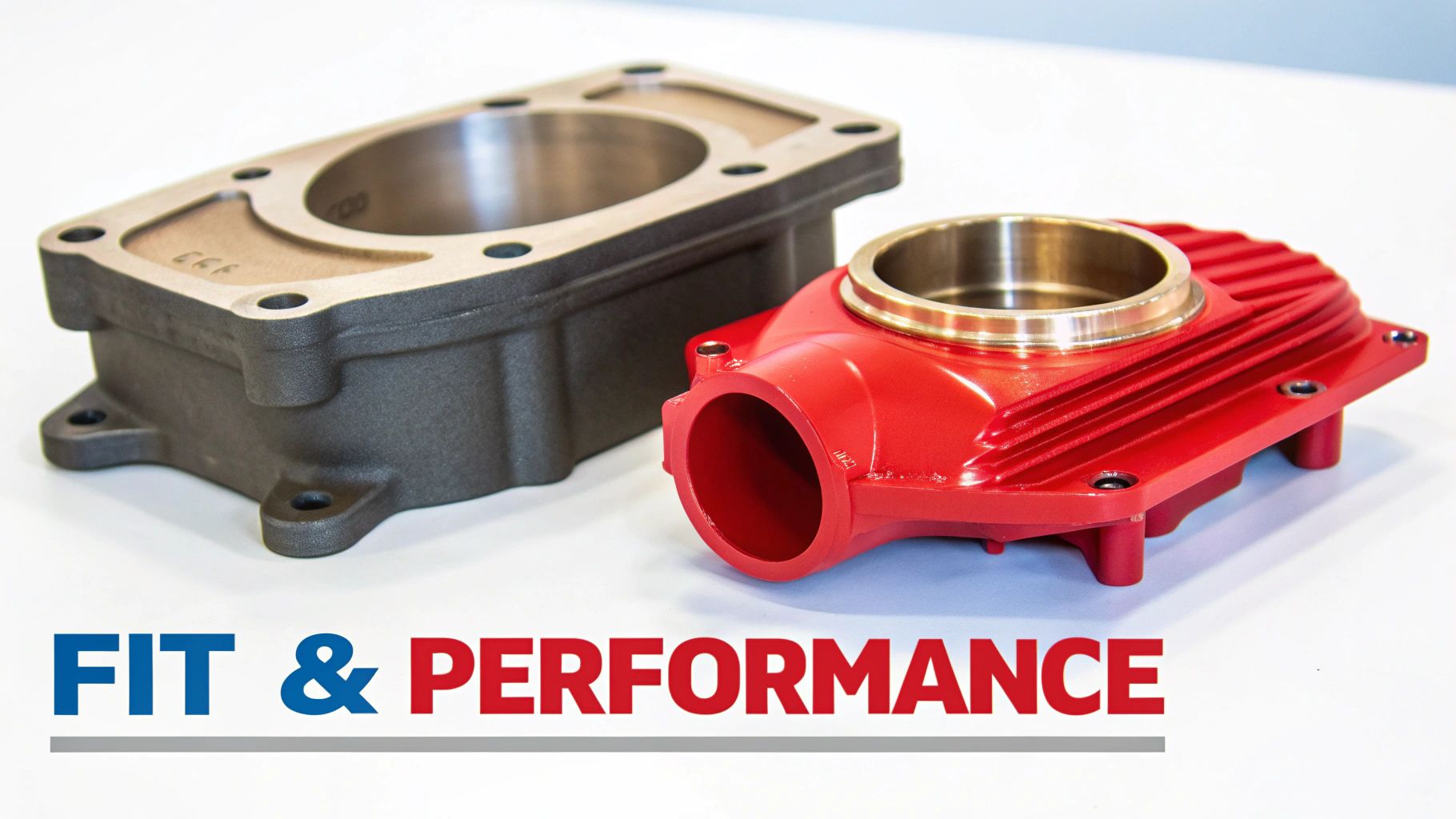
When you get down to the nuts and bolts, the real difference between OEM and aftermarket parts shines through in their quality, fit, and real-world performance. An OEM part is the safe bet—it’s identical to what your car rolled off the assembly line with. The aftermarket, on the other hand, is where engineering and innovation can really solve problems.
There’s a common myth that all aftermarket parts are a step down. In reality, the aftermarket is a massive landscape with a huge quality spectrum. Sure, at the low end, you’ll find cheap copies. But at the premium end, you find components that have been specifically re-engineered to fix the known failures of an original factory design.
What Guaranteed Fitment Really Means
An OEM part is guaranteed to fit perfectly because it's a carbon copy of the original. That’s its main selling point; you know every bolt hole and mounting point will line up without any fuss. You don't need to make adjustments, which is critical in collision repair where even slight misalignments can mess with safety systems.
But here’s the thing: a premium aftermarket part from a reputable supplier like T1A Auto also comes with guaranteed fitment. This isn't just a hopeful guess; it’s a promise backed by some serious reverse-engineering.
Aftermarket suppliers use advanced 3D scanning and precise vehicle data to ensure their parts match the original specifications down to the millimeter. This process allows them to replicate the fit while improving the materials and design, giving you the best of both worlds.
This data-driven approach means you can install an aftermarket part with the same confidence you’d have with an OEM component. You get the easy, straightforward installation you need, but often with a part that’s actually built to last longer.
Challenging the Myth of Inferior Quality
The idea that "aftermarket" is just code for "lower quality" is long outdated. Truth is, many high-wear components fail precisely because the original OEM design had a built-in weak point. Smart aftermarket manufacturers see these failures as an opportunity to do better. They figure out why a part breaks and then engineer a stronger solution.
A classic example is a window regulator. Many OEM regulators rely on plastic gears or clips that get brittle and snap over time, causing the window to drop. A premium aftermarket brand will spot this common failure and replace those fragile plastic pieces with durable metal components.
This isn't just a replacement; it's a genuine upgrade. The new part directly addresses the original design flaw, creating a component that is fundamentally more reliable than what came from the factory.
A Real-World Performance Comparison
Let's look at a practical scenario. Picture the plastic tailgate handle on a popular pickup truck. After years of being pulled, slammed shut, and baked in the sun, the internal plastic latch mechanism cracks. Now the handle is useless.
- The OEM Solution: You head to the dealership and buy a new OEM handle. It fits perfectly, installs in minutes, and works just like the old one. The problem? It’s made from the exact same plastic as the one that just broke. The clock is already ticking on its next failure.
- The Premium Aftermarket Solution: Instead, you buy an aftermarket handle from a brand that focuses on durability. This handle also guarantees a perfect fit, but its internal latching mechanism has been reinforced with metal. It can withstand far more stress and isn't as vulnerable to weather fatigue.
In this head-to-head comparison, the aftermarket part doesn't just match OEM performance—it blows it away. It provides a permanent fix to a recurring problem, which is the ultimate measure of quality and value. When weighing the difference between OEM and aftermarket, these material upgrades are a key factor to consider for any part that sees heavy use. Your goal should be to fix the problem for good, not just put a band-aid on it.
Decoding Certifications and Warranties
When you’re staring at two different parts, how do you really know what you’re getting? The answer lies in the certifications and warranties. These aren't just marketing fluff; they are the true measure of a part's quality, telling you everything you need to know about its fit, function, and longevity.
Think of it as a part's resume. A solid certification proves it passed a tough, independent exam, while a strong warranty shows the manufacturer is willing to bet its own money on the product's performance. Together, they give you the confidence to move beyond the OEM box.
The Gold Standard of Aftermarket Quality: CAPA Certification
Let's be honest, not all aftermarket parts are made the same. This is especially true for components where looks and safety are critical—think bumpers, mirrors, and rearview cameras. To separate the good from the bad, the Certified Automotive Parts Association (CAPA) created a rigorous set of testing standards.
A CAPA-certified part isn't just a clone. It's a component that has been independently tested and verified to meet or even beat OEM standards in key areas:
- Fit and Finish: It has to line up perfectly with your vehicle’s mounting points and body panels. No weird gaps or misalignments.
- Material Quality: The plastics, metals, and coatings must be just as good as, or better than, the original.
- Durability and Safety: The part is put through its paces to ensure it performs correctly and safely over the long haul, a must for collision repairs.
For professional body shops and insurance companies, CAPA certification isn't a suggestion—it's often a requirement. It takes the guesswork out of the equation, guaranteeing that an aftermarket part will bring a vehicle back to its pre-accident condition without cutting corners on safety. You can get the full rundown on these standards in our guide on CAPA-certified parts.
Warranties: A Tale of Two Philosophies
Beyond third-party seals of approval, the warranty a company offers tells you everything about their confidence. This is where you see one of the biggest philosophical divides between OEM and top-tier aftermarket brands.
OEM parts almost always come with a standard, no-frills warranty—typically 12 months or 12,000 miles. It covers defects, but it’s designed to be short and sweet. The thinking is straightforward: it’s a direct replacement, and it gets a warranty to match the original.
Premium aftermarket brands, on the other hand, often use their warranties as a competitive weapon. It's their way of proving their parts aren't just cheaper, but often better.
A Clear Comparison
| Warranty Aspect | Typical OEM Part | Premium Aftermarket Part |
|---|---|---|
| Duration | 12 months / 12,000 miles | 3 years to a lifetime warranty |
| Coverage | Covers manufacturing defects | Often covers defects and premature failure |
| Purpose | Guarantees original specifications | Demonstrates superior durability and value |
When you see a lifetime warranty on something like a metal-reinforced door handle, that’s a powerful statement. It tells you the part was specifically engineered to fix a known OEM weak point and is built to last as long as you own the vehicle. That long-term promise is a direct result of smarter design and better materials.
How Certifications and Warranties Drive Purchase Decisions
For professional techs and weekend warriors alike, these quality markers are the deciding factor. The demand for standards like CAPA has exploded because major collision shops and national repair chains require certified parts to guarantee consistent, reliable repairs. This industry-wide push for proven quality is steering purchasing decisions everywhere.
In fact, while independent shops accounted for over 56% of aftermarket service dollars in the mid-2020s, online DIY sales were climbing by 7–9% annually. This shows that both pros and at-home mechanics are on the same page: they value proven durability and strong warranties when choosing aftermarket over OEM. By focusing on certifications and warranties, you’re simply using the same criteria the experts trust every day.
When to Choose OEM vs. Aftermarket Parts
Figuring out whether to go with an OEM or an aftermarket part isn't about which one is universally "better." It’s about making the right call for your specific situation. The best choice really boils down to your vehicle's age, your budget, what you're replacing, and whether keeping a factory warranty intact is a top priority. Each path has its clear advantages in different scenarios.
An OEM part is the go-to when originality is a must. If your vehicle is still covered by its original manufacturer's warranty, sticking with OEM components is the safest move, especially for complex jobs like swapping out electronic modules or internal engine parts. This way, you avoid any potential arguments over compatibility or warranty claims down the line.
Choosing OEM for Warranty and Complex Systems
For anyone with a new or leased vehicle, using OEM parts is usually the smart play to protect its value and stay on the right side of your warranty or lease agreement. Manufacturers can be pretty strict, and installing a non-OEM part could cause major headaches if a related system fails later.
Key Insight: For incredibly sensitive, safety-critical systems like airbag sensors or Advanced Driver-Assistance System (ADAS) modules, I almost always recommend OEM. These parts are so deeply woven into your vehicle's software that only an OEM part can guarantee the seamless communication and calibration they need to work correctly.
It’s also worth noting that in collision repair, OEM parts are essential for restoring a vehicle’s crumple zones and structural integrity back to exact factory specs—a critical safety factor you can't overlook.
Choosing Aftermarket for Durability and Value
For the vast majority of repairs on vehicles that are out of warranty, a high-quality aftermarket part isn't just a good alternative—it's often the more intelligent financial and practical decision. This is especially true for those high-wear parts that seem to fail because of a known design flaw from the factory.
Think about these everyday situations where aftermarket parts really shine:
- High-Wear Body Hardware: Parts that get used constantly, like door handles, tailgate latches, and window regulators, are perfect candidates for an aftermarket upgrade. Brands like T1A Auto specifically re-engineer these parts with reinforced metal internals to fix the plastic-on-plastic weak points that cause the OEM versions to fail in the first place.
- Routine Maintenance Items: For things like sensors, mirrors, and lighting assemblies, the aftermarket provides a massive selection of quality choices at a fraction of the dealer’s price. You can often find a part with identical performance and a better warranty for less cash.
- Older or High-Mileage Vehicles: When your goal is to keep an older truck or car running reliably without draining your bank account, aftermarket parts are a lifesaver. They offer an affordable path to maintaining your vehicle without paying the premium for a dealership logo.
This decision tree gives you a peek into how professional body shops often think about certifications when they're sourcing parts.
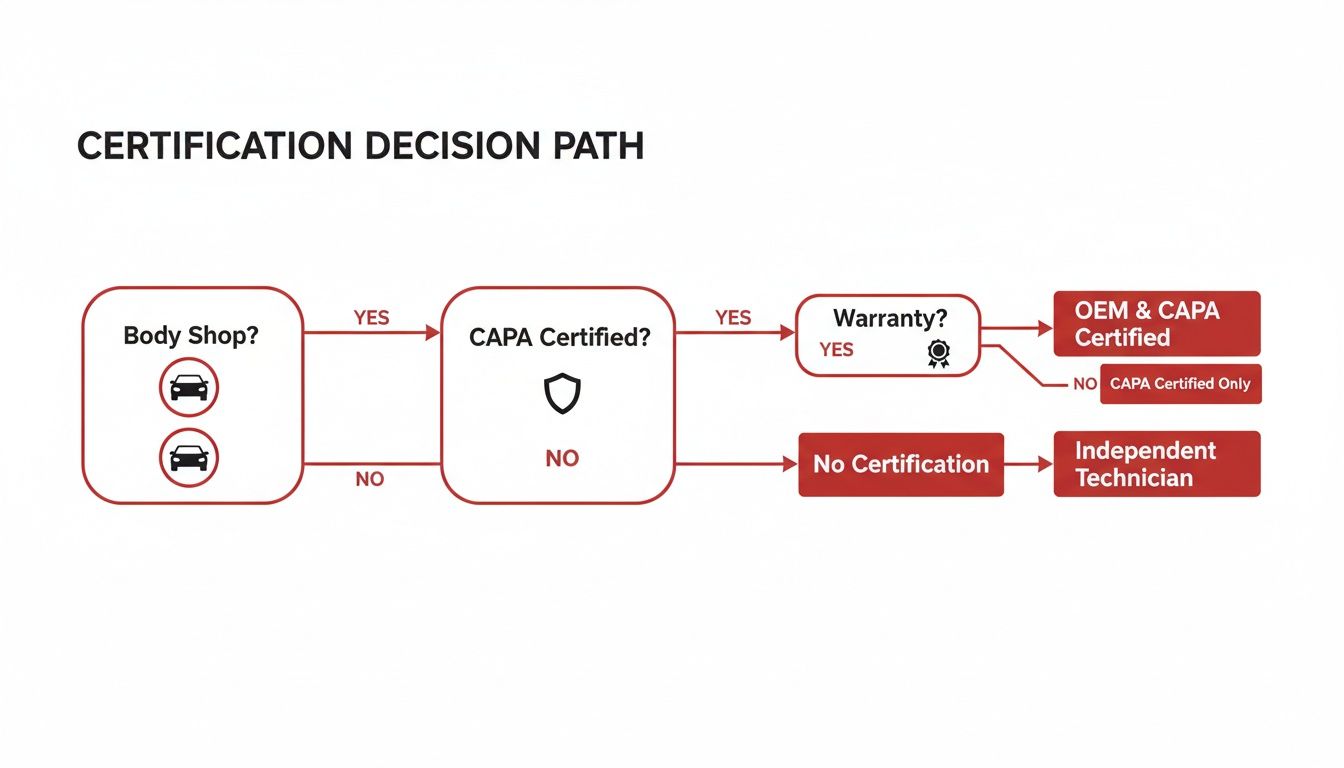
As the flowchart shows, the pros often lean on verifiable quality seals, like CAPA certification and strong warranties, as reliable indicators of OEM-level quality.
A Practical Decision Framework
To make the choice even simpler, just ask yourself these three questions:
- Is my vehicle still under its original factory warranty? If the answer is yes, and you're dealing with a critical engine or electronic part, lean toward OEM to prevent any coverage disputes. If no, a premium aftermarket part is almost certainly your best move.
- Is this a common failure point on my model? If you're replacing a door handle or window regulator for the second time, it's clear the original design was the problem. Look for a premium aftermarket part that's been specifically engineered with better materials for a permanent solution.
- What does my budget look like? If you need to keep repair costs in check, high-quality aftermarket parts deliver incredible value. You can get the job done with a reliable component that often includes a lifetime warranty, giving you long-term peace of mind without that dealership price shock.
Choosing a Trusted Aftermarket Partner
When you're weighing OEM vs. aftermarket parts, the conversation always circles back to one thing: trust. OEM parts give you a familiar baseline of factory quality. But the best aftermarket brands do something more—they often pinpoint common OEM weak spots and engineer a better, more durable solution. Your job is to find a partner who can back up their claims with solid proof of quality.
A truly great aftermarket supplier isn't just selling you a replacement; they're providing a fix that lasts. They take the guesswork out of repairs by specializing in those high-wear components and redesigning them to be stronger. This focus on improvement has built a massive global industry, with the automotive aftermarket estimated to be worth over $430 billion in 2024. The market is booming because smart suppliers are investing heavily in quality control, better materials, and detailed vehicle data to give customers the reliability they demand.
What Sets a Premium Brand Apart
So, how do you spot a reliable aftermarket partner? They build confidence by offering real, tangible benefits that put to rest the common worries about non-OEM parts. These companies understand their entire supply chain, and knowing how to negotiate with suppliers is a key part of how they deliver consistent quality without an outrageous price tag.
The top brands make their value crystal clear, no matter who you are:
- For the DIYer: They offer dependable, easy-to-install parts with a fitment guarantee. This turns what could be a frustrating weekend project into a permanent, satisfying repair.
- For Professional Mechanics: They supply certified components that shops can install with total confidence, backed by strong warranties that protect both the customer and the shop's reputation.
- For Fleet Managers: They provide tough, upgraded parts that keep vehicles on the road, minimizing downtime and cutting the total cost of ownership across the entire fleet.
The Bottom Line: A trusted partner doesn't just offer a budget alternative to OEM. They provide a strategic upgrade. They prove their worth not only with superior parts but also with exceptional support, like lifetime warranties and no-hassle returns.
Making the Confident Choice
When you find the right aftermarket supplier, the choice between price and quality disappears. For components like door handles, tailgate assemblies, and sensors, a premium aftermarket brand can deliver a part specifically engineered to outlast the original. You get to fix the problem once and for all.
By focusing on suppliers who show a real commitment to engineering excellence and customer support, you truly get the best of both worlds.
Ready to explore a better option for your vehicle? Our guide on the best aftermarket auto parts will walk you through the key signs of quality to look for.
Got Questions? We've Got Answers.
When you're trying to fix your vehicle, questions are bound to pop up. Let's tackle some of the most common ones head-on, giving you clear, no-nonsense answers so you can choose the right parts with total confidence.
Will Using an Aftermarket Part Really Void My Car's Warranty?
This is a huge myth, and the short answer is no. Using an aftermarket part does not automatically void your vehicle's warranty. In the United States, you're protected by the Magnuson-Moss Warranty Act.
What does that mean for you? It means the dealership or manufacturer can't deny a warranty claim just because you installed an aftermarket part. They have to prove that the specific part you installed was the direct cause of the failure. So go ahead, you have the right to choose.
Are All Aftermarket Parts Created Equal?
Absolutely not. The quality across the aftermarket world is a massive spectrum. On one end, you have cheap, generic parts that might not last the season. On the other, you have premium, meticulously engineered components from trusted brands designed to be better and last longer than the original.
To make sure you’re getting a top-tier part, look for these tell-tale signs:
- A serious warranty, like a lifetime guarantee on metal components.
- Real-world customer reviews that consistently mention a perfect fit and long-term durability.
- Industry certifications, especially CAPA certification for body panels and lights where precise fit is crucial.
- Smarter materials, like a brand that upgrades a failure-prone plastic piece to reinforced metal.
How Can I Be Sure an Aftermarket Part Will Fit?
The best way to guarantee a perfect fit is to use a vehicle lookup tool on the supplier's website. You enter your car's exact year, make, and model, and it matches you with the right part for the job. It takes the guesswork out of the equation.
Look for brands like T1A Auto that back this up with a "guaranteed fitment" promise. When a company is that confident in its data and offers a straightforward return policy, you can order knowing it will bolt on without a headache.
When Should I Stick with an OEM Part?
While a premium aftermarket part is often the smarter, more durable choice, there are a few rare instances where sticking with OEM makes sense. If you're dealing with a highly complex electronic control module on a car that's still under the factory warranty, an OEM part might be the safest bet.
But for the common stuff that wears out—door handles, window regulators, tailgate latches, and sensors—a well-made aftermarket part from a reputable brand usually offers a much better value and a longer lifespan.
For parts engineered to solve common problems and backed by a lifetime warranty, trust T1A Auto to deliver a solution that lasts. Find the right part for your vehicle today.
