


When your car door latch starts acting up, you're not just dealing with an annoyance—you're facing a security risk. Getting it fixed is a top priority, and you can generally expect a professional door latch replacement to cost between $250 and $450.
The part itself usually runs from $100 to $300, with labor making up the other $150 to $250. This repair is crucial for making sure your door stays shut, locks correctly, and keeps you and your belongings safe.
Your Guide to Door Latch Repair Costs
A faulty door latch might seem like a minor issue at first, but it’s a core part of your vehicle's safety system. Think of it as the gatekeeper; if it fails, your car is vulnerable. The good news is that understanding the repair costs is pretty simple once you know what goes into the final bill.
At its heart, the total price is just parts plus labor. But the numbers can swing quite a bit depending on your vehicle. For instance, truck owners in the U.S. might see a total replacement cost anywhere from $250 to $600 per door.
However, if you're comfortable with a wrench, a DIY approach can cut that bill by as much as 60%. This is especially true for common problem spots, like the notorious Tundra tailgate latch. The global car door latch market is massive, which means there are plenty of part options out there.
Quick Cost and Time Estimates
To help you weigh your options, here’s a look at how professional and DIY repairs stack up in terms of cost and time.
Typical Door Latch Replacement Cost Breakdown
This table provides a quick summary of the estimated costs and time for replacing a car door latch, comparing professional services with a DIY approach.
| Expense Item | Professional Repair Estimate | DIY Project Estimate |
|---|---|---|
| Parts Cost | $100 - $350+ | $75 - $250 |
| Labor Cost | $150 - $250+ | $0 |
| Total Cost | $250 - $600 | $75 - $250 |
| Time Required | 1 - 2 hours | 2 - 4 hours |
As you can see, the savings from doing it yourself are significant, provided you have the right tools and a bit of mechanical know-how.
One great way to save money without skimping on quality is to opt for high-quality aftermarket parts. Many of these are actually built better than the original, often using metal components where the factory part used plastic. This not only saves you money upfront but can also give you a more durable, longer-lasting repair.
So, What Goes Into the Final Bill?
Trying to nail down the exact door latch replacement cost without seeing the car is a bit like a contractor giving you a price for a kitchen remodel over the phone. A few key things can really make that final price swing up or down. Once you know what they are, you'll be able to better understand your mechanic's quote and maybe even spot a few places to save some cash.
The final invoice isn't just a number pulled out of thin air; it's a specific calculation based on your vehicle. You can really break it down into two main buckets: the cost of the part itself and the cost of the labor to put it in.
The Part Itself: Brand Name vs. Aftermarket
The first big variable is the door latch assembly. Think of it like buying groceries—you can go for the premium name brand or the store brand. With car parts, you have similar options, and they come with very different price tags.
- OEM (Original Equipment Manufacturer): This is the exact part your car was built with at the factory. It’s a perfect fit, guaranteed, but you'll pay a premium for that dealership logo on the box.
- Aftermarket: These parts are made by different companies, not the original car manufacturer. Quality can vary, but reputable aftermarket brands often take the original design and make it better, maybe by swapping out a flimsy plastic piece for a sturdier metal one.
An OEM latch from the dealer might set you back $150-$300, plus another $100-$200 for the labor. On the flip side, you can often find high-quality metal aftermarket latches, sometimes even with a lifetime warranty, for well under $100. That’s a serious savings without cutting corners on quality. For a deeper dive, you can explore the trends in the automotive door latch market.
Labor Costs: Where You Are and How Tricky the Job Is
The other half of the bill is labor, and this is where it gets really specific to your car and your location. A mechanic’s hourly rate isn't the same everywhere.
The most straightforward factor is geography. A shop in a big city with high rent and overhead is naturally going to charge more per hour than a small-town, independent garage. When you're trying to budget, getting some auto repair cost comparison insights can give you a better feel for what's fair in your area.
Key Takeaway: The biggest driver of labor cost is how complex your car door is. An older pickup with a simple, all-mechanical latch is a quick and easy job. A modern luxury SUV, on the other hand, is a different beast entirely, packed with sensors, power lock motors, and a spiderweb of wiring that has to be carefully disconnected and reconnected.
That added complexity means more time on the clock. A repair that’s a one-hour job on a basic truck could easily become a two or three-hour job on a high-end vehicle. That can double or even triple your labor cost right there. It’s why replacing a latch on a brand-new Ford F-150 Lariat is almost always more expensive than on a base model from ten years ago—it's the same basic repair, but the newer truck has a lot more technology packed into that door panel.
When your door latch fails, you've got a decision to make that will directly impact what you end up paying. Should you head to the dealership for an OEM part, or should you look at aftermarket options? It’s a bit like choosing between a name-brand prescription and its generic equivalent—often, they do the exact same thing, but one costs a whole lot more.
OEM, which stands for Original Equipment Manufacturer, parts are identical to the ones your car came with from the factory. You're guaranteed a perfect fit, but you’re also paying for the carmaker's logo, which always comes at a premium. Aftermarket parts, on the other hand, are made by independent companies, giving you a huge range of choices when it comes to price and quality.
Don't Fall for the "Aftermarket is Always Worse" Myth
There's a persistent rumor that all aftermarket parts are junk. And sure, there are some cheap, poorly made options out there. But the best aftermarket brands don't just copy the original part—they actually improve it. They find the weak spots, like a flimsy plastic piece that's known to break, and re-engineer it with a stronger metal component.
What this means for you is that a top-tier aftermarket latch can often outlast the original factory part it's replacing, all while saving you a good chunk of change. If you want to dive deeper into this, check out our detailed guide on OEM vs. aftermarket parts.
The smartest repairs focus on long-term value, not just the lowest initial price. A premium aftermarket part with upgraded materials and a solid warranty often delivers a much better return on your money than a pricey OEM part that might just fail again in the same way.
How to Spot a Quality Aftermarket Latch
So, how do you separate the good from the bad? Since not all aftermarket parts are built the same, you need to know what to look for to make sure you're getting a component that's truly built to last.
Here’s what really sets a great part apart from the rest:
- Upgraded Materials: The best manufacturers will tell you exactly what they improved. Look for callouts about replacing plastic internals with more durable metal—it’s a dead giveaway that they’ve engineered out a common failure point.
- Independent Certifications: Look for a CAPA (Certified Automotive Parts Association) seal of approval. This is an independent verification that the part meets strict standards for fit and performance, essentially guaranteeing it will work just like the original.
- A Solid Warranty: Nothing shows a manufacturer's confidence like a lifetime warranty. It’s their way of saying, "We built this to last, and we'll stand behind it."
This is why experienced mechanics, fleet managers, and savvy DIYers usually skip the dealership parts counter. They know they can find better value and often better quality from specialized online suppliers. Getting access to things like free shipping and straightforward returns makes managing that typical $200 to $500 per door replacement cost much easier.
Comparing OEM and Premium Aftermarket Door Latches
To make the choice clearer, let's break down the key differences between a standard dealership part and a premium aftermarket alternative.
| Feature | OEM (Dealership) Parts | Premium Aftermarket (e.g., T1A Auto) |
|---|---|---|
| Cost | Highest price point, includes brand markup. | Significantly more affordable, often 20-50% less than OEM. |
| Design & Materials | Identical to the original part, including any known flaws. | Often re-engineered with upgraded materials to fix common failures. |
| Quality Assurance | Meets factory standards. | Independently certified (e.g., CAPA) to ensure fit and function. |
| Warranty | Typically a limited warranty, often 12 months. | Frequently comes with a lifetime warranty. |
| Availability | Primarily available through dealership parts counters. | Widely available from online retailers and independent auto shops. |
Ultimately, choosing a premium aftermarket latch gives you the best of both worlds: a high-quality, long-lasting part without the dealership price tag.
Deciding Between a DIY or Professional Repair
When your door latch gives out, you’re faced with a classic decision: roll up your sleeves and do it yourself, or hand the keys over to a pro? There’s no single right answer. It really comes down to a trade-off between your budget, your free time, and how comfortable you are with a wrench in your hand.
The biggest motivator for a DIY repair is, without a doubt, the cost savings. By taking labor out of the equation, you can slash the final door latch replacement cost significantly. We’re talking about keeping an extra $150 to $250 in your pocket, which is what a shop typically charges for the work. For many, that’s a huge win, not to mention the satisfaction of fixing your own car.
The Realities of a DIY Latch Replacement
But let's be honest—this job takes more than just good intentions. It demands the right tools, a healthy dose of patience, and the ability to work in some pretty tight quarters. Before you even order the part, you need to have a frank conversation with yourself about whether you're up for the challenge.
You can't get this done with a basic screwdriver. You’ll absolutely need:
- A trim removal kit to get the door panel off without snapping any of the plastic clips that hold it in place.
- A good socket set and screwdrivers to unbolt the old latch assembly.
- Needle-nose pliers are a must-have for wrestling with the small rods and connectors tucked deep inside the door.
Working inside a door isn't like working under the hood with everything laid out. You'll be feeling your way around window regulators, bundles of wires, and some surprisingly sharp metal edges. If the idea of carefully releasing tiny electrical connectors you can barely see sounds more like a nightmare than a fun Saturday project, calling a mechanic is probably the smart move.
Expert Insight: Preparation is everything for a successful DIY job. I always tell people to watch at least two different how-to videos for their exact year, make, and model before they even think about buying the part. You'll spot the tricky steps and learn from someone else's mistakes, which can save you from breaking a brand-new latch or a pricey piece of door trim.
Making the right part choice is also a huge part of the process, whether you're doing it yourself or having a shop do the work.
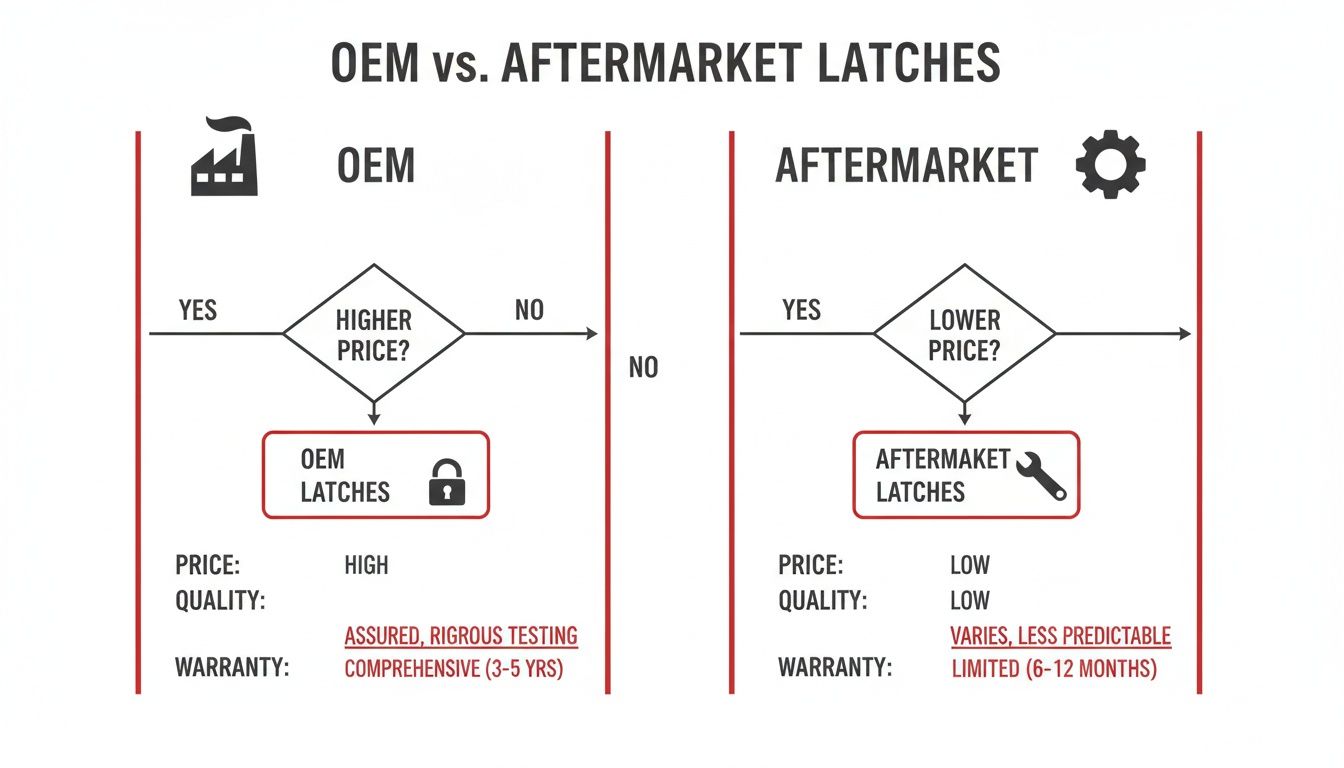
As you can see, while OEM parts are a perfect match, a high-quality aftermarket latch can often give you better bang for your buck with a lower price and a more robust warranty.
When to Call a Professional
Choosing to go with a professional is essentially buying yourself peace of mind. A good mechanic has the experience and specialized tools to get the job done quickly and correctly. What might take you an entire afternoon of frustration, they can usually knock out in just one to two hours.
Plus, any reputable shop will stand behind their work with a labor warranty. If the new latch acts up because of an installation issue, it’s on them to make it right. That guarantee, combined with a pro’s experience, is often worth the extra cost, just to know the job was done right the first time.
If you want to see exactly what's involved from start to finish, our detailed guide on a car door latch replacement breaks down every step.
Real-World Cost Estimates for Popular Trucks
Theory is one thing, but what does a door latch replacement actually cost for the trucks we see on the road every day? Let's put some real numbers to it.
Below, we’ll break down the expected costs for three of America’s most popular pickups. You'll see a clear pattern emerge, highlighting the significant savings you can get by choosing a high-quality aftermarket part instead of heading to the dealership.
For these estimates, we're using a typical shop labor rate of about $125 per hour. Keep in mind that this can easily be higher in a big city or a bit lower in a small town, so your final quote might shift a little.
Ford F-150 Door Latch Replacement Cost
The Ford F-150 has been the king of truck sales for decades, so parts are everywhere. The flip side is that modern F-150s have some pretty complex door electronics, which can add to the labor time. A good mechanic will likely need around 1.5 hours for the job.
- OEM Latch Part: You're looking at $200 - $350 from the dealer.
- Premium Aftermarket Part: A quality alternative runs between $80 - $150.
- Estimated Professional Labor: About $180 - $200.
- Total Professional Cost (OEM): $380 - $550
- Total Professional Cost (Aftermarket): $260 - $350
Just by choosing a solid aftermarket part, an F-150 owner can save over $200 on a single door repair without giving up reliability.
Key Insight: The price gap between OEM and aftermarket parts is huge, especially for popular models like the F-150. This is your single biggest opportunity to cut down the total repair bill.
Chevrolet Silverado and GMC Sierra Cost
Since the Chevy Silverado and GMC Sierra are corporate cousins, they share a lot of the same hardware, including door latches. The replacement job is pretty standard for a modern truck, and a skilled tech can usually knock it out in 1.2 to 1.5 hours.
- OEM Latch Part: Expect to pay $180 - $300.
- Premium Aftermarket Part: These typically cost $75 - $140.
- Estimated Professional Labor: Around $150 - $190.
- Total Professional Cost (OEM): $330 - $490
- Total Professional Cost (Aftermarket): $225 - $330
Toyota Tundra Door Latch Replacement Cost
Toyota Tundras have a well-earned reputation for being bulletproof, but even they aren't immune to wear and tear. Fortunately, the door latch replacement is a straightforward job that a pro can usually finish in about 1.2 hours.
- OEM Latch Part: The Toyota part will set you back $220 - $380.
- Premium Aftermarket Part: A much more palatable $90 - $160.
- Estimated Professional Labor: Roughly $150 - $180.
- Total Professional Cost (OEM): $370 - $560
- Total Professional Cost (Aftermarket): $240 - $340
No matter which of these popular trucks you drive, the math tells the same story. Choosing a quality aftermarket door latch assembly will consistently save you well over $100, and in many cases, closer to $200, compared to buying the OEM part from a dealership.
Smart Ways to Save Money on Your Repair
Whether you’re a seasoned DIYer or plan to hand the keys to a pro, there are some clever ways to keep more money in your wallet. Saving on your door latch replacement doesn't have to mean compromising on quality.
Honestly, the biggest single way to cut your costs is by sourcing your own part. Dealerships and even some shops add a hefty markup to the parts they sell. If you buy a quality aftermarket latch yourself from a trusted online store, you can easily save 50% or more on that part of the bill. That’s a huge chunk of the total cost right there.
Tips for the DIY Crowd
If you're tackling this repair in your own garage, the name of the game is preparation. Your goal is to avoid any "oops" moments that could damage your door panel or the new latch.
- Watch a Few Videos First: Before you touch a single screw, find a couple of how-to videos for your exact make and model. Seeing it done helps you spot potential hang-ups, like hidden clips or tricky wiring harnesses, before they become a problem.
- Get the Right Tools: A plastic trim removal kit is your best friend here. These kits are cheap—usually under $20—and they’ll let you pop off the door panel without scratching your paint or snapping those brittle plastic fasteners.
A Quick Note on Warranties: Never overlook the warranty. A lifetime warranty on an aftermarket part isn't just about peace of mind; it's a financial safety net. It protects you from ever having to pay for the same part again if it fails down the road.
For Those Calling a Mechanic
Not doing the work yourself? You still have a ton of control over the final invoice. It all comes down to being a smart, prepared customer.
- Shop Around for Quotes: Never settle for the first price you hear. Make a few calls to at least three different independent shops in your area. You’ll often find their hourly rates are 20-30% lower than what a dealership charges.
- Combine Repairs: Does your car need anything else done that involves removing the door panel, like a new window regulator? Get it done at the same time. The panel is already off, which means you avoid paying for the same labor twice.
- Bring Your Own Part: A lot of independent mechanics are perfectly fine with installing a part you bring them. Just make sure you've found one of the best online auto parts retailers to ensure you're handing them a quality component they can stand behind.
Frequently Asked Questions
Even with all the numbers laid out, you probably still have a few questions floating around. Let's tackle some of the most common ones that pop up when dealing with a door latch replacement.
What Are the Warning Signs of a Failing Door Latch?
A bad door latch usually doesn't fail overnight. It gives you plenty of warning signs, which tend to get more obvious as the internal parts wear out. Catching them early can save you the headache of getting locked out or having a door that just won't cooperate.
Here are the big red flags to watch for:
- The Door Won't Latch: You find yourself having to slam the door, sometimes multiple times, just to get it to catch.
- Sticking Locks: Your key feels stiff when you turn it, or the power lock button seems to struggle, taking a few tries to lock or unlock the door.
- Rattling from Inside the Door: Hearing a distinct metallic rattle from inside the door panel while driving is a classic sign. It usually means a spring or another small part has broken off inside the latch assembly.
- A Loose or "Mushy" Handle: The handle, either inside or out, feels sloppy and disconnected. There’s a lot of free play before you feel it even try to engage the latch.
Can I Just Repair the Broken Part of the Latch?
I get this question all the time, especially from folks looking to keep the door latch replacement cost down. Unfortunately, the answer is a hard no. Modern door latches are incredibly complex little boxes. They're sealed units packed with tiny gears, springs, and even electronic sensors.
Think of it like a sealed transmission—it's designed as a single, non-serviceable component. For both safety and reliability, the entire assembly needs to be replaced. Trying to MacGyver a fix on a single internal part is just not practical and could lead to the latch failing at the worst possible moment.
Is a Broken Door Latch a Major Safety Concern?
Yes, one hundred percent. A failing door latch isn't just an annoyance; it's a critical safety hazard. If the latch can't hold the door securely, there's a real risk it could fly open while you're driving. That’s an incredibly dangerous scenario for you and your passengers.
Beyond that, it's also a major security issue. A door that won't lock properly is an open invitation for thieves. Getting this fixed quickly is non-negotiable for keeping yourself safe on the road and your vehicle secure when you're not.
For guaranteed fitment and lasting durability on your next repair, trust T1A Auto. Find the premium aftermarket parts you need for your truck or SUV at https://t1aauto.com.
