


You replace a driver-side door handle, install it carefully, and expect the problem to be over. Months later, the handle snaps again. The product page promised a lifetime warranty, so you naturally ask whether the seller will send a free replacement, whether your installation caused the failure, and what “lifetime” even means.
Those questions matter for DIY owners, repair shops, and fleet managers because a warranty isn't the same thing as a durability guarantee. It's usually a defect-based retail promise, limited by ownership rules, installation requirements, exclusions, and proof.
This guide explains how lifetime warranty car parts work in plain English. You'll learn what the promise covers, how it differs from limited lifetime and fixed-term protection, why handles and regulators require careful interpretation, and how to prepare a claim that doesn't get delayed by missing records.
Table of Contents
- Introduction Why Lifetime Warranty Confuses Every Car Owner
- What Lifetime Warranty Really Means for Car Parts
- Lifetime vs Limited Lifetime vs Fixed Term Warranties Compared
- What Is Covered and What Is Not With Real Examples
- How to Verify and Claim Your Warranty Without Hassle
- T1A Auto Warranty Benefits for DIYers Shops and Fleets
- Making a Smart Choice and Getting the Most From Your Warranty
Introduction Why Lifetime Warranty Confuses Every Car Owner
You replace a window regulator, latch, hinge, mirror, or handle, then see lifetime warranty beside the listing. The phrase sounds permanent. In practice, the seller may mean coverage for the original buyer's ownership of the vehicle or for the period when that product remains supported. Consumer warranty guidance explains that “lifetime” can refer to ownership or a product's market life, not the buyer's entire life or unlimited replacements (consumer warranty explanation).
The warranty is a filter, not a promise that every failed part qualifies. A manufacturing crack, poor weld, or assembly flaw may point to a covered defect. Impact can bend a handle, exposure can cause rust, and an installation mistake can damage a regulator. Those failures may fall outside the policy. The seller is evaluating the cause of the failure, much as a mechanic separates a faulty component from damage caused by the surrounding system.
The same fine print creates different work for each buyer:
- DIY owners should retain the receipt, installation details, and failed part. Photos can help show what happened before the component is discarded.
- Independent shops need records linking the part to the vehicle, repair order, and installation procedure. That trail helps distinguish a product problem from a fitting problem.
- Fleet managers need a repeatable process, including purchase records, vehicle identification, mileage or service notes when requested, and a clear description of the failure.
A claim-ready file works like a service history. It gives the seller enough context to test the warranty's conditions instead of relying on a brief statement that the part “just failed.”
Historical aftermarket data also shows why sellers can offer this coverage without suggesting that every part will fail. An Automotive Aftermarket Suppliers Association study reported warranty returns averaging 2.6% of sales, while 2.5% of returned parts were tied to an actual quality issue, according to this Automotive Aftermarket Suppliers Association summary. Fitment, installation, service conditions, and customer expectations therefore matter alongside manufacturing quality.
Before buying, ask four questions: What does lifetime mean here? What failure causes coverage? What evidence will the seller request? And is lifetime protection worth prioritizing for this part?
What Lifetime Warranty Really Means for Car Parts
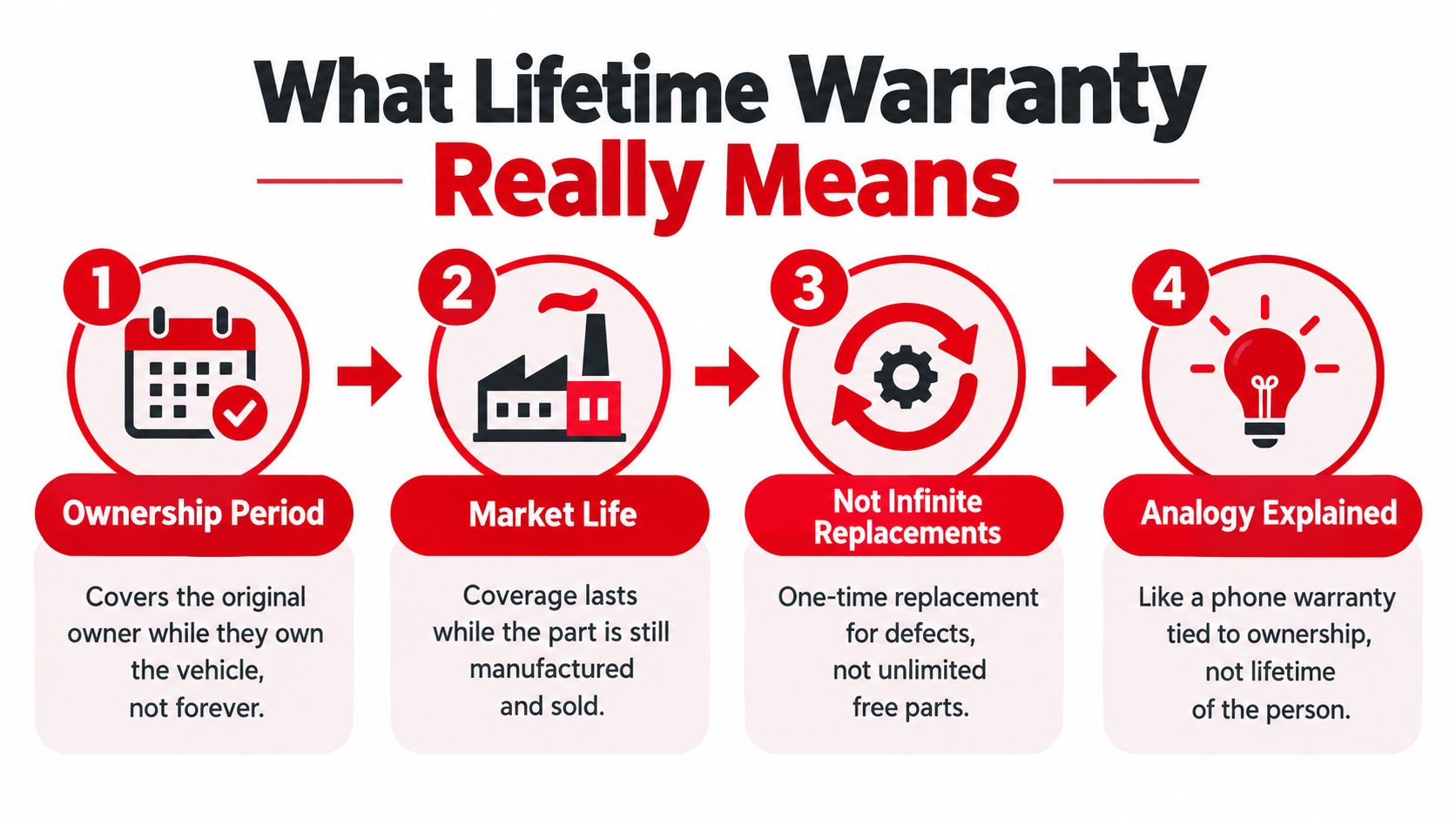
A lifetime warranty generally protects the original purchaser for a defined ownership period. It doesn't automatically promise that every future owner receives coverage, that the part will never wear out, or that the seller will replace it repeatedly without review.
A useful analogy is a gym membership assigned to one person. You can use it while the membership remains valid, but you can't automatically transfer it to every person who later receives your membership card. A lifetime warranty often works similarly. The contract follows the original buyer, vehicle ownership, or product availability rules stated in the written terms.
Key definition: A lifetime warranty for a car part usually covers the original owner against defects in materials or workmanship for the applicable ownership or product-life period. It doesn't guarantee permanent service life or unlimited replacements.
The three meanings hidden inside lifetime
Check the warranty language for three separate ideas.
Ownership period may mean coverage continues while the original purchaser owns the vehicle. Selling the vehicle can end protection unless the terms allow transfer.
Market life may limit support to the period when the part is manufactured, stocked, or sold. If a product is discontinued, the seller may provide a comparable remedy rather than the exact same part, depending on the policy.
Coverage event usually means a qualifying defect. The seller may inspect the returned part and decide whether the failure came from manufacturing or from use, installation, corrosion, impact, or neglect.
The distinction is especially important for high-cycle parts. A door handle gets pulled repeatedly. A window regulator moves through a demanding range of motion. A latch or hinge carries loads every time the vehicle is opened and closed. Buyers should evaluate material choice, construction, fitment, and expected use, not treat the word lifetime as proof of permanent durability. Industry guidance describes these warranties as generally focused on material and workmanship defects, with common exclusions for wear, corrosion, misuse, and installation mistakes (consumer guidance on lifetime car-part warranties).
Read the promise before installing the part
The product page is only the starting point. Open the full warranty terms and look for:
- Who qualifies as the purchaser.
- Whether the warranty transfers with the vehicle.
- Which components receive lifetime coverage.
- Whether labor, diagnosis, shipping, or removal costs are excluded.
- What installation or maintenance records the seller requires.
- Whether replacement, repair, credit, or refund is the stated remedy.
For a deeper explanation of the wording, compare the seller's policy with this plain-English guide to lifetime warranty coverage.
Lifetime vs Limited Lifetime vs Fixed Term Warranties Compared
Warranty labels sound similar, but they place different boundaries around time, eligibility, and remedy. Lifetime usually offers the longest stated protection, but it still depends on the definition of lifetime and the exclusions. Limited lifetime adds explicit restrictions, such as coverage for only certain components, ownership conditions, or specific failure types. A fixed-term warranty runs for a stated period, which can make the end date easier to understand.
The right choice depends on how long you expect to keep the vehicle, how heavily the part will be used, and whether the failure is likely to come from a defect or ordinary wear.
| Warranty Type | Duration Basis | What Triggers Coverage | Common Limits |
|---|---|---|---|
| Lifetime warranty | Original ownership, vehicle ownership, or product market life | Covered defect in materials or workmanship | Nontransferability, exclusions, proof requirements, no labor coverage |
| Limited lifetime warranty | Lifetime period subject to stated conditions | Qualifying defect in listed components | Narrow component scope, installation and use restrictions, ownership limits |
| Fixed-term warranty | A clearly stated time period | Covered defect occurring during the term | Protection ends at the stated deadline, exclusions still apply |
Why limited lifetime can be more restrictive
“Limited” isn't a warning that the warranty has no value. It tells you to look for the boundary. One seller might cover a metal handle but exclude cosmetic finish damage. Another might cover the regulator assembly but not switches, wiring, clips, or labor. A third might require the original receipt and reject claims from commercial use.
The label also doesn't tell you whether the part is OEM or aftermarket. For that comparison, review the aftermarket parts versus OEM guide, then read the actual warranty attached to the part number you're considering.
Match the warranty to your ownership pattern
A fixed-term warranty may be perfectly practical for a vehicle you plan to sell soon. Lifetime coverage becomes more useful when you expect to keep the vehicle and the part has a meaningful chance of developing a manufacturing defect over time. It may be less valuable when the component normally fails because of friction, contamination, corrosion, impact, or repeated misuse.
Shops and fleets should also ask whether the warranty recognizes commercial or repeated use. A private vehicle, a delivery van, and a body-shop replacement may experience different service conditions, even when they use the same part.
What Is Covered and What Is Not With Real Examples
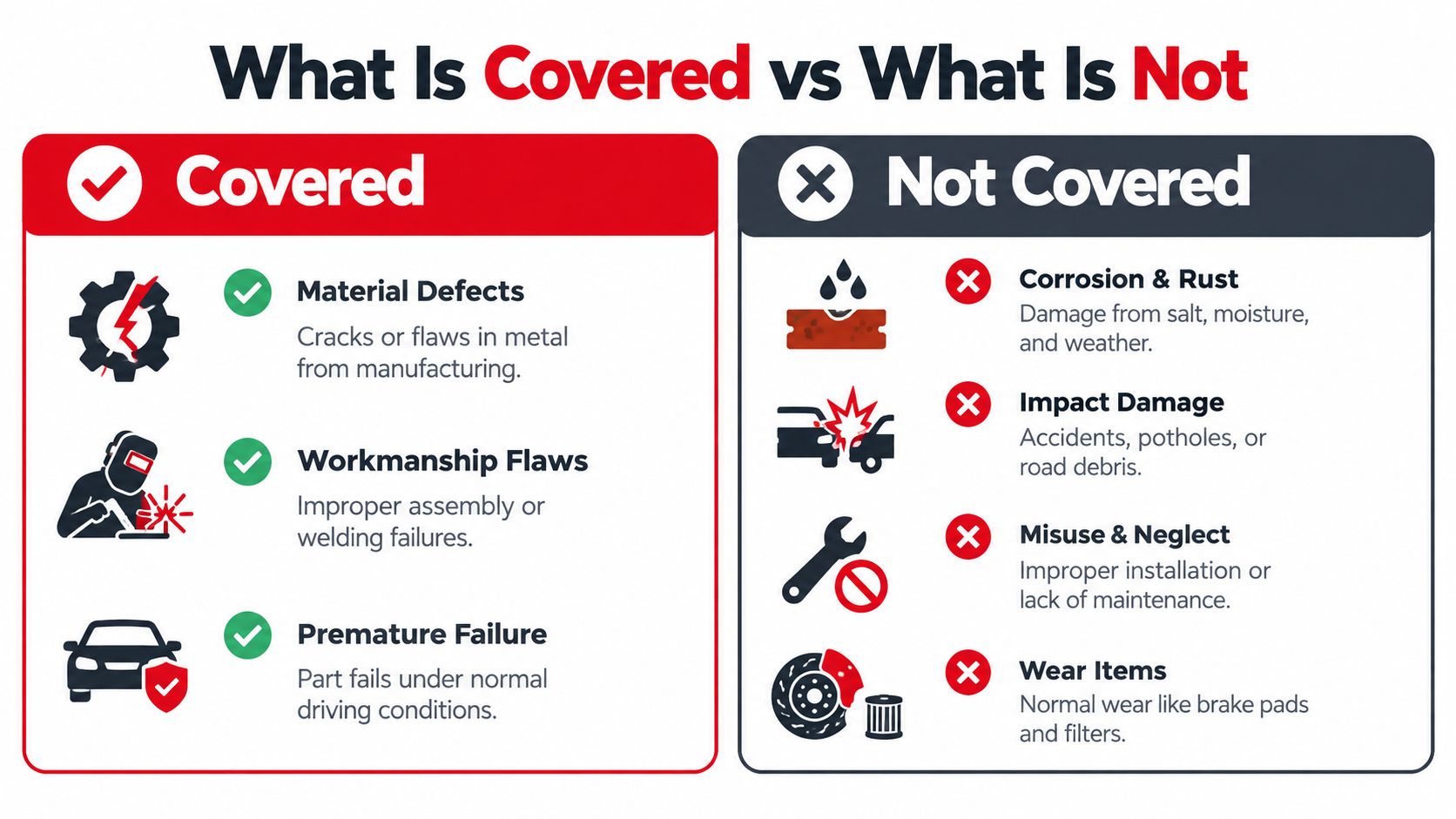
The cleanest way to evaluate a claim is to separate failure from cause. “The part broke” describes the result. “A casting flaw caused the part to break during normal operation” describes a possible covered event. Warranty reviewers usually need the second explanation, supported by the returned part, photos, purchase record, and installation details.
Typical covered conditions include a material flaw, a defective weld, poor assembly, or premature failure during normal use. Typical exclusions include corrosion, accident damage, improper installation, misuse, neglect, and ordinary wear. These categories appear in consumer-facing warranty explanations and in manufacturer warranty documents that treat coverage as conditional on the claimed defect and the part's role in the failure (manufacturer warranty terms).
Four common parts and their edge cases
Door handles: A handle that cracks at a manufacturing point during ordinary use may support a claim. A handle pulled sideways after a frozen door, struck by cargo, or damaged during trim removal may be excluded.
Window regulators: A clean mechanical failure under normal operation can indicate a defect. A regulator installed with misaligned glass, missing fasteners, damaged wiring, or excessive resistance from the window channel may be denied because installation or a related vehicle condition caused the failure.
Mirrors: A faulty motor or defective mounting component may qualify. A mirror hit by another vehicle, scraped against a wall, or corroded by moisture exposure usually presents a different coverage question.
Sensors: A sensor that fails internally may be treated differently from one damaged by impact, contamination, wiring problems, or an incorrect vehicle connection. Fitment verification matters because the correct-looking sensor may still be wrong for a particular trim or connector.
Part warranty and vehicle warranty are separate
Installing an aftermarket part doesn't automatically void the vehicle's entire warranty. The relevant question is usually whether the aftermarket part caused the failure being claimed. If a replacement door handle fails, that doesn't by itself explain a separate engine problem. If an incorrectly installed electrical component damages a vehicle module, the causation question becomes more complicated.
The person making the claim usually needs to provide enough information for the seller or manufacturer to evaluate that causation. The seller may request photos, diagnostic notes, installation records, or the failed part. Don't assume a warranty denial proves the seller is right, but don't assume the warranty guarantees approval either. Ask for the exact exclusion or failure cause cited and request the next review step in writing.
How to Verify and Claim Your Warranty Without Hassle
A warranty claim becomes easier when you treat documentation as part of the installation. Start before purchase, not after the part fails. Save the product page, warranty terms, vehicle fitment information, and seller name in the same folder as the receipt.
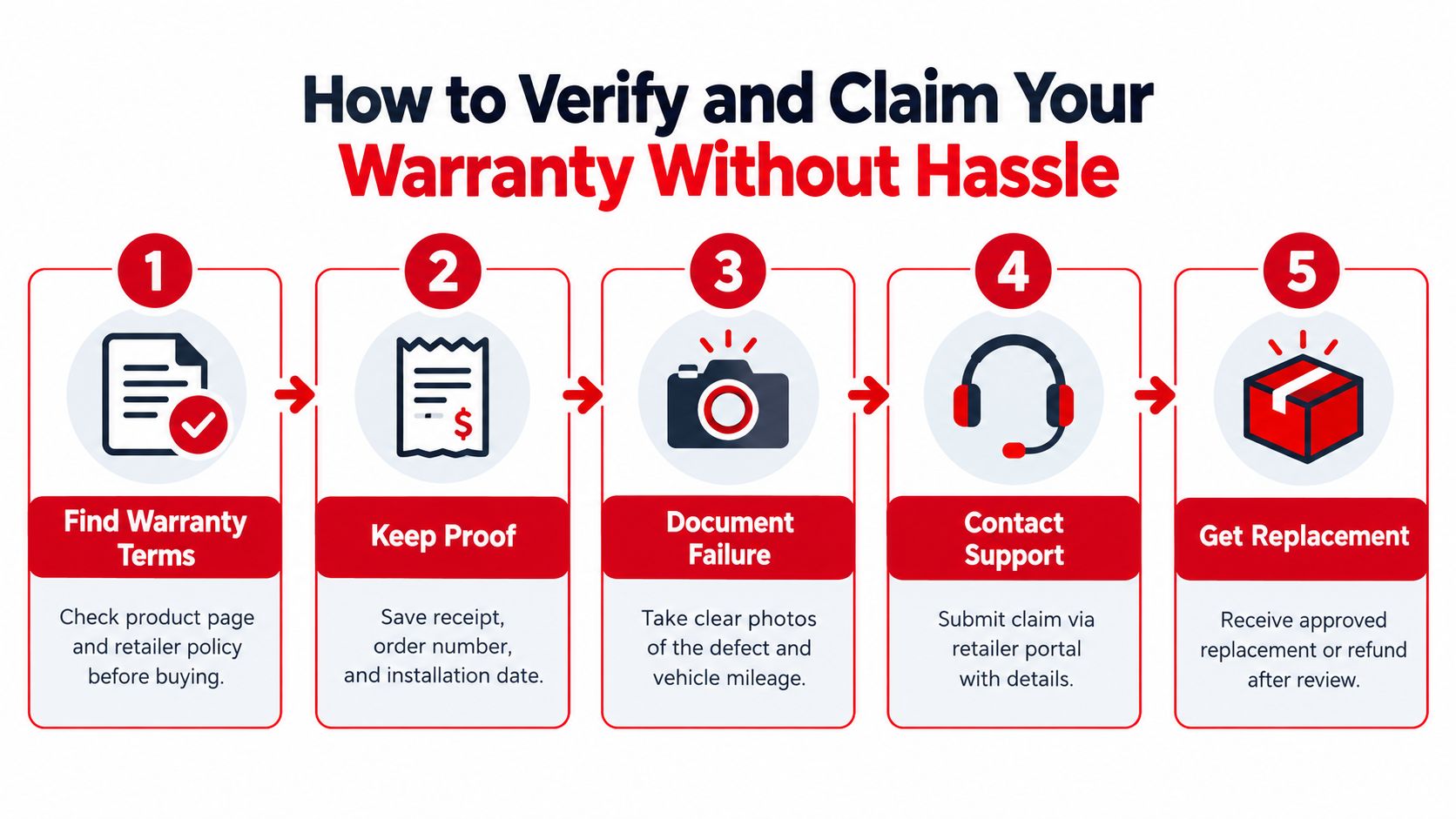
Use this five-step workflow
- Confirm the exact coverage. Check whether the promise applies to the complete assembly or only a component. Confirm the ownership rule, transfer policy, exclusions, and remedy. A lifetime label on a category page may not apply identically to every part number.
- Save proof of purchase. Keep the receipt, order number, invoice, and payment record. Shops should attach the part number and customer vehicle to the repair order. Fleets should connect the purchase to the unit number and internal maintenance record.
- Record the installation. Write down the installation date, vehicle mileage, installer, and any related work. Keep photos of the old part, new part, mounting points, connectors, fasteners, and final fitment. These details can help distinguish a product defect from a vehicle-side problem.
- Document the failure before removal. Photograph the failure in place when safe to do so. Capture cracks, broken tabs, separated seams, stripped gears, bent brackets, or other visible evidence. Avoid throwing away the failed part because the seller may require inspection.
- Open the claim through the seller. Ask for the return authorization or RMA instructions. Provide the part number, purchase date, vehicle information, failure description, photos, and installation notes in one message. Then ask whether the remedy is replacement, repair, credit, or refund and whether shipping or labor is handled separately.
Keep a claim-ready file
For a DIY installation, a phone album and a saved receipt may be enough to preserve the basic record. A repair shop should retain the estimate, technician notes, torque or adjustment details where relevant, and photos showing the completed installation. A fleet should use the same fields for every vehicle so one missing document doesn't slow down an otherwise valid claim.
Don't modify the failed part before contacting support. Cleaning, grinding, disassembling, or discarding evidence can make it harder to determine why it failed. You can register or record coverage through the T1A Auto warranty registration page when that option applies, but registration doesn't replace the purchase record or the written warranty terms.
T1A Auto Warranty Benefits for DIYers Shops and Fleets
Warranty value depends on the part category and the buyer's operating conditions. A DIY owner replacing a broken exterior handle wants fitment confidence and a clear remedy if the replacement contains a defect. A shop needs predictable reordering and records that connect the part to a repair order. A fleet manager cares about repeatable sourcing, downtime, and whether the same component can be documented across vehicles.
T1A Auto offers lifetime warranty coverage on metal components and a three-year warranty on standard items, with coverage determined by the applicable product terms. Its catalog includes components such as door handles, hinges, latches, mirrors, regulators, sensors, tailgate hardware, and related parts. The retailer also emphasizes vehicle-specific fitment, so buyers can search by make and model rather than relying only on a generic visual match.
Why material and certification answer different questions
An upgraded metal component may address a recurring weakness in a plastic original part, but the warranty still doesn't erase installation requirements or external damage exclusions. Buyers should ask two separate questions: Does the part meet the required quality or fitment standard? And what failure does the seller promise to remedy?
CAPA illustrates this separation in the collision-parts market. CAPA has certified more than 100 million aftermarket parts since 1990, according to BodyShop Business coverage of CAPA's milestone, but CAPA states that it doesn't itself warrant the parts. The warranty relationship remains between the buyer and seller. Certification addresses whether a part meets defined standards, while a warranty describes the seller's contractual response to a covered failure.
Practical value by buyer type
For DIYers, vehicle-specific search, documented installation, and a saved receipt reduce avoidable fitment and claim problems. Free standard shipping on orders over $75 and free 90-day returns are separate purchasing policies, not substitutes for warranty coverage, so check the applicable terms before ordering.
For shops, consistent part numbers, photographs, and repair-order notes help support a claim and make future reordering easier. A CAPA-certified collision component can address a standards question, while the seller's warranty addresses a coverage question.
For fleets, standardizing approved parts and claim records can help maintenance staff identify repeat issues without treating every failure as a warranty defect. The strongest process records the vehicle, part, installation, symptoms, and cause assessment before removal.
Making a Smart Choice and Getting the Most From Your Warranty
A lifetime warranty is most useful when you plan to keep the vehicle and the part might fail because of a hidden material or workmanship defect. It offers less value for routine wear items or parts exposed to impact, corrosion, contamination, or incorrect installation. Treat the label as a retail promise tied to a covered defect and your ownership, not as a prediction that the part will last forever.
Warranty-market reporting gives buyers context. Average U.S. claims were about 1.30% in 2025, while the average accrual rate was 1.43%, according to Warranty Week's market reporting. Those figures describe warranty activity across the market, not the expected life of one specific component. They support a practical question: does the coverage address a plausible defect, and can you prove the part was fitted correctly?
Use this buying checklist:
- Choose by failure cause: coverage matters more when an internal defect would be hard to detect during installation.
- Verify fitment: confirm the vehicle, trim, connector, mounting points, and side.
- Install carefully: follow instructions, retain fasteners, and correct binding, misalignment, or electrical faults.
- Keep evidence: save the receipt, mileage, installation date, part number, and failure photos.
- Claim before disposal: contact the seller before altering or discarding the failed part.
For a DIYer, these records connect the purchase to the repair. A shop should add the repair order, technician notes, and installation photographs. A fleet can record the vehicle, approved part, symptoms, and suspected cause. The record works like a chain of custody, showing whether the failure points to a covered defect or to wear and damage.
If a high-wear handle, hinge, latch, mirror, regulator, sensor, or tailgate component is needed, review the exact coverage and fitment details before ordering from T1A Auto. If a covered defect appears, provide the seller with the original part information and clear photos.
