


Your F-150's tailgate is a surprisingly complex piece of machinery, and finding the right tailgate parts for a Ford F150 starts with knowing how everything works together. From the simple handle you grab every day to the high-tech cameras and sensors, each piece has a critical job to do for function, security, and convenience.
Your Complete Ford F150 Tailgate Parts Breakdown
It’s best to think of your F-150’s tailgate less like a simple hinged door and more like a small, well-coordinated team. Every part has a specific role, and if one of them starts slacking, the whole system feels it. Getting a handle on this team dynamic is the key to figuring out what’s wrong and fixing it with confidence.
The core of the system is purely mechanical. The tailgate handle is what you interact with—the team captain, if you will. When you pull it, you're not directly opening the tailgate; you're triggering a set of internal rods.
Those rods connect to the latches on each side. These are the strongmen of the group, the locking mechanisms that bite down on the truck bed's striker bolts to hold everything securely shut.
The Mechanical Backbone
Holding it all up—literally—are the tailgate cables. These tough steel ropes are the only things stopping the tailgate from slamming down when you open it, and they have to support its full weight. You can see why a frayed or snapped cable is a major safety hazard. On newer F-150s, a tailgate assist damper often works with the cables to give it that smooth, controlled opening instead of a jarring drop.
This quick map shows how these core mechanical parts—the handle, latches, and cables—all depend on one another.
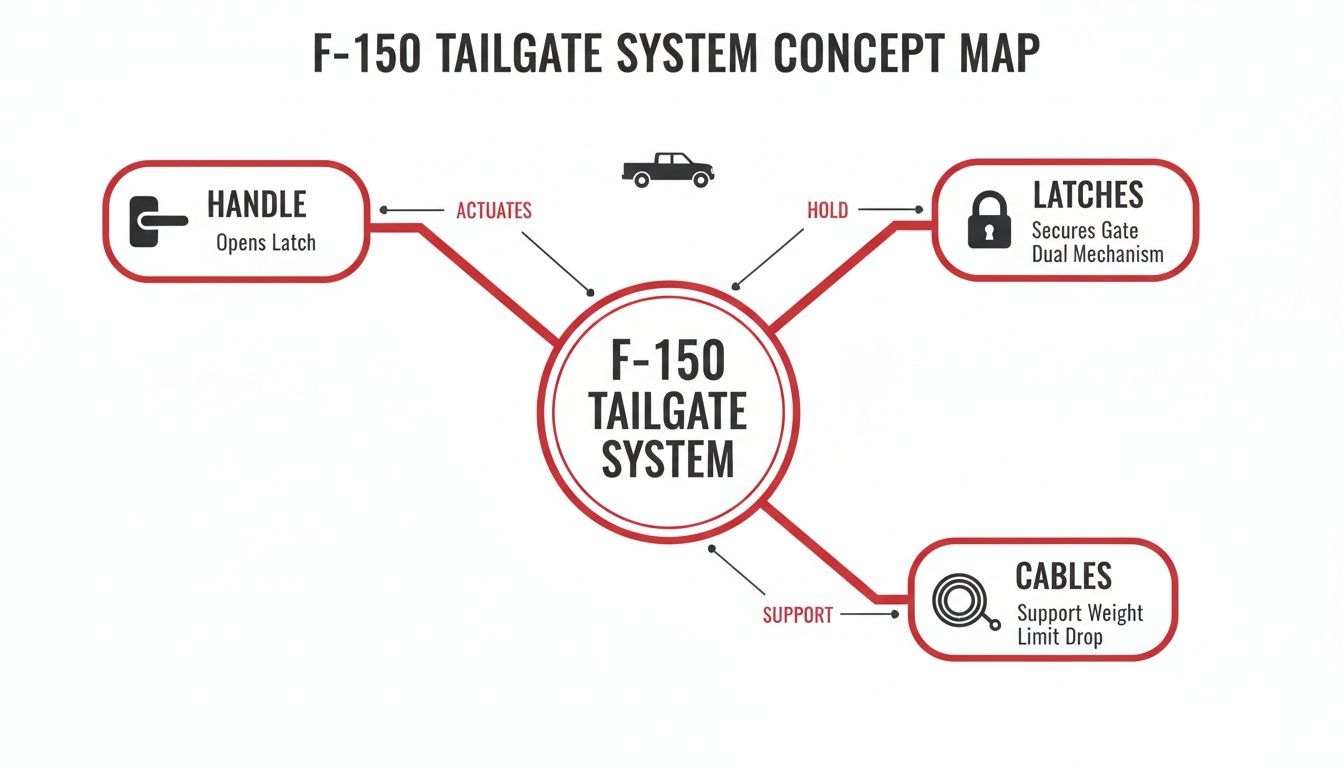
When you look at it this way, it’s easy to see how a problem with one part can make the whole system feel broken. A sticky latch can make you think the handle is bad, when it's really the other way around.
Integrating Modern Electronics
Of course, it's not all just rods and cables anymore. Modern F-150s have a whole layer of sophisticated electronics built right into the tailgate. Many now feature a backup camera for visibility, electronic release actuators for power locking, and sensors that talk to the truck's main computer.
These electronic parts are wired directly into the truck's nervous system. The most common ones you'll run into are:
- Backup Camera: Essential for safety, usually tucked into the handle assembly itself.
- Power Lock Actuator: This lets you lock and unlock the tailgate with your key fob, just like the doors.
- Tailgate Ajar Sensor: The little switch that tells your dashboard if the tailgate isn't latched properly.
- LED Lighting: Higher trims often have lights built into the tailgate to illuminate the bed.
Pro Tip: Understanding how the mechanical and electronic parts work together is crucial. A tailgate that won’t open might not be a broken handle at all. It could easily be a fried electronic actuator, a blown fuse, or a damaged wire.
At the end of the day, every one of these tailgate parts for a Ford F150 plays a part in the bigger picture. Once you can identify each component and what it does, you're well on your way to spotting wear, diagnosing problems, and choosing the right replacements to get the job done right.
Diagnosing Common F150 Tailgate Problems
A Ford F-150 tailgate that’s on the fritz is more than a small headache—it can throw a wrench in your workday, make loading gear a pain, and even create a safety hazard. The good news is, most tailgate problems don't happen out of the blue. They give you warning signs, and if you know what to look for, you can pinpoint exactly which part needs your attention.
It’s all about playing detective. That annoying rattle you hear on bumpy roads or a handle that feels wobbly isn't just a random failure. It's a clue pointing you straight to a specific component. A few simple checks can confirm your suspicions, saving you the time and money you’d waste on parts you don't actually need.
Uncovering The Mechanical Suspects
Most of the time, F-150 tailgate issues boil down to a few common mechanical parts giving out. These components take a beating from constant opening, closing, and carrying weight, so wear and tear is just part of the game.
A loose or floppy handle is a classic. It almost always means the little plastic clips connecting the handle to the internal latch rods have finally snapped. The handle itself might be perfectly fine, but if it can't pull the rods, it's not doing its job. On the other hand, if the handle feels stuck or you have to yank on it, one of the side latches is probably seized up with rust or gunk.
What if your tailgate slams down hard the second you unlatch it? That’s a dead giveaway for a failed tailgate assist strut. On older F-150s, it could be a broken internal torsion bar. That part is there specifically to slow the tailgate's descent, and when it goes, you're left holding the full, heavy weight of the steel gate.
What Those Rattles and Squeaks Are Telling You
Don’t ignore strange noises; they’re excellent diagnostic tools. A constant rattle when you’re driving is often caused by misaligned tailgate latch strikers—the posts on the truck bed—or worn-out rubber bumpers on the tailgate itself. These are meant to create a tight, quiet seal, and when they wear down, you get that metal-on-metal clatter.
To make things easier, sometimes you just need a quick cheat sheet to match the symptom to the problem.
F150 Tailgate Problem and Solution Quick Reference
This table can help you quickly narrow down the cause of your tailgate trouble and figure out the next step.
| Symptom | Potential Failing Part(s) | Recommended Action |
|---|---|---|
| Handle feels loose or pulls with no resistance. | Handle clips, linkage rods | Open the access panel and inspect the plastic clips and rod connections. |
| Tailgate won't latch on one or both sides. | Side latch mechanism(s) | Check the latches for rust or damage. Lubricate or replace as needed. |
| Tailgate slams down when opened. | Tailgate assist strut, torsion bar | Inspect the assist strut for leaks or damage. Replace the strut. |
| Rattling or clunking noise while driving. | Latch strikers, rubber bumpers, hinges | Check striker alignment and inspect bumpers and hinge bushings for wear. |
| Tailgate is hard to open or close. | Hinges, side latches | Lubricate all moving parts. Check for bent hinges or seized latches. |
| Power tailgate won't lock/unlock. | Power lock actuator, wiring | Listen for the actuator motor. If silent, check the fuse and wiring harness. |
| Backup camera is blank or flickering. | Camera, wiring harness | Inspect the wiring loom between the tailgate and truck bed for broken wires. |
Using this as a guide, you can confidently zero in on the root cause instead of just guessing.
A critical safety check involves the tailgate support cables. If you see any signs of fraying, serious rust, or kinks in these steel cables, replace them immediately. A snapped cable can cause the tailgate to drop without warning, which could lead to serious injury or damage.
Diagnosing Electrical Gremlins
On modern F-150s, electrical gremlins can sometimes masquerade as mechanical problems. If your power tailgate refuses to lock or unlock with the key fob, the power lock actuator is the prime suspect. This little motor can burn out, leaving the lock stuck even if all the mechanical parts are working perfectly.
A blank screen when you pop the truck into reverse is a clear sign of a backup camera problem. Before you rush to order a new camera, though, always check the wiring harness first. This bundle of wires runs from the tailgate into the truck body and gets flexed every single time the gate opens and closes. A broken wire is a very common—and much cheaper—fix.
By working through these key points methodically, you can move from symptom to solution with confidence. This targeted approach ensures you’re ordering the right tailgate parts for your Ford F150 and getting your truck back in working order without wasting time or money.
Getting the Right Parts for Your F-150 Generation
Trying to slap a tailgate part from a 2008 F-150 onto a 2021 model is a recipe for frustration. It's like trying to use an old flip-phone charger on a new smartphone—it just won't work. The Ford F-150 has changed a ton over the years, and with each new generation comes a complete rethink of the tailgate's design, materials, and technology.
Nailing down these generational differences is the single most important step in finding the right tailgate parts for your Ford F150. What looks like a simple cosmetic tweak on the outside often hides a total redesign of the guts on the inside. This guide will help you sort through the noise and get the right part the first time.
Major Shifts in F-150 Tailgate Design
The story of the F-150 tailgate is one of constant evolution. Early trucks had simple steel slabs, but today's models are packed with features. Knowing these key milestones makes it way easier to figure out which parts belong to which era.
-
10th Gen (1997-2003): This was the "jelly bean" or "aero" body style era. Tailgate parts were basic steel components with straightforward mechanical handles and latches that are completely incompatible with newer trucks.
-
11th Gen (2004-2008): Ford went back to a more traditional, boxy truck design. The parts were still mostly mechanical, but this is when you started seeing options like tailgate assist, making components like torsion bars more common.
-
12th Gen (2009-2014): This is where the tech really started to take off. The famous "man step" was introduced, which required a totally different tailgate shell and handle assembly to accommodate it. Backup cameras also became a popular option, fitting right into the handle bezel.
-
13th Gen (2015-2020): This generation was a game-changer with the switch to an aluminum alloy body. Every single tailgate component—the shell, hinges, latches, you name it—was redesigned for the new, lighter material. Trying to use a steel-era part here will cause fitment problems and kick off galvanic corrosion. This is also when power-release and damped tailgates became common on higher trim levels.
-
14th Gen (2021-Present): Today's F-150s are loaded. You've got the Pro Power Onboard system with outlets in the bed and the optional Pro Access Tailgate that swings open like a door. The internal wiring harnesses and control modules for these features are unique to this generation.
Your VIN is the Ultimate Shortcut to the Right Part
Your truck’s Vehicle Identification Number (VIN) is your secret weapon for finding the perfect part. Think of it as your truck's fingerprint—it tells you the exact build date, trim level, and all the options it left the factory with.
You can find the VIN on a metal plate on the driver-side dashboard (look through the windshield) or on the sticker inside the driver’s door jamb. When you’re shopping for parts, plugging that VIN into a decoder or giving it to the seller takes all the guesswork out of the equation. It will pinpoint the exact part number your truck needs, even accounting for those subtle changes Ford sometimes makes in the middle of a production year.
By cross-referencing your VIN with the OEM part number, you can guarantee a perfect fit. This step is non-negotiable when dealing with parts that have multiple variations, like a handle assembly with or without a camera hole.
How to Cross-Reference OEM Part Numbers
Once you’ve got that original equipment manufacturer (OEM) part number, you can easily find high-quality aftermarket parts that deliver the same fit and function, often for a much better price. Just pop the OEM number into the search bar on a trusted aftermarket parts site.
This trick ensures the replacement part was engineered to the original's exact specs. For example, if you just need a solid, no-frills replacement, finding a textured black metal tailgate handle assembly that matches your OEM number means it will bolt on perfectly and work just like it should. This is the smartest way to avoid the headache of getting a part that doesn't fit.
Choosing The Best Aftermarket Tailgate Parts
So, you’ve figured out what’s broken on your F-150’s tailgate. Now comes the big question: do you head to the dealership for an original equipment manufacturer (OEM) part, or do you explore the world of aftermarket replacements? This is a crossroad every truck owner faces, and the right choice really comes down to balancing cost, quality, and how long you expect the fix to last.
OEM parts are, quite simply, the exact same components your truck rolled off the factory line with. You get a guaranteed perfect fit and the quality you're used to, but that peace of mind comes with a steep price tag. If your truck is still under warranty, this is usually the path you'll take. But for those of us paying out of pocket, that dealership invoice can be a tough pill to swallow.
That's where aftermarket parts come in. These are made by companies other than Ford, and let's be honest, the quality can be all over the map. But a little bit of smart shopping can uncover some real gems. The best aftermarket brands don’t just copy the original part; they often identify its weaknesses and make it better.
Spotting High-Quality Aftermarket Upgrades
Think about the classic F-150 tailgate handle. We’ve all seen them—the original plastic handle gets brittle from sun exposure and everyday use, and then one day, snap. This is a perfect example of where a good aftermarket company steps up. They see that common failure and engineer a tougher solution, like a handle made with all-metal construction. That simple material swap adds a huge amount of durability and means you probably won’t have to replace it ever again.
When you’re looking for tailgate parts for a Ford F150, keep an eye out for these tell-tale signs of quality:
- Upgraded Materials: Look for parts that ditch failure-prone plastic in favor of sturdy metal, especially for high-stress components like handles, latches, and hinges.
- Lifetime Warranties: A company willing to back its parts with a lifetime warranty is putting its money where its mouth is. That’s a strong signal they believe in their product's durability.
- Solid Customer Reviews: Don't just skim the star ratings. Dig into reviews for comments about fitment and longevity. Phrases like "bolted right on, no problem" or "feels way sturdier than the factory part" are what you want to see.
The OEM vs. aftermarket debate is a classic one. OEM guarantees a familiar fit, but a top-tier aftermarket part can deliver a smarter, more robust fix for your truck. To really get into the weeds on this, you can read our detailed comparison of OEM vs. aftermarket parts to see which makes the most sense for you.
Understanding Value Beyond The Price Tag
The aftermarket industry is a massive part of the automotive world. Just look at the broader pick-up truck accessories market—it was valued at a whopping $2.4 billion in 2024. And with the F-150 dominating the roads, the demand for reliable tailgate parts for a Ford F150 is huge, fueled by an estimated 5-7% annual failure rate from hard work, rust, or the occasional parking lot mishap. This isn't some niche market; it's a thriving ecosystem that gives you plenty of great options outside the dealership.
Of course, it can be tempting to grab the cheapest part you can find online. But a poorly made, no-name component might end up costing you more in the long run, whether it's through a premature failure or the headache of trying to make it fit. The real goal is to find that sweet spot: a part that meets or beats OEM quality without the OEM price.
Your best bet is to stick with trusted sellers who specialize in direct-fit replacements and stand by their products with a strong warranty and good customer service. When you choose a well-engineered aftermarket part, you’re not just fixing a problem—you’re making a smart upgrade to your truck’s reliability for years to come.
A Step-By-Step Guide To Basic F150 Tailgate Repairs
Ready to get your hands dirty? You’d be surprised how many common tailgate problems are simple enough to fix right in your driveway. Forget the hassle and expense of a trip to the shop—with a few basic tools and a little patience, you can tackle these jobs yourself.
This guide will walk you through replacing the three most common culprits on an F-150 tailgate: the handle, the support cables, and the side latches. First things first, safety. Always make sure you’re parked on level ground with the parking brake on. I also like to keep an old blanket or a thick towel nearby to lay over the bumper—it's cheap insurance against accidental scratches.
Replacing A Broken Tailgate Handle
A floppy or completely snapped handle is probably the number one issue F-150 owners face. The good news is that it’s usually a quick fix.
Tools You'll Need:
- Socket set with an extension
- Torx bit set (typically a T30)
- Flathead screwdriver or a trim removal tool
Step-by-Step Instructions:
- Get the Tailgate Open: Lower the tailgate. If the handle is shot, you'll have to pop off the access panel and manually trip the latch rods from the inside to get it open.
- Remove the Access Panel: You'll see a series of screws (usually Torx heads) holding the inner panel on. Zip those out and gently pry the panel off.
- Disconnect the Latch Rods: Inside, you’ll find two metal rods running from the handle to the latches. They're held on by little plastic clips. Carefully pop those clips open with a screwdriver and slide the rods out.
- Unbolt the Old Handle: The handle itself is held in by a couple of nuts. Use your socket to remove them from behind, then the old handle assembly will push right out the front.
- Install the New Handle: Slide the new handle into place from the outside and tighten the nuts from behind. Snug is good, but don't crank down so hard you crack the plastic.
- Reconnect and Test: Snap the latch rods back into their clips on the new handle. Before you bolt the access panel back on, give the handle a few pulls to make sure everything is working smoothly.
For a more in-depth look, check out our full guide on how to replace a Ford F-150 tailgate handle, which has a few extra tips.
Swapping Out Worn Support Cables
Frayed or rusted tailgate cables aren't just ugly; they're a serious safety risk. Don't wait for one to snap. Luckily, this is a five-minute job that anyone can handle.
Tools You'll Need:
- Torx bit set (often a T45 or T50)
Step-by-Step Instructions:
- Support the Tailgate: You’ll need some slack in the cables, so either have a friend hold the tailgate up or prop it on a stool.
- Remove the Upper Bolt: Use your Torx bit to remove the bolt where the cable attaches to the truck bed wall.
- Unhook the Lower End: The other end just slips over a post on the tailgate. Lift the tailgate up a bit and the C-shaped clasp will slide right off.
- Install the New Cable: Slide the new cable's clasp onto the tailgate post, then bolt the other end back into the truck bed. Do the same for the other side, and you're done.
Installing A New Latch Mechanism
Is your tailgate refusing to shut on one side, or does it get stuck when you try to open it? A bad latch is almost always the cause.
Important Takeaway: My advice? Always replace latches in pairs. If one side has worn out enough to fail, the other one isn't far behind. Doing both at once ensures the tailgate operates evenly and saves you from having to do the same job twice.
Tools You'll Need:
- Socket set or Torx bit set
- Lubricant spray (white lithium grease works great)
Step-by-Step Instructions:
- Get Inside the Tailgate: Just like with the handle job, you’ll need to start by removing the inner access panel.
- Disconnect the Rod: Find the control rod running to the bad latch. Pop open its plastic clip and set it aside.
- Unbolt the Latch: A few bolts hold the latch assembly to the side of the tailgate. Remove them, and the old latch will come right out.
- Install the New Latch: Bolt the new latch in, reconnect the control rod, and give the moving parts a quick shot of lubricant. Test it out before you put the access panel back on.
While you're at it, if your tailgate has some minor cosmetic battle scars, you can find some easy DIY tips for removing car bumper scratches that apply just as well here. Knocking out these repairs yourself not only saves you a good chunk of change but also gives you the confidence to tackle the next project that comes your way.
What to Expect on the Bill: Costs and a Glimpse into the Future
Alright, let's talk money. Whether you're a seasoned DIYer or plan to have a pro handle the job, knowing the potential cost is crucial. The good news is that when it comes to tailgate parts for a Ford F150, you can save a ton of cash by doing the work yourself.
For basic mechanical parts, the fix can be surprisingly cheap. A new handle or a fresh set of support cables will often run you less than $50. On the other hand, if you're replacing something electronic like a backup camera or a power lock actuator, you’re looking at a higher price tag, usually somewhere between $100 and $300.
If you decide to hire a mechanic, remember to factor in labor. Shop rates typically fall between $75 to $150 per hour, which can quickly turn a simple, inexpensive part replacement into a more significant expense.
The Future of F150 Tailgates is Already Unfolding
While we're busy fixing today's handles and latches, tailgate technology is leaping forward. It's not just about opening and closing anymore; tailgates are becoming a major feature. The global market for automotive tailgates, valued at USD 15.22 billion in 2024, is expected to surge to USD 23.22 billion by 2033. This growth is all about adding convenience and smart features, especially power-operated tailgates on trucks like the F-150. You can actually dig into these market trends to see where things are headed.
Ford is already pushing the boundaries with innovations like the Pro Access Tailgate. This clever design adds a swing-out door to the middle of the tailgate, making it a breeze to access the bed even when you’ve got a trailer hooked up. But that's just the beginning.
Think about a tailgate that senses you walking up with your hands full and opens on its own. Or one with built-in scales that display your payload weight right on the dash as you load up. This isn't science fiction—it's the next logical step for making these trucks even more useful.
We're seeing other truck makers get creative, too. GMC’s MultiPro tailgate, for instance, can transform into a workbench, a bed extender, or even a step. As these multi-function designs become the new standard, the tailgate parts for a Ford F150 will evolve right along with them, combining tough, reliable mechanics with smart, integrated tech.
F-150 Tailgate Parts: Your Questions Answered
Even after getting into the weeds on tailgate parts, you probably still have a few specific questions. It's only natural. Here are some of the most common things F-150 owners run into, with straightforward answers to get you back on track.
Can I Add A Tailgate With The Built-in Step To My Truck?
Yes, you absolutely can, and it's a fantastic upgrade. But the key here is compatibility—it's everything. You can't just mix and match parts from different generations.
To do this right, you need the entire tailgate assembly from a truck within your F-150's generation. This is the only way to guarantee the body lines match, the latches click into place, and any wiring for cameras or lights plugs right in. Just be sure to double-check the model year range of the donor tailgate before you hand over any cash.
Why Does My F-150 Tailgate Suddenly Feel So Heavy?
If you feel like you're suddenly wrestling a slab of steel, the culprit is almost always the lift assist system. On most F-150s, a torsion bar is tucked inside the tailgate. Think of it like a big spring that counterbalances the weight, making it feel light. When that bar snaps, you're left lifting the full, unforgiving weight of the tailgate yourself.
Newer models might use a small damper shock instead.
You'll know the damper has failed if you notice two things: the tailgate is a beast to lift, and it slams down hard when you open it instead of gently lowering.
Should I Buy A Used Tailgate Or Just Replace The Broken Parts?
This really comes down to the extent of the damage. If you're dealing with a single broken handle, a worn-out cable, or a latch that won't catch, it's way cheaper and easier to just replace that specific part. These are usually quick, simple jobs you can knock out in your own driveway.
On the other hand, if your tailgate is badly dented, rusting through, or has a laundry list of broken components, you're better off finding a complete used tailgate. Sourcing a color-matched one from a good salvage yard can save you a ton of time, money, and headaches in the long run.
How Can I Stop My F-150 Tailgate From Rattling?
That annoying rattle you hear on every bump is usually caused by one of three things. The best way to fix it is to work through them one by one.
- Check the Bumpers: First, look at the little rubber bumpers on the tailgate. If they're worn flat or missing entirely, they can't create a snug fit, and you'll get a rattle.
- Adjust the Strikers: Next, pop open the tailgate and look at the striker bolts on the truck bed. You can loosen them and make tiny adjustments to tighten up how the tailgate closes.
- Inspect the Latches: If the bumpers and strikers are fine, the problem is likely worn-out internal latches. They develop play over time, which creates that clatter. Replacing the latches is usually the final fix.
When you need tough, direct-fit tailgate parts for a Ford F150, check out the full catalog at T1A Auto. Shop with the confidence that comes from our lifetime warranty on all metal components. Find the exact part your truck needs at https://t1aauto.com.
