


You're halfway through a repair, stretched under a dash or wedged into a wheel well, and the fastener in front of you doesn't match what your hand expects. The 6-point socket won't seat. The 12-point catches just enough to give you false hope, then starts slipping. That's the moment a 10 point socket stops sounding like a weird niche tool and starts making perfect sense.
Most mechanics can get a long way with a normal metric and SAE set. But not every bolt is a plain hex, and not every lug nut was designed with serviceability in mind. Some fasteners need a matching profile, or you risk rounding the head before the job even starts. When that happens, the right specialty socket saves time, saves parts, and saves you from having to turn one repair into three.
The Right Tool for the Strangest Bolt
A 10 point socket earns its keep on the jobs where common sockets fail. You don't buy one because it looks interesting in the drawer. You buy it because one day a bolt head forces the issue.
The tool world started from a much simpler place. The foundation for modern sockets was laid in 1920, when Snap-On introduced the first interchangeable socket sets. Those early sets were 1/2-inch square drive and 6-point only, a standard that dominated for nearly two decades and shaped what most of us still think of as a “normal” socket today, according to Alloy Artifacts' history of early Snap-On sockets.
When normal sockets stop working
Most of the time, a 6-point is the right answer on a standard hex fastener. It grips well and handles serious hand torque. But some OEM hardware and some aftermarket lug systems use a different shape entirely. If the fastener has ten lobes, forcing a hex socket onto it is how people end up with rounded hardware, bruised knuckles, and a repair that stalls out.
That same thinking applies all over the shop. Good brake work, for example, depends on matching the tool to the hardware and the job. If you're brushing up on service basics, this breakdown of Front brake pad replacement is a useful reminder that clean disassembly matters as much as the new parts going back on.
Practical rule: If a socket needs to be hammered on just to feel usable, stop and verify the fastener shape before you commit.
What a prepared toolbox really looks like
A 10 point socket is not an everyday carry item like a 10mm shallow. It's a problem-solver. The mechanics who avoid unnecessary damage are usually the ones who recognize early that the fastener is unusual and reach for the correct tool before they start improvising.
That same habit matters when hardware is already damaged. If the head is partly stripped or broken off, the extraction method changes fast. This guide on the best way to remove a broken bolt is worth keeping handy because the line between “special fastener” and “broken fastener” gets crossed quickly when the wrong socket is involved.
- Use your eyes first: Count the lobes and inspect the corners before choosing a socket.
- Test fit by hand: A correct specialty socket should seat fully before you apply torque.
- Don't let urgency choose the tool: The extra minute up front is cheaper than drilling out hardware later.
Comparing 10 Point vs 6 and 12 Point Sockets
A socket profile is not just a shape. It decides how force gets transferred into the fastener, how much metal carries the load, and how likely the head is to survive removal.
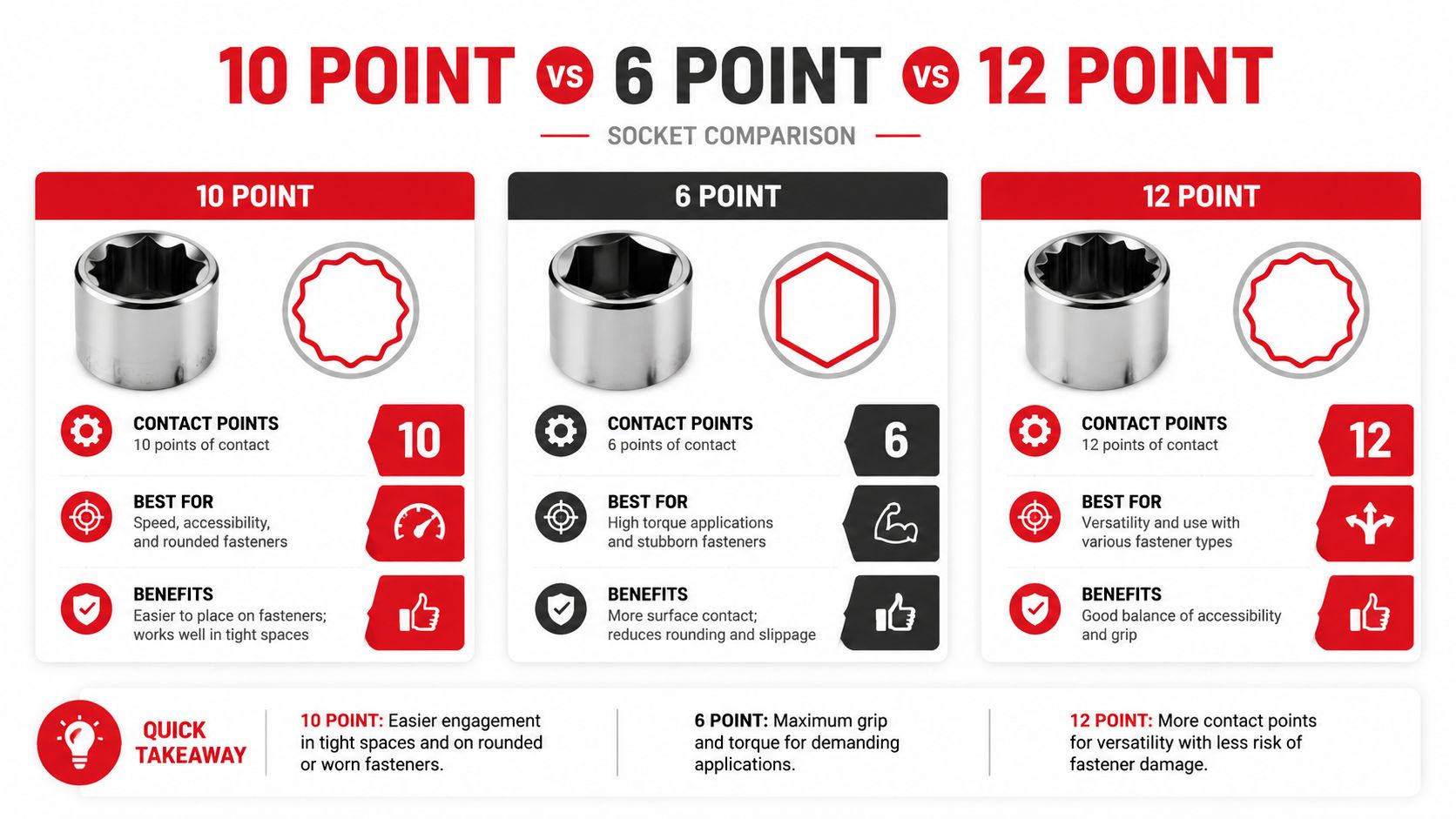
What each socket is actually for
A 6-point socket is still the standard for ordinary hex bolts and nuts. It gives solid engagement on flat-sided fasteners and stays the best choice for stubborn suspension, brake, and chassis hardware that uses a regular hex head.
A 12-point socket fits more often and indexes more easily in tight spaces. That can help when you only have a few degrees of swing on a ratchet. The tradeoff is simple. On the wrong fastener, especially one that's rusty or already softened at the corners, a 12-point can slip sooner than a good 6-point.
A 10 point socket is not a “better 6-point” or a “stronger 12-point.” It is the correct answer for a matching 10-lobed fastener. On that hardware, fit matters more than versatility.
Contact matters more than people think
A 10 point socket provides 20% more contact points than a 6-point design, which helps distribute turning force more evenly across the fastener and lowers the chance of stripping rounded or corroded heads, as summarized in Wikipedia's socket wrench overview.
That doesn't mean you should replace your 6-point set with 10-point sockets. It means a matching profile spreads load where it should, instead of concentrating force on a shape the socket was never meant to drive.
A specialty socket is only “better” when it matches the fastener in front of you.
Socket Comparison 6-Point vs 12-Point vs 10-Point
| Socket Type | Best For | Primary Advantage | Primary Disadvantage |
|---|---|---|---|
| 6-Point | Standard hex bolts and nuts | Strong grip on common fasteners | Won't properly fit specialty 10-lobed hardware |
| 12-Point | Tight access where indexing matters | Easier engagement angle in cramped spaces | More likely to slip on damaged or incorrect fasteners |
| 10-Point | Matching 10-lobed bolts or tuner-style lugs | Correct fit on specialty hardware, better force distribution on that profile | Limited use outside those specific applications |
Real trade-offs in the shop
Here's the practical breakdown:
- For routine service: A 6-point does most of the heavy lifting.
- For awkward access: A 12-point can make the ratchet usable where a 6-point won't clock nicely.
- For oddball hardware: A 10 point socket stops being optional.
If the fastener shape and the socket shape don't agree, torque won't save you. It will just destroy the head faster.
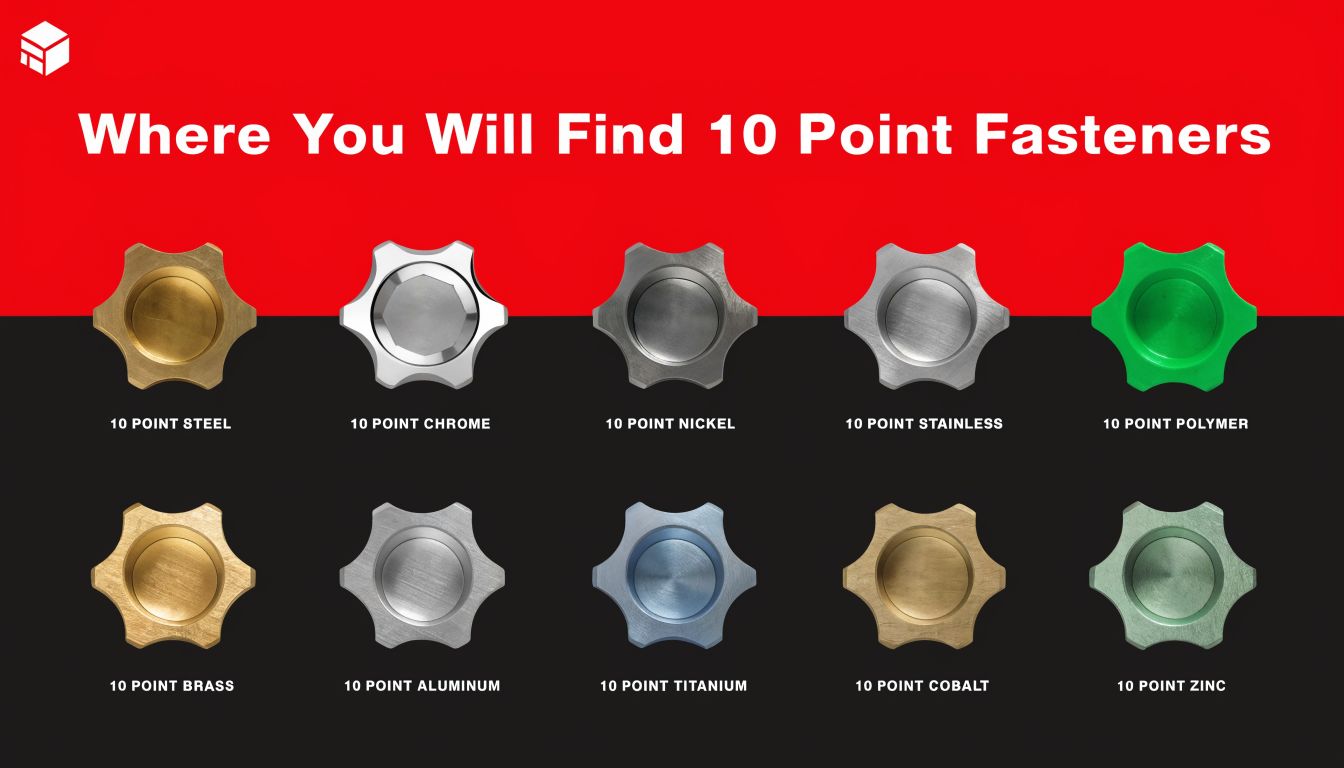
Where You Will Find 10 Point Fasteners
You usually find out you need a 10 point socket the hard way. The bolt looks close enough to a standard head, the 12-point seems to grab, and then the corners start to smear before the fastener even breaks loose.
Honda and Acura suspension and seat hardware
Honda and Acura are still the most repeatable place to run into true 10-lobed fasteners. That is why these sockets earned their reputation there first. Suspension bolts and certain seat hardware can look serviceable with a regular socket right up until the moment they slip.
The common trouble spots are well established in the CTA 3751 Honda 10-point socket set application notes, including:
- Rear lower control arm hardware on Civic and Acura RSX applications
- Seat track fasteners on later Odyssey and Pilot applications
- Dedicated 8mm and 10mm 10-point service points where standard sockets do not seat correctly
In the bay, the pattern is simple. If the socket does not sit fully down on the head, stop. Forcing a near-fit on suspension hardware turns a straightforward control arm job into a fastener extraction job.
Clean engagement matters more than brute force.
If you are already working in that corner of the vehicle, it helps to know what other hardware sits nearby. This guide to bolts for wheel hub assembly is a useful companion because hub, knuckle, and control arm work often overlap during the same repair.
Aftermarket tuner lug nuts
The other place 10 point tools show up is wheel service, especially with aftermarket tuner-style lug nuts. Those lug nuts use narrow specialty profiles, and they do not give you much room for error.
On a car, that usually comes up during wheel swaps or brake work. On trucks, it shows up after somebody installs aftermarket wheels on a Silverado, F-150, or Tacoma and tosses the original lug key in a glove box, tool bag, or junk drawer. Then the truck comes in for tires, front brakes, or a hub replacement, and now the wheel cannot come off without the right key or socket.
That does not mean every truck lug nut is a 10 point. It means truck owners are just as likely to run into specialty wheel hardware, especially on modified half-tons and midsize pickups.
What to check before you put a breaker bar on it
A quick inspection saves a lot of grief:
- Count the lobes or flats instead of guessing by size.
- Check whether the socket seats flush and full-depth on the fastener.
- Look for narrow wheel hardware, recessed lug holes, or a missing specialty key.
- Treat any suspension or seat fastener that feels wrong on engagement as an identification problem first, not a torque problem.
That habit saves fasteners, studs, and time. It also keeps a simple service job from turning into drill work.
Beyond Honda A Tool for Truck Owners Too
A lot of online advice treats the 10 point socket like a Honda-only tool. That's too narrow, and it leaves truck owners unprepared.

The gap truck owners run into
Content analysis shows that search interest around 10-point sockets is dominated by Honda applications, but questions keep appearing about alternatives for Toyota Tacoma suspension and Ford F-150 control arms, which points to a real knowledge gap that retailer content hasn't filled, as noted in the NAPA product and market-gap summary.
That lines up with what happens in real garages. Truck owners doing suspension, interior, or chassis work often run into fasteners that are awkward, corroded, partially shielded, or unfamiliar. The hardware may not always be a 10-lobed OEM bolt, but the decision process is the same. If the profile doesn't match your standard socket set, stop assuming and start identifying.
Where truck owners should stay alert
On Ford F-Series, Chevy Silverado, and Toyota Tacoma repairs, the places worth watching are the spots that combine limited access with high wear:
- Suspension attachment points
- Control arm and chassis hardware
- Seat track fasteners in the cab
- Aftermarket wheel hardware
That doesn't mean every truck job needs a 10 point socket. It means truck owners should stop dismissing the tool just because most search results talk about Hondas.
The practical takeaway for pickups
Truck work often adds corrosion, dirt, and tight access to the equation. That makes profile mismatch more expensive. If a specialty fastener rounds off inside a rusty wheel well, the repair gets ugly fast.
If you work on older pickups or trucks that live in salt, identifying the fastener correctly matters even more than brute force.
For a shop that sees mixed makes, keeping a 10 point socket on the wall is cheap insurance. For a DIY owner with a Tacoma, F-150, or Silverado, it's the kind of tool you may not touch for months, then suddenly need right now.
How to Choose and Use Your 10 Point Socket
You usually figure out whether you bought the right 10 point socket when the truck is already in the air and the fastener will not give you a second chance. A rusty lug key on a Silverado, an odd seat track bolt in an F-150, or tuner hardware on a Tacoma will expose a bad fit fast.
Match the fastener, not the packaging
Start at the bolt head or lug, not the tool rack. A proper 10 point socket should drop on fully with no rocking, no forced angle, and no daylight between the socket and the fastener. If it only grabs on the corners, stop there. That is how specialty hardware gets rounded.
Some 10 point sockets are built for specific lug patterns, while others are meant for certain service applications. The point is simple. Buy the socket that matches the exact shape and size in front of you, as noted earlier, instead of trying to make a 12 point or a worn 6 point do a job it was never made to do.
Pick the drive size by load and access
Drive size matters because these fasteners show up in very different places.
- Small drive sizes make sense for interior trim areas, seat hardware, and tighter access where a bulky ratchet head gets in the way.
- 3/8-inch drive is the usual middle ground for mixed service work.
- 1/2-inch drive is the better choice for wheel hardware, truck suspension jobs, and anything that needs more controlled force.
On trucks, I lean toward the heavier setup if corrosion is part of the job. A compact ratchet is nice until the fastener fights back.
Use the right socket type
Hand socket for hand tools. Impact socket for impact tools.
That sounds obvious, but it gets ignored all the time. If you are working on aftermarket lug hardware on a pickup, or dealing with crusty chassis fasteners that need an impact gun, use an impact-rated socket and matching accessories. A chrome hand socket can split, distort, or slip once the tool starts hammering.
Material matters less than setup.
- Clean the fastener first. Dirt packed into the head keeps the socket from seating all the way.
- Test the fit by hand. If it does not slide on cleanly, reassess the size and profile.
- Keep the tool straight. Side-loading a specialty socket is a fast way to damage both the socket and the bolt.
- Break it loose with control. A short breaker bar often gives better feedback than rushing straight to an impact.
- Torque it correctly on reassembly. Specialty fasteners are expensive to replace, and many get damaged after the hard part is already over.
If you need a quick refresher before buttoning up the job, read this guide on how to use a torque wrench correctly.
Good mechanics in every field work this way. The same habits show up in these comprehensive bike servicing details, where fit, tool choice, and controlled tightening matter just as much as they do on a truck.
Shop habit: Slow down on odd fasteners. Ten extra seconds checking fit can save an hour of extraction work.
The Final Verdict A Problem-Solver for Your Toolbox
A 10 point socket is not a gimmick, and it's not a replacement for your regular socket set. It's a targeted fix for a specific kind of problem. When the fastener calls for it, nothing else works as cleanly.
The clearest need shows up on known Honda and Acura applications, and tuner-style lug hardware is another solid reason to own one. But the bigger lesson is broader than any one make. Truck owners and mixed-line shops run into unusual hardware too, especially on suspension, seat, and wheel-related jobs where corrosion and tight access make mistakes expensive.
Why experienced mechanics keep odd tools around
The best tool collections aren't just big. They're deliberate. They include the strange pieces that solve real problems without drama.
That applies outside automotive work too. If you enjoy seeing how skilled maintenance thinking carries across machines, these comprehensive bike servicing details make the same point in a different setting. The mechanic who understands fit, torque, and tool choice usually finishes with fewer broken parts.
So the verdict is simple. A 10 point socket is a specialist. You may not need it every weekend. But when a weird bolt stops a job cold, having the right socket on hand is the difference between a clean repair and a long afternoon of damage control.
If you're replacing worn handles, mirrors, latches, sensors, or other high-wear parts on a truck or SUV, T1A Auto is worth a look. Their catalog is built around durable aftermarket replacements with guaranteed fitment, which makes the repair side of the job simpler before you ever reach for the toolbox.
