


You plug in your phone on the way to work, glance down a few minutes later, and the battery percentage hasn't moved. Or the dash cam that worked yesterday is suddenly dead. Or the tire inflator starts, then cuts out, then works again if you wiggle the plug.
That's the kind of problem that makes a 12V power outlet seem trivial right up until you need it. In most vehicles, that little socket has gone from old smoking-era hardware to a daily-use power point for chargers, GPS units, air pumps, coolers, and emergency gear.
What trips people up is that a dead outlet isn't always a dead outlet. Sometimes the fuse is blown. Sometimes the socket is loose. Sometimes the plug fits badly, the contacts have built resistance, or the wiring polarity is wrong and the outlet fools you by showing voltage with no real working power. A quick fix might get it alive for a day. A proper fix keeps it reliable.
When Your Car Charger Port Stops Working
The usual failure starts small. Your charger works if you twist it a little. Then only one adapter works. Then nothing charges at all, even though the rest of the car seems fine.
A lot of drivers call it the “car charger port,” and that makes sense because charging phones is the most common use now. But the socket itself is still an electrical outlet with its own fuse, contacts, wiring, and mounting. If any one of those is weak, the problem keeps coming back.
One of the most common mistakes is assuming the port is dead because a device won't power up. In the shop, I'd always verify the accessory first. Cheap USB adapters fail all the time. So do cords. A bad adapter can waste an hour of diagnosis if you start tearing trim apart before checking it.
The failure you can feel
A healthy outlet usually gives you a firm, consistent plug fit. A worn one often feels vague. The plug may sit loosely, spring back, or lose power over bumps. That matters because these sockets depend on contact pressure at the side shell and center terminal. If either contact gets weak or dirty, the outlet may act alive but fail under load.
A charger that only works when you hold it just right usually points to a contact problem, not a mysterious electronic issue somewhere else in the car.
The frustrating part is that generic advice often stops at “check the fuse.” Yes, start there. But if you want a fix that lasts, you need to look at the whole circuit, the quality of the socket, and whether the plug and outlet mate correctly.
The Unsung Hero of Your Dashboard
The 12V power outlet is basically the car's universal wall socket. It gives you quick access to the vehicle's DC electrical system without hardwiring every accessory you want to use.
That's why it has survived for so long. The outlet traces back to the 1920s, when it first appeared as a cigarette-lighter socket, and it stayed in widespread use because it can power all kinds of accessories even as vehicles added USB-C and wireless charging. In a modern vehicle, the circuit is typically protected by a 10 to 20 ampere fuse, which works out to roughly 120 to 240 watts, and with the engine running the system voltage is often around 13.5 to 15 volts rather than a nominal 12 volts, as explained in this overview of why modern cars still have 12V power sockets.

What that means in real use
Those numbers matter because they tell you what the outlet can realistically do. A phone charger barely asks anything from the circuit. A tire inflator, heated travel mug, or portable cooler asks a lot more. The outlet may look simple from the outside, but it has real limits.
That's also why people get confused when one accessory works and another doesn't. The socket might be fine for light charging and still struggle with anything that pulls more current. Weak contacts, light-gauge wiring, or heat damage often show up first with heavier loads.
Why it still matters in newer vehicles
USB ports are convenient, but they're purpose-built for electronics. The 12V outlet remains useful because it powers devices that don't fit neatly into a USB-only world. Air pumps, work lights, portable vacuums, and emergency tools still rely on it.
Practical rule: Think of the 12V outlet as a general-purpose power point, not just a phone charger port. That mindset helps you diagnose it correctly and choose better replacement parts.
If you understand that the outlet is part of a larger automotive power circuit, the rest of the repair process makes more sense.
Understanding Outlet Types and Connections
Not every dashboard socket is the same, even when they all get called “12V outlets.” Some were built to heat a cigarette lighter element. Others were designed only as accessory sockets. Then there are combo panels with USB ports added beside them.
That difference matters because plug fit, internal contact design, and intended use can vary. If you're replacing one, don't buy by appearance alone.
Common 12V outlet configurations
| Socket Type | Primary Use | Key Feature | Common Power Rating |
|---|---|---|---|
| Traditional cigarette lighter socket | Original lighter and accessory use | Built around the classic lighter-style form factor | Varies by vehicle circuit |
| Accessory-only 12V socket | Chargers, inflators, dash cams | Usually intended for power delivery rather than heating a lighter element | Often matched to the vehicle's outlet circuit |
| Multi-port panel | Mixed accessory use in trucks, campers, utility setups | Combines a 12V socket with extra ports in one panel | Varies by panel design |
| 12V plus USB combo unit | Charging phones plus powering 12V accessories | Adds USB-A or USB-C beside the round socket | Depends on both the socket and the integrated USB electronics |
Why “universal” can mislead you
The round opening looks standardized, but the details still matter. Some sockets hold plugs tightly. Others feel sloppy from day one. Some have better spring tension and contact plating. Others lose grip quickly, especially with heavier adapters hanging from them.
A traditional lighter socket can also behave differently than an accessory-only outlet. If you install the wrong style in a location that sees frequent plug-in use, you may end up with inconsistent retention or weak contact pressure.
Here's the simple way to identify what you have:
- Look at the outlet cap or trim: Many accessory-only sockets are labeled for power use, while older lighter sockets may not be.
- Check how you use it: If the location regularly powers inflators, coolers, or work gear, durability matters more than a bare-minimum replacement.
- Inspect the back side before ordering: Mounting depth, terminal style, and retention method often differ.
If the original outlet failed from looseness or heat, replacing it with the cheapest lookalike usually repeats the same problem.
Modern combo units can be useful, especially in work trucks and overlanding setups, but they also add complexity. If the integrated USB module fails, you may lose part of the panel even though the 12V socket itself is still fine. For many DIY repairs, a dedicated standalone socket is simpler and easier to service later.
Automotive Wiring and Fuses Explained
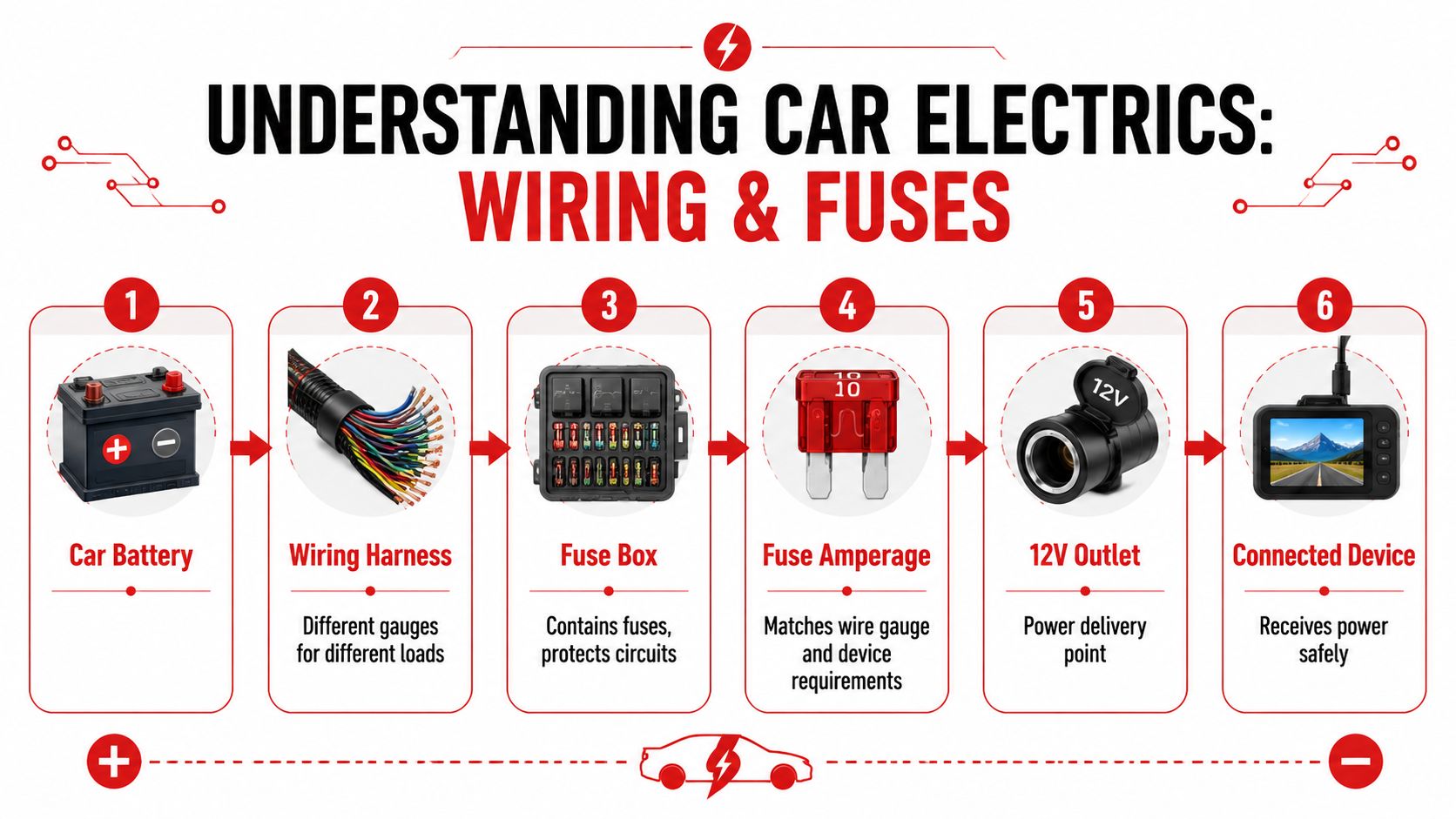
A 12V socket is only as good as the circuit feeding it. People focus on the outlet because that's the visible part, but the wiring and fuse decide whether the setup runs safely or turns into a heat problem.
The easiest way to think about it is a garden hose. The wire is the hose. Current is the flow. The fuse is the safety device that opens the circuit before the hose gets pushed beyond what it can handle. If you ask too much from a small wire, voltage drops, the outlet runs weaker, and heat builds where resistance is highest.
Match the whole circuit, not just the gadget
Current aftermarket 12V sockets are commonly designed around 10A to 15A continuous load capability, which corresponds to roughly 120W to 180W at 12V DC. One example specifies 12V/10A (120W) with 18 AWG lead wire and a 10A inline fuse, while another specifies a 15A maximum output. The important takeaway from this aftermarket socket specification example is that the socket rating is only part of the story. The wire and fuse have to match the job too.
If you're planning a new outlet circuit and want a quick refresher on how overcurrent protection relates to conductor size, a circuit breaker wire size guide is a useful general reference for thinking through the pairing.
For broader vehicle electrical diagnosis before you start cutting into trim, this car electrical problem diagnosis guide helps frame the process.
Switched power versus constant power
Many DIY installs encounter issues when selecting between outlet types. A switched outlet only works with the key in an accessory or run position. A constant hot outlet stays live all the time.
Each one has a place:
- Switched power: Better for dash cams, chargers, and anything you might forget plugged in.
- Constant hot: Useful if you need power with the vehicle off, but it requires more discipline.
- Dedicated fused feed: Best when the new outlet will support heavier accessories and you don't want to burden an existing interior circuit.
Shop advice: Fuse the wire for the wire's capacity and the socket's rating. Don't size the fuse only around what you hope to plug in.
What actually causes trouble
Most repeat failures come from one of these:
- Undersized wiring that causes voltage drop and heat.
- Overfusing that lets the wire suffer before the fuse opens.
- Poor grounds that create intermittent operation.
- Tapping a crowded existing circuit because it was easy to reach.
A clean, dedicated installation takes more time, but it avoids the headaches that make 12V accessories seem unreliable.
Troubleshooting a Dead 12V Power Outlet
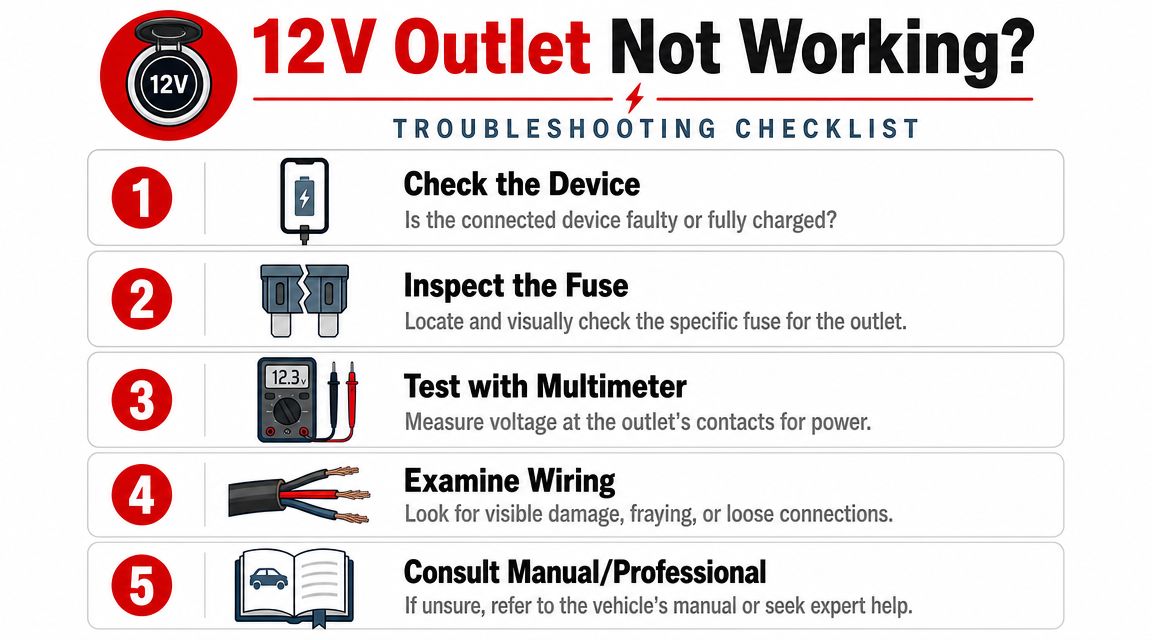
If the outlet suddenly stops working, don't start by replacing parts. Diagnose it in order. Most bad outlet repairs get expensive or annoying because someone skipped the simple checks.
Start with the accessory you're plugging in. Test the charger, inflator, or adapter in another known-good vehicle outlet. If that device is dead, the socket isn't your problem.
A clean diagnostic sequence
-
Verify the accessory first
USB adapters fail often. So do cheap cords and plug-in inverters. One known-good accessory saves a lot of guesswork. -
Check the correct fuse
Don't assume because one interior outlet works, they all share the same fuse. Many vehicles split them by location or function. Use the fuse diagram in the owner's manual or service information. -
Test for voltage at the socket
A multimeter or test light tells you whether power reaches the center contact and whether the socket shell has a proper ground. -
Inspect the socket physically
Look for a burned center contact, loose shell, corrosion, or debris down in the bore. Coins and metal fragments in console-mounted outlets aren't rare.
The subtle failure most guides miss
A socket can show voltage and still fail under load. That usually points to high resistance at the connection or reversed wiring polarity, both of which came up in practical troubleshooting discussed in this forum thread on sockets that show power but won't run devices.
That's why “it has 12 volts” doesn't end the diagnosis. A meter may show power with no accessory connected because the circuit is unloaded. Plug in a real device, and the weak connection falls on its face.
Signs you're dealing with contact resistance
- The plug works if twisted or held sideways
- The adapter gets hot
- A light-load charger works, but an inflator doesn't
- The center contact looks dark, pitted, or pushed down
If a socket passes a voltage test but fails with an actual device, suspect the mechanical connection before you condemn the whole harness.
The troubleshooting mindset is similar across low-voltage vehicle systems. If you like methodical electrical checks, this guide to electric golf cart fixes is a useful example of the same logic: verify the load, trace power, inspect connections, and only then replace parts.
When to stop and remove the socket
Pull the outlet for bench inspection if you find any of the following:
- Loose retention in the dash panel
- Melted plastic around the terminals
- Evidence of previous wiring repairs
- Recurrent fuse failure after replacing the fuse
At that point, the problem usually isn't going to resolve with contact cleaner and hope.
How to Replace or Upgrade Your 12V Outlet
Replacing a bad outlet is usually straightforward. The challenge is access, not theory. Most sockets live in a dash trim panel, console side panel, or cargo trim piece where the back side is hidden.
Before you touch the wiring, disconnect the battery.

Basic replacement steps
A typical replacement goes like this:
-
Remove the trim panel carefully
Use trim tools, not a screwdriver if you can avoid it. Plastic trim marks easily, and hidden clips break when you pry from the wrong edge. -
Access the back of the outlet
Some outlets have a threaded retaining ring. Others lock in with tabs. Take a photo before disconnecting anything so terminal orientation is easy to confirm during reassembly. -
Disconnect the wiring connector or terminals
If the connector feels heat-damaged or loose, inspect it closely. A new socket won't fix a cooked terminal. -
Remove the old socket from the panel
Don't force it. Most damage happens when someone twists the body against a locking tab or bezel they didn't notice. -
Install the new outlet and confirm polarity
The center terminal is the power feed and the shell is ground. Get that wrong and you can end up with a socket that fools basic testing but won't reliably power accessories.
If you need a parts-and-process walkthrough for the lighter-style format itself, this cigarette lighter replacement guide is worth keeping open while you work.
Adding a new outlet the right way
A lot of DIY installs fail because the outlet gets added as an afterthought. Someone finds nearby power, taps it, and calls it done. That can work for a low-draw device, but it's not the standard to aim for if you want long-term reliability.
A key issue when adding a new 12V outlet is doing it without draining the battery or overloading an existing circuit. Installation tutorials commonly show tapping the fuse panel and making the outlet switched, but they often don't dig into load planning or why a dedicated fused circuit matters for modern accessories, as discussed in this 12V outlet installation tutorial reference.
Here's the practical decision tree:
- For light, occasional use: A switched fuse-panel tap can be fine if the donor circuit is appropriate.
- For regular accessory use: Run a dedicated fused feed.
- For cargo-area or overland setups: Use proper routing, abrasion protection, and a solid ground point on clean metal.
Watch this process video before you start if you want to see the hardware layout and install flow in a real vehicle context.
What works and what doesn't
What works:
- A firm-mounted socket that doesn't rotate in the panel
- A fuse placed correctly in the circuit
- Clean crimped or factory-style terminal connections
- Routing that avoids sharp edges and moving parts
What doesn't:
- Loose push-on terminals under a console
- Grounding to painted or dirty metal
- Choosing the fuse based only on the device
- Letting a heavy adapter hang from a weak socket in thin plastic trim
Replace the outlet and inspect the connector at the same time. If one shows heat damage, the other often does too.
After installation, test the socket with a known-good low-draw charger first, then with the actual accessory you plan to use most. A repair isn't finished just because the outlet shows voltage. It's finished when it holds a load without heat, looseness, or intermittent dropout.
Choosing the Right Aftermarket 12V Outlet
The best replacement outlet isn't the one that merely fits the hole. It's the one that fits the hole correctly, grips the plug well, and survives repeated use without cooking the terminals or loosening in the panel.
That starts with fitment. The 12V outlet ecosystem is governed by SAE J563, which defines dimensional and performance requirements for plugs and sockets. It matters because installers can't assume every “universal” socket will fit the same way. Even panel opening sizes can differ. One aftermarket socket lists a 1-1/8 inch (28.58 mm) cutout while another lists a 26 mm mounting hole, which is why this SAE J563 standards overview is relevant when you're checking replacement dimensions.
What to look for before you buy
- Solid contact design: The plug should seat with real tension, not wobble.
- Heat-resistant materials: Thin brittle plastic around the socket body tends to age badly.
- Good terminal quality: Weak terminals create resistance and intermittent power.
- Accurate mounting specs: Measure the panel opening before ordering.
Material quality matters more than flashy features. A plain, well-built outlet usually outlasts a gimmicky panel with poor terminals and weak plastic.
If you're weighing factory-style parts against replacement options, this OEM vs aftermarket parts comparison is a good framework for deciding where fitment precision and long-term durability matter most.
A reliable 12V power outlet should feel boring in the best way. Plug in the accessory, and it just works. No twisting. No heat. No random dropouts over bumps.
If you're replacing worn interior hardware or tracking down the small parts that make daily driving less frustrating, T1A Auto is a strong place to start. Their catalog focuses on durable aftermarket automotive parts with vehicle-specific fitment, which makes it easier to repair the problem once and move on.
