


The right aftermarket parking sensors can give you an immediate safety upgrade, saving you from those frustrating bumper scuffs and low-speed bumps in tight spaces. For most folks, a solid ultrasonic sensor kit hits the sweet spot between accuracy and cost, making stressful parking jobs a thing of the past. It's a small price to pay for a whole lot of peace of mind.
Why Upgrading to Parking Sensors Is Worth It

Trying to navigate a packed parking lot or reverse into a cramped garage can be a real headache. Parking sensors, once a feature reserved for luxury cars, are now an affordable and almost essential tool for avoiding the kind of minor dings that lead to expensive body shop bills. Honestly, it's one of the smartest and most practical upgrades you can give an older vehicle.
Where these systems really prove their worth is in those everyday moments. They act like an extra pair of eyes, picking up on low-profile hazards like concrete parking stops, a kid's bike, or even a small child hidden in your blind spot. This extra awareness doesn't just protect your car's paint job; it makes the area around your vehicle safer for everyone.
Tangible Benefits of a Sensor Upgrade
Aside from just preventing dents, installing parking sensors brings a few other key benefits that you'll notice right away:
- Slashed Repair Bills: By helping you avoid those common, low-speed collisions, sensors can save you a bundle on bumper repairs and paint jobs. A single avoided accident can easily pay for the entire kit.
- Parking with Confidence: Forget the anxiety of parallel parking or backing into a tight spot. The audible beeps or visual display gives you precise feedback, letting you maneuver with much greater accuracy.
- Boosted Resale Value: A car that's been updated with modern safety tech is always going to look better to a potential buyer. Adding sensors can genuinely increase your vehicle's appeal and resale value.
There's a good reason the global market for automotive parking sensors is taking off. Drivers want these assistance systems because they've proven time and again that they make driving safer and more convenient.
This move toward better driver aids is part of a bigger trend in vehicle protection. While sensors protect you from bumps, other upgrades like car window security film can protect your car from break-ins. It's always worth checking out the best aftermarket auto parts to see how you can improve your vehicle's safety and security.
How Different Parking Sensor Technologies Work
Before you start shopping for aftermarket parking sensors, it helps to know what's going on behind the bumper. You'll mainly run into two types of tech: ultrasonic and electromagnetic. Each one works differently, and that difference has a big impact on how they perform in the real world.
Figuring out which one is right for you comes down to understanding how they operate and what you need from a parking system.
Ultrasonic Systems: The Tried-and-True Standard
Most kits you'll find use ultrasonic sensors. Think of them like a bat using echolocation. They send out high-frequency sound waves you can't hear.
When those waves hit something—a high curb, another car, or your garage wall—they bounce back. A control unit inside your car times how long it took for the sound to return and instantly calculates the distance, setting off an alert. It’s a simple, incredibly effective way to detect solid objects.
This straightforward reliability is why ultrasonic tech has become the industry standard. It’s not just popular; it’s the go-to choice for both factory-installed systems and aftermarket kits because it just works, day in and day out.
Ultrasonic parking sensors are the clear market leader, holding about 34.7% of the market share for park assist systems in 2025. Their dominance comes down to being cost-effective, dependable in all sorts of weather, and relatively easy to install. If you want to dive deeper, you can read the full research on park assist technology.
The biggest hang-up for most people? Installation. Ultrasonic kits almost always require you to drill small, precise holes in your bumper to mount the sensors. It gives you that clean, factory-installed look, but drilling into your own car can feel a bit intimidating.
Electromagnetic Systems: The No-Drill Alternative
If drilling holes in your bumper sounds like a nightmare, electromagnetic sensors offer a completely different path. This system uses a thin, adhesive metallic strip that you stick to the inside of your plastic bumper.
From the outside, it’s completely invisible. No drilling, no holes—a huge win if you're leasing your car or just want a totally non-invasive setup.
The strip generates a low-power electromagnetic field around your bumper. When an object, like a pole or pedestrian, enters that field, it creates a disturbance that the system picks up, triggering an alert.
A major plus here is that you get a continuous detection zone without any of the blind spots you might find between individual ultrasonic sensors. On the flip side, they aren't quite as precise with distance feedback and are a no-go for metal bumpers, which mess with the electromagnetic field. They can also be a bit fussy in bad weather; a sheet of heavy rain running down the bumper can sometimes trick the system into a false alert.
Comparing the Features That Actually Matter
When you start shopping for aftermarket parking sensors, the technical specs can look like a foreign language. It's easy to get lost in the details, but a few key features really separate a genuinely helpful system from a frustrating one. Let's cut through the marketing noise and zero in on what makes a real difference when you're backing into a tight spot.
The first thing you’ll notice is how a system alerts you. This is all about personal preference and how you process information while driving.
H3 Alert Systems: LED vs. LCD vs. Audible
The way a sensor system communicates with you is probably its most important feature. Do you want a simple sound, a visual guide, or a combination of both?
- Audible-Only Systems: These are the simplest of the bunch. You get a series of beeps that increase in frequency the closer you get to an object. It’s clean, effective, and lets you keep your eyes on the road and in your mirrors.
- LED Displays: A great middle-ground, LED displays use colored lights—think green, yellow, red—often paired with a number showing the distance in feet or meters. It’s an intuitive, at-a-glance visual that’s easy to process quickly.
- LCD Screens: For those who want maximum information, LCD screens are top-tier. They can display a graphic of your car, showing exactly which sensor is triggered and where the obstacle is. These are frequently integrated with backup cameras for a truly comprehensive view.
To understand the two main technologies driving these systems, let's look at a side-by-side comparison of how Ultrasonic and Electromagnetic sensors work.
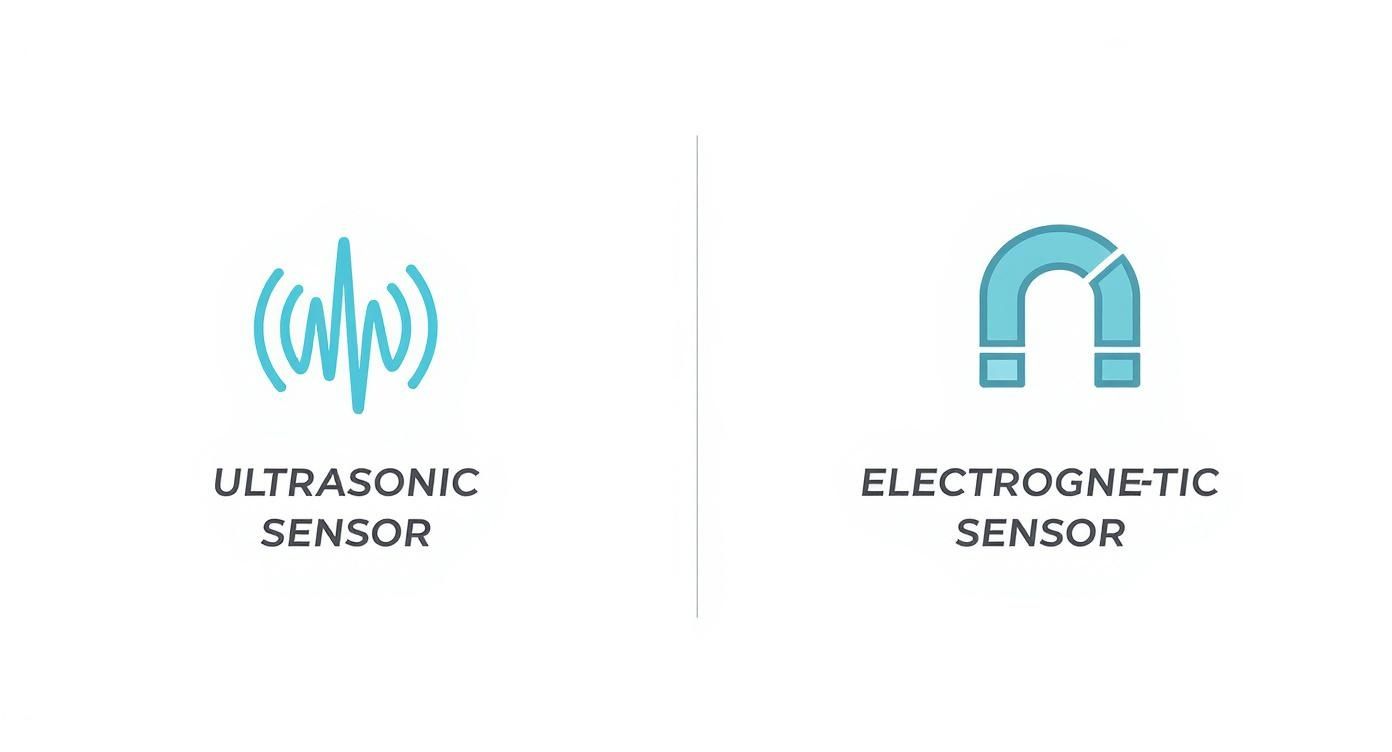
As you can see, ultrasonic sensors rely on individual detection points, while electromagnetic systems cast a continuous detection field across the bumper.
To help you decide which technology is the right fit, here's a quick breakdown of how they stack up against each other in the real world.
Feature Comparison of Leading Sensor Technologies
| Feature | Ultrasonic Sensors | Electromagnetic Sensors |
|---|---|---|
| Installation | Requires drilling holes in the bumper for a factory look. | No drilling needed; an adhesive antenna strip mounts inside the bumper. |
| Detection Pattern | Creates distinct detection zones around each sensor. | Forms a continuous, even detection field across the bumper's length. |
| Blind Spots | Can have small blind spots between individual sensors. | No blind spots, offering seamless coverage. |
| Object Detection | Excellent at detecting solid, large objects like walls and poles. | Better at detecting smaller, thinner objects like narrow posts or shrubs. |
| Weather Impact | Can be affected by heavy rain, snow, or mud buildup on sensors. | Less affected by weather conditions since the strip is protected. |
| Appearance | Visible on the bumper, but can be painted to match the vehicle color. | Completely invisible, preserving the vehicle's original look. |
Ultimately, ultrasonic sensors are the industry standard for their reliability with solid objects, while electromagnetic sensors offer a stealthy, drill-free installation with more uniform coverage.
H3 Detection Range and Sensor Angle
A sensor's reach is critical. The detection range tells you how far away it can spot an obstacle. For a compact car, a 5-6 foot range is usually plenty. But if you're driving a long-bed truck or a big SUV, you’ll want a system that can see things from 8 feet away or more.
Just as important is the sensor angle. A wider angle provides better coverage at the corners of your vehicle, helping you avoid scraping a pillar in a parking garage. You're looking for a sweet spot: long-range detection in the middle sensors and wide-angle coverage on the outer ones. If you need a specific configuration, checking out a quality collection of bumper sensors will help you find the right specs for your ride.
A sensor system's true value is revealed in its reliability. Look for kits with an IP (Ingress Protection) rating of at least IP67. This ensures the sensors are completely sealed against dust and can handle being submerged in water—a must-have for all-weather driving.
H3 Sensitivity and Weather Resistance
Finally, think about where you park every day. If you're constantly near bushes or live in an area with heavy snow, you might want a system with adjustable sensitivity. This handy feature lets you dial down the responsiveness to avoid false alarms from non-threatening objects like heavy rain or blowing leaves.
Weather resistance is absolutely non-negotiable. The sensors live on the outside of your vehicle, exposed to everything from blistering sun to freezing ice. Look for kits made from durable, UV-resistant materials that won't get brittle or fade over time. A solid IP rating is your best guarantee that the system is built to last.
Matching a Sensor Kit to Your Driving Needs
There’s no such thing as a one-size-fits-all "best" aftermarket parking sensor. The right system for a tiny city car will be completely wrong for a full-size truck, and the perfect setup for a DIY enthusiast might not suit someone who wants professional installation. The best choice really comes down to your vehicle, your daily driving environment, and what you need the sensors to do.
Think about your most common parking headaches. By matching a kit's features to those specific problems, you can find a solution that genuinely makes your life easier. Let's break down a few common driver profiles to see which systems make the most sense.
For the Urban Commuter
Navigating tight city streets and squeezing into parallel parking spots is a game of inches. When you’re constantly dealing with tight quarters, you need a sensor system that delivers dead-on, instant feedback. There's just no room for error.
For this kind of precision work, a high-quality ultrasonic sensor kit with at least four sensors is your best bet. This setup excels at detecting the exact distance to a specific point, like another car’s bumper or a high curb. Look for models that offer both audible alerts and a visual display showing the distance in real-time. That combination of hearing and seeing the feedback removes all the guesswork and stress from those tight maneuvers.
For the SUV or Truck Owner
When you’re behind the wheel of a large SUV, truck, or van, the challenges are completely different. You’re wrestling with massive blind spots and trying to accurately judge distances over a much longer vehicle. The tiny sensors designed for a compact sedan simply won’t cut it.
If this sounds like you, your priority should be a system with an extended detection range—look for something that can pick up obstacles from 8 feet or more. This gives you a much earlier warning, which is crucial when you have a lot of vehicle to manage. Durability is also a big deal, so seek out kits with a high IP rating (IP67 or higher) to make sure they can handle being blasted with mud, rain, and road debris. For complete peace of mind, a front-and-rear system is a wise investment, helping you spot low-lying objects that are totally invisible from the driver’s seat.
Your main goal is to effectively shrink your vehicle's massive footprint. A rugged, long-range sensor system acts as an extension of your own awareness, making it safer to handle everything from packed mall parking lots to tight job sites.
For the DIYer on a Budget
Looking for a simple, affordable upgrade you can tackle yourself in an afternoon? An electromagnetic sensor kit is a fantastic option. The biggest draw for this technology is that it gets rid of the most nerve-wracking part of the installation: drilling holes in your bumper.
Instead of individual sensors, this system uses an adhesive antenna strip that you mount discreetly on the inside of the bumper. This keeps your car's factory look intact and makes the whole process much faster. While it might not provide the pinpoint distance measurements of an ultrasonic system, it creates a continuous detection field that leaves no blind spots, which is great for catching skinny poles or stray branches. For anyone who wants a solid safety boost without breaking the bank or committing to a complex project, it’s a smart, practical choice.
What to Expect from the Installation Process
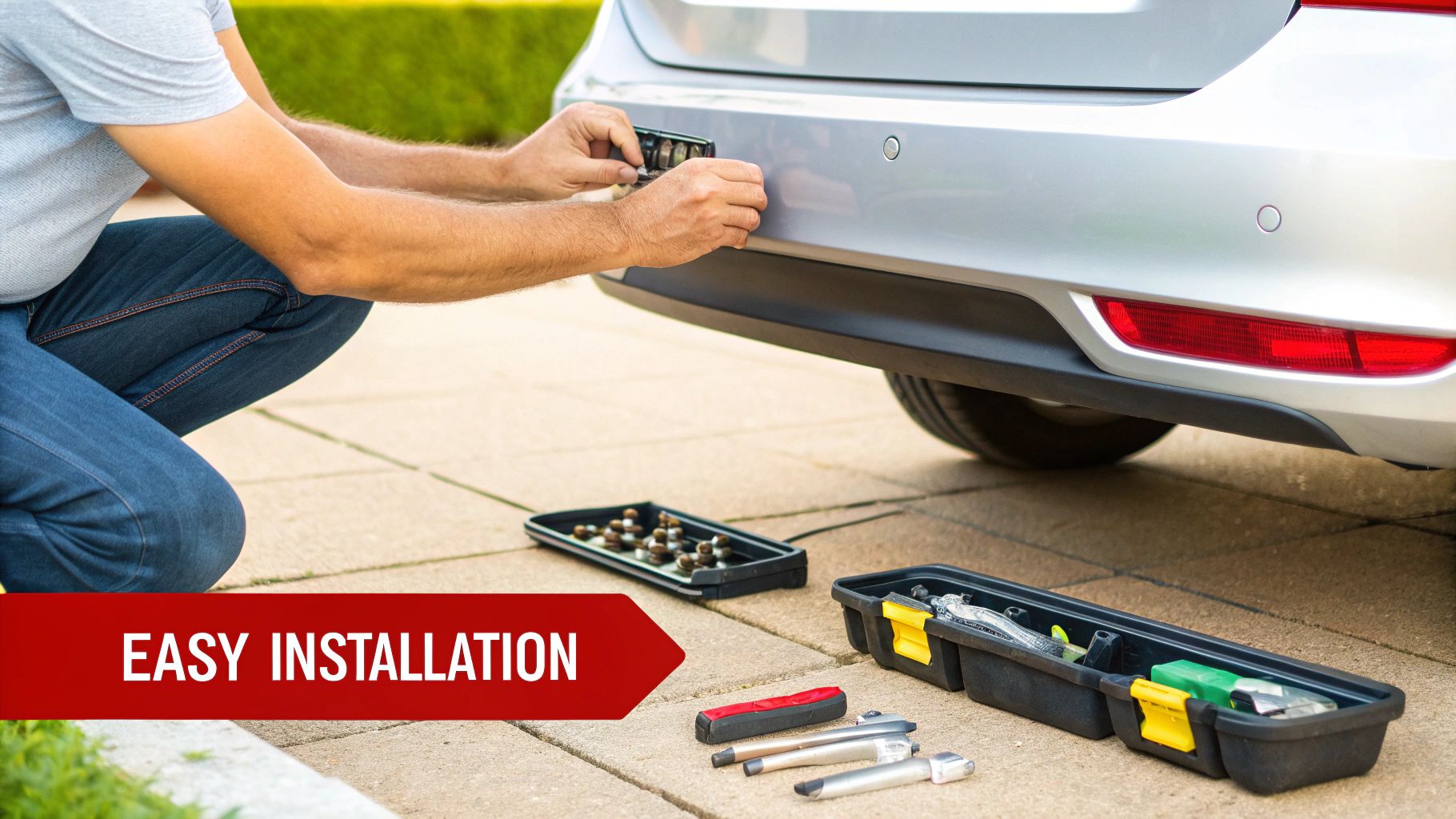
The idea of installing aftermarket parking sensors can feel a bit daunting, but in reality, it's often more straightforward than you might expect. The real question is how hands-on you want to get, as the complexity depends entirely on the type of kit you choose: a traditional drilled ultrasonic setup or a drill-free electromagnetic strip.
For most folks, the decision really comes down to one thing: are you comfortable drilling holes into your car's bumper? That one step is the biggest difference between the two most popular aftermarket options.
Installing Drilled Ultrasonic Kits
Ultrasonic sensors are the classic choice, giving you that clean, factory-installed look. But, as the name implies, they do require drilling. The job starts with carefully measuring and marking the sensor locations on your bumper to ensure you get full, even coverage.
The good news is that most kits come with a specialized hole saw drill bit perfectly sized for the sensors, which takes a lot of the guesswork out of this critical step.
Once the holes are made, you simply push the sensors into place. The wires are then routed discreetly along the inside of the bumper and connected to a central control box, which is usually stashed away inside the trunk.
The final piece of the puzzle is power. You'll almost always tap into your car’s reverse light circuit. This is a smart setup—when you shift into reverse, the lights come on, and your sensor system powers up right along with them. Getting this connection right is crucial, so if you're a bit shaky on wiring, understanding your vehicle's electrical system is a great starting point.
A successful installation all comes down to precise placement. If the sensors are angled incorrectly or spaced poorly, you can end up with blind spots or frustrating false alerts. My advice? Measure twice, drill once. Taking your time here pays off big time in performance.
Installing No-Drill Electromagnetic Strips
If drilling into your bumper is a hard no, then an electromagnetic sensor strip is your answer. The installation is far less invasive. The whole process involves removing the bumper cover, giving the inner surface a good cleaning, and sticking the antenna strip along its length.
Because the strip is completely hidden inside the bumper, there’s no drilling, and you don't have to worry about paint matching. The wiring is just like the ultrasonic kits—you connect the strip to a control unit and tap into the reverse light for power. This makes it a fantastic option for leased cars or for anyone who wants to keep their vehicle's body completely original.
Want a more detailed breakdown of the steps for both systems? Our complete guide on how to install parking sensors offers a full walkthrough. It’ll help you see exactly what’s involved and decide if it's a weekend project you're ready to take on.
Your Top Parking Sensor Questions Answered
Even with all the specs and features laid out, you probably have a few more practical questions floating around. That’s completely normal. Let's tackle some of the most common things people ask before they pull the trigger on a new parking sensor kit.
Getting these final details sorted out is what makes the difference between a good purchase and a great one. We’ll cover everything from getting the look right to making sure the system works with your specific vehicle.
Can Aftermarket Parking Sensors Be Painted to Match My Car?
Absolutely. Most ultrasonic sensors are designed with this in mind, so you can get that perfect, from-the-factory look.
But here’s the trick: the paint job has to be done right. You need to apply very thin, even coats. If you lay the paint on too thick, it can muffle the high-frequency sound waves the sensors use to see obstacles, making them unreliable or completely useless. Electromagnetic strips, on the other hand, are a different story—they install inside the bumper, so they're totally invisible and don't need any paint at all.
Will These Sensors Work on a Metal Bumper?
This is a big one, and the answer really depends on the type of sensor you're looking at. For traditional ultrasonic sensors that you drill into the bumper, a metal bumper is usually no problem. Just make sure you use a drill bit that’s made for cutting through metal. The material itself won't interfere with how the sensor works.
However, electromagnetic strip sensors are a hard no for metal bumpers. The metal messes with the electromagnetic field the strip generates, causing it to give false readings or not detect anything at all. If your truck or classic car has chrome or steel bumpers, a drill-in ultrasonic kit is your only reliable choice.
It's easy to assume that aftermarket parts are always a downgrade from what the factory installs. The truth is, a quality aftermarket kit installed with care can perform just as well as—and sometimes even better than—an OEM system. The real game-changer is the quality of the installation.
Do I Need Both Front and Rear Parking Sensors?
For most drivers in regular cars, a rear-only system is all you'll ever need. It covers the biggest blind spot and helps you nail those tricky reverse parking jobs. It’s the simplest, most cost-effective way to avoid common backup bumps.
That said, if you're behind the wheel of something big—a truck with a long hood, a large SUV, or a van—a front and rear system is a smart investment. It gives you a complete picture of your surroundings, which is a lifesaver when pulling into a tight garage, navigating a crowded parking lot, or inching forward in a drive-thru. It’s all about total situational awareness.
How Accurate Are Aftermarket Parking Sensors?
A top-tier aftermarket kit can be every bit as accurate as what comes standard on a new car. The two things that really matter are the quality of the sensors themselves and, just as importantly, how precisely they are installed.
When you buy a kit from a reputable brand and take the time to measure out the sensor placement and secure all the wiring, you’ll get reliable, accurate distance alerts. The difference between a system that works and one that works flawlessly often comes down to that extra 15 minutes spent on a careful installation.
At T1A Auto, we live and breathe premium aftermarket parts that are built to last and guaranteed to fit. Our bumper sensors are engineered to deliver OEM-level performance without the dealership price tag, giving you the confidence to park anywhere. Explore our parts and find the perfect fit for your vehicle.
