


When you're trying to find the best place to buy car parts online, it's not about finding one single "perfect" website. It's about finding a retailer you can trust—one that guarantees the part will fit, proves its quality, and has your back with real support. Think of it less like a store and more like a reliable partner for your repair projects.
Why Your Next Car Part Will Probably Come From an Online Store
The days of driving to the local auto shop, hoping they have your specific part on a dusty shelf, are pretty much over. The internet has completely changed the game for how both DIYers and professional mechanics get their hands on components. This isn't just a passing trend; it's a permanent shift, and for good reason.
Shopping online gives you access to a massive selection that no physical store could ever hope to stock. Instead of being stuck with whatever brands your local guy carries, you can browse a huge inventory from countless manufacturers. That means you can find the exact part you need, whether it’s a common replacement or a hard-to-find component for an older truck.
The Power of Convenience and Competitive Pricing
Beyond the sheer variety, the convenience is what really seals the deal. You can order a new window regulator from your garage at 10 PM on a Tuesday and have it show up right at your door. No more wasting gas driving around town or sitting on hold. This kind of access puts you in control of your own repair schedule.
The online auto parts market has absolutely exploded, becoming the go-to resource for anyone looking for reliable components. In the U.S. alone, online sales are projected to hit a staggering $5.7 billion in 2024. That number says it all—people are voting with their wallets, and online retailers are now a dominant force. For a deep dive into this growth, the full report from IBISWorld is worth a read.
This fierce competition also drives prices down. Online retailers usually have lower overhead than brick-and-mortar shops, and those savings get passed on to you. With just a few clicks, you can compare prices from multiple sellers and make sure you’re getting a fair deal.
Before we dive into the nitty-gritty of what to look for, here's a quick cheat sheet. Think of this table as your pre-flight checklist before you commit to a purchase.
Quick Guide to Choosing an Online Parts Retailer
| Evaluation Criterion | Why It Matters for Your Repair | What to Look For |
|---|---|---|
| Compatibility Tools | Avoids the frustration of ordering a part that doesn't fit. | Accurate year/make/model lookup, VIN search, clear fitment notes. |
| Quality & Certifications | Ensures the part is durable, safe, and performs like the original. | Details on materials, manufacturing processes, and seals like CAPA or NSF. |
| Materials & Warranties | Gives you peace of mind that your investment is protected. | Clear warranty terms, lifetime options, and hassle-free return policies. |
| Shipping & Returns | Gets you the part quickly and makes it easy to fix mistakes. | Fast shipping options, transparent costs, and a simple return process. |
| Customer Support | Provides a lifeline when you have questions or run into issues. | Accessible phone, email, or chat support with knowledgeable staff. |
| Pricing & Availability | Lets you get the best value without waiting weeks for a part. | Competitive pricing, price-matching policies, and real-time stock info. |
| Installation Resources | Helps you finish the job correctly, especially for DIY repairs. | How-to guides, video tutorials, and detailed product instructions. |
Keeping these points in mind will help you sift through the options and find a retailer that truly delivers on its promises, making your entire repair process smoother from start to finish.
The Anatomy of a Top-Notch Online Parts Retailer
Shopping for car parts online can feel like a total crapshoot. You're faced with a wall of options, and it’s tough to tell the quality suppliers from the digital junk drawers. So, what really separates the best from the rest?
It all boils down to a handful of core principles. Think of them as your personal seven-point inspection for any website you’re considering buying from. Once you know what to look for, you can dodge the common headaches—like getting a part that doesn't fit or one that breaks a month later—and find a reliable go-to source every single time.
1. Fitment Tools That Actually Work
Let's be honest: nothing is more infuriating than getting a part, jacking up the car, and then realizing it’s the wrong one. The absolute first thing a great online store has to nail is guaranteeing the part will fit your specific vehicle.
This is about more than a basic year, make, and model search. A truly reliable system will dig deeper.
- Detailed Vehicle Specifics: It should ask for things like your engine size, trim level, or drivetrain (2WD vs. 4WD) to pinpoint the exact component you need.
- VIN Search: The Vehicle Identification Number (VIN) is your car’s unique DNA. A VIN lookup is the most foolproof method for confirming a perfect match.
- Clear Fitment Notes: The best retailers add helpful notes, like "for models built after 06/2015" or "only for vehicles with the tow package," which eliminates all the guesswork.
If a site doesn't have these robust tools, you're essentially rolling the dice. Trustworthy stores invest a ton of resources into their catalog data to make sure what you see is what you need.
2. Proof of Quality: Certifications and Materials
Okay, so the part fits. The next big question is, will it last? The aftermarket is a wild west of varying quality, so you need to know what you're buying. This is where materials and certifications come into play.
A huge seal of approval to look for is the CAPA (Certified Automotive Parts Association) certification. CAPA is a non-profit that independently tests aftermarket parts to make sure they fit, perform, and hold up just as well as the original factory parts. For bodywork and collision repairs, insurance companies often demand CAPA-certified parts because they meet strict safety and quality standards.
When a retailer proudly displays the CAPA seal on their products, it’s a massive green flag. It tells you they’re not just peddling the cheapest stuff they can find; they're committed to selling parts that have been independently verified to perform.
Beyond that, look at what the parts are actually made of. Many original components, like interior door handles or window regulator clips, are notoriously made from cheap plastic that gets brittle and breaks. Smart aftermarket companies, like T1A Auto, often re-engineer these failure-prone parts using upgraded metal components. This simple switch from plastic to metal in a high-stress part is one of the best durability upgrades you can make.
3. Warranties That Show True Confidence
A warranty isn't just a piece of paper; it's a direct signal of how much a company believes in its own products. A short or fuzzy warranty is a major red flag. You want to see clear, simple terms that have your back.
You'll generally see two kinds:
- Limited Warranty: This is the standard, covering defects in the part for a set period, like one year.
- Lifetime Warranty: This is the gold standard, especially for those parts made with upgraded materials. It’s a promise to stand by the product for as long as you own your car.
A lifetime warranty shows the seller is betting on the part's long-term durability. Just make sure to read the fine print so you know exactly what’s covered and how the replacement process works.
4. Shipping and Returns That Don’t Waste Your Time
A great price on a part doesn't mean much if it takes two weeks to show up or if returning it is a complete nightmare. Smooth, efficient logistics are the backbone of any good online store. Honestly, getting shipping right is so critical that entire guides on courier service comparison for ecommerce success exist just to help businesses nail this down.
Here's what to look for:
- Transparent Shipping Costs: No one likes getting hit with surprise fees at checkout. Clear flat-rate shipping or free shipping offers are a good sign.
- Fast Turnaround: The best retailers get orders out the door within one business day.
- A Hassle-Free Return Policy: A clear, simple return process is non-negotiable. A 90-day return window gives you plenty of time to get the part and make sure it’s right without feeling pressured.
The entire auto parts industry is moving online, fast. The global automotive aftermarket eCommerce market is on track to hit a staggering $113.3 billion by 2025. This shift is happening because people are getting comfortable with handy digital tools, making quick shipping and easy returns more critical than ever. You can read more on these trends in this Tire Review report.
5. Customer Support From Actual Humans
When you hit a snag, you need to talk to a real person who knows what they're talking about—not an unhelpful chatbot or an endless phone menu.
Top-tier customer support means:
- Multiple Ways to Reach Out: Phone, email, and live chat should all be easy to find.
- Knowledgeable Staff: The person on the other end should be able to answer technical questions about the parts, not just track your package.
- Responsiveness: A commitment to solving your problem quickly, like within 24 hours, shows they respect your time and business.
6. Helpful Resources and Genuine Reviews
Finally, the best online retailers do more than just sell you a part; they empower you to get the job done right. They provide the resources you need to make a smart purchase and nail the installation.
Look for sites that feature verified customer reviews right on the product pages. This gives you unfiltered, real-world feedback on how the part actually performs.
Even better are retailers that offer installation help—things like detailed how-to guides, video tutorials, or step-by-step instructions. This is a huge bonus for any DIYer and shows the company is truly invested in your success, not just making a quick sale. This kind of all-around support is the final piece of the puzzle that separates a good parts supplier from a great one.
Matching the Store to Your Specific Repair Needs
Let's be honest: the idea of a single “best place to buy car parts online” is a bit of a myth. The right store for a weekend warrior tackling a brake job on the family sedan is worlds away from what a professional body shop needs to keep its bays full and turning a profit. The real key is matching a retailer’s strengths to your specific goals for the repair.
Think of it like picking the right tool. You wouldn't grab a sledgehammer for delicate trim work, right? In the same way, your priorities as a buyer—whether you’re looking for peace of mind, raw speed, or long-term durability—should guide you to the online store that’s a perfect match for you.
You can cut through the noise by following a clear path that puts quality, warranty, and fitment front and center.
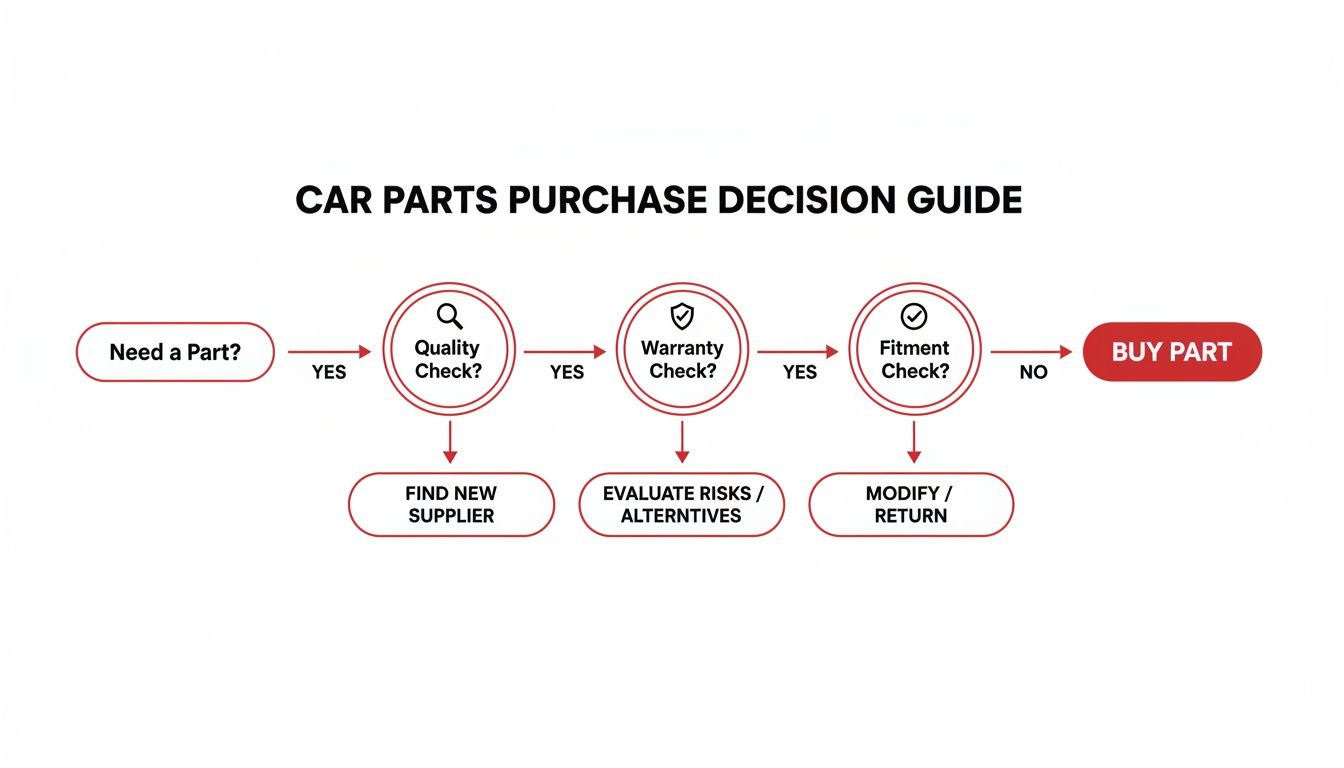
This flowchart lays out a simple but powerful sequence for checking out any part. It ensures you’ve covered the most critical bases before you click "buy."
For the DIY Enthusiast
If you're the one in the garage on a Saturday morning with grease on your hands, you’re not just buying a part. You’re buying a successful repair experience from start to finish. Your time is valuable, and nothing is more frustrating than having to do a job twice because of a bad part.
Your checklist should be all about features that build confidence and take the guesswork out of the equation.
- Guaranteed Fitment: Look for stores with really solid vehicle lookup tools, especially those that let you search by VIN. A perfect fit is everything.
- Lifetime Warranties: For any part that sees a lot of action, a lifetime warranty is your ultimate safety net. It’s a clear signal that the company is willing to stand behind its product for as long as you own your car.
- Clear Installation Resources: Access to how-to guides, video tutorials, and detailed instructions can be the difference between a tough job and a totally manageable one.
The DIY community is built on empowerment. A retailer that gives you not just the component but also the knowledge to install it correctly becomes more than a supplier—it becomes a trusted partner in your project.
For the Professional Mechanic or Body Shop
When repairs are your livelihood, the whole game changes. Time is literally money. Every minute a car sits on a lift waiting for a part is a direct hit to your bottom line. Professionals need a parts supplier that operates at the speed of their business.
For mechanics and collision centers, the focus has to be on efficiency, verifiable quality, and rock-solid reliability. You can dive deeper into the different types of parts available in our guide on the differences between OEM and aftermarket components.
Your priority list should look a lot like this:
- Rapid and Reliable Shipping: Same-day or next-day shipping options are essential. They minimize bay downtime and keep your entire workflow moving smoothly.
- CAPA Certifications: This is a big one for body shops. Using CAPA-certified parts is often a requirement for insurance work because it guarantees OEM-level fit, finish, and safety standards.
- Dedicated B2B Support: Having a dedicated support line or an account manager who gets the needs of a professional shop is a huge advantage. It can speed up ordering and make resolving any issues painless.
For the Fleet Manager
Managing a fleet of commercial vehicles is a constant balancing act between maintenance costs and operational uptime. Your main concern is the total cost of ownership over the life of your vehicles. A cheap part that fails early ends up costing you far more in lost revenue and labor than a quality component ever would.
Fleet managers need a supplier that supports the long-term health of their operation.
- Proven Durability: Zero in on parts made with upgraded materials, like metal replacements for plastic originals that are known to fail. These beefier components cut down on how often you have to make the same repair.
- Access to Bulk Pricing: The ability to get discounts on bulk orders for common high-wear parts is crucial for keeping your budget in check.
- Comprehensive Warranties: Look for warranties that cover parts put through the heavy-duty use typical of commercial vehicles. This ensures your investment is protected across the entire fleet.
Buyer Priority Checklist Online Parts Store
While every criterion is important, your role dictates which ones you should weigh most heavily. This table breaks down how different buyers might prioritize their search for the perfect online parts store.
| Criterion | DIY Owner Priority | Body Shop Priority | Fleet Manager Priority |
|---|---|---|---|
| Compatibility Tools | High: Non-negotiable for a first-time fit. | Medium: Experienced, but tools speed up verification. | Medium: Crucial for managing diverse vehicles. |
| Quality & Certifications | Medium: Good quality is key, but certifications less so. | High: CAPA certifications are often required. | High: Proven quality means less vehicle downtime. |
| Materials & Warranties | High: Lifetime warranties offer ultimate peace of mind. | Medium: Warranty must be easy to process and fast. | High: Durability and long-term guarantees are critical. |
| Shipping & Returns | Medium: Fast is good, but a clear return policy is key. | High: Next-day shipping is vital to shop workflow. | High: Reliable delivery schedules are essential. |
| Customer Support | High: Access to help is vital for troubleshooting. | High: B2B support for fast, professional-level help. | Medium: Needs support for bulk orders and logistics. |
| Pricing & Availability | High: Value is a major factor for personal budgets. | Medium: Competitive pricing is important, but speed is king. | High: Total cost of ownership and bulk pricing are key. |
| Installation Resources | High: Guides and videos empower successful repairs. | Low: Pros typically have their own resources. | Low: In-house technicians handle installations. |
Ultimately, understanding your own needs is the first step. Once you know what matters most—whether it's getting back on the road by Saturday afternoon or keeping a fleet of 50 trucks running smoothly—you can easily spot the retailer that’s built to help you succeed.
It’s one thing to talk about the theory of what makes a good online parts store, but it’s another to see it in action. So, let's put the principles we’ve discussed under the microscope and see how a real-world company, T1A Auto, actually stacks up.
This isn’t just a feature list. It’s a practical look at how a company focused on the core needs of truck and car owners builds a better, more reliable buying experience. By doing this, T1A Auto offers a solid benchmark for what you should expect when you're looking for the best place to buy car parts online.
Getting the Fit Right, The First Time
The absolute first hurdle any online parts store has to clear is guaranteeing the part you order will actually fit your vehicle. This is non-negotiable. T1A Auto gets this, and their vehicle-specific search is your first line of defense against getting the wrong part.
You simply plug in your year, make, and model, and it filters the entire catalog down to only the components engineered for your specific truck or car. Whether you're working on a Ford F-150, a Chevy Silverado, or a Toyota Tacoma, it takes the guesswork out of the equation. This simple step prevents that sinking feeling of opening a box on a Saturday morning only to realize you have to repackage it and send it back.
A Focus on Durability and Quality You Can Verify
In the aftermarket world, "quality" can be a vague term. It needs to be proven. T1A Auto backs up its claims in two important ways: by offering CAPA-certified parts and by actively re-engineering parts that are known to fail.
For body shops or anyone serious about safety, that CAPA seal of approval is a big deal. When you see a CAPA certification on T1A Auto parts like rearview cameras, it means they’ve been through exhaustive third-party testing to ensure they perform just as well as the original factory part. This is critical for maintaining your vehicle’s safety systems.
But they go a step further by focusing on real-world durability upgrades.
- Upgraded Metal Components: They’ve identified common failure points—like those flimsy plastic interior door handles or window regulator clips—and offer replacements made from much stronger metal.
- Lifetime Warranty: They stand behind these beefed-up components with a lifetime warranty on their metal-upgraded parts. That's a serious vote of confidence in their longevity.
This approach is all about solving common frustrations, turning what could be a recurring headache into a one-and-done repair.
Policies That Don't Punish You for Being Human
A good retailer builds its policies around the customer, removing risk and making the whole process easier. T1A Auto’s shipping and return setup is refreshingly straightforward, designed so you aren't penalized for a simple mistake or a change of plans.
They offer a free 90-day return policy, giving you a generous window to make sure the part is right without feeling the pressure of a ticking clock. For busy mechanics and DIYers whose project timelines can shift, that kind of flexibility is a lifesaver.
The global auto parts market hit $545.31 billion in 2024 and is on track to reach $909.62 billion by 2033. Online sales are a huge part of that, growing at a blistering 10.2% rate as people increasingly buy high-wear items like steering and suspension parts online. This shift shows why specialized online retailers are winning. By offering customer-first policies like free 90-day returns and detailed product education, they're earning the trust of truck owners and repair shops. You can dig into more of the numbers in the full Market Data Forecast report.
This simple, fair approach shows a fundamental respect for your time and money.
Real Support and Resources to Get the Job Done
Finally, a great parts supplier does more than just move boxes. They give you the support and knowledge you need to successfully finish your project. T1A Auto makes sure help is easy to find, aiming to answer customer support questions within 24 hours. When you're stuck on a technical question or have an issue with an order, that kind of responsiveness is invaluable.
The company also provides genuinely useful educational resources. Their blog is full of practical guides on everything from understanding CAPA standards to installation tips for common parts. When you combine that with the verified customer reviews on every product page, you get an environment where you can buy with confidence and feel ready to tackle the repair yourself.
From the fitment tools to the lifetime warranty on upgraded parts, T1A Auto's entire model is a living, breathing example of the principles we've covered. It’s how a retailer earns trust—by focusing squarely on quality, durability, and the real-world needs of its customers.
Common Mistakes to Avoid When Shopping for Parts Online
Knowing what to look for when you're hunting for the best place to buy car parts online is only half the battle. Just as crucial is knowing which common mistakes to sidestep. Falling into these traps can turn a simple fix into a frustrating, time-sucking ordeal that ends up costing you more.
Think of it as navigating a minefield. The path to a successful purchase is clear, but one wrong step can lead to trouble. By understanding these pitfalls, you can protect your wallet, your time, and your sanity, making sure every online parts purchase is a smart one.
Ignoring Shipping and Return Policies
It's so easy to get fixated on the price tag and slam that "buy" button. But this is one of the most common—and costly—mistakes you can make. A rigid return policy or painfully slow, expensive shipping can vaporize any savings you thought you were getting.
Imagine this: you order a part, but it shows up damaged, or it's just the wrong one for your car. If the retailer has a tiny 14-day return window and slaps you with a 20% restocking fee, you're already out money and time. Always hunt for sellers with clear, customer-friendly policies, like free returns for at least 30 to 90 days.
Chasing Unbelievably Low Prices
Everyone loves a bargain, but some deals are genuinely too good to be true. An unusually low price is often a massive red flag for a counterfeit or junk-quality part. These knock-offs might look identical to the real deal, but they’re often built with shoddy materials that just can’t hold up under normal use.
That super-cheap aftermarket door handle might feel like a win, but it’s no bargain when it snaps off in your hand a month later. Now you’re right back where you started, but you're out the cost of the part and your time.
Reputable sellers price their parts competitively but realistically. The price reflects quality materials, proper testing, and a solid warranty. A price that wildly undercuts the market isn't a discount—it's a warning.
Overlooking Material Quality and Durability
The material a part is made from is everything. A lot of original factory parts are engineered with materials that are just good enough to outlast the vehicle’s warranty. This is especially true for small plastic bits in high-wear areas like window regulators or door latches.
One of the biggest wins of buying aftermarket is the chance to find parts that are actually better than the original. The best sellers will re-engineer these failure-prone components using more robust materials—like swapping out that brittle plastic for reinforced metal.
- Plastic vs. Metal: Always check if a metal, upgraded version of a notoriously fragile plastic part is available. It’s a small investment for a massive upgrade in durability.
- Finish and Fit: Scour the customer reviews for photos to see how the part actually looks and fits when installed. Low-quality parts often have rough finishes or dimensions that are just slightly off, turning installation into a total headache.
Choosing a part based on superior materials is one of the smartest moves you can make to ensure your repair lasts. Skipping this step is basically signing up to do the same repair all over again down the road. Keep these common errors in mind, and you'll be able to shop with confidence.
Your Questions Answered About Buying Car Parts Online
Even when you have a solid plan, you're bound to have questions when hunting for the best place to buy car parts online. Let's tackle some of the most common ones head-on. Getting these answers straight will give you the confidence to shop smart and skip the headaches.
Think of this as your personal FAQ. We've distilled the core advice from earlier into practical answers for the questions we hear most from car owners and professional mechanics.
How Can I Be 100 Percent Sure a Part Fits My Vehicle?
This is the big one, and for good reason. The most reliable way to guarantee a perfect fit is to buy from a retailer whose website has a robust, multi-layered vehicle lookup tool. A simple year, make, and model search is a decent starting point, but it's rarely enough to be certain.
For that peace of mind, you need to look for a couple of key features:
- VIN (Vehicle Identification Number) Search: Your car’s VIN is its unique DNA. A store that lets you search by VIN is linking you directly to the precise parts made for your exact vehicle, not just a general model.
- Detailed Fitment Notes: The best retailers will add critical details like "For models with a tow package" or "Fits vehicles built after 08/2019." These notes clear up the ambiguity that often leads to ordering the wrong part.
If a site lacks these deeper search options, your odds of getting a part that doesn't fit go way up.
Are Aftermarket Parts as Good as OEM?
It’s a classic debate, and the answer isn't a simple yes or no. The truth is, a high-quality aftermarket part can be just as good—and sometimes even better—than an OEM (Original Equipment Manufacturer) one. Many original parts are designed to meet a specific budget for the assembly line, not necessarily to last a lifetime.
The real secret is to look for evidence of quality. A great aftermarket part from a reputable brand that's been re-engineered with stronger materials—like swapping a flimsy plastic gear for a sturdy metal one—is a genuine upgrade over the original.
This is where a retailer's focus on durability really shows. By identifying and fixing known weak points in OEM designs, the aftermarket can deliver parts that truly last longer.
What Does CAPA Certified Mean and Why Does It Matter?
CAPA stands for the Certified Automotive Parts Association. It's an independent, non-profit watchdog that puts aftermarket collision parts (think bumpers, headlights, and cameras) through a battery of intense tests. Their goal is to ensure these parts meet or exceed the standards set by the original car manufacturer.
Think of the CAPA seal as an unbiased stamp of approval. It tells you the part has been verified for:
- Fit and Finish: It will line up perfectly with your vehicle's body panels, no weird gaps.
- Material Quality: It’s made from materials that are just as strong and durable as the factory part.
- Performance and Safety: It works exactly as it should and won’t compromise your vehicle's safety features.
For any body shop or safety-conscious owner, insisting on a CAPA-certified part is a must for a professional-grade repair. You can learn more about what separates good parts from bad by reading a few auto parts reviews and comparisons.
What Is a Reasonable Warranty for an Aftermarket Part?
A warranty says a lot about how much a company believes in its own products. For most standard aftermarket parts, a one-year warranty is a common baseline. But when you’re looking at parts that have been specifically upgraded for durability, you should expect more.
A lifetime warranty is the gold standard, especially for components that have been re-engineered with tougher metal parts. It shows the manufacturer is willing to stand behind their product for as long as you own your car. A clear, long-term warranty is one of the best signs you're buying a high-quality part from a seller you can trust.
At T1A Auto, we focus on providing durable, high-quality parts with guaranteed fitment, backed by lifetime warranties on our upgraded metal components and a free 90-day return policy to ensure you shop with complete confidence. https://t1aauto.com