


Trying to figure out where to buy car parts can feel like navigating a maze. You've got dealerships, countless online stores, and local shops all vying for your attention. The truth is, the best place to buy car parts really boils down to what you value most.
Are you after the guaranteed quality that comes straight from the manufacturer? Or maybe you're looking for the best possible value from an online specialist? Sometimes, you just need a part right now from a local store. Getting a handle on these trade-offs is the key to making a smart buy every single time.
How to Find the Right Car Parts
Staring at a wall of options can be intimidating, but picking the right supplier is easier than it looks. I like to think of it like grocery shopping. You can go to a high-end organic market for premium, brand-name ingredients (that’s your dealership). Or you could head to a massive supermarket with a huge selection and great deals (think online retailers). Then there’s the corner store you run to when you realize you’re out of milk and need it immediately (the local parts store). Each one has its place.
This guide will be your map. We'll break down all the common places to source parts, giving you a clear picture of what to expect from each.
Your Main Options at a Glance
To get started, let's simplify things with a quick side-by-side look. The table below cuts right to the chase, laying out the good and the bad of your main options.
Quick Guide to Car Part Sources
| Part Source | Best For | Pros | Cons |
|---|---|---|---|
| Dealership | Guaranteed OEM quality and perfect fitment, especially for complex or newer vehicles. | 100% compatibility, highest quality materials, expert staff. | Highest price point, limited to one brand. |
| Specialty Online Retailer | DIY owners and shops seeking high-value aftermarket parts with strong warranties. | Excellent pricing, broad selection, guaranteed fitment tools, direct shipping. | Potential for shipping delays, cannot inspect part before purchase. |
| Local Auto Parts Store | Urgent repairs where you need a common part immediately. | Immediate availability, helpful in-person advice, easy returns. | Higher prices than online, selection limited to store inventory. |
| Salvage Yard | Finding rare or discontinued parts for older vehicles at a low cost. | Extremely low prices, access to hard-to-find components. | No warranty, used condition, requires effort to find and remove parts. |
This table gives you the high-level view, but the real story is in the details. While dealerships offer the peace of mind that comes with Original Equipment Manufacturer (OEM) parts, the aftermarket world provides a fantastic, cost-effective alternative. If you want to get into the nitty-gritty, you can learn more about the differences between OEM vs aftermarket parts in our complete guide.
Specialized online retailers, in particular, have really changed the game. They directly tackle old fears about poor fitment and spotty quality by offering things like robust fitment guarantees, lifetime warranties, and even parts engineered to be better than the original. This opens up a whole new way to get reliable components without the dealership markup, putting you in the driver's seat of your next repair.
Comparing Your Options for Buying Car Parts
Sourcing car parts isn't a one-size-fits-all game. Just like you wouldn't buy a custom suit from a bulk warehouse, the best place to find what you need depends entirely on what you're working on. Is it a quick weekend fix? A professional restoration? Are you prioritizing a perfect factory match, or is budget your bottom line?
Let's walk through the six main places you can get parts, exploring the personality and purpose behind each one.
This quick decision tree can help get you started, clarifying whether a new or used part is the right call for your specific situation.
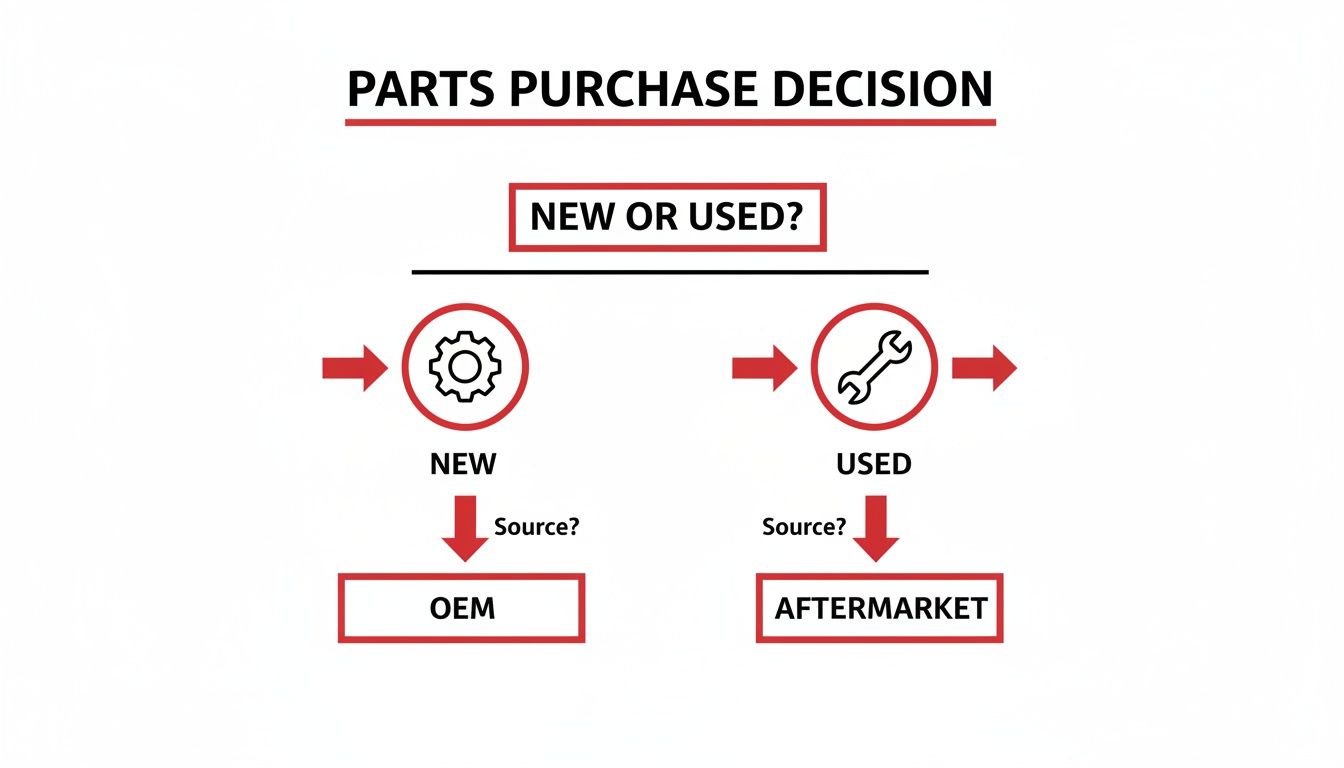
That first choice—new or used—points you toward either OEM/aftermarket suppliers or salvage yards, setting the stage for the rest of your search.
The Dealership: Original Equipment Manufacturer Parts
Think of your car's dealership as the official brand boutique. When you buy from them, you're getting an Original Equipment Manufacturer (OEM) part. This is the exact same component that was bolted onto your car at the factory, guaranteeing a perfect fit and preserving the vehicle's original engineering.
For sensitive electronics or crucial safety systems on newer cars, the dealership is often the safest—and sometimes only—option. But that precision comes with a hefty price tag. You're paying for the brand name, the R&D, and the peace of mind that comes with a flawless match, making it the most expensive route you can take.
Specialty Online Retailers: The Modern Sweet Spot
Specialty online retailers have become the expert curators of the aftermarket world. Their entire business is built on providing high-quality parts that meet or even beat OEM standards, but at a much more reasonable cost. A good one, like T1A Auto, directly tackles the biggest headaches of online parts shopping: questionable quality and the fear of getting something that doesn't fit.
Here’s how they do it:
- Guaranteed Fitment Tools: You plug in your vehicle's year, make, and model, and you can shop confidently, knowing every part you see is engineered for your specific car or truck.
- Strong Warranties: Many offer lifetime warranties on durable parts, a vote of confidence in their own quality that often goes beyond what even the dealership offers.
- Engineered Improvements: Top-tier aftermarket brands often spot and fix original design flaws, like swapping out a failure-prone plastic piece for a sturdier metal version.
This approach has completely changed the game. Online retailers are now the dominant force in the industry, projected to grab 54.2% of the retail distribution channel in a global automotive aftermarket valued at over $489 billion. That explosive growth is all thanks to the convenience of finding the exact part for a Toyota Tundra or GMC Sierra and having it arrive at your door, backed by real customer support.
Online Marketplaces: A Vast and Varied Universe
Places like Amazon and eBay are the massive superstores of the parts world. You can find almost anything here, from genuine OEM parts sold by dealership storefronts to the absolute cheapest aftermarket knock-offs imaginable. The selection is practically infinite.
That vastness, however, is a double-edged sword. Quality is all over the map, and it’s frighteningly easy to get duped by a counterfeit or low-grade part if you aren't careful. You have to become the quality control expert, diligently vetting sellers, scrutinizing reviews, and triple-checking return policies. While there are bargains to be had, the risk of getting a dud is significantly higher.
Key Takeaway: The crucial first decision when buying car parts is choosing between OEM and aftermarket. Understanding the key differences between OEM and aftermarket parts is the key to making a smart choice that balances quality, cost, and compatibility.
Local Auto Parts Stores: Immediate Gratification
Your local auto parts store is the neighborhood emergency room for your car. When your starter dies on a Saturday morning and you have to get the car running by the afternoon, this is your destination. Their biggest selling point is immediate availability. You can walk in, talk to a real person, and walk out with the part in hand.
Of course, that convenience has its trade-offs. Their inventory is limited to what they can physically fit on the shelves, so you might be out of luck for less common parts. Prices are also usually higher than online because they have to cover the overhead of a brick-and-mortar shop. But for common items you need right now—like brake pads, oil filters, or a battery—they’re unbeatable. If you're looking for more specific information on this topic, check out our guide on the best online auto parts retailer.
Salvage Yards: The Treasure Hunt
A trip to the salvage yard, or junkyard, is a genuine treasure hunt. These lots are filled with end-of-life vehicles, giving you a shot at finding used OEM parts for pennies on the dollar. For anyone trying to keep an older or discontinued model on the road, this might be the only place to find that specific piece of interior trim or a matching body panel.
Just know that it takes work. You often have to find the donor car yourself and pull the part with your own tools. There are zero guarantees on quality or how long the part will last; everything is sold as-is. It’s a calculated risk. But for non-critical components or for classic car restorers on a tight budget, the savings can be well worth the effort.
Wholesale Suppliers: The Bulk Advantage
Wholesale suppliers are the quiet giants working behind the scenes, keeping professional repair garages, fleet managers, and body shops stocked. Their entire business is built on volume, so they offer deep discounts for buying in bulk. They are the go-to source for any business that burns through common maintenance items like filters, fluids, and brake pads.
For the average weekend mechanic, getting access to wholesale pricing is tough, since most require a business license and have minimum order quantities. But if you’re an independent mechanic or you manage a fleet of vehicles, building a relationship with a good wholesaler is a critical part of controlling costs and keeping your bays running smoothly. Their world is all about efficiency and professional-grade reliability.
What to Look for in a Car Parts Supplier
Knowing where you can buy parts is one thing. Knowing how to tell the good suppliers from the bad is the real skill. Think of it like hiring a contractor to work on your house—you wouldn't just pick the cheapest one without checking their reputation, looking at past work, and seeing if they guarantee their repairs.
A great supplier doesn’t just move boxes; they sell you confidence. This means looking past the price tag to see the total value you’re getting. From how well a part is guaranteed to fit, to the warranty that backs it up, these are the details that separate the pros from the pretenders. Let's walk through the checklist I use to evaluate any supplier.
Price and Overall Value
Price is always part of the conversation, but it's never the whole story. The cheapest part you can find often becomes the most expensive one when it fails a few months down the road, forcing you to do the entire job all over again.
Instead of hunting for the rock-bottom price, I always focus on overall value. This is the sweet spot where cost meets quality, durability, and a supplier who stands behind their product. A $30 plastic door handle that snaps in six months is a terrible deal compared to a $50 upgraded metal handle with a lifetime warranty. That extra $20 buys you peace of mind and saves you from a future Saturday spent fixing the same problem.
Fitment Guarantee and Accuracy
There’s no worse feeling than spending hours taking your car apart only to find the new part doesn't quite line up. It's frustrating and a massive waste of time. This is exactly why a fitment guarantee is one of the most important things to look for.
The best online stores have tools that let you punch in your vehicle’s Year, Make, and Model to show you only the parts that are confirmed to fit. A solid guarantee is their promise: if you use our tool and the part doesn't fit, we’ll make it right with a simple, free return. This takes all the guesswork out of buying online and shows the company is serious about getting you the right part the first time.
Warranty and Product Confidence
You can tell a lot about a part by the warranty it comes with. A warranty is a direct measure of the manufacturer's confidence in what they're selling. A basic 90-day warranty might be fine for a simple clip, but it’s a red flag for a part that does real work.
On the other hand, a lifetime warranty on something like a window regulator or a door handle tells you that the part was built to last with better materials and engineering.
A strong warranty isn't just a policy; it's a statement about quality. It tells you the company has invested in better materials and manufacturing and is willing to stand behind that investment for the life of the part.
Before buying, it's always a good idea to see what other people are saying. Checking out different auto parts reviews gives you a real-world look at how a supplier's parts actually perform over the long haul.
Quality Certifications Like CAPA
For certain parts, especially anything related to collision repair, you should look for third-party certifications. The gold standard here is CAPA (Certified Automotive Parts Association). CAPA is an independent organization that acts like a watchdog, putting aftermarket parts through a battery of tests to make sure they're just as good as the original.
They check for three key things:
- Fit: Does it line up perfectly with the car’s body panels and mounting points?
- Performance: Does it function exactly as it’s supposed to?
- Durability: Is it built from quality materials that will hold up to wear and tear?
When you see that CAPA seal on a bumper, fender, or mirror, you know it has passed those tests. For body shops, using CAPA-certified parts is often a requirement from insurance companies. For the rest of us, it’s a trusted shortcut to knowing you're getting a safe, reliable component.
Shipping and Return Policies
A supplier's shipping and return policies say a lot about how they treat their customers. Look for clear, fair rules. Free shipping, even if you have to meet a minimum order, can make a big difference in the final cost. Fast processing is just as important—when your car is out of commission, you need that part now, not next week.
A hassle-free return policy is just as crucial. Let's be honest, mistakes happen. Maybe you ordered a part for the wrong trim level, or maybe you misdiagnosed the problem entirely. A good supplier gets that. A flexible return window (like 90 days) and a simple process for sending things back show that the company cares more about your experience than just the sale.
Customer Support and Accessibility
Finally, think about what happens when you need help. Can you get a real person on the phone? When you run into an installation snag or have a question about your order, great customer support can make all the difference.
Look for suppliers that offer multiple ways to get in touch—phone, email, or live chat. A company that invests in a knowledgeable support team is a company that's invested in your success.
A Foolproof Method for Ordering the Right Part
We’ve all been there. You're halfway through a repair, covered in grease, and then you realize the new part doesn't fit. That moment kills your momentum, wastes a perfectly good afternoon, and sends you right back to square one. The good news? It’s completely avoidable if you have a solid pre-purchase checklist.
Think of it like a pre-flight inspection for your car repair. A few simple, systematic steps can take all the guesswork out of the equation, so you can order with confidence, knowing the right part is on its way.
Start with Your Vehicle Identification Number
Your Vehicle Identification Number (VIN) is your car’s unique fingerprint. Seriously. That 17-character code tells you everything—the exact manufacturing date, the engine it came with, the specific trim package, and more. It’s the single most reliable piece of information for guaranteeing you get a part that fits.
You can usually find the VIN in a few common spots:
- On a small metal plate on the driver's side dashboard, right at the base of the windshield.
- On a sticker inside the driver’s side doorjamb.
- Printed on your vehicle’s registration and insurance cards.
Plugging in your VIN cuts through all the noise of different sub-models, mid-year production changes, and optional packages. It ensures you’re looking at parts made specifically for your car.
Use Fitment Tools and Cross-Reference Part Numbers
With your VIN in hand, it’s time to put it to work. Any decent online parts store will have a fitment tool where you can enter your VIN (or at least your year, make, and model). This instantly filters out everything that won’t fit your vehicle, saving you a ton of time.
For an extra layer of certainty, go find the OEM part number on the old part you're replacing. It's often stamped, engraved, or printed right on the component. Cross-referencing this number with the one in the online product listing is a bulletproof way to confirm you’ve found an exact match.
This level of detail is crucial in the massive global automotive aftermarket. The industry is valued at an eye-watering USD 860.08 billion, and North America holds the biggest piece of the pie with a 35.05% market share. This mature market is what allows DIYers and pros alike to find high-quality components, fueling the demand for reliable replacements like CAPA-certified cameras or upgraded metal door handles that fix common OEM weak points. You can dig deeper into the numbers in the Precedence Research aftermarket automotive parts report.
The Final Visual Inspection
Even when all the numbers line up, don’t skip a final visual check. Technology is great, but your own eyes can often spot a subtle difference a database might have missed.
Never click "buy" without visually comparing the new part to the old one. High-quality product photos from multiple angles are a non-negotiable feature of a trustworthy online supplier. Check mounting points, connector shapes, and overall dimensions.
Pay attention to the little things. For instance, a side mirror for a Toyota Tacoma might look identical at first glance, but the electrical connector could be totally different between a base model and a TRD Pro. These are the small variations a visual check is designed to catch, saving you from a massive installation headache later.
Finally, take a minute to read recent customer reviews for the specific part you’re buying. Other owners are usually quick to point out fitment issues or installation quirks they ran into. A quick scan of these comments can be your last line of defense, offering real-world feedback that ensures you get it right the first time.
Finding the Best Supplier for Your Needs
Not everyone is looking for the same thing when they shop for car parts. A weekend warrior tackling their first brake job has a completely different checklist than a fleet manager trying to keep a dozen trucks on the road. The best place to buy parts isn't a one-size-fits-all answer; it's about finding a supplier that gets what you're trying to accomplish.
Think of it like picking the right tool for the job. You wouldn't use a sledgehammer for delicate trim work, right? In the same way, the best parts source for you depends entirely on whether you're a DIY enthusiast, a professional mechanic, a body shop tech, or a fleet manager. Let's dig into what each role really needs.
For the DIY Enthusiast
If you're the one under the hood on a Saturday, your priorities are usually pretty clear: great value, a guaranteed fit, and help when you need it. You want a part that works without breaking the bank and the peace of mind that it will bolt on without any headaches.
This is exactly where specialty online retailers really come through. They offer the affordability of the aftermarket world but wrap it in tools and policies that take the guesswork out of ordering online.
Your ideal supplier should offer:
- Clear Fitment Tools: A simple way to enter your Year, Make, and Model to see only the parts confirmed to fit your ride.
- Strong Warranties: Look for lifetime warranties, especially on high-wear items like door handles or window regulators. It’s a huge indicator of quality.
- Real Human Support: When you hit a snag, having a responsive team you can actually call or email is a lifesaver.
For a DIYer, it's all about maximum confidence and minimum hassle. A supplier who guarantees the fit and backs it up with a solid warranty lets you focus on the repair, not on whether you ordered the right part.
For Professional Mechanics and Shop Owners
When you're a professional mechanic, the whole equation changes. Cost matters, of course, but reliability is everything. A failed part isn't just a do-over—it's an angry customer, a clogged service bay, and a ding to your reputation. Your name is on every job, so you need suppliers you can absolutely count on.
Pro-grade suppliers focus on:
- Durability and Longevity: They source parts built to meet or exceed OEM specs, often with common-sense upgrades like replacing flimsy plastic gears with metal ones.
- Ironclad Warranties: A great warranty protects both you and your customer, proving the manufacturer is willing to stand behind their product's performance.
- Supplier Reliability: Fast shipping and knowing the part is in stock are non-negotiable. You need a partner who gets you the right stuff, right away, to keep the shop humming.
For Body Shops and Collision Repair Centers
Body shops live in a world of precision and paperwork. Insurance companies often call the shots on which parts are approved for a repair, making third-party validation a must. The number one priority is finding parts that meet strict industry standards for fit, finish, and safety.
This is where CAPA certification is king. A CAPA-certified part has been independently tested to ensure it performs identically to its OEM counterpart, a critical requirement for most insurance jobs. Body shops need suppliers with a deep inventory of these certified parts, from bumpers to side mirrors, to stay compliant and deliver flawless results.
For Fleet and Commercial Vehicle Managers
Fleet managers are laser-focused on one thing: total cost of ownership. Every single hour a vehicle is down for repairs is an hour it's not making money. The goal is to find parts that last as long as possible and minimize maintenance, even if they cost a little more upfront.
Fleet buyers need suppliers who can deliver:
- Heavy-Duty Components: Parts specifically engineered for the high-stress, high-use environment of commercial vehicles.
- Cost-Effectiveness at Scale: Access to bulk purchasing options and competitive pricing to keep operational budgets in check.
- Long-Term Reliability: A focus on parts with proven durability to cut down on surprise breakdowns and keep the fleet rolling.
As the global auto parts market grows, sourcing these durable components from around the world is becoming standard practice. The Asia-Pacific region, for instance, is a major hotspot, projected to see the fastest growth in the massive USD 909.62 billion global market. This growth is fueled by huge vehicle production numbers and a constant demand for high-wear replacements, making it a key area for finding quality aftermarket parts. You can dive deeper into the numbers with this Market Data Forecast global auto parts market report.
Got Questions? We've Got Answers
Even with a roadmap in hand, you might still have a few questions lingering. Let's tackle the most common ones we hear from DIYers and pros alike, so you can make your final choice with total confidence.
Are Aftermarket Parts Really as Good as OEM?
This is the big one, and the honest answer is: it depends. The aftermarket world is a spectrum. On one end, you have basic, budget-friendly replacements designed to just get the job done. But on the other, you have premium brands that actually engineer their parts to outperform the original.
It’s not uncommon for a top-tier aftermarket manufacturer to spot a known weakness in an OEM part—say, a plastic gear that always fails—and upgrade it to a more robust metal component. A high-quality aftermarket part can absolutely deliver equal, or even better, performance and durability. The trick is knowing what to look for: solid customer reviews, a strong warranty, and third-party certifications are your best friends here.
What’s the Deal with CAPA Certification?
Think of CAPA (Certified Automotive Parts Association) as an independent, unbiased referee for collision parts. When you see that CAPA seal on a part, it means it has been put through the wringer—rigorously tested to ensure it fits, works, and holds up just like the original factory part it’s meant to replace.
This certification is a huge deal for body shops, as many insurance companies flat-out require CAPA-certified parts for repairs they'll cover. For everyone else, it’s a simple, trustworthy stamp of approval that guarantees safety and quality for things like bumpers, headlights, and mirrors. It takes the guesswork out of the equation.
How Do I Know an Online Part Will Actually Fit My Car?
Nothing’s worse than getting a part, popping the hood, and realizing it’s not right. To avoid that headache, use a multi-step check before you click "buy."
- Start Broad: First, plug your vehicle's Year, Make, and Model into the seller’s fitment tool. This is your initial filter.
- Get Specific with Your VIN: The most foolproof method is using your Vehicle Identification Number (VIN) to find the exact OEM part number you need. It’s like using a fingerprint instead of a general description.
- Do a Visual Match-Up: Don't skip this. Pull up the product photos and compare them side-by-side with your old part. Pay close attention to details like mounting points, hose connections, and electrical plugs.
Of course, the best online stores remove the risk entirely by offering a fitment guarantee and a no-fuss return policy if something does go wrong.
Is It Cheaper to Buy Parts Online or From a Local Store?
More often than not, buying online is going to save you some serious cash. Online sellers don't have the massive overhead of a physical storefront, and they pass those savings directly to you. It's common to find aftermarket parts online for 30-50% less than the equivalent OEM part at a dealership.
Plus, once you order, you can track your package's progress right to your door. Understanding what is a tracking number and how to use it gives you peace of mind. When you combine the lower prices with a much, much wider selection, shopping online is a clear winner for most people.
At T1A Auto, our goal is to eliminate the hassle. We offer durable, high-quality aftermarket parts with a fitment guarantee you can count on. Whether it's our upgraded all-metal door handles or CAPA-certified side mirrors, every part is built to last and backed by a lifetime warranty and real-person customer support. Shop with confidence and get your vehicle back on the road by visiting https://t1aauto.com.
