


A single ignition coil replacement at a shop typically costs $150 to $400. On more complex engines, or when you're replacing a full set on a V6 or V8, the bill can climb past $700, which is why this repair surprises a lot of people.
That's usually the moment people start searching for coil pack price. The engine is stumbling at idle, the check engine light is on, and the car feels like it's trying to run on fewer cylinders than it has. You want one answer, but coil jobs don't price out like brake pads or a battery. Access matters. Parts quality matters. Whether you replace one coil or all of them matters even more.
The mistake I see most often is treating coil pack price like it's only a parts question. It isn't. The true number that matters is what it costs to fix the misfire once, fix it correctly, and avoid paying labor again because a cheap part failed early.
Your Check Engine Light Is On What Now
A rough idle and flashing or steady check engine light usually push this repair from “I'll get to it later” to “I need to handle this now.” When an ignition coil starts breaking down, the engine can misfire under load, stumble on acceleration, or shake at idle. Sometimes it feels minor. It rarely stays minor.
The first thing to understand is simple. A coil problem can be a small repair, or it can turn into a bigger bill fast depending on the engine layout and how many parts need to come off to reach the bad coil. That's why one owner gets a modest invoice and another gets a quote that feels out of proportion to the part itself.
What the first quote is really telling you
When a shop gives you a price, they're not just pricing a coil. They're pricing diagnosis, access, installation, and the chance that adjacent worn coils may not be far behind. On some engines, replacing one coil is straightforward. On others, half the labor is getting to it without breaking brittle plastic covers, connectors, or intake pieces.
Practical rule: If the engine is already apart to reach buried coils, think about total ownership cost, not just today's parts bill.
That matters most on higher-mileage vehicles, work trucks, and daily drivers that can't afford repeat downtime. If one rear-bank coil on a V6 is buried under intake hardware, the cheapest part isn't always the cheapest repair.
What to ask before approving the job
Use these questions to keep the estimate honest and useful:
- Ask what failed: Is the shop replacing a confirmed bad coil, or guessing based on symptoms?
- Ask about access: Is this a simple top-side job, or does the intake or other hardware need to come off?
- Ask about strategy: Does it make sense to replace one coil now, or a set because labor overlap is high?
- Ask about warranty: Part warranty matters, but labor warranty matters too if you're paying someone else to install it.
Most customers don't need to know every ignition theory detail. They need to know why the number changes so much from one vehicle to the next, and how to avoid spending twice.
Breaking Down the Total Replacement Cost
A customer sees a coil online for a modest price, then gets a repair quote that is two or three times higher. That gap usually comes down to labor, access, and the risk of paying for the same job twice if the replacement part does not last.
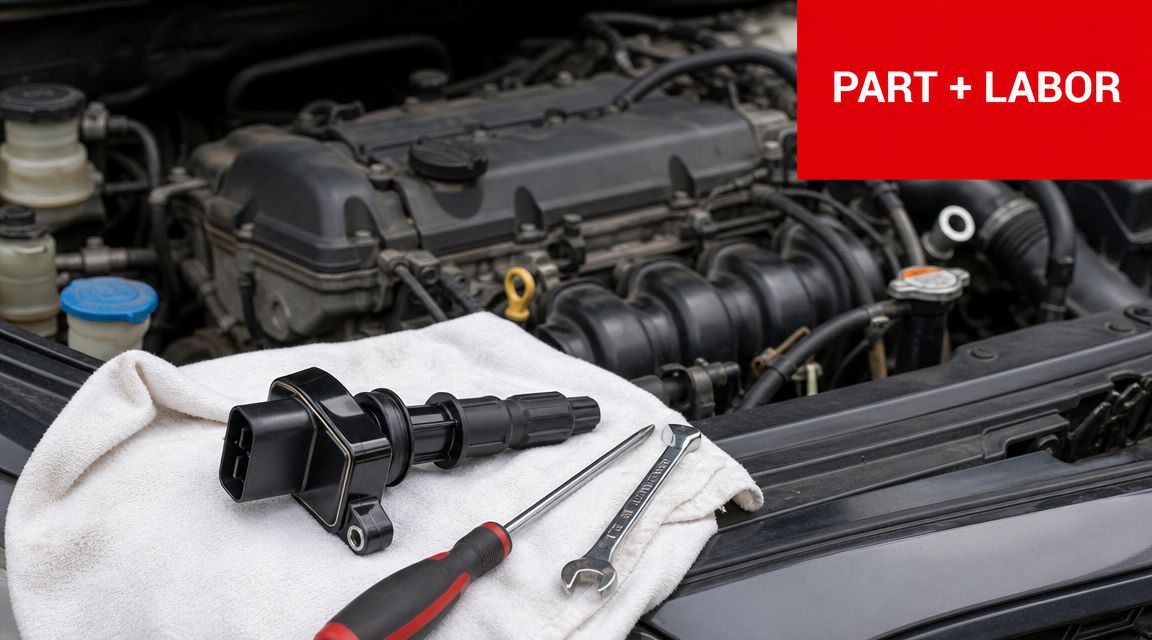
According to CarParts' ignition coil replacement cost breakdown, independent shops typically charge $150 to $400 for a single coil replacement, with national averages around $225 to $331. The same source reports that prices can start near $150 on simple four-cylinder engines, climb past $700 when multiple coils are difficult to reach, and range from about $300 to more than $1,700 for full-set replacements on some engines.
The invoice covers more than the coil
The part is only one line on the bill. The rest is the work required to confirm the fault, get to the coil, install it correctly, clear the misfire, and make sure the engine is fixed.
That matters a lot on engines with rear-bank coils tucked under intake hardware or tight plastic covers. A budget coil may save money at the counter, but it can cost more over time if it fails early and forces you to pay that labor again.
This is the total cost of ownership side of the repair.
Why the same repair can swing so much
Two vehicles can both need one ignition coil and still end up with very different totals.
| Situation | What usually changes the price |
|---|---|
| Easy access engine | Lower labor time and less disassembly |
| Buried rear bank coils | More teardown, more reassembly, higher labor cost |
| Full set replacement | More parts cost upfront, but labor overlap can make it the better long-term value |
| One coil only | Lower bill today, but higher chance of another labor charge if a matched old coil fails soon after |
On a simple inline-four, replacing one coil can be quick. On a transverse V6 or a packed engine bay, access is the job. That is why a cheap part does not always produce a cheap repair.
On hard-to-reach engines, part quality affects labor cost twice. Once on install, and again if the coil fails early.
That is where it makes sense to spend carefully, not blindly. A premium aftermarket coil with a strong warranty, including options from brands like T1A Auto, can be the cheaper choice over the life of the repair if it helps you avoid repeat downtime and repeat labor.
Key Factors That Drive Your Coil Pack Price
Coil pack price starts getting confusing fast because the same search term can point to three very different purchases. You might be looking at one replacement coil, a full set, or a specialty kit built for a specific engine.
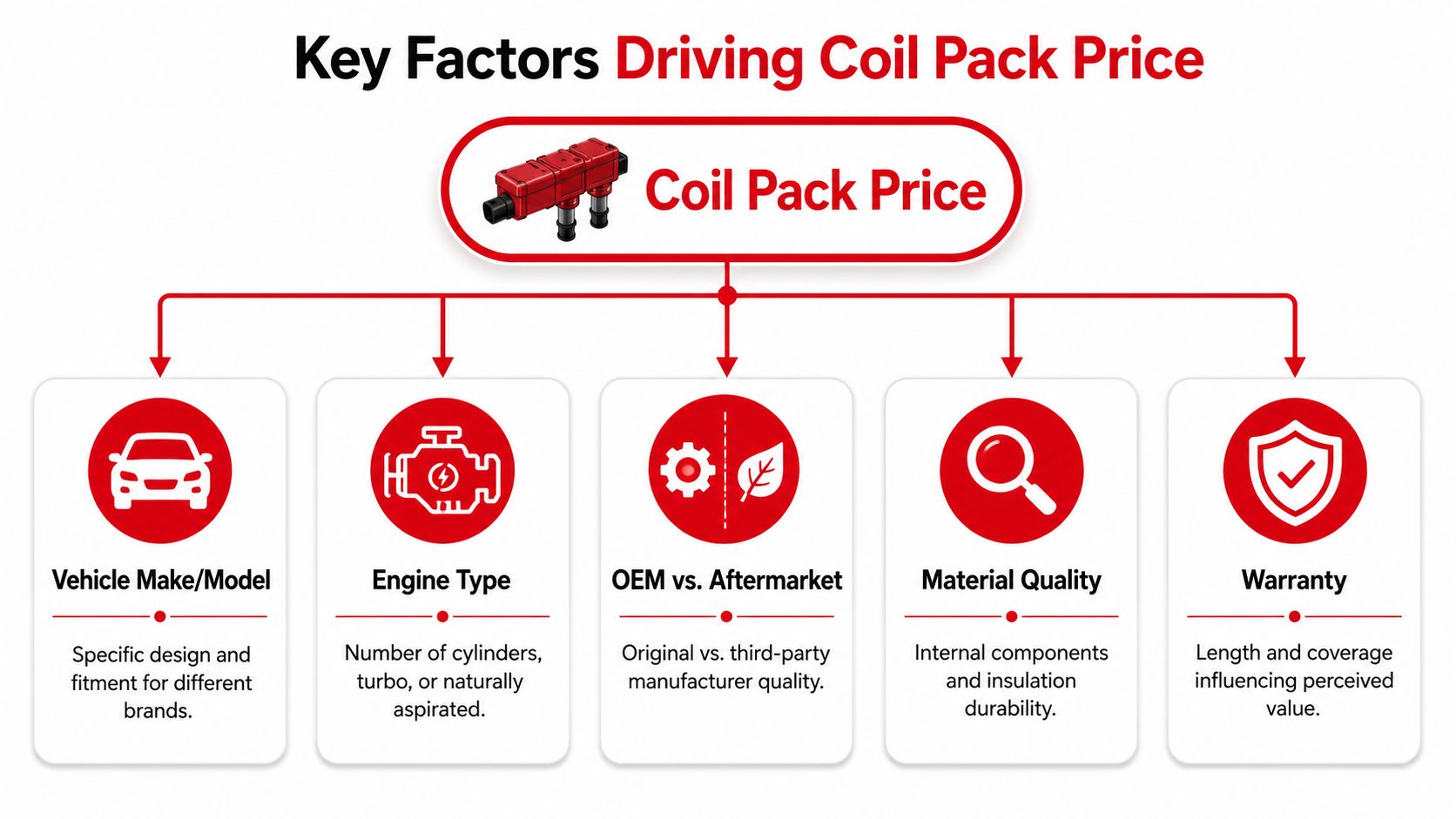
A good example comes from AutoZone's direct ignition coil kit listing. One mass-market 8-pack is listed at $79.99, while a performance-oriented 8-pack for the same V8 application shows an MSRP of $726.25 and a sale price of $610.05. That is a huge spread before labor even enters the conversation.
The question is not just what the box costs. The question is what you are buying, how long it is likely to last, and whether a failure means paying for the same job twice.
Application and fitment drive the number first
Common engines usually have more options. That keeps pricing competitive. Niche applications, luxury models, turbo engines, and performance setups often have fewer choices, tighter fitment requirements, and higher prices.
Catalog details matter here. Connector style, boot length, heat shielding, coil shape, and mounting design all affect whether the part fits and survives in service. A cheap coil that technically clicks into place but runs hot, fits loose, or misfires under load is not a bargain.
This is also where owners get tripped up on single-coil versus full-set pricing. A set can look cheap per coil and still be the wrong buy if the materials or fitment are poor. If you need help comparing part quality, this guide on aftermarket parts vs OEM gives the right framework.
Cylinder count changes the parts bill fast
Cylinder count affects cost in a simple way. More cylinders usually mean more coils if you are replacing the set.
That sounds basic, but it changes the repair math. Replacing one failed coil on a four-cylinder daily driver is usually manageable. Refreshing a full set on a V8 truck or SUV can turn into a serious parts bill, especially if the owner wants to avoid staggered failures over the next year.
Some appearance parts and accessories can also push pricing around in specialty builds. Owners dressing up an engine bay may add pieces like Rusted Rooster Fab's coil plates, but those are cosmetic costs, not ignition reliability upgrades.
What usually pushes coil prices up
Several factors move coil prices more than people expect:
- Vehicle application: Common commuter engines cost less to source than niche, luxury, or performance applications.
- Number of coils purchased: One coil, a matched set, and a specialty kit are priced differently.
- Brand tier: Budget replacement, premium aftermarket, and performance parts sit in very different price ranges.
- Included components: Some kits include boots, couplers, or other hardware that changes the overall value.
- Warranty and build quality: Better materials and a stronger warranty usually cost more up front, but they can cut repeat labor costs later.
That last point matters more than the sticker price suggests.
A bargain coil can make sense on an older beater that is near the end of its life and easy to work on. On a vehicle you plan to keep, or one with coils buried under covers, intake parts, or tight rear-bank access, premature failure gets expensive fast. Paying more for a premium aftermarket coil with proven fitment and warranty support, including options from brands like T1A Auto, can lower the total cost of ownership because you are buying a better chance of doing the job once.
Construction affects price for a reason
Price gaps are often tied to what is inside the part. Some coils are basic replacements. Others use better insulation, improved internal electronics, or application-specific hardware to handle heat and load more consistently.
That does not mean the most expensive coil is automatically the right one. It means the cheapest one needs more scrutiny. If the vehicle is a stock commuter with easy access, a solid mid-tier coil is often the smart buy. If labor is the expensive part of the job, cutting corners on the coil itself is where repair costs start coming back around.
OEM vs Aftermarket and Performance Coils
A customer comes in with a misfire, asks for the cheapest coil, and plans to keep the car another three years. That is where part choice stops being a simple price question. If the coil fails early, the second labor bill can wipe out any savings from the first invoice.
The practical differences
OEM is the baseline choice. Fitment is usually predictable, the calibration matches factory intent, and it is often the safest route for vehicles that are picky about ignition components. The downside is cost. Dealer pricing can push the total repair higher than it needs to be.
Premium aftermarket is often the best value on a stock vehicle you care about. The good ones are built for the application, carry decent warranty support, and cost less than OEM without turning the job into a gamble. If you want a plain-English breakdown of that decision, T1A Auto has a useful guide on aftermarket parts vs OEM.
Performance coils belong in a narrower lane. They fit modified engines, hard-use trucks, tuned applications, or owners who are solving a specific ignition problem under higher load. On a stock commuter, they often add cost without giving you a real return.
Why the price gap exists
The difference is usually inside the part. Better insulation, cleaner electronics, stronger boots, and tighter quality control all cost money. Premium coils can also be designed to manage heat and voltage demand more consistently, which matters because heat is one of the main reasons ignition parts die early.
That does not mean every expensive coil is worth it.
It means the part has to match the vehicle, the labor involved, and how long the owner plans to keep it. On an easy-access engine in an older car, a decent mid-tier coil can be a rational choice. On a V6 with a miserable rear bank, or any engine where you have to strip covers and intake pieces to get back in there, paying more for a coil with a strong warranty is often the cheaper repair over the life of the vehicle.
| Feature | OEM (Original Equipment) | Premium Aftermarket (e.g., T1A Auto) | Performance |
|---|---|---|---|
| Fitment approach | Factory-spec replacement | Vehicle-specific aftermarket replacement | Often tuned to enthusiast or modified applications |
| Typical buyer | Owner wanting factory-style parts | Owner balancing cost and repeat-repair risk | Enthusiast, tuner, performance truck owner |
| Main strength | Predictable compatibility | Lower total ownership cost if durability and warranty are strong | Specialized engineering and packaged upgrades |
| Main risk | Higher upfront cost | Quality varies by brand | Extra cost a stock daily driver usually will not use |
What actually works in the shop
For daily drivers, I usually judge coils by one question first. How expensive will it be if this one fails in 18 months?
If access is simple and the vehicle is near the end of its life, saving money up front can be reasonable. If access is tight, labor is high, or the owner wants to keep the vehicle, cheap coils are where false savings show up. A premium aftermarket option with good support, including lines from T1A Auto, often makes more sense because you are buying a better chance of doing the job once.
Owners already make that same call with fitment-specific parts elsewhere on the vehicle. Truck owners buying Rusted Rooster Fab's coil plates are not looking for a generic universal piece that almost fits. They want a part made for the application. Ignition coils deserve the same mindset.
DIY Replacement vs Professional Installation
Here, the biggest money can be saved. It's also where the most expensive mistakes happen.
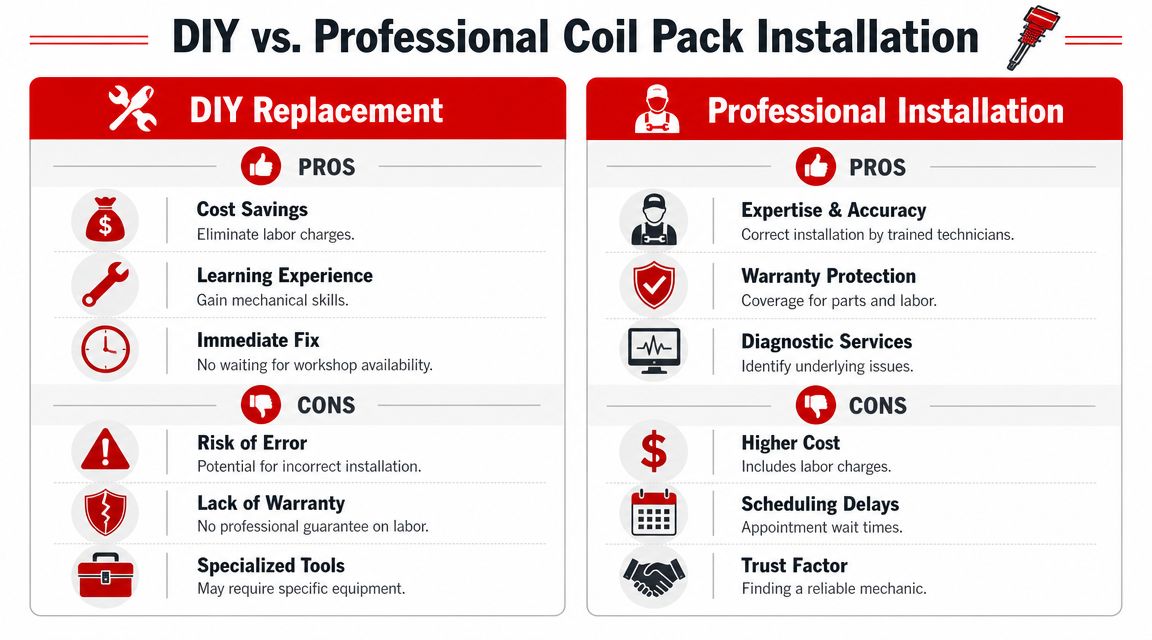
If your engine has easy access and you're replacing coils on a common vehicle, DIY can make a lot of sense. The parts side is attractive. The global ignition coil market was estimated at USD 15.50 billion in 2026 and is forecast to reach USD 21.24 billion by 2033, implying a 4.6% CAGR, according to Coherent Market Insights' ignition coil market report. The same report also lists aftermarket 4-pack examples at $60 to $110, which is why many owners look at a coil job and think, “I can do that myself.”
When DIY makes sense
A straightforward top-side coil replacement on a common four-cylinder or truck engine is often within reach for a careful owner with basic hand tools. If you can identify the correct cylinder, disconnect connectors cleanly, inspect boots, and reinstall everything without damaging brittle plastic, it's a solid DIY candidate.
For owners who like install guides before turning the first bolt, a detailed resource such as this ignition coil replacement walkthrough helps set expectations. It's the same reason people read a remote start system installation guide before tackling electrical work. The job goes better when you know what can go wrong before you start.
Here's a visual walkthrough if you want to see the process in context.
When to let a shop handle it
If the coils are buried, the diagnosis isn't certain, or the engine has a history of connector and harness issues, professional installation is usually cheaper in the long run. Misfire complaints aren't always just coils. Spark plugs, wiring, fuel issues, and vacuum leaks can point in the same direction.
- Choose DIY if: access is easy, the fault is clear, and you're comfortable working carefully.
- Choose a shop if: access is poor, diagnosis is shaky, or breaking something during teardown would cost more than labor.
- Choose quality parts either way: labor is the expensive part to repeat.
Paying a shop once with a durable part can cost less than doing the same repair twice with a cheap one.
Making the Smart Purchase A Buyer's Guide
The best coil pack price isn't always the lowest one. It's the one that fixes the misfire without sending you back into the same labor bill a few months later.
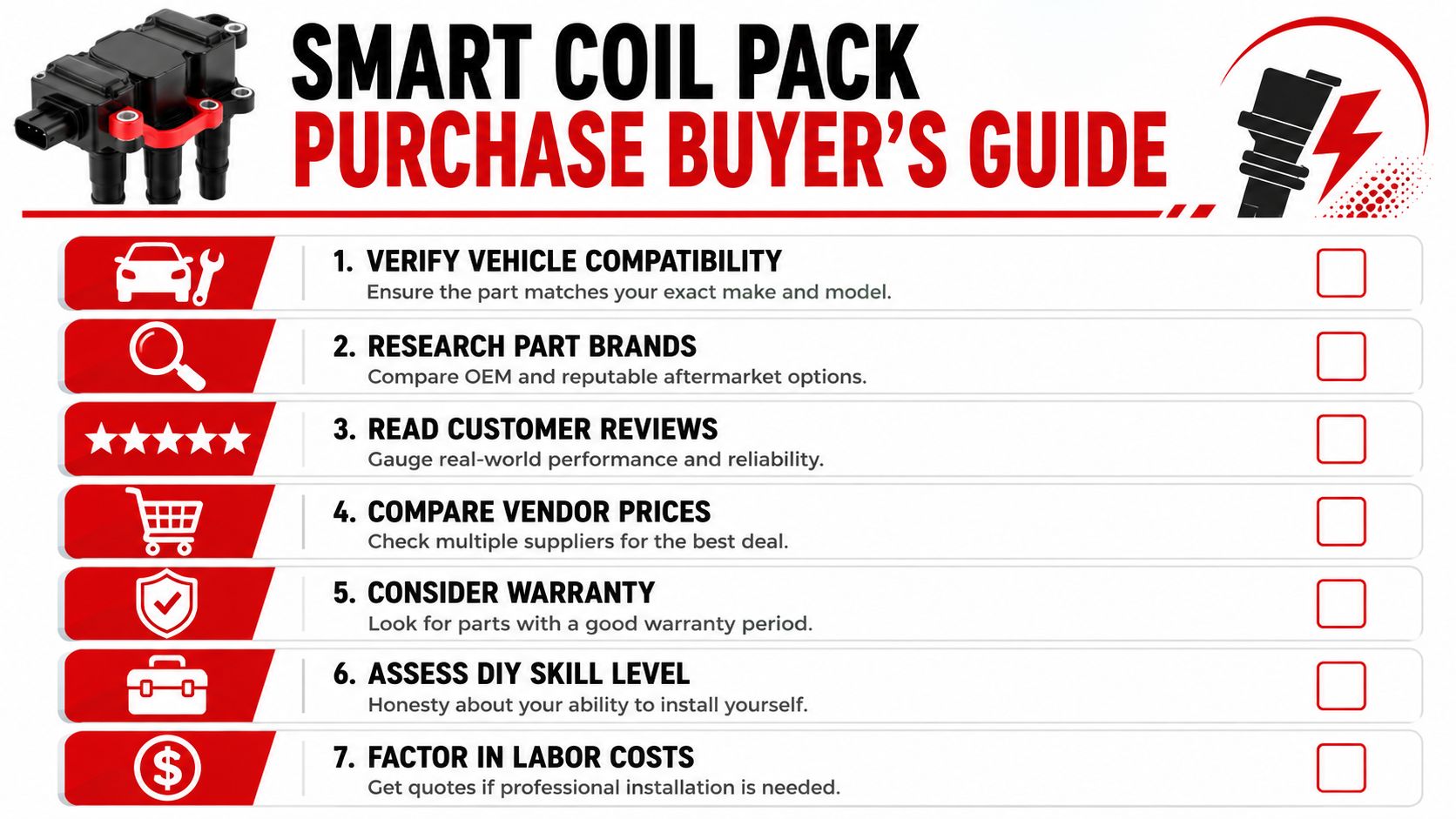
One pricing comparison from the available data sums this up well. Budget coils can run around $20 to $30 each, while premium coils may cost $80 to $150 each, but the better value for daily drivers, trucks, and fleet vehicles is often the part that reduces repeat labor exposure, as discussed in this coil value and durability discussion.
The short checklist that saves money
Before you buy, slow down and check these points:
- Verify exact fitment: Year, engine, and ignition setup have to match.
- Decide on one coil or a set: If access is difficult, set replacement can make more financial sense.
- Compare warranty with labor reality: A part warranty helps, but it doesn't always refund your install time or shop labor.
- Match the part to vehicle use: A stock commuter doesn't need race-oriented hardware. A hard-worked truck may benefit from a better-built replacement.
- Buy from a seller with clear fitment support: If you're shopping online, a catalog that lets you search by vehicle and compare options, like the guidance in T1A Auto's article on the best online auto parts retailer, makes mistakes less likely.
If I were advising a customer with a daily driver or work truck, I'd push them toward the repair that minimizes the chance of paying labor twice. That's the total cost of ownership view, and it usually leads to better decisions than chasing the cheapest coil on the page.
If you're replacing ignition coils and want vehicle-specific aftermarket options with clear fitment support, T1A Auto is one place to compare parts by vehicle and shop with warranty information in mind. That approach matters on coil jobs because the smartest buy usually isn't the cheapest box. It's the part that keeps you from doing the same labor again.
