


When your car door handle snaps, getting it fixed is probably top of your list. So, what's the damage going to be? Generally, you can expect the cost to replace a door handle on a car to land somewhere between $150 and $450 if you take it to a professional. That total covers both the new handle and the mechanic's time.
Your Quick Guide to Car Door Handle Replacement Costs
A broken door handle is one of those small problems that brings your day to a grinding halt. It’s a real pain. Figuring out the repair bill is the first step to getting things back to normal, but the final price isn't set in stone.
Think of the total cost as two main puzzle pieces: the price of the handle itself and the labor to get it installed. The size of those pieces can change a lot depending on your car and how you decide to handle the repair.
The Core Cost Factors
So, what really moves the needle on the final price? A few key things come into play:
- Vehicle Make and Model: It's no surprise that a simple, mechanical handle for a Honda Civic costs a fraction of a fancy, sensor-packed handle for a newer luxury vehicle or a Tesla.
- Handle Type: Are we talking about a basic exterior handle, a more involved interior one, or the handle on your tailgate? Each comes with its own price tag and installation quirks.
- Repair Method: This is the big one. Deciding whether to tackle the job yourself or hand the keys to a mechanic will have the biggest impact on your wallet.
This isn't just theory—recent repair data backs it up. For a common car like a Toyota Camry, the average replacement cost hovers around $250. That typically breaks down to about $80 for the part and $170 for a pro to install it. It just goes to show you that labor can easily be the most expensive part of the job. You can find more details on how car door repairs are priced over at Lemonade.
To help you get a better handle on what you might pay, let's break down how these variables can affect your estimate.
Quick Look at Car Door Handle Replacement Cost Factors
This table gives you a snapshot of how different choices can swing the final cost from a minor expense to a significant repair.
| Cost Factor | Low-End Estimate (e.g., Economy Car, DIY) | High-End Estimate (e.g., Luxury Car, Pro Install) |
|---|---|---|
| Parts Cost | $25 - $75 | $150 - $300+ |
| Labor Cost | $0 (Your time) | $120 - $250+ |
| Total Estimated Cost | $25 - $75 | $270 - $550+ |
As you can see, your car's badge and your willingness to get your hands dirty are the biggest drivers of the final price.
Decoding Your Repair Bill: Parts and Labor Explained
Ever glanced at a mechanic’s estimate and felt like you were trying to read a foreign language? You see the big number at the bottom, but the breakdown between parts and labor can leave you scratching your head. These two items are the building blocks of any repair bill, and getting a handle on them is the first step to understanding what you’re truly paying for.
The cost to replace a door handle on a car is a perfect example. It's a simple story of two key elements: the physical part you need and the expert hands required to install it. Let's pull back the curtain on each one.
The Part Itself: Sourcing Your New Handle
The first big-ticket item on your bill is the door handle itself. This isn't a one-size-fits-all situation; the part you choose has a huge impact on both the price and the quality of your repair. You've got three main roads you can go down.
- OEM (Original Equipment Manufacturer) Parts: Think of these as the name-brand option. They are identical to the parts your car came with from the factory, guaranteeing a perfect fit. The downside? They’re almost always the priciest choice.
- Aftermarket Parts: Made by companies other than your car's manufacturer, these parts are designed to function just like the original. High-quality aftermarket options often meet or even exceed OEM specs at a fraction of the cost, making them a popular sweet spot for savvy car owners.
- Salvaged or Used Parts: These are the cheapest of the bunch, pulled directly from junked vehicles. While the price is tempting, it’s a gamble—you don’t know its history, there’s no warranty, and it could fail again sooner than you’d like.
For most drivers, a premium aftermarket part strikes the perfect balance between reliability and affordability. To dig deeper, check out our guide on the differences between OEM and aftermarket parts to decide what’s best for your ride.
Labor Costs: The Price of Expertise
The second piece of the puzzle is labor. This is what you’re paying the shop for a technician's time, knowledge, and specialized tools. Shops don't just guess at these numbers; they’re carefully calculated.
Most professional shops have a set hourly rate, which typically falls somewhere between $75 and over $150 per hour. This number can change based on the shop's location (big city rates are higher), the mechanic's certifications, and all the other costs of running a business.
A simple mechanical handle on an older Honda Civic might only take a pro 30-45 minutes to swap out. But a sophisticated handle on a new SUV—with its keyless entry sensors, built-in lights, and delicate wiring—could easily turn into a two-hour job, driving the labor cost way up.
The real driver here is complexity. Getting a door panel off without snapping a dozen hidden plastic clips takes a practiced hand. A technician has to carefully disconnect rods, linkages, and electrical connectors in just the right order. It's that expertise and finesse you're paying for.
Putting It All Together
So, what does this look like in the real world? A standard door handle job on a sedan might land around $213. However, that same repair on a big truck like a Ford F-150 could easily hit $450, thanks to more complex parts and a trickier installation.
The rise of keyless entry, now found in 40% of new cars, has also changed the game. These tech-heavy handles have a 12% higher failure rate due to their electronics, making repairs both more common and more expensive.
At the end of the day, every repair bill follows a basic formula: Part Cost + (Labor Rate x Hours) = Total Cost. By understanding both sides of this equation, you can make smarter choices about your car and feel confident you know exactly where your money is going.
How Your Car's DNA Drives Up the Repair Cost
It’s no surprise that not all cars are built the same, but the same goes for their door handles. This might sound obvious, but the differences go way beyond just looks. The make, model, and even the year of your vehicle create a unique profile that directly dictates the cost to replace a door handle on a car, sometimes by hundreds of dollars.
Think of it like this: replacing a simple knob on a bedroom door is a quick, cheap fix. But what about the electronic keypad lock on a high-security vault? That's a whole different ballgame, demanding special parts and know-how. The exact same idea applies to your car's door handle.
Economy and Mainstream Vehicles
For the vast majority of cars you see every day—your Honda Accords, Toyota Corollas, and Ford Escapes—the door handle is a pretty straightforward mechanical part. It's built to be reliable and inexpensive to produce, usually made from durable plastic or a simple metal alloy.
When one of these breaks, the fix is usually no big deal. The handle itself is an affordable part, and the installation is a bread-and-butter job for any decent mechanic.
- Expected Parts Cost: $30 - $90 for a quality aftermarket handle.
- Expected Labor Time: Typically 0.5 to 1.5 hours.
- Total Estimated Cost: $100 - $275.
These cars are the baseline. They represent the most common and affordable scenario for a door handle replacement, with far fewer electronic headaches to worry about.
Luxury Cars and High-End SUVs
Now, let's step up to a luxury brand like BMW, Mercedes-Benz, or Lexus. Suddenly, the door handle is no longer just a simple lever; it's a piece of integrated technology that's part of the car's whole experience. This is where the costs really start to climb.
These handles are often packed with features that make both the part and the installation more complicated.
- Keyless Entry Sensors: A touch sensor on the handle talks to your key fob, unlocking the doors before you even press a button.
- Puddle Lights: Small LEDs built into the handle light up the ground below, adding a premium touch.
- Chrome Accents and Paint Matching: The finish has to perfectly match the vehicle’s high-end paint, which often means extra prep work or a more expensive, pre-painted part.
Every one of these features adds wiring, sensors, and modules that are tucked away inside the door panel. A technician can't just swap the handle; they have to carefully unplug and reconnect a delicate web of electronics.
The job gets complicated fast. What was a simple mechanical rod is now a network of wires and sensors. This is how a $50 part becomes a $250 electronic module, and a one-hour job turns into a three-hour procedure.
This extra complexity hits your wallet directly, pushing the total cost well beyond what you'd pay for a standard car. For these vehicles, expect a big jump in both parts and labor charges.
Electric Vehicles and Modern Tech-Heavy Cars
At the very top of the cost ladder, you'll find modern Electric Vehicles (EVs) and other cars loaded with new tech. Brands like Tesla have made features like flush, pop-out door handles a signature part of their design. They look incredibly sleek and help with aerodynamics, but they also bring a whole new level of mechanical and electronic complexity to the table.
These handles aren't just sitting there waiting for you to pull them; they are active components with their own motors, gears, and control modules. If one fails, you aren't just replacing a piece of plastic. You're replacing an entire motorized assembly that has to be perfectly synced with the car's main computer.
Because everything is so integrated, the repair is much more involved. The part itself is a specialized, high-tech component, and the labor requires a technician with specific training in EV systems. That combination sends the replacement cost through the roof.
- Expected Parts Cost: $250 - $500+ for a single handle assembly.
- Expected Labor Time: 2 to 4 hours, which can include software diagnostics.
- Total Estimated Cost: $450 - $900+.
At the end of the day, the badge on your car's grille is a pretty good clue as to what kind of repair bill you're facing. The more technology and luxury packed into your vehicle, the more you should budget for even a seemingly simple fix.
Choosing Your Path: DIY vs. Professional Repair
Okay, you've figured out the problem and know which door handle you need. Now comes the big decision: do you roll up your sleeves and tackle this yourself, or do you hand the keys over to a professional? This choice is the single biggest factor that will determine the final cost to replace a door handle on a car. It's the classic trade-off: saving money versus saving time and potential headaches.
Making the right call really depends on your budget, your comfort level with tools, and what your weekend is worth to you. Both options have their clear upsides and downsides. Let's walk through them so you can choose the route that makes the most sense for your situation.
The DIY Approach: Saving Cash at the Cost of Time
The biggest draw for a Do-It-Yourself repair is, without a doubt, the cost savings. When you take on the job yourself, you completely cut out labor charges, which can easily make up 60-70% of a professional repair bill. You're only on the hook for the part itself, potentially turning a $350 shop quote into a $50 fix.
But that savings comes with a price, and it's paid in your time and maybe a little frustration. A car door is a surprisingly crowded space, crammed with window regulators, lock mechanisms, speakers, and wiring. It’s definitely not as simple as unscrewing the old handle and popping in a new one.
You'll have to carefully pry off the interior door panel, which is held on by a series of hidden plastic clips that are famous for being brittle and easy to snap. From there, you have to work in a tight space to disconnect mechanical rods and electrical connectors before you can even get to the handle itself. If you're new to this kind of work, a job that takes a pro an hour could easily eat up your entire Saturday afternoon. For a great visual walkthrough, our guide on how to replace a car door handle can give you a much better idea of the steps involved.
The type of car you drive also plays a huge role in this decision.
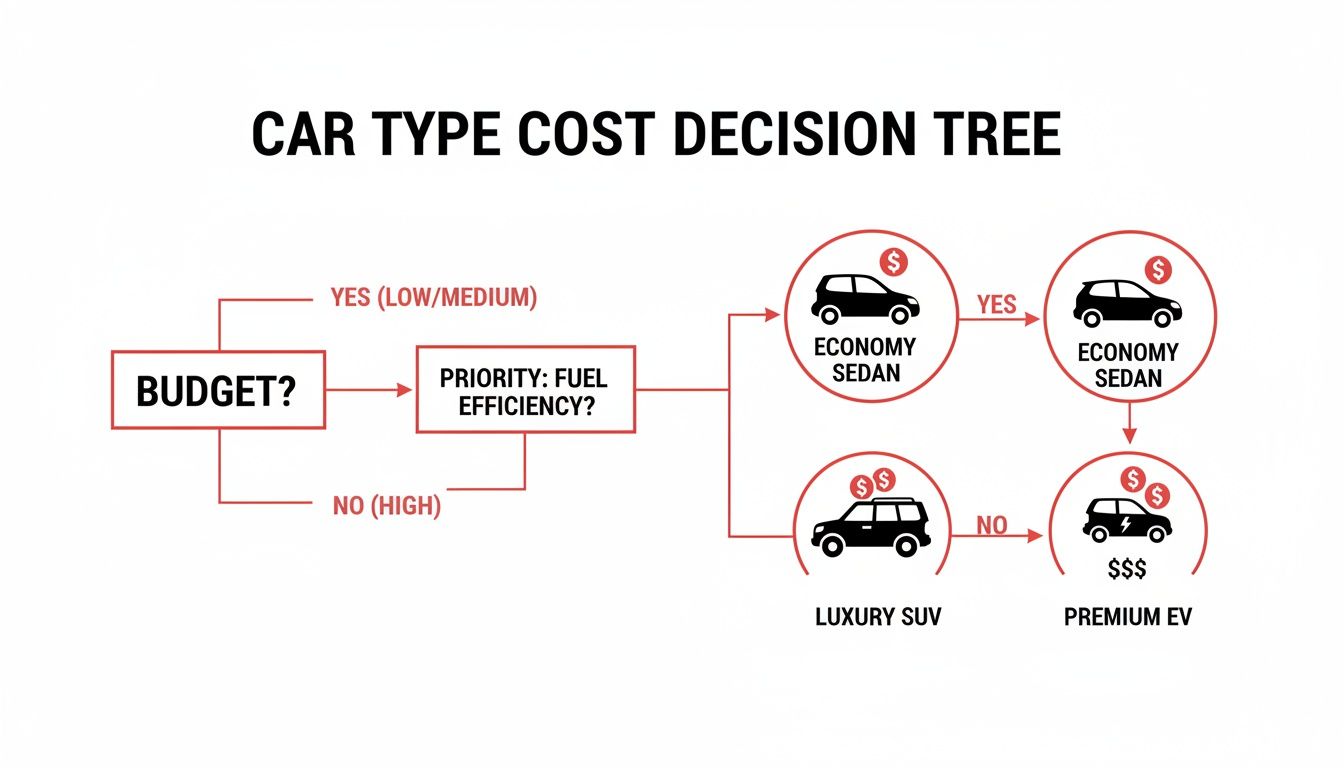
As you can see, the complexity and cost of parts jump significantly when you move from a basic economy car to a premium or electric vehicle, making the DIY-vs-pro decision even more critical.
The Professional Repair: Paying for Peace of Mind
Going to a professional mechanic at a dealership or a trusted independent shop is the path of least resistance. You drop off your car, and a few hours later, you pick it up with the problem solved. The main benefit here is the expertise and efficiency that a seasoned technician brings to the table.
They already have the specialized tools, like panel poppers and trim removal kits, needed to do the job without causing collateral damage. More importantly, they know the common quirks of your specific make and model and can handle any curveballs that come up, like a seized bolt or a stubborn wiring harness.
When you pay for professional labor, you're buying more than just someone's time. You're buying the confidence that the job will be done right the first time, and it's backed by the shop's warranty on both the part and their workmanship.
That peace of mind is worth a lot. If the new handle fails in six months because of a defect or improper installation, the repair is covered. If you did the job yourself and a clip breaks or something isn't quite right, you're the one making another trip to the auto parts store.
Making Your Decision: A Head-to-Head Comparison
So, which is the right path for you? It really boils down to that trade-off between your wallet and your willingness to tackle a project that can be a bit tricky. There's no single correct answer, but putting the key factors side-by-side can make the choice a lot clearer.
To help you decide, let's compare the DIY and professional options directly.
DIY vs. Professional Handle Replacement
| Factor | DIY Replacement | Professional Installation |
|---|---|---|
| Total Cost | Low (parts only). Typically $25 - $100. | High (parts + labor). Typically $150 - $450+. |
| Time Investment | High. 2-5 hours for a first-timer, plus research. | Low. Usually under 2 hours at the shop. |
| Required Skill | Moderate. Needs basic mechanical aptitude and patience. | None. Handled entirely by a trained technician. |
| Tools Needed | Basic hand tools plus specific items like a trim removal kit. | None from you; the shop has everything. |
| Risk Factor | Moderate. Risk of breaking clips, scratching paint, or incorrect installation. | Low. The shop is liable for any damage and guarantees their work. |
| Warranty | Parts warranty only. No coverage for your labor or mistakes. | Comprehensive. Covers both the part and the labor for a set period. |
Ultimately, if you're on a tight budget, enjoy working on your car, and have the patience for a project, the DIY route is a fantastic way to save a good chunk of cash. However, if you need your car back quickly, don't have the tools or confidence, or just want the assurance of a professional guarantee, paying for an expert installation is an investment that makes a lot of sense.
Proven Strategies to Lower Your Repair Costs
Knowing what goes into the cost of replacing a car door handle is one thing. Learning how to get ahead of those costs is where you really save money. With a few smart moves, you can knock down that repair bill without ever compromising on the quality of the fix.
This isn't about cutting corners—it’s about being a savvy car owner. Whether it's sourcing your own parts or picking the right mechanic, you have more control over the final price than you might realize. Let's break down some of the best ways to keep your expenses in check.
Source Your Own High-Quality Parts
One of the most effective ways to save cash is to buy the replacement door handle yourself. Repair shops almost always add a markup to the parts they sell, sometimes tacking on an extra 20-50% or even more. When you buy the part directly, you completely sidestep that markup.
You can find top-tier aftermarket handles online that meet or exceed OEM quality for a much lower price. If you want a deeper dive on this, our guide on choosing the best online auto parts retailer has some great tips. With the part in hand, you just need an independent mechanic to install it, meaning you're only paying for their time.
Pro Tip: Before you buy anything, give the shop a call and confirm they're okay with installing customer-supplied parts. Most independent mechanics are cool with it, but larger chains and dealerships often have strict policies against it.
Choose an Independent Shop Over a Dealership
Dealerships have brand-specific knowledge, but that expertise comes with the highest labor rates and parts prices in town. For a job like this, your local, trusted independent mechanic is almost always the smarter, more affordable choice. Their overhead is lower, which usually translates to more competitive hourly rates.
An independent shop is also far more likely to be flexible, like being willing to install a part you brought in. Building a good relationship with a local mechanic is an investment that pays off for years to come, long after this door handle is fixed.
Get Multiple Quotes
Don't ever take the first price you're given. Just calling three different local shops can uncover a huge difference in quotes for the exact same work. It’s a few minutes of your time that could easily save you $50 to $100.
When you call for estimates, be ready with the right info:
- Your vehicle's year, make, and model.
- Which specific door handle needs replacing (e.g., front driver-side exterior).
- Ask for a clear breakdown of parts versus labor.
- Confirm their policy on installing parts you provide.
Getting this information puts you in the driver's seat and gives you the power to find the best deal. It’s also a good idea to look for specials, like mechanical repair coupons, which can trim down the final cost even more.
Bundle Repairs to Save on Labor
Is your car due for an oil change, tire rotation, or brake inspection anyway? Think about getting everything done at once. While it won’t change the price of the door handle itself, it can save you on the overall labor bill.
Shops often have a minimum labor charge, so tackling the handle while the car is already on the lift is just more efficient. You'll avoid the hassle of a separate trip and might even see a small discount on the total hours billed. It's a clever way to manage your car's maintenance budget.
Why Your Next Car Door Handle Will Cost More
If you're staring at a repair bill for a car door handle and thinking, "Wow, this is a lot more than I expected," you're not wrong. The repair you're facing is part of a much bigger story playing out across the entire auto industry. The simple, purely mechanical door handle is quickly going the way of the dinosaur, and this evolution is changing what it costs to get one replaced.
The biggest driver behind this is the industry-wide push for electric vehicles (EVs) and super-aerodynamic designs. To squeeze every last mile out of a battery charge, carmakers are getting rid of anything that creates wind resistance—and that includes traditional door handles. They're being replaced with slick, flush-mounted handles that pop out only when you need them. These aren't just simple levers anymore; they're complex little modules with their own motors, sensors, and computer chips.
When one of these high-tech handles breaks, it's not a quick swap. It’s a delicate operation. A technician often needs special training to replace the entire motorized unit and then program it to talk to the car's main computer. Suddenly, a basic fix has turned into a high-tech procedure.
Technology is Creeping In Everywhere
This isn't just an EV thing, either. Even on regular gas-powered cars, door handles are getting packed with more and more tech. Features that used to be reserved for high-end luxury cars are now showing up on everyday models.
- Smart Sensors: Many handles now have built-in proximity sensors for keyless entry. Just walk up, and the car unlocks.
- LED Lighting: Puddle lights that illuminate the ground or lighted strips on the handle itself look cool, but they add extra wiring and complexity.
- Electronic Latches: Some cars are even ditching the old metal rods inside the door for fully electronic latches, adding another potential point of failure.
It's this move from simple mechanics to sophisticated electronics that's really driving up the price. What used to be a chunk of molded plastic is now a smart device, and it costs more to make and takes more skill to install.
Supply Chains and Raw Materials Play a Part, Too
On top of all the new tech, global economics are also nudging prices higher. The cost of everything from the plastic and metal in the handle to the copper in its wiring goes up and down with global demand. Then you have to factor in the logistics of shipping parts all over the world.
The market for these parts is already huge and it's getting bigger. The global automotive door handle market was valued at $4.8 billion and is expected to climb to $7.0 billion by 2033. This growth is almost entirely due to the industry shifting to advanced electronic handles, which already make up over 55% of the handles on new cars. As that demand keeps growing, it will continue to put pressure on the supply chain and, ultimately, the final price you pay. You can dig into the numbers yourself and explore more about the global automotive door handle market to see where things are headed.
Got Questions About Replacing a Car Door Handle?
It's completely normal to have a few lingering questions even after you've got a handle on the costs. Let's tackle some of the most common things people ask when they're staring at a busted door handle.
Can I Legally Drive with a Broken Door Handle?
This one's a bit of a gray area, and it really hinges on which handle is broken. A broken rear passenger handle probably won’t get you pulled over. But a driver's side exterior handle that doesn't work? That’s a serious safety risk.
Think about it: in an emergency, first responders have to be able to get you out. For that reason alone, it's best to get it fixed right away. You'll ensure your own safety and sidestep any potential local fines for safety violations.
How Long Does This Job Actually Take?
The time it takes to swap out a handle can vary quite a bit depending on who’s holding the tools.
- At the Shop: A professional mechanic can usually knock this out in 45 minutes to 1.5 hours. They’ve done it a hundred times and have all the right trim tools to make it go smoothly.
- In Your Driveway: If you're tackling this yourself for the first time, give yourself a good 2 to 4 hours. That extra time gives you a buffer to carefully pry off the door panel without breaking clips and follow along with a tutorial video.
Will My Insurance Company Pay for This?
More often than not, the answer is no. Standard auto insurance policies will not cover parts that break from simple wear and tear. A handle that gives out from years of use is seen as a regular maintenance issue, and that falls on you, the owner.
The big exception is if the handle was broken during a covered incident—like a car accident, a break-in attempt, or vandalism. In that case, your collision or comprehensive coverage should kick in once you've paid your deductible. Just be sure to double-check your policy.
The bottom line: for an everyday failure, the cost of a new door handle is almost always an out-of-pocket expense. Insurance is really there for the sudden, unexpected stuff.
Will an Aftermarket Handle Hurt My Car's Resale Value?
For the vast majority of cars on the road, using a quality aftermarket handle will have zero effect on resale value. What matters to a buyer is that the handle works perfectly and doesn't look out of place. A functional, color-matched aftermarket part is infinitely better than a broken factory one.
The only time it might become a sticking point is with high-end luxury vehicles, rare collector cars, or vintage classics. For those, purists and serious buyers often want everything to be original OEM. But for your daily driver? A solid, good-looking repair is all anyone will care about.
For reliable, OEM-quality replacement parts that guarantee a perfect fit and lasting durability, trust T1A Auto. Find the exact door handle you need for your vehicle and get back on the road with confidence. Explore our selection at the T1A Auto website.