


When a car door handle snaps, you're usually looking at a professional repair bill somewhere between $150 and $450. That range covers both the new part and the mechanic's time, but the final number on your invoice can swing quite a bit depending on your car and the choices you make.
What Is the Real Cost to Replace a Door Handle?
A busted door handle is more than just a little annoyance—it's a genuine headache that messes with your day. Figuring out the potential cost is the first step to getting things back to normal. The total bill isn't just one number; it's a sum of two main things: the price of the handle itself and the cost of the labor to install it.
That final price tag can really shift based on a few key variables. Every decision you make along the way will determine whether this is a small, easy fix or a more significant hit to your wallet.
Key Factors Influencing Your Estimate
Every repair is a little different, and a few major factors will drive your final cost.
- Your Vehicle's Make and Model: It's no surprise that a simple, mechanical handle for an older Honda Civic is going to be way cheaper than a fancy, sensor-packed handle for a new luxury SUV.
- The Quality of the Part: You have options. You can go for a pricey Original Equipment Manufacturer (OEM) part from the dealer, a much more affordable aftermarket version, or even an upgraded metal handle built to last longer than the original plastic one.
- Who Does the Work: This is the big one. Are you going to pay a professional for their time and skill, or are you willing to roll up your sleeves and do it yourself?
To get a better feel for how different auto repairs are priced, you can check out comprehensive guides on various vehicle repair costs, which show how things like labor rates and part complexity affect the bottom line for all sorts of issues.
Here's something most people don't realize: with a professional installation, 60-70% of your total bill is often for labor, not the part. That really puts the potential savings of a DIY job into perspective.
To give you a clearer idea of what to expect, the table below breaks down the potential costs. It's a quick way to see how your choices on parts and installation can really change the final price.
Estimated Door Handle Replacement Cost at a Glance
| Scenario | Part Cost (Approx.) | Labor Cost (Approx.) | Total Estimated Cost |
|---|---|---|---|
| DIY with Standard Part | $25 - $75 | $0 | $25 - $75 |
| DIY with Upgraded Part | $40 - $90 | $0 | $40 - $90 |
| Pro Install with Standard Part | $25 - $75 | $100 - $200 | $125 - $275 |
| Pro Install with Upgraded Part | $40 - $90 | $100 - $200 | $140 - $290 |
As you can see, tackling the job yourself offers some serious savings if you have the tools and a bit of confidence.
Breaking Down Your Repair Bill: Parts vs. Labor
When a mechanic hands you a quote for a door handle replacement, that final number is really two separate costs bundled together: the price of the new handle and the charge for the time and skill to install it. Getting a handle on these two parts of the bill is the first step to understanding what you're paying for and finding ways to save money.
Think of it like getting a pizza. You've got the cost of the ingredients (the part) and the cost of someone making and delivering it (the labor). You can go for simple pepperoni or fancy prosciutto, and you can pick it up yourself or pay for delivery. It's the same principle with your car repair.
Understanding the Cost of the Part
First up is the handle itself. This isn't a simple, one-size-fits-all situation. The type of handle you choose has a huge effect on both the upfront cost and how long the fix will last. You've got three main paths to go down.
- OEM (Original Equipment Manufacturer) Parts: These are the genuine, straight-from-the-factory parts, identical to the one that just broke. They guarantee a perfect fit and finish, but you’ll definitely pay a premium for that brand name.
- Aftermarket Parts: These are made by companies other than your car's manufacturer, designed to work just like the original. A good aftermarket supplier, like T1A Auto, often sees where the original part failed—usually a cheap plastic piece—and re-engineers it with stronger materials like metal for a longer-lasting solution.
- Used or Salvaged Parts: This is your cheapest option, pulled from a car in a scrapyard. But it's a total gamble. You have no idea how old it is or how much stress it’s been under, it comes with zero warranty, and you could be right back where you started in a few months.
For most people, a high-quality aftermarket part hits the sweet spot. It gives you a great balance of affordability and durability, often outlasting the original without emptying your wallet.
Factoring in Professional Labor Costs
The other half of your bill is labor. This is what you're paying a mechanic for their expertise, their tools, and their time. Auto shops charge an hourly rate that can swing from $75 to over $150 per hour, depending on where you live, the shop's reputation, and the technician's experience level.
Most door handle replacements take a pro somewhere between one and two hours. It might look easy from the outside, but modern car doors are packed with complex machinery. The mechanic has to carefully pry off the interior door panel without snapping any of the brittle plastic clips, work around window regulators and speakers, and then unhook and reattach all the little rods and electrical connectors.
What you're really paying for with professional labor isn't just speed—it's precision. It's for the expert who can do the job right the first time without causing a cascade of other expensive problems inside your door panel.
It’s also worth noting that global factors are pushing these prices up. The cost of raw materials, especially aluminum which can make up 40-60% of a handle's cost, is on the rise. In fact, recent reports show the global door handle market grew from $8.30 billion to $8.78 billion in just one year, mostly due to these material price hikes. That means both DIY parts and professional jobs for popular trucks like a Tacoma or Tundra are getting more expensive. You can read more about these automotive market trends to see how it all trickles down to you.
At the end of the day, the math is simple: Part Cost + (Labor Rate x Hours) = Total Cost. By knowing what goes into both sides of that equation, you’re in a much better position to make a smart choice for your car and your budget.
Why Factory Parts Aren't Always the Smartest Choice
For years, we've been told that Original Equipment Manufacturer (OEM) parts are the only way to go for car repairs. And while they guarantee a perfect fit, this conventional wisdom often misses a huge point: you're paying a premium to put the exact same flawed part back on your vehicle.
Think about it. That plastic door handle just snapped. Grabbing an identical OEM replacement from the dealership just resets the timer on the next failure. You're shelling out top dollar for the brand name, not for better quality or a stronger design. This is precisely where high-quality aftermarket parts come into the picture and change the game.
The Aftermarket Advantage: More Than Just a Lower Price
Going with an aftermarket part isn't just about saving money; it's about making a smarter repair. The best aftermarket companies, like us at T1A Auto, don't just mindlessly copy factory parts. We look at why they failed in the first place and engineer those weak points out of the design.
Remember that flimsy plastic lever inside the handle that couldn't take the stress? A top-tier aftermarket part often swaps that out for reinforced metal, making the new handle fundamentally stronger than the one that came from the factory. You're not just replacing a part—you're genuinely upgrading your vehicle.
This is critical because the part itself is a huge chunk of your total repair bill.
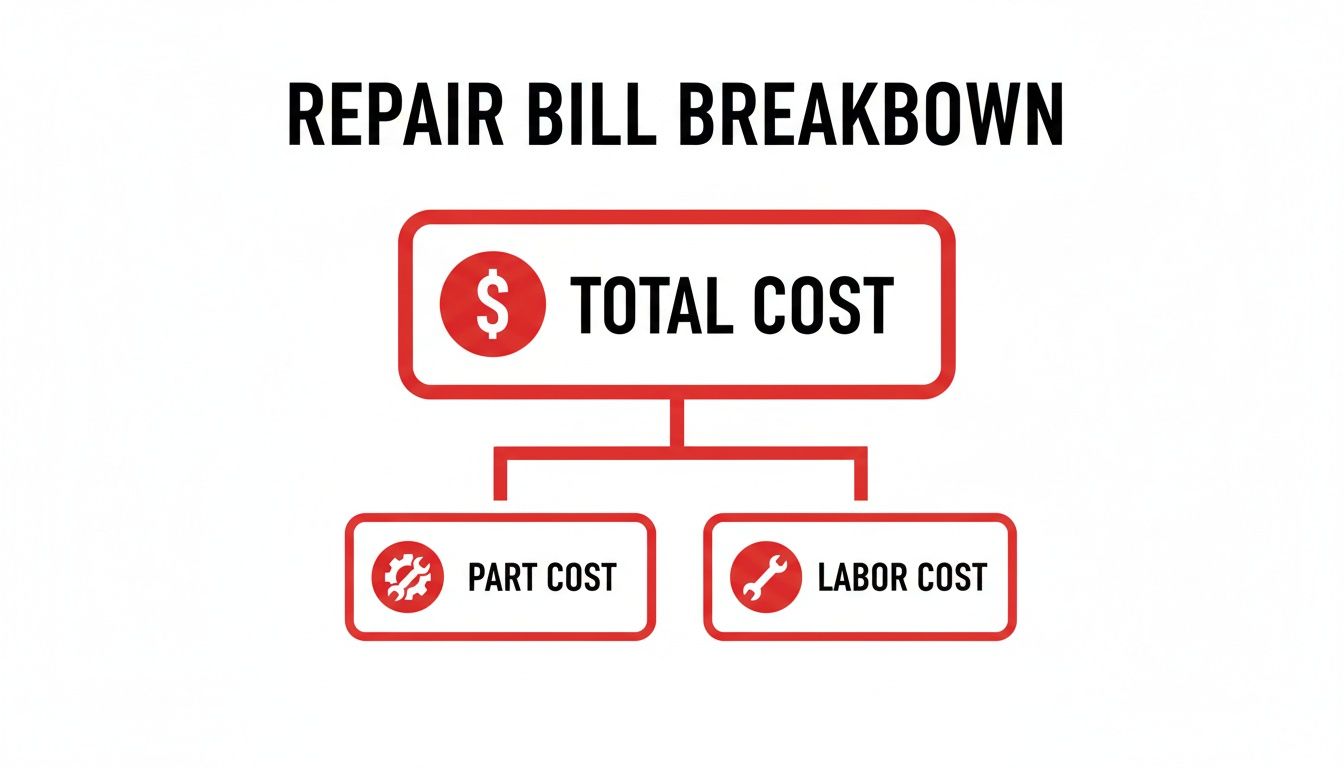
As you can see, choosing the right part makes a massive difference to your wallet, both now and down the road.
A Head-To-Head Look at Your Part Options
To really get a feel for what you're buying, it's helpful to understand the key differences between OEM and aftermarket parts. When you're standing at the parts counter (or shopping online), you really have three main choices.
To make things simple, here’s a quick comparison to help you weigh your options.
Part Comparison OEM vs Aftermarket vs T1A Upgraded
| Feature | OEM Parts | Standard Aftermarket | T1A Upgraded Aftermarket |
|---|---|---|---|
| Material Quality | Typically plastic, same as the original part that failed. | Often a direct copy of the OEM plastic; quality can vary. | Reinforced with metal at common failure points for superior strength. |
| Cost | Highest price point. | Most budget-friendly, but you get what you pay for. | Significantly less than OEM, offering premium quality at a great price. |
| Durability | Prone to the same failure as the original. You're just starting the clock over. | Durability is often inconsistent and comparable to the original plastic part. | Engineered for longevity to solve the root problem and prevent future breaks. |
| Warranty | Usually a limited 12-month warranty from the dealership. | Varies, but often limited to 90 days or 1 year. | Backed by a lifetime warranty. We stand behind our engineering. |
Ultimately, the choice comes down to what you value most: paying a premium for a brand name or investing in a part designed to last a lifetime.
The real value of an upgraded aftermarket part isn't just its lower price today, but its ability to prevent you from having to pay for the same repair again in the future. It’s a long-term solution, not just a temporary fix.
You're not just fixing the problem; you're solving it for good. If you want to dive deeper, you can explore a detailed breakdown of OEM vs. aftermarket parts and see what makes the most sense for your vehicle.
The Unbeatable Value of a Lifetime Warranty
Here’s where the decision gets really easy. An OEM part from the dealer might give you a 12-month warranty if you're lucky. A standard, budget aftermarket part? Maybe 90 days, maybe a year.
But a company that truly believes in its product puts its money where its mouth is. At T1A Auto, we back our upgraded metal door handles with a lifetime warranty. That kind of guarantee says everything you need to know about the part's quality and our confidence in its design. It turns a simple purchase into a lasting investment in your vehicle.
When you add it all up—stronger materials, a smarter design that fixes the original flaw, a much lower price, and a lifetime guarantee—the choice is clear. A premium aftermarket part isn't just the "cheaper" option. It's the smartest one.
Real-World Cost Examples for Popular Vehicles
It’s one thing to talk about general estimates, but seeing the numbers for a vehicle like yours is where it really hits home. The truth is, door handle replacement cost isn't a single, fixed price; it can swing quite a bit depending on what you drive.
Let's get down to brass tacks and look at some of the most common cars and trucks on the road. I'll break down what you can expect to pay a professional versus what it would cost to do it yourself with a quality part from T1A Auto. This side-by-side view will give you a much clearer picture of your options.
Ford F-150 Door Handle Replacement Cost
The Ford F-150 has been the king of trucks in America for decades, so you'd think parts would be cheap and easy. They are widely available, but as the F-150 has gotten more sophisticated, so have its door handles.
- Professional Installation: Take a newer F-150 to a shop, especially one with keyless entry, and you're looking at a bill between $220 and $450. The handle itself is pricier, and the technician has to carefully disconnect sensors and wiring, which adds to the labor time.
- DIY Replacement (with T1A Auto Part): Here's where you can save a bundle. An upgraded, heavy-duty handle from T1A Auto will only set you back $40 to $85. Your only other cost is an hour or two of your time, making it a no-brainer for anyone comfortable with basic tools.
It's also worth noting that global supply chains can throw a wrench in the works. For instance, recent tariffs have had a real impact. Back in March 2025, a 25% ad valorem tariff was placed on imported autos and parts, directly increasing the cost of aluminum and stainless steel handles. For truck owners fixing an F-Series or Silverado, a simple mechanical handle that was once $50-$100 might now cost $65-$130 after accounting for markups from Asian-Pacific producers, who control about 40% of the market. If you're curious, you can explore more about automotive door handle market intelligence to see how these factors play out.
Toyota Tacoma and Tundra Cost Estimates
Toyota trucks are legendary for their durability, but even they aren't immune to a broken plastic door handle. The good news is that the replacement process is pretty straightforward, making these trucks perfect candidates for a DIY fix.
- Professional Installation: A mechanic will likely quote you between $180 and $350 to swap out a Tacoma or Tundra handle. The price inches up for newer models loaded with more electronics.
- DIY Replacement (with T1A Auto Part): This is where you really see the savings. A high-quality aftermarket handle for these trucks typically runs from $35 to $70. With a few common tools, you can easily get the job done and keep over $200 right where it belongs—in your wallet.
Key Takeaway: When it comes to popular trucks, the biggest chunk of your bill is almost always labor. Choosing a DIY-friendly, quality aftermarket part can cut your total cost by as much as 75%.
Common Sedans like Honda Accord and Toyota Camry
With millions of Accords and Camrys on the road, this is a repair that mechanics see all the time. Thankfully, their handles are usually less complicated than what you'll find on a modern truck, which helps keep the cost reasonable.
- Professional Installation: For these everyday drivers, expect a professional quote in the $150 to $300 range. It’s a routine job for most shops, so labor hours are kept to a minimum.
- DIY Replacement (with T1A Auto Part): The part itself is incredibly affordable. You can often find a premium aftermarket version for just $25 to $50. This makes it an ideal, low-risk project if you're just dipping your toes into DIY auto repair.
These real-world examples all point to the same conclusion: the more bells and whistles your car has, the more you'll pay a pro. But in nearly every case, tackling the job yourself with the right part offers massive savings and the satisfaction of a job well done.
Should You Replace a Door Handle Yourself?
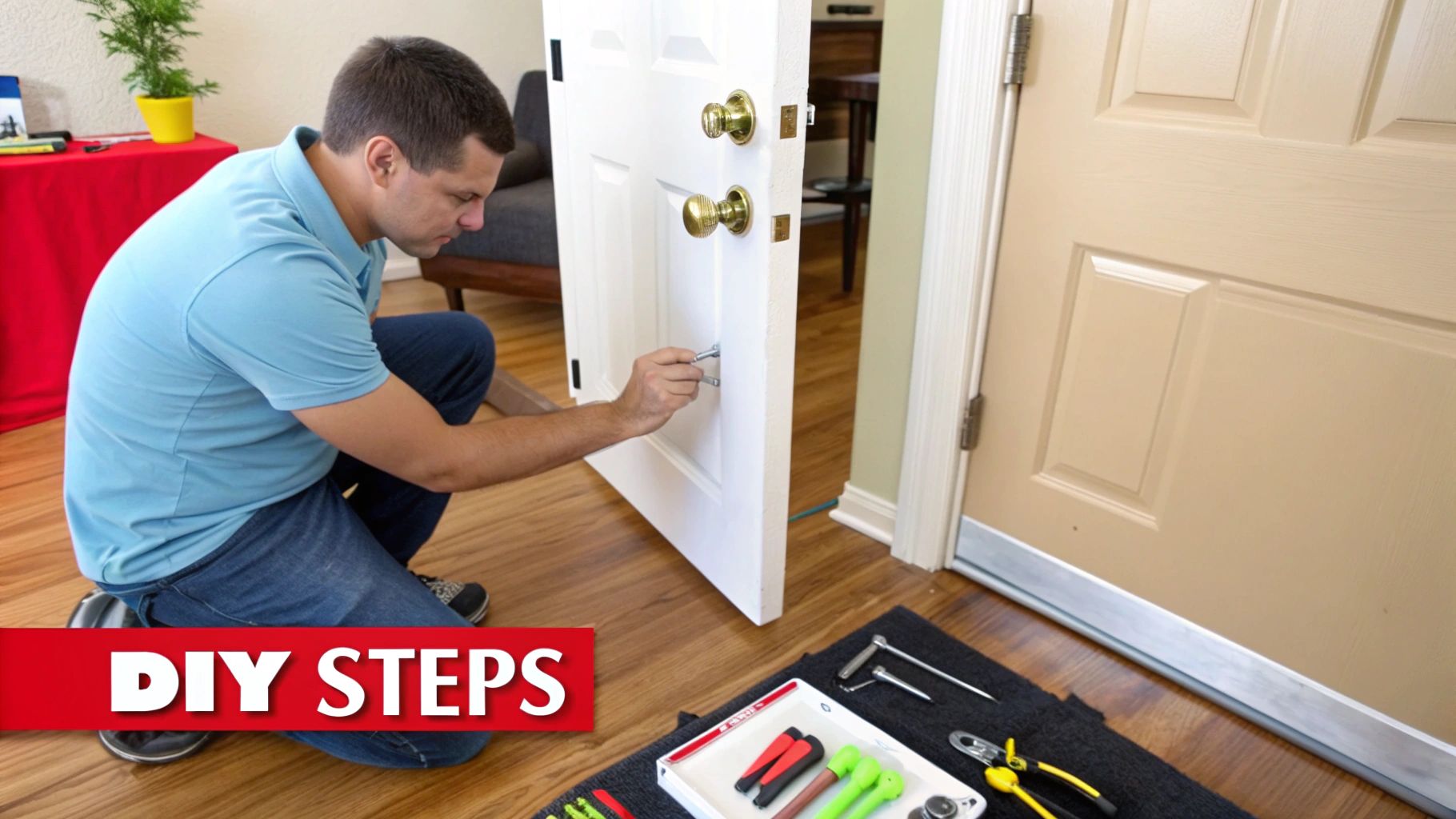
So, you're staring at that broken door handle and the big question pops into your head: "Can I actually fix this myself?" For most car and truck owners, the answer is a definite yes. This is one of the most doable and satisfying DIY repairs out there, and the reason to tackle it is simple: saving a ton of money.
By choosing to do the job yourself, you immediately cut out the single biggest expense on a professional repair bill—the labor. That simple decision can save you anywhere from $100 to $200, turning what could be a pricey trip to the shop into a manageable weekend project.
How Hard Is It, Really?
Think of this as a beginner-to-intermediate-level job. It's a bit more involved than changing your oil, but it’s nowhere near as intimidating as diving into engine work. If you're generally handy and have a little patience, you've got this.
The part that usually makes people nervous is having to take off the interior door panel to get to the handle's hardware. It sounds tricky, but with the right tools and a good guide, it’s a pretty straightforward process.
The Tools You'll Need
You don’t need a professional-grade garage to pull this off. You probably already own most of the tools required, and the couple of specialty items you might need are cheap and easy to find.
- A Good Screwdriver Set: You'll want a mix of Phillips head and flathead drivers for the various screws and clips holding things together.
- Socket and Ratchet Set: A basic set is all you need to unbolt the old handle and secure the new one.
- Trim Removal Tools: This is your secret weapon. A plastic trim removal kit costs next to nothing and is the key to prying off the door panel without scratching the paint or snapping any of the plastic clips. Don't use a screwdriver for this!
- Needle-Nose Pliers: These are perfect for getting a grip on the small metal linkage rods you'll need to disconnect from the latch mechanism.
With these four things on hand, you’re ready to go.
A Quick Rundown of the Job
While every car is a little different, the basic steps for swapping out a door handle are pretty much the same across the board. Here’s a quick look at what a Saturday afternoon with this project looks like.
- Pop the Interior Door Panel Off: First, you'll hunt down and remove a few screws (they often hide behind little plastic covers or inside the armrest). Then, you'll use your trim tools to carefully pry the panel away from the door.
- Unplug the Electronics: You'll need to disconnect the wiring harnesses for the power windows, locks, and speakers. They just clip in and out.
- Get to the Handle: With the panel gone, you’ll have a clear view of the bolts holding the old handle in place.
- Disconnect the Linkage Rods: Carefully unclip the small metal rods that connect the handle to the door's latch and lock.
- Install the New Handle: Bolt the new one on, reconnect those linkage rods, and plug the electronics back in.
- Test Everything: This is a crucial step! Before you snap the door panel back on, test the new handle, the lock, and the window to make sure it all works perfectly.
If you want a detailed video walkthrough, our guide on how to replace a car door handle can give you the confidence to get the job done right.
The decision to DIY a door handle replacement is a classic trade-off: you're exchanging a few hours of your time for significant financial savings. For many, the satisfaction of fixing it yourself is the biggest reward of all.
Ultimately, this is one of those repairs that puts you back in the driver's seat, turning a frustrating problem into an empowering—and much cheaper—solution.
What's Next? Putting Your Plan into Action
Alright, you're now armed with a solid understanding of what goes into a door handle replacement cost, from the parts themselves to the labor involved. You know the variables, and that puts you in the driver's seat. The next move is simple, whether you're handing the keys to a pro or rolling up your sleeves to do it yourself.
If you're leaning toward a professional repair, the goal is to get a clear, honest quote. And if you're ready to tackle the job yourself, the focus shifts to finding the best possible part for a permanent fix.
How to Get an Accurate Quote from a Mechanic
Walking into a shop with a little knowledge goes a long way. Instead of just asking, "How much to fix my door handle?" you'll want to be more specific. This is how you get a quote you can actually rely on.
Call a few local, independent shops and give them your vehicle's exact year, make, and model. Tell them precisely which handle needs replacing (for example, the "front driver-side exterior"). The crucial step? Ask them for a detailed breakdown that separates the cost of the part from the estimated labor charges. This simple request eliminates surprises and makes it easy to compare apples to apples.
Pro Tip: Don't forget to ask if the shop will install a part that you bring in. Many independent mechanics are happy to do this, letting you avoid their typical parts markup and save a good chunk of change.
Finding the Perfect Part for Your Ride
Decided to go the DIY route? Awesome. Your most important mission now is securing the right part. This is where we at T1A Auto can really help simplify things. Forget wandering the aisles of a generic parts store; our website makes finding a guaranteed-fit handle a breeze.
Just head to the T1A Auto site and plug in your vehicle's make, model, and year. Our system will immediately show you the upgraded, heavy-duty parts we've engineered specifically for your car or truck. To learn more about what separates a great supplier from a mediocre one, check out our guide on choosing the best online auto parts retailer.
When you buy from T1A Auto, you aren't just getting a replacement—you're getting a serious upgrade. Our handles feature reinforced metal components to fix the original weak points, and we back them with a lifetime warranty. With fast, free shipping and a team that’s here to help, you'll have everything you need to get that door working perfectly again.
Common Questions About Door Handle Replacement
Even with a good handle on the costs, you probably still have a few questions floating around. Let's clear those up with some quick, straight-to-the-point answers so you can tackle this repair with confidence.
Is It Cheaper to Repair or Replace a Handle?
Nine times out of ten, replacing the entire door handle is cheaper and more effective than trying to repair it. Modern handles are complex little gadgets. Once a key plastic piece inside snaps, trying to patch it up with super glue or epoxy is just a temporary fix—it’s going to break again, and probably sooner rather than later.
Think about it: the labor cost for a mechanic to carefully take apart a broken handle, attempt a tricky repair, and put it all back together can easily cost more than a brand-new aftermarket part. A full replacement gives you a solid, long-term solution, especially if you upgrade to a part that fixes the original design flaw.
How Long Does a Mechanic Take to Replace a Door Handle?
For a pro, swapping out an exterior door handle usually takes about one to two hours. The exact time really depends on your vehicle. A simple, all-mechanical handle on an older car? A good mechanic might have that done in under an hour.
But if you've got a newer truck or SUV with all the bells and whistles—keyless entry sensors, puddle lights, and extra wiring—it's a different story. The technician has to spend more time carefully popping off the interior door panel and disconnecting all the electronics. That extra complexity is why labor can be such a big chunk of the final door handle replacement cost.
Does Car Insurance Cover a Broken Door Handle?
This one's a classic "it depends" situation, and it all comes down to why the handle broke.
- When it's covered: If the handle was busted in a car accident, a parking lot fender-bender, or due to vandalism or a break-in, your comprehensive or collision coverage should kick in (once you've paid your deductible, of course).
- When it's not covered: If the handle just gave up the ghost from years of opening and closing, that's considered normal wear-and-tear. Standard auto insurance policies almost never cover maintenance issues like this.
It never hurts to double-check your policy, but for a handle that simply failed from everyday use, you should expect it to be an out-of-pocket expense.
The rule of thumb is simple: insurance covers sudden and accidental damage, not parts that gradually wear out over time. Understanding that distinction is key to knowing what your policy will and won't do for you.
With these common questions out of the way, you should have a clear path forward. Now you can confidently decide whether to call a shop for a quote or order the parts for a satisfying weekend DIY project.
When you're ready for a permanent solution, T1A Auto offers upgraded metal door handles engineered to last a lifetime. Find the perfect, guaranteed-fit part for your vehicle and fix it right the first time by visiting the T1A Auto parts store.
