


The Toyota Tacoma maintenance schedule is your truck's official roadmap, outlining all the factory-recommended services needed at specific mileage or time intervals. Sticking to this schedule, which kicks off at the 5,000-mile mark, is genuinely the most effective thing you can do to keep your Tacoma running strong for years to come.
Your Quick-Reference Tacoma Maintenance Schedule
To keep your Tacoma in prime condition, you have to stay on top of its service needs. While the full schedule gets quite detailed over the life of the truck, a few key milestones stand out as the most critical. Skipping these can lead to worse gas mileage, sluggish performance, and—eventually—costly repairs. The whole point of the schedule is to be proactive and catch normal wear and tear before it spirals into a real problem.
Toyota lays out a maintenance guide for every model year to ensure you get that legendary durability and performance. For a new Tacoma, the rhythm starts with an oil and filter change, tire rotation, and a full fluid-level check every 5,000 miles or 6 months. Many of these early services are even covered under the ToyotaCare program, which gives you no-cost maintenance for the first two years or 25,000 miles. You can always find more details about the factory-recommended services for your Tacoma directly from Toyota.
Key Service Milestones
The infographic below gives you a bird's-eye view of the first three major service intervals, zeroing in on the essential tasks at 5,000, 15,000, and 30,000 miles.
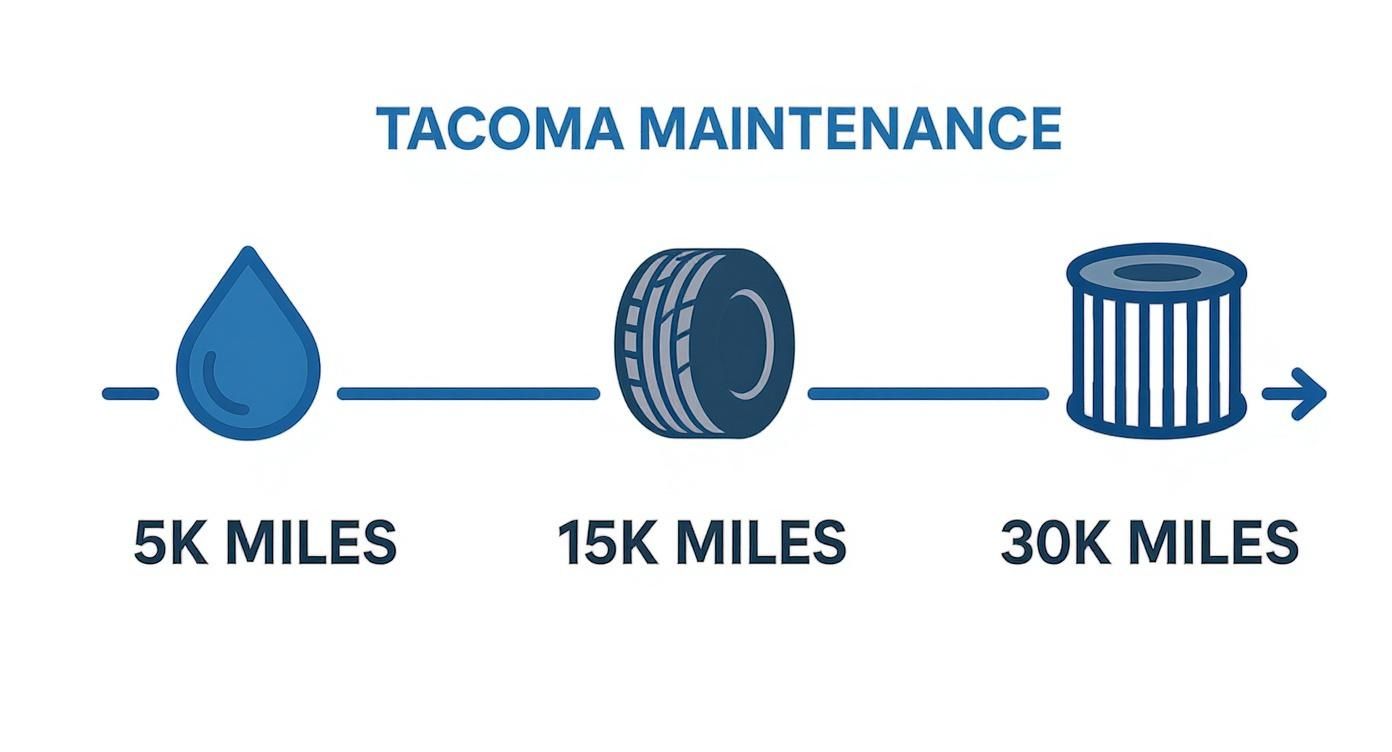
As you can see, the maintenance plan builds on itself. It starts with the basics like fluid changes and then layers on more in-depth inspections and replacements as your truck racks up the miles. For a quick cheat sheet, the table below highlights the most important jobs to tackle at each major interval.
Toyota Tacoma Key Maintenance Intervals Overview
This table offers a snapshot of the essential maintenance tasks required at major mileage milestones for your Toyota Tacoma.
| Mileage Interval | Key Services Required |
|---|---|
| 5,000 Miles | Change engine oil and filter, rotate tires, inspect all fluid levels. |
| 15,000 Miles | Re-torque propeller shaft bolts, inspect brake components. |
| 30,000 Miles | Replace engine and cabin air filters, inspect fuel system. |
| 60,000 Miles | Inspect drive belts, consider changing transmission fluid. |
| 100,000 Miles | Replace spark plugs, change engine coolant. |
Think of these intervals as the non-negotiables. Staying on top of this schedule helps ensure your Tacoma remains the reliable workhorse it was built to be.
Why Following Your Maintenance Schedule Matters
Think of the official Toyota Tacoma maintenance schedule as the blueprint for your truck’s long and healthy life. It’s easy to see regular service as just another expense, but seasoned owners know it’s the single best investment you can make in your rig. Following this schedule is the key to unlocking the legendary reliability and lifespan Tacomas are famous for, and it directly impacts performance, safety, and what your truck is worth down the road.
This is all about proactive care—catching small problems before they snowball into wallet-draining disasters. A simple oil change is a perfect example; it's cheap insurance against premature wear on critical engine parts. Likewise, flushing your brake fluid on time can save you from a catastrophic master cylinder failure later on. To get a better sense of how this works, it’s worth understanding the essentials of preventive maintenance for vehicles and applying those principles to your own Tacoma.
Keeping Your Truck Safe and Valuable
A thick stack of service receipts is more than just paper; it’s solid proof that your truck has been properly cared for. When it comes time to sell, that documented history makes your Tacoma far more appealing to buyers and almost always brings a better price.
But it’s not just about the money. Sticking to the schedule is fundamental to your safety on the road. Regular checks of your truck's most important systems ensure everything works exactly as it should, especially when you need it most.
- Brake System Integrity: Keeping an eye on your pads, rotors, and fluid means you can count on your truck’s stopping power. A spongy pedal or a grinding sound isn't just annoying—it's a warning sign of potential brake failure.
- Tire Health: Regular rotations are crucial for even tread wear. This not only makes your tires last longer but also ensures your truck handles predictably, rain or shine.
- Fuel Efficiency: A clean engine air filter and a fresh set of spark plugs help your engine breathe better and burn fuel more efficiently, which means fewer trips to the pump.
A well-maintained Tacoma doesn't just feel more reliable—it's a safer, more economical truck to own. Every service appointment is a strategic move to head off expensive future repairs and get the most possible miles out of your truck.
Your Detailed Service Checklist: 5k to 15k Miles
The first 15,000 miles are your Tacoma's break-in period, and they really set the stage for its long-term health. These early services are simple, cheap, and your best chance to spot any factory quirks before they grow into real problems. If you want your truck to last, sticking to the Toyota Tacoma maintenance schedule from day one is the smartest move you can make.
Honestly, these initial check-ups are so straightforward that plenty of owners just knock them out in their own driveway. Whether you’re a seasoned pro with a full toolbox or you'd rather let a shop handle it, knowing exactly what's on the docket is key.
The Foundational 5,000 Mile Service
Your Tacoma’s first real check-up comes at 5,000 miles or six months, whichever rolls around first. This one is all about getting fresh fluids in and giving the truck a basic once-over to make sure everything is settling in correctly.
- Engine Oil and Filter Change: This is non-negotiable for engine longevity. Fresh oil is the lifeblood that lubricates all those moving parts, cuts down on friction, and pulls heat away from critical components. A new filter just makes sure all the gunk stays out of circulation.
- Tire Rotation: Getting your tires rotated ensures they all wear down at the same rate. It's a simple thing that pays off big in tire life, consistent handling, and good traction. The typical pattern is to move the fronts to the back and cross the rears as they come forward.
- Multi-Point Inspection: A tech (or you) will run through all the basic fluid levels—coolant, brake fluid, power steering fluid, and washer fluid. They’ll also give the wiper blades a look for any signs of cracking and check the battery for nasty-looking corrosion on the terminals.
DIY Tip: You can easily check most fluids yourself. Just pop the hood and look for the MIN and MAX lines on the clear reservoirs. For wiper blades, if they're leaving streaks or you see cracks in the rubber, it's time for a new set.
Expanding the Checklist at 10,000 and 15,000 Miles
The 10,000-mile service is pretty much a carbon copy of the 5,000-mile one: another oil change, tire rotation, and inspection. Think of it as reinforcing those good habits.
But when you hit 15,000 miles, the inspection list gets a bit longer, digging into more critical components. This service builds on everything you've done before, adding a few key new items to the list.
Deeper Dives Into Key Systems
At 15,000 miles, it’s time to get a closer look at your truck's brakes and air filters. These checks are absolutely vital for safety and keeping the engine breathing easy.
Thorough Brake Inspection
Your brakes are obviously your most important safety system. This isn't just a quick glance; it's a full check of every component.
- Pads and Rotors: A good look at the brake pads will tell you how much life they have left. New pads are usually 10-12mm thick, and you'll want to think about replacing them once they get down to around 3mm. The rotors should be smooth, without any deep grooves, warping, or blueish discoloration from excessive heat.
- Lines and Hoses: Every brake line and hose gets checked for cracks, leaks, or signs of becoming brittle.
- Calipers: The calipers need to be checked to make sure they're moving freely and not seized or sticking, which can cause uneven pad wear.
Air Filter Replacements
Clean air is just as important for your engine's health as it is for yours.
- Engine Air Filter: This is the gatekeeper that stops dust and road grit from getting sucked into your engine. A clogged filter chokes the engine, which can tank your performance and gas mileage.
- Cabin Air Filter: This one cleans the air you breathe inside the truck. Swapping it out keeps pollen, dust, and other junk out of the cabin. It’s usually a ridiculously easy job you can do yourself in under five minutes.
The 30,000-Mile Service: Your First Major Check-Up
Hitting the 30,000-mile mark in your Tacoma is a pretty big deal. Think of it as your truck's first major physical. This service goes way beyond a simple oil change and tire rotation; it's a critical interval for taking a much deeper look at key systems and swapping out parts that are starting to show their age. Staying on top of this service is one of the best things you can do to keep your Tacoma running strong for years to come.

This comprehensive check-up folds in all the usual tasks from earlier services but adds several crucial new items to the to-do list. The focus here shifts to systems that wear down more gradually and aren't always obvious until a problem pops up.
Core Components of the 30k Service
At this point, you're moving from basic fluid changes into true preventative maintenance. The goal is to catch and replace parts that are getting close to the end of their service life, long before they can cause a breakdown.
Here’s what’s typically on the docket for this service:
- Engine & Cabin Air Filter Replacement: A clean engine air filter is absolutely essential for keeping your power and fuel economy where they should be. The cabin filter is just as important for keeping the air you breathe inside the truck clean and fresh.
- Fuel System Inspection: This is a thorough check of the fuel lines, all connections, the tank itself, and even the gas cap. Mechanics are looking for any hint of a leak, corrosion, or physical damage that could affect performance or safety.
- Comprehensive Brake System Examination: The brake inspection gets serious here. It's another detailed look at the pads, rotors, fluid lines, and calipers to make sure your stopping power is 100%.
- Suspension and Drivetrain Check: This involves getting underneath to inspect ball joints and their dust covers, checking steering components for play, and re-torquing the propeller shaft bolts to keep the chassis tight and responsive.
Generally, you'll want to tackle this 30,000-mile tune-up every 24 months—whichever comes first. It’s a vital step for preserving your engine’s efficiency. Expect the cost to land somewhere between $300 and $600, though this can vary depending on your local shop rates and exactly what your truck needs. For a broader look at tune-up costs, CarParts.com has some great resources.
Pro tip: One common wear item around this mileage is the serpentine belt. Take a close look for any cracks, fraying, or a shiny, glazed appearance on the belt's surface. A worn belt can snap without warning, which means you instantly lose your power steering and the alternator stops charging the battery.
Beyond the Checklist: Key Inspections
The official checklist is great, but a good 30k service is also an opportunity to inspect things that could become a problem down the road. This is where a sharp technician—or a savvy owner doing their own work—can really make a difference by spotting trouble early.
A perfect example is the ignition system. While your spark plugs probably have a lot of life left, it’s a smart time to look at the related components. Pay close attention to the ignition coil boots for any signs of cracking or wear. If you’ve noticed any rough idling or the check engine light has made an appearance, a failing coil could be the culprit. Our guide on how to change an ignition coil walks you through that whole process.
Don't forget the battery, either. A technician will clean any corrosion off the terminals and run a load test to see how much life it has left. Batteries can be unpredictable, and finding a weak one during a scheduled service is a whole lot better than getting stranded somewhere with a truck that won't start.
Getting Ready for the Major 60k and 90k Mile Services
Once your Tacoma hits the 60,000-mile mark, the maintenance game changes. We're moving beyond the simple fluid changes and rotations and into more serious, long-term preventative work. These major services are designed to catch and replace parts that have seen some serious action, ensuring your truck stays dependable for the long haul.
It's a good idea to budget for these appointments. They're more involved than your typical oil change and are absolutely crucial for the health of your truck's drivetrain, cooling system, and suspension. Skipping them is like rolling the dice—you might turn a simple, proactive replacement into a costly and frustrating breakdown down the road.
What to Expect at the Critical 60,000 Mile Service
The 60,000-mile service is a big one. It covers everything from the 30,000-mile checkup and adds a few new, critical items to the list. This is all about preventing premature wear on some very expensive components.
- Drive Belt Inspection: Your serpentine belt is the lifeblood of the engine's accessories, running everything from the alternator to the water pump. A technician will give it a hard look for any signs of cracking, fraying, or glazing. If that belt snaps, you're not going anywhere, so replacing it at the first sign of wear is just smart money.
- Transmission Fluid Change: Toyota might call the transmission fluid a "lifetime" fluid, but that's really only under perfect, lab-like conditions. If you actually use your truck for towing, hauling, or hitting the trails, that fluid is working hard and breaking down. Most real-world mechanics and experienced owners will tell you to change it at 60,000 miles to protect the transmission's delicate internals.
- Deep Cooling System Inspection: This is more than just a glance at the coolant level. A mechanic will check every coolant hose for softness, bulging, or cracks. They'll also inspect the radiator for leaks and test the coolant itself to make sure it's still able to protect your engine from corrosion and extreme temps.
Navigating the 90,000 Mile Inspection
As you close in on 90,000 miles, the maintenance schedule calls for another deep dive into your truck's key systems. This service is mostly about inspection, building on the work done at 60k to spot components that are getting close to the end of their life before they actually fail.
At this point, the focus really shifts to parts that are under constant stress and movement. Your technician will go over all the fluids, belts, and hoses again, but they’ll be paying special attention to the suspension and chassis.
At this kind of mileage, it’s not just about what’s broken now—it’s about figuring out what’s going to break soon. Finding a worn-out bushing or a cracking hose at 90,000 miles lets you plan the repair instead of having to react to a breakdown on the side of the highway.
Common Parts to Watch at the 90k Mark
All those years of potholes, sharp turns, and heat cycles really start to add up. Around the 90,000-mile mark, a few specific parts are usually ready for retirement. Knowing what they are helps you have a smarter conversation with your mechanic and plan your budget.
Potential Replacement Checklist
- Suspension Bushings: The rubber bushings in the control arms and leaf springs get brittle and crack over time. If you're hearing clunks, feeling sloppy handling, or seeing uneven tire wear, worn bushings are a likely culprit.
- Hoses: After nearly 100,000 miles, every rubber hose—coolant, power steering, vacuum lines—is a potential failure point. Heat makes them hard and prone to cracking, which is a leak waiting to happen.
- Shocks and Struts: Is your Tacoma starting to feel bouncy or less controlled on rough roads? The original shocks and struts have probably done their job and are worn out. A new set will bring back that factory ride quality and handling you've been missing.
- Spark Plugs: While modern iridium plugs can last 100,000 miles, swapping them out around 90,000 miles is cheap insurance. It can restore lost fuel economy and smooth out engine performance, especially if you've been putting the truck to work.
Taking these major services seriously is the key to pushing your Tacoma well into high-mileage territory with confidence.
High-Mileage Maintenance: 100k Miles and Beyond
Hitting 100,000 miles in a Tacoma isn't the end of the road; for many of us, it's just getting broken in. This is where your diligent maintenance really starts to show its value. Now, the game changes from simple fluid changes to proactively replacing parts that have put in a lot of work, keeping your truck ready for the next 100k.
At this point, we're looking at the heart of the engine—its ignition and cooling systems. These aren't just things to check off a list; they're critical replacements that will prevent the kinds of failures that tend to pop up on higher-mileage trucks. Following this plan is how you maintain that legendary Tacoma reliability we all count on.
Critical Drivetrain and Engine Services
After a hundred thousand miles, some parts have simply done their job and are nearing the end of their design life. Swapping them out now is a smart, preventative measure that helps you avoid a breakdown on the side of the road and the much bigger repair bills that usually follow.
- Spark Plug Replacement: Those modern iridium plugs last a long time, but they don't last forever. As they wear down, you'll start to notice worse gas mileage, a rough idle, and just a general lack of punch when you hit the gas. A new set brings back that crisp engine response and efficiency.
- Engine Coolant Flush: The anti-corrosion additives in your engine coolant don't last forever. A complete drain and fill with fresh Toyota Super Long Life Coolant is cheap insurance against rust and gunk building up in your radiator, water pump, and engine.
Seeing that odometer roll over to 100,000 miles is proof of your Tacoma's solid engineering. It’s the perfect time to get serious about preventative maintenance to make sure the next 100,000 miles are just as smooth.
Essential High-Mileage Inspections
Once the major replacements are done, it's time for a deep dive into the systems that take the most abuse. The idea here is to catch small problems before they become big, expensive ones.
Driveline Components Check
Your driveline is what gets the power to the wheels, and it’s under a ton of stress every time you drive.
- Universal Joints (U-Joints): Listen for a "clunk" when you shift from drive to reverse. A bad U-joint can also cause a vibration that gets worse with speed. If one fails completely, you're not going anywhere.
- Wheel Bearings: A failing wheel bearing often makes a humming or grinding sound that changes with speed or when you turn. You can also jack up the truck and check each wheel for wobble or roughness when you spin it. This is a major safety issue, so don't ignore it.
- Differential Fluid: This is a classic "out of sight, out of mind" service. Check the fluid level in your front and rear diffs. If the fluid looks dark, milky, or has metal flakes in it, it's way past due for a change.
When you find parts that are worn out, you don't have to pay dealer prices. You can save a lot of money by looking for quality aftermarket components. For reliable parts that won't break the bank, check out some of the best online auto parts retailers to find great deals for your high-mileage Tacoma. Staying on top of these checks will keep your truck the reliable workhorse you need it to be.
Deciding Between DIY and Professional Tacoma Service
Keeping up with your Toyota Tacoma’s maintenance schedule is the best way to ensure it lasts, but you have a choice in how that work gets done. The big question is always: should you do it yourself or take it to a professional? The right answer usually boils down to your personal comfort level, what tools you have on hand, and the risk involved if the job goes wrong.
Plenty of routine services are perfect for the weekend mechanic. Things like changing the engine oil, swapping out the cabin and engine air filters, or even just replacing wiper blades are straightforward jobs. Doing them yourself can save you a good chunk of change on labor costs and it's a great way to get more familiar with your truck. Most of these tasks only require basic hand tools, giving you a high reward for a small investment of time.
Assessing the Job Difficulty
Of course, as you get further into the maintenance schedule, the jobs get more complex and the tool requirements get more specific. A brake pad replacement, for example, is definitely a step up from a simple oil change. It requires a floor jack, jack stands, and a C-clamp or a piston spreader to get the job done safely and correctly.
Then you have major services like a transmission fluid exchange or replacing a wheel bearing. These demand specialized equipment and a much higher level of technical know-how. The most important thing is to be honest with yourself about your own skills and what’s in your toolbox before you start unbolting parts.
The biggest savings in DIY maintenance come from labor costs, which can account for over 50% of a typical repair bill. By tackling a few key jobs yourself, you can significantly reduce your Tacoma's long-term ownership costs without compromising on quality.
Tacoma Maintenance DIY vs Professional Service Guide
To make the decision a little easier, we've put together a quick guide that breaks down common maintenance tasks. It covers the general difficulty, any special tools you might need, and our honest recommendation.
| Maintenance Task | DIY Difficulty Level | Special Tools Required | Recommendation |
|---|---|---|---|
| Check Fluid Levels | Easy | None | DIY |
| Replace Air Filters | Easy | Basic hand tools | DIY |
| Change Engine Oil | Easy | Jack, stands, drain pan, wrench | DIY |
| Rotate Tires | Moderate | Jack, stands, lug wrench, torque wrench | DIY |
| Replace Brake Pads | Moderate | Jack, stands, C-clamp, specific sockets | Advanced DIY |
| Flush Brake Fluid | Moderate | Brake bleeder kit, wrenches | Advanced DIY |
| Change Transmission Fluid | Difficult | Fluid pump, level-check tools, specific sockets | Professional Recommended |
Remember, doing it yourself doesn't mean you have to choose between expensive dealership parts and low-quality alternatives. High-quality aftermarket parts can give you the same fit and performance as the original, often for a fraction of the price. If you want to dive deeper, our guide explaining the difference between OEM and aftermarket parts can help you make a smart choice for your truck and your wallet.
Common Questions About Tacoma Maintenance
Even with a detailed maintenance schedule in hand, you're bound to have a few specific questions. It happens to everyone. The Toyota Tacoma maintenance schedule is pretty clear, but things like fluid types, driving habits, and which parts to buy can get complicated.
This section cuts right to the chase, answering the most common questions we hear from Tacoma owners. Getting these details right helps you make better decisions, whether you're grabbing supplies for a weekend project or talking things over with your mechanic.
What Type of Oil Is Best for a Toyota Tacoma?
For most modern Tacomas, the go-to is SAE 0W-20 full synthetic motor oil. You really want to stick with this particular weight. It’s crucial for the proper operation of sophisticated engine systems, like Toyota's VVT-i (Variable Valve Timing with intelligence).
That said, always double-check your owner's manual. It's the ultimate source of truth for your specific model year and engine, as the needs can sometimes vary between the 4-cylinder and V6 engines. Using the right oil is the single best thing you can do for your engine's longevity and fuel economy.
How Often Should I Change My Tacoma Transmission Fluid?
This is probably one of the most debated maintenance items in the Tacoma community. Officially, Toyota often calls the transmission fluid a "lifetime" fluid under normal conditions, simply recommending an inspection every 30,000 miles. But that's a big "if."
If you put your truck to work by towing, off-roading, or hauling heavy loads, Toyota changes its tune and recommends a full replacement at 60,000 miles.
Here's the real-world advice: many seasoned mechanics and long-time Tacoma owners will tell you to do a drain-and-fill every 60,000 miles, no matter how you drive. Think of it as cheap insurance against a catastrophic transmission failure, which is one of the most expensive repairs you can face.
Do I Need to Follow the Severe Maintenance Schedule?
If your truck works hard, then yes, absolutely. And "working hard" doesn't just mean hardcore off-roading. A surprising amount of everyday driving actually falls under the "severe" category.
You should follow the severe schedule if you find yourself doing any of these regularly:
- Towing a trailer or boat.
- Carrying heavy cargo, like a rooftop tent or a loaded bed rack.
- Driving on dirt, gravel, or dusty roads often.
- Spending a lot of time idling or stuck in stop-and-go city traffic.
- Making a lot of short trips, especially in freezing weather.
The severe schedule just tightens up the intervals for fluid changes and inspections to compensate for the extra stress these conditions put on your truck.
Is It Worth Using OEM Parts for Tacoma Repairs?
OEM (Original Equipment Manufacturer) parts are a safe bet—they're guaranteed to fit and meet factory specs. But they’re far from your only choice. Reputable aftermarket brands often provide parts that meet or even beat OEM quality, usually for a fraction of the cost.
For some incredibly complex electronics, sticking with OEM might give you peace of mind. For the vast majority of common wear-and-tear items, though—things like filters, brake pads, window regulators, and door handles—a quality aftermarket part is a smart move that delivers fantastic value without cutting corners on safety or reliability.
For reliable, high-quality aftermarket components engineered to last, explore the catalog at T1A Auto. Find parts with guaranteed fitment for your Tacoma at https://t1aauto.com.
