


You hit the switch and the glass starts up like it's dragging a weight. It chatters against the felt, stalls around the halfway point, then closes with a groan you can feel through the door. Most owners read that as a dying motor. Most of the time it's friction in a dry guide and a channel packed with grit, and the motor is just the messenger.
The fix isn't a can of whatever is on the shelf. A window regulator is five or six different materials moving in different ways, and window regulator grease is not one product. Guide tracks slide. Gears carry load. Plastic sliders need protection from the grease itself. The run channel needs almost nothing. Get those placements right and a tired regulator often runs another few years. Get them wrong and you'll smear grease on the glass, attract more grit, and mask a mechanical fault until it strands the window open in a parking lot.
Table of Contents
- Which Grease Goes on Which Part of a Window Regulator
- Reading Grease Labels and the Four Properties That Matter
- How Much Grease to Apply and Where Too Much Causes Trouble
- How to Clean and Re-Grease a Window Regulator
- Telling Lubrication Problems From Regulator Failure
- Decide Whether to Re-Grease or Replace Your Regulator
Which Grease Goes on Which Part of a Window Regulator
Match the product to the surface before the panel comes off. The table below is the version I'd tape inside a door cabinet.
| Component | Suitable lubricant | Why it works | Avoid |
|---|---|---|---|
| Guide track and sliding flanks | PAO or lithium-soap grease with PTFE | Holds a film through cold mornings and summer heat, and cuts squeak | Petroleum jelly or thin oil that washes out |
| Gears and cable drum | Lithium multipurpose grease, GC-LB rated | Handles gear load and wear under tension | Thin spray oils that run off gear teeth |
| Plastic guides and rollers | Silicone or PTFE-thickened grease | Safe for plastic and resists water washout | Solvent-based greases that swell or crack plastic |
| Window run channel | Light coat of silicone spray | Low friction on rubber without attracting grit | Heavy grease that collects dust and drags on glass |
| Rubber seals and channel lips | Silicone-based lubricant | Keeps rubber supple | Petroleum-based products that swell rubber |
| Motor gear housing | Grease as the motor maker specifies | Follows the motor maker's specification | Any grease on brushes or connectors |
Two placements catch people out, and both cause comebacks.
Silicone spray belongs in the run channel, not grease. The channel is where glass rides against rubber or felt under light pressure. Heavy grease there turns into a dust magnet within a week, forms a grinding paste, and migrates onto the glass where the wiper smears it across your view. A light silicone coat drops friction without holding grit. On a felt-lined channel, dry-film PTFE is the better call, because wet product loads the felt until it packs solid.
Nothing goes near the motor's brushes or connectors. Grease stays in the gear housing, in the quantity and type the motor maker specifies. Brushes need clean, dry contact to commutate. Grease on a brush face causes intermittent operation that reads as an electrical fault, and grease bridged across connector pins can do the same thing.
The gears and cable drum are the load path. A regulator that's lifting glass is pulling against gravity through a cable and pulley system, so those teeth see real pressure rather than a gentle slide. A lithium multipurpose grease with the GC-LB designation has the film strength to stay between loaded teeth. A thin spray oil doesn't, and after a few hundred cycles you have metal on metal and a whine that no further greasing will fix.
One caution before you buy anything. Plenty of regulators leave the factory pre-greased on the guide and around the drum. Adding a second product on top of a healthy film can soften the original grease, and mixed thickeners sometimes separate into a gummy residue. If the guide looks wet and clean, leave it alone and look at the channel instead.
Reading Grease Labels and the Four Properties That Matter
A grease tub may carry an automotive rating and still be a poor fit for a window regulator. The label needs to match the materials and conditions inside the door, not just list general automotive use.
What the GC-LB stamp certifies
GC-LB is a combined rating for grease used in wheel bearings and chassis systems. The NLGI technical paper on the ASTM D4950 standard reports that, by May 2019, 253 of 306 licensed grease products carried the GC-LB designation. The rating is a useful benchmark for those applications, but it does not establish compatibility with every plastic, rubber seal, or painted surface in a door.
Read the label for material compatibility as well as performance claims. If it gives no guidance on plastic or rubber contact, you have no basis to assume it is suitable for those parts.
Four properties to check
Low-temperature mobility affects how freely the window moves on a cold morning. Grease that stiffens can add drag, making a marginal motor struggle.
Plastic and rubber compatibility matters because unsuitable grease can damage a slider or seal. Check that the label names the materials rather than relying on a general “automotive” claim.
Water resistance helps the lubricant stay in place despite moisture inside the door. A grease that washes off can leave a track without a protective film.
Noise control depends on reducing friction and stick-slip between contacting parts. A quieter window is a useful sign, but noise alone does not identify the cause.
A useful label should address these properties for the intended application. The MOLYKOTE window-regulator lubricant data sheet describes a PAO-based grease with lithium soap, PTFE, and additives for window-regulator guides. It lists an operating range of -40°C to 150°C and describes a lubricating film intended to reduce squeak and stick-slip. Those figures apply to the product in that data sheet; check the specifications for the grease you are considering.
A checklist you can use in the aisle
- Cold-rated: Does the label give a low-temperature service rating suitable for the coldest conditions your vehicle faces?
- Plastic-safe: Does it identify compatibility with plastic and rubber?
- Water-resistant: Does it specify resistance to water washout?
- Friction control: Does the product information address friction or noise?
Choose by the material and temperature requirements of the part. A GC-LB mark can support a grease choice for its rated applications, but the window-regulator label should also address cold service and material compatibility.
How Much Grease to Apply and Where Too Much Causes Trouble
A window can squeal because the guide is dry, then slow down after someone fills the track with grease. The right amount leaves moving surfaces coated without creating a ridge that traps dirt or adds drag.
A technical instruction submitted to the U.S. National Highway Traffic Safety Administration for a power-window master-switch remedy specifies approximately 0.5 to 0.9 milliliters of grease per circuit-board assembly. The same NHTSA submission cites lubricant-industry commentary putting a typical automotive window regulator at roughly 2 grams. Those amounts refer to different components, but both show that a modest quantity can be enough. Measure the grease and apply it sparingly.
Spread a thin, continuous film across the guide tracks, sliding flanks, and contact points. Cover each surface evenly. Do not fill the channel until grease squeezes out at the ends.
Three ways excess grease causes trouble
It collects grit. A raised bead catches road dust and carpet fibers, holding them against the track. The resulting abrasive paste can wear the guide faster than a clean, lubricated surface.
It migrates. Excess grease can reach the glass, weather seal, or door-check area. Heat can make it run; cold can leave it smeared across nearby surfaces.
It adds resistance. Packed gears and a heavily coated channel increase the effort required to move the glass. A marginal motor may then run more slowly and generate more heat.
If a window squeals, adding a large amount of grease may quiet it briefly. Once dirt sticks to the excess, the noise can return. Clean the contaminated surfaces with a plastic-safe solvent and soft brush, allow them to dry, then apply a film thin enough that the track remains visible through it.
The NHTSA submission also cites industry commentary comparing grease life of two years with ten years. It notes that premature lubricant breakdown in widely produced regulators can create warranty, repair, or recall exposure. For a vehicle owner, the practical question is whether the lubricant suits the heat, load, moisture, and materials inside the door, not just whether it quiets the regulator at first.
The visual check: if grease extends beyond the guide, remove the excess.
There is no single service interval for every vehicle. Inspect the guide and gears when the door is open for other work, and consider re-greasing when you hear squeaking, feel stick-slip, or notice slower travel. Follow the separate guidance for window track lubrication, since the run channel has different contact surfaces from the regulator. High-mileage vehicles merit an earlier inspection if operation slows or motor noise increases.
How to Clean and Re-Grease a Window Regulator
A regulator that moves roughly after lubrication needs a proper clean before fresh grease goes on. Otherwise, grit and old residue remain under the new film and continue to foul the moving parts.
The job has eight steps, from opening the door to checking the window's travel:
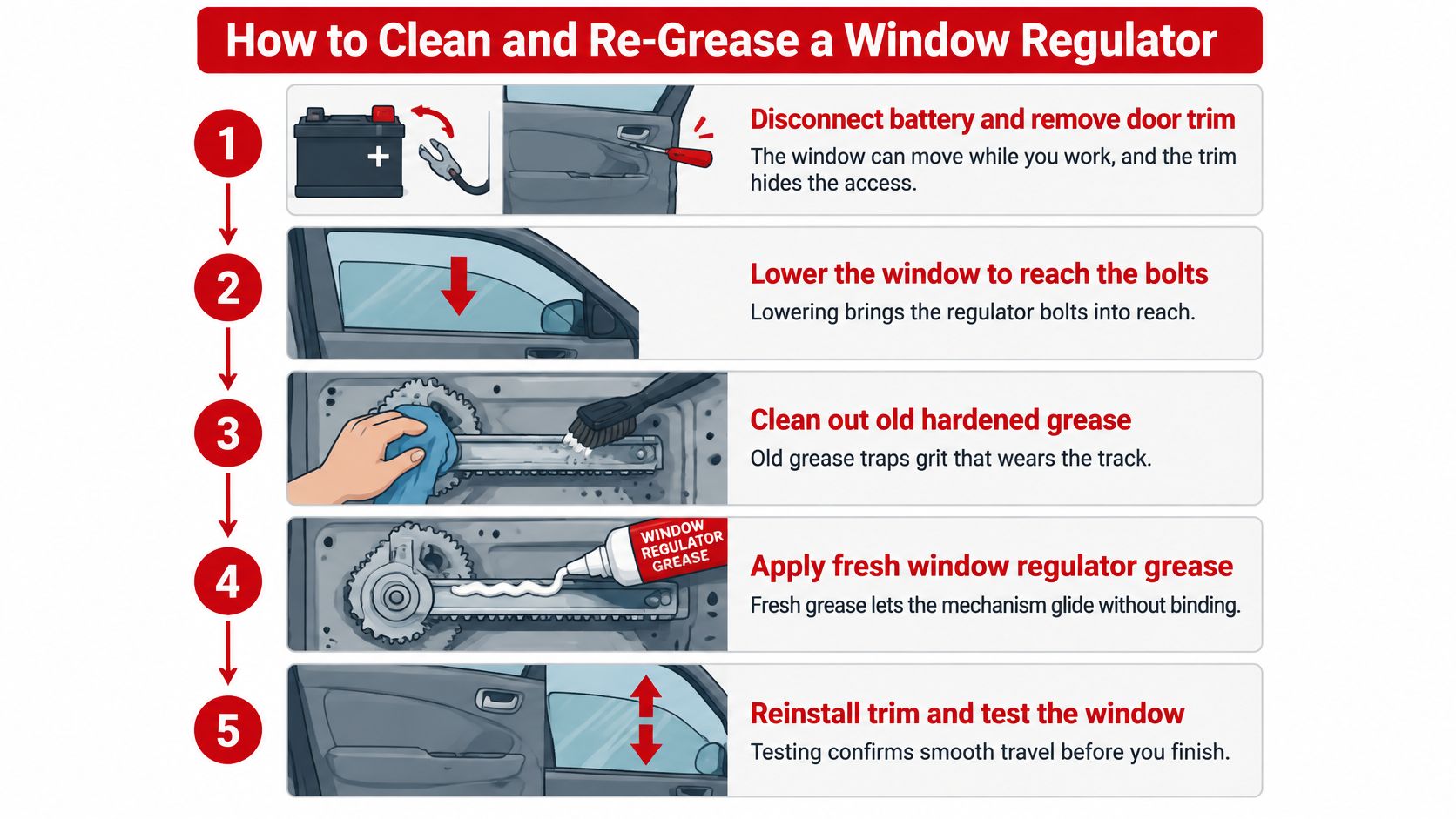
- Disconnect the battery and remove the door trim. The window can move while your hands are inside the door. Use plastic trim tools and release the clips from the bottom edge upward.
- Support the glass, then unbolt the regulator and unplug the motor. Move the glass until the regulator fasteners are accessible, then secure it with tape or a wedge so it cannot drop.
- Remove old grease and grit. Use a plastic-safe solvent and a soft brush on the regulator surfaces. Vacuum or wipe away loosened residue before it can scratch the track.
- Clean the run channel and seals. Keep solvent off the rubber where possible. Wipe the channel with a damp cloth, then dry it fully; grease applied to a wet surface may not stay in place.
- Apply a thin, even film using the placement table above. Keep grease on the specified contact surfaces rather than spreading it across the whole assembly.
- Treat the run channel lightly, then wipe the glass. Apply only a small amount of suitable lubricant to the channel and remove any transfer from the glass.
- Reinstall the regulator and reconnect the battery. Cycle the window through its full travel several times so the lubricant spreads along the working surfaces.
- Check the movement and alignment. The glass should travel smoothly and stop level at both ends. Crooked movement points to a mechanical fault that lubrication will not correct.
The video below shows the procedure and the small amount of product needed:
After reassembly, check for smooth travel, grease on the glass, and any binding at the point where movement was rough before cleaning. If the window improves briefly and then slows again, residue may remain in the channel, or the lubricant may not suit the conditions.
Telling Lubrication Problems From Regulator Failure
The most common symptom is a squeal or a jerky stop-start as the glass moves, and it's the one most likely to be a lubrication fault. The sound is stick-slip: the slider grips the track, releases, grips again, and the motor loads and unloads with it. Clean and re-grease, and that symptom usually goes away within one cycle.
The useful test is whether the glass moves straight and level. Rough movement with a glass that tracks true is a lubrication problem. Rough movement with a glass that tilts, drops, or runs crooked is mechanical, and no amount of product will square it up.
| Symptom | Likely cause | Fix |
|---|---|---|
| Squeal or groan as the glass moves | Dried or missing guide grease | Clean the guide and re-grease with silicone or PTFE grease |
| Jerky stop-start travel | Stick-slip from aged or contaminated grease | Clean the track and apply a thin new film |
| Slow travel with a whining motor | Over-greased gears or dried lubricant | Remove excess grease and re-grease lightly |
| Glass drops, tilts or runs crooked | Broken clip, slipping cable or distorted track | Replace the failed part or the regulator; grease will not fix it |
| Window stops partway with no motor sound | Failed switch or motor circuit | Test the switch and motor before touching the grease |
| Grinding after re-greasing | Worn gears or stripped teeth | Replace the regulator assembly |
Read the table in that order, from top to bottom, because the cheap causes are also the common ones. A groan on the way up is nearly always a dry guide. A window that stops partway with no motor sound at all is electrical: the switch, the motor circuit, or a broken wire in the door jamb boot. Silence never confirms a bad motor on its own, so test for power and ground at the connector before buying anything.
A slow window with a whining motor is the case that catches out enthusiastic DIY owners. Often it's over-greased gears or old lubricant that has stiffened into something closer to glue, and the motor is fighting both the drag and the excess. Strip it back to clean surfaces before adding anything.
Stop cycling a window that binds in the same spot every time. Each attempt works a weak regulator harder, and a repair turns into a replacement.
Where grease stops being useful: a glass that drops into the door, one that tilts in the opening, or one that runs crooked after a proper clean. Those point to a broken clip, a slipping cable, or a distorted track. There's a full breakdown of window regulator problems worth reading before you spend another hour with a grease gun.
Grinding that starts after a re-grease is the other clear signal. Fresh grease doesn't cause grinding; it reveals worn gears or stripped teeth that the old, thick residue was cushioning. Adding more will only quiet it briefly and hide the wear while it gets worse.
Decide Whether to Re-Grease or Replace Your Regulator
Three questions settle it, and you can answer all of them with the panel off and the battery connected.
- Does the glass move straight and level after cleaning? If it tracks true through the full range, the mechanism is sound.
- Does the cable hold without slipping? A cable that jumps or slips under load is failing, regardless of lubrication.
- Does the motor run without grinding or stalling? Noise from inside the gear housing means worn teeth, not dry grease.
Three yeses means re-grease as described and watch the window for a few weeks. Any no means replace the assembly. Grease on a broken clip or a stretched cable buys you days and costs you a door panel removal.
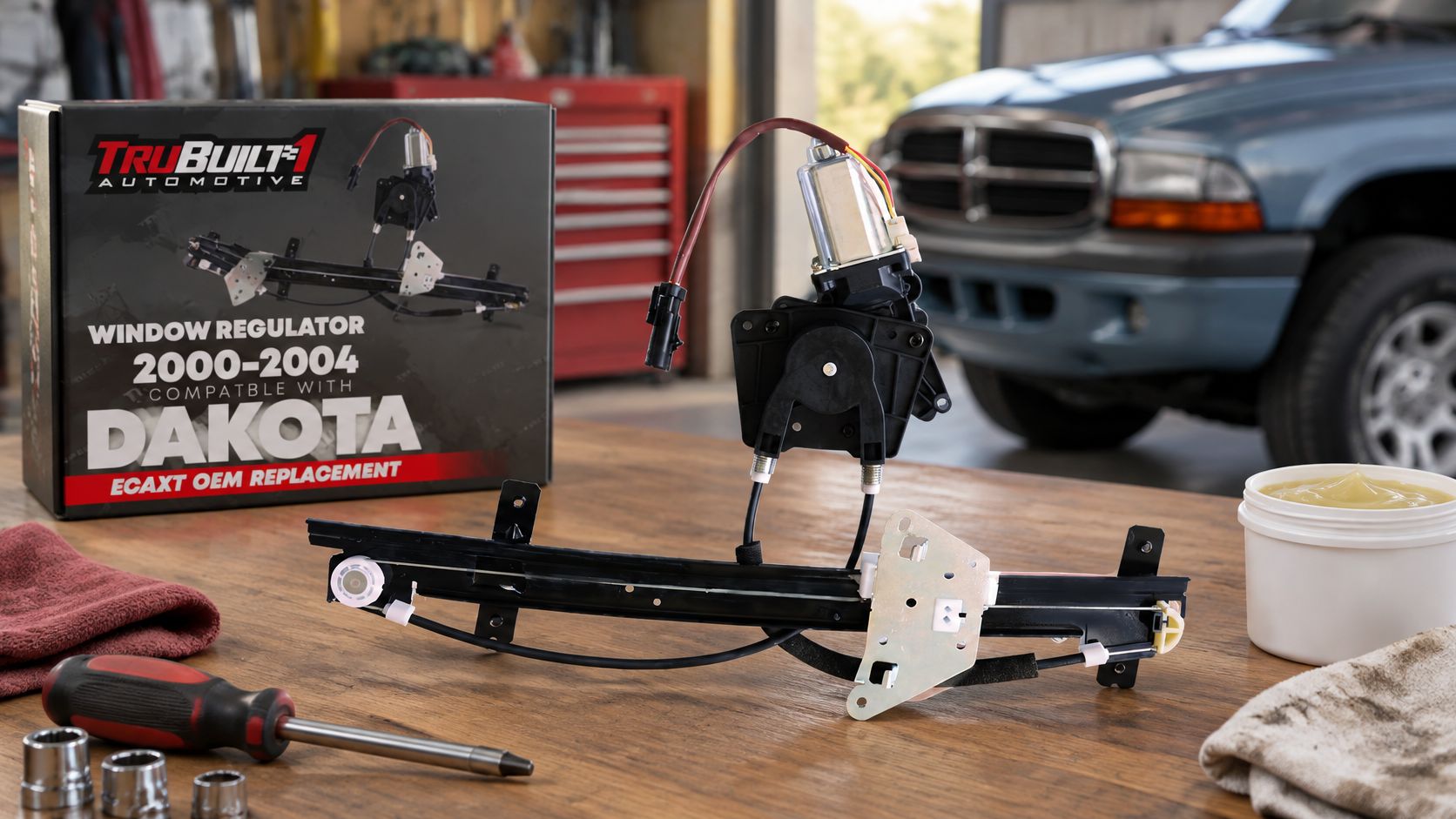
When you go the replacement route, match more than the year, make, and model. Confirm front or rear door and driver or passenger side, compare the connector shape and pin count, and check the mounting points against the old unit before you commit. A complete assembly such as this Power Window Regulator w/Motor Assembly, Front Passenger Side - Compatible with 2000-2004 Dodge Dakota, 1998-2003 Dodge Durango - OEM 5066430AB, 55256418, 741-648 ships with the motor already fitted, which removes the transfer and alignment step that trips up a lot of first-time installs.
If you've diagnosed a failed regulator rather than a dry one, T1A Auto stocks powered and manual window regulators alongside the cables, hinges, latches, and door handles that fail around them, all tested and quality-controlled to meet or exceed OEM specifications. Search by vehicle to confirm the exact fit for your truck or car before the panel comes off, and check the mounting points and connector against the old part when it arrives. Visit T1A Auto to match the right assembly to your vehicle and get the window moving properly again.
