


You can hear a motor whir and still watch the glass sit dead in the door. So why do so many parts orders start with a motor when the cables, arms, or rails are what quit?
A window regulator without motor is the lift hardware by itself. Match the symptom to the failed part, confirm the door and the build, and buy only what the checks support.
Table of Contents
- What a Window Regulator Without Motor Actually Does
- Which Part Has Failed
- Regulator-Only Versus Complete Window Assembly
- Matching a Regulator to Your Vehicle
- Purchasing Checklist for Materials, CAPA and Warranty
- How to Install a Regulator Without Motor
- Common Pitfalls and Troubleshooting
- Frequently Asked Questions for DIYers, Shops and Fleets
What a Window Regulator Without Motor Actually Does
Turn a manual crank and the glass rises. Something between the handle and the pane has to turn that spin into straight vertical travel. That something is the regulator.
Common layouts do the same job in different ways. Cable-drum systems wind a cable onto a drum. Cross-arm scissor linkages pivot a main arm against a movable rail. Gear-and-rail arms push the glass along a track. Gears, cables, arms, and channels all convert crank rotation into controlled up-and-down movement.
The split of jobs is the part people mix up. The regulator guides and supports the glass. A motor, when the door has one, only supplies the driving force. A motorless replacement normally reuses the existing crank and needs no electrical connection.
Manual hardware still earns its place because it skips electrical failure modes: burned-out motors, damaged switches, wiring faults, and low-voltage operation. You still see it on entry-level cars, commercial and fleet trucks, older vehicles, and any door where the original motor still runs but the lifting hardware has failed. OICA reported 92.7 million motor vehicles produced worldwide in 2024, so the fleet that will eventually need a mechanical window repair stays huge. Fit still depends on door position, body style, model year, glass mounting points, regulator geometry, and whether the truck or car left the factory with manual or power windows. Two trucks that share a model name can still need different regulators.
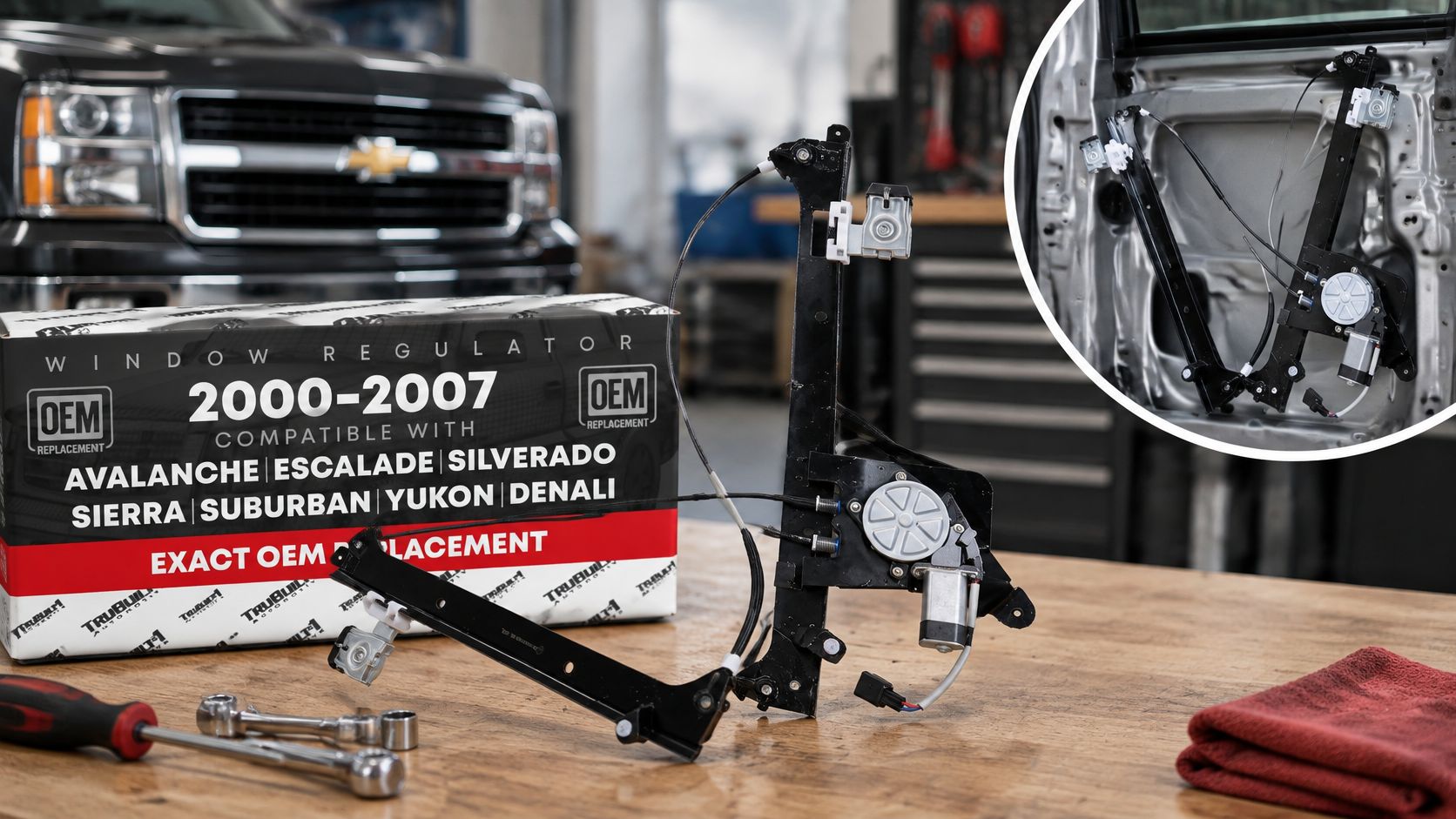
Practical rule: If the crank turns and the glass moves with effort, grinds, or drops unevenly, the regulator is the likely suspect. If a powered window will not move at all, start with power and ground before you blame the lift hardware.
Which Part Has Failed
Diagnose before you buy. A window regulator without motor is not an automatic money-saver if the motor you plan to transfer is already worn out.
Slow movement, chatter, a sudden drop, and pinch-protection faults can come from the regulator, the motor, the glass channels, or the wiring. Manufacturer service information treats those symptoms as shared. Excessive resistance, motor gear wear, backlash, bushings, wiring, glass channels, and regulator alignment can all look the same. One Ford bulletin ties glass jumping or chattering to several motor-related conditions and calls for inspection or replacement of multiple door components, not the regulator alone. Another bulletin says to replace a regulator only when a motor axle guide is outside specification. The two parts need separate diagnosis.
Run the checks in this order
- Test switch power and ground with a multimeter before the door panel comes off.
- Listen for the motor when you press the switch. A whir with no glass travel points at the lift link, not a dead circuit.
- Move the glass by hand, with it supported, and feel for binding or uneven resistance in the runs.
- Inspect cables, rails, and carrier bolts for fray, a torn track, or loose fasteners.
- Compare the motor axle guide and gear with the service specification before you reuse that motor.
Transferring a motor that still runs can cut cost and waste. Transferring a worn, high-resistance motor recreates the original failure and can upset anti-pinch behavior. The difference between a motor and a regulator is laid out in this window motor versus regulator comparison if the symptom still feels ambiguous.
| Symptom | Likely cause | Check first |
|---|---|---|
| Glass drops suddenly or falls into the door | Broken cable, torn rail, or loose carrier bolts (regulator) | Inspect cable, rail, and carrier bolts |
| Slow or hesitant movement with a strained motor sound | Friction in glass channels or a worn motor gear | Clean and lubricate channels, then test motor movement |
| Motor runs but glass does not move | Stripped motor gear or a disconnected arm | Check spline and arm engagement |
| Chattering or jerky movement | Worn motor gear, bushing wear, or misalignment | Measure motor axle guide against specification |
| No motor sound and no movement | Blown fuse, faulty switch, or wiring | Test switch power and ground |
| Auto-reverse triggers early | Excess resistance from the glass run or a binding regulator | Move glass by hand to find binding |
Match the row, run that first check, then order the part the result points to.
Regulator-Only Versus Complete Window Assembly
You can order three different things, and they are not interchangeable.
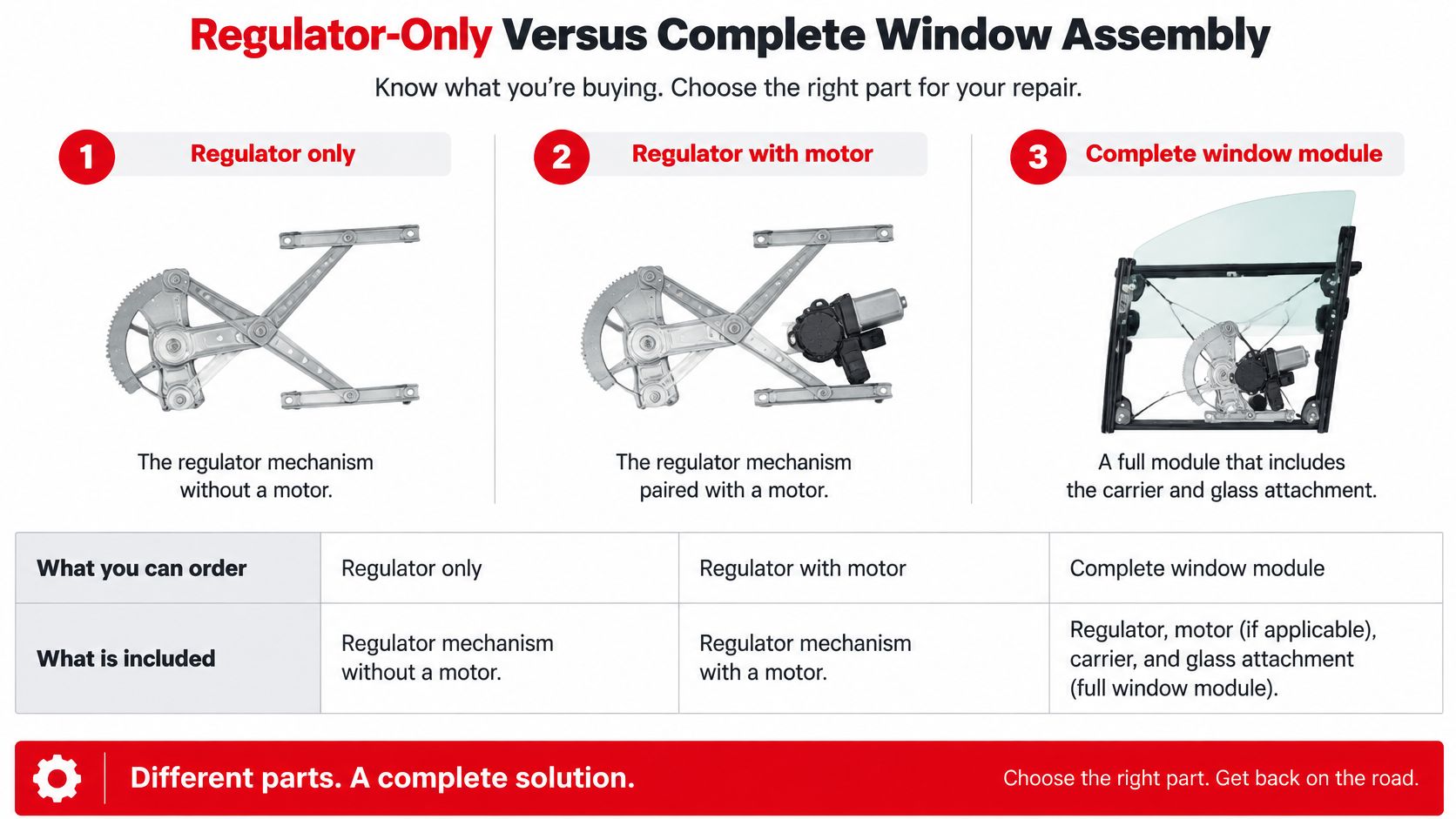
| Option | What it includes | Transfer needed | Best when |
|---|---|---|---|
| Regulator only | Lift arms or cable drum with carrier | Original motor and switch | Motor tests good and only the lift hardware failed |
| Regulator with motor | Regulator and motor mounted together | Wiring and switch | Motor failed but door wiring is sound |
| Complete window module | Carrier, regulator, motor, and glass attachment | Connector and bolts only | Several parts failed or a fast repair is needed |
A regulator-only purchase is the lowest parts spend when the motor still passes the checks above, but you have to seat the motor spline yourself. A regulator with motor suits a failed motor when the harness is sound. A complete module removes most of the alignment work and suits several failed parts or a shop that needs the truck back the same day. It also costs more, and parts are only one slice of a shop invoice.
On a front driver door of many 2000–2007 Chevrolet and GMC trucks, a Power Window Regulator with Motor, Front Driver Side, Upgraded Metal is the paired assembly, listed to OEM 15095843 and 741-644, built in metal for that left front opening.
Why a manual unit still has to hold the glass
In the United States, Federal Motor Vehicle Safety Standard No. 118 has applied to passenger cars and multipurpose passenger vehicles with power windows manufactured since February 1, 1971. NHTSA wrote it to reduce injury when someone is caught between a closing window and the frame, channel, or seat. The rule targets power systems because they can close without continuous effort and can be triggered by accident. A manual regulator sits outside that electrical problem: you have to turn the crank, so the glass does not rise on its own after the key is off.
The mechanical job remains safety-critical. The assembly has to hold the glass, keep it in the run channels, resist backlash or an uncontrolled drop, and bolt correctly to the door shell and the glass carrier. A failed unit can leave the window stuck open, partly closed, or unsupported. That hits weather sealing, visibility, security, and daily use.
This short clip shows the regulator and motor as separate pieces during a door repair:
Matching a Regulator to Your Vehicle
Which regulator fits your door? A wrong order usually fails one of four checks: door side, door position, body style, or model year. Glass mounting points, regulator geometry, and whether the truck left the factory with a crank or a motor can differ even when the badge on the tailgate matches.
Newer doors add another layer. NHTSA-hosted service bulletins show regulators that change by supplier and production date. Replacement electronics can need a specific calibration file, and the wrong file can set a window-motor configuration fault. The same bulletin notes cases where some assemblies need both the regulator and the motor replaced, while another supplier's motor still works with the existing setup. Anti-entrapment logic adds one more variable: automatic reversal can be delayed during unattended closing. That is powered-window behavior, and it is why a late-model part should not be chosen from a photo.
What to confirm before you pay
- Read the VIN and the build date, not just the model name on the title.
- Note connector style and motor spline so the reused motor mates properly.
- Confirm the supplier or option code when the repair information lists one.
- Check whether initialization or a scan-tool calibration is required after the glass is back in.
Older cable regulators are mostly a mechanical transfer. Late-model systems tied to body electronics and pinch protection are not. A visually identical, motorless regulator will not cover every trim or build date. Use a VIN parts search before you commit.
| Vehicle case | Must match | Verify before ordering |
|---|---|---|
| Older cable-type manual regulator | Door side, glass mounting points, body style | Model year and door position |
| Late-model powered window | Connector style, supplier, motor spline | VIN, build date, and repair information |
| Pickup door (Tacoma, Tundra, F-Series, Silverado, Sierra) | Cab style, door side, and model year | Year range and whether a motor is included |
| Fleet or commercial vehicle | Original manual or powered specification | VIN and fleet part record |
A regulator that bolts up but uses the wrong spline will spin without moving the glass, and you will have paid for a second diagnosis.
Purchasing Checklist for Materials, CAPA and Warranty
Tick these five items before you pay. A wrong regulator is cheaper to catch on the listing than inside the door.
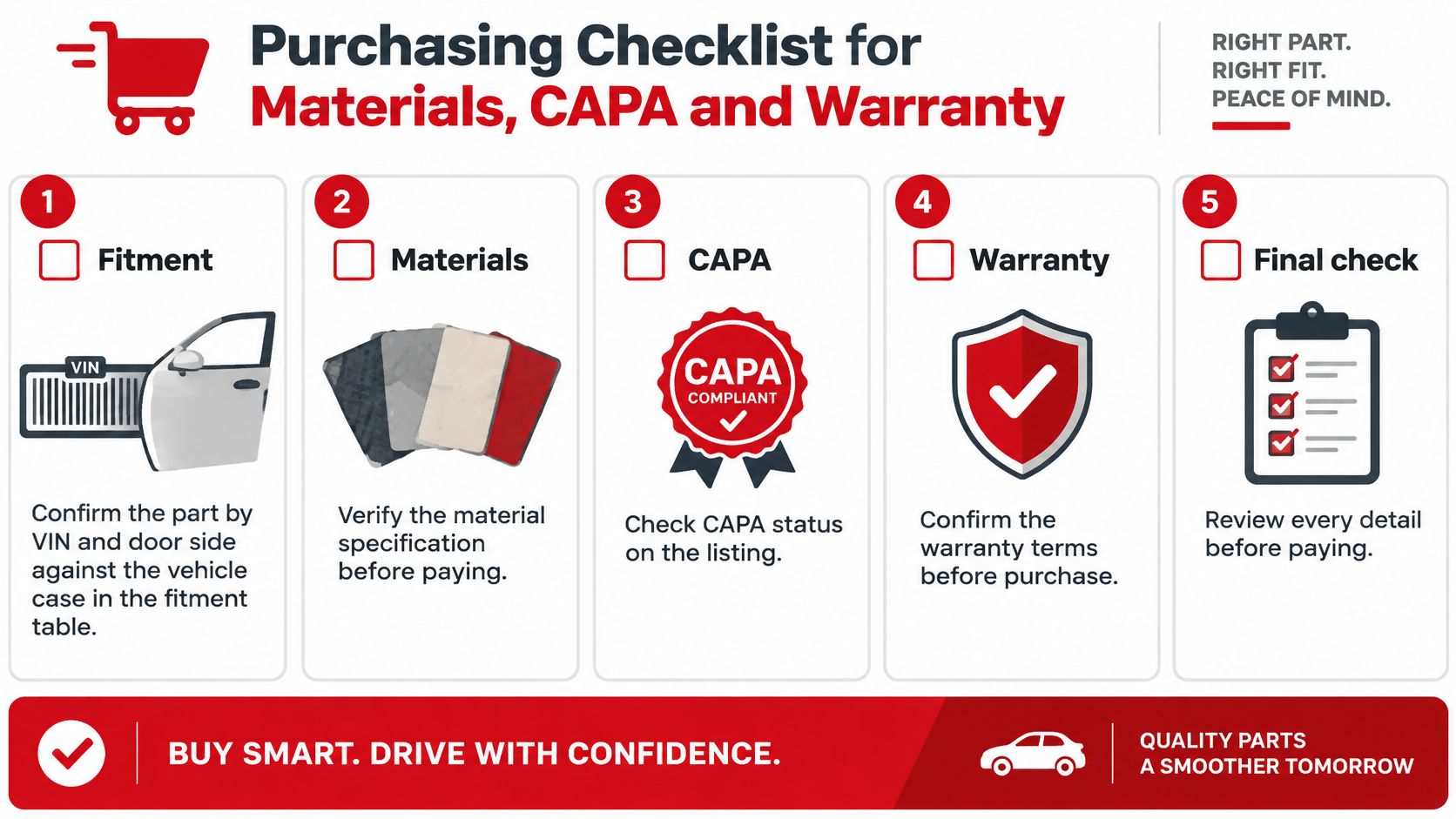
Fitment. Confirm the part by VIN and door side against the vehicle case in the fitment table. A Silverado front left and a Silverado rear left are different parts even when the photos look close.
Materials. Prefer metal arms, carriers, and housings. Plastic pivots and sliders are the usual break points on older regulators, and a metal replacement is what you want when the door gets daily use.
CAPA. Look for CAPA certification when a body shop or insurer is paying. It means the part was independently checked against the original for fit and performance. Shops that need that paperwork can start with how CAPA-certified parts are judged.
Warranty. Compare length, and notice whether metal parts are covered differently from standard items. We back metal components with a lifetime warranty and standard items with a 3-year warranty. Coverage does not include cosmetic damage that does not affect function, or parts damaged by other faulty components on the vehicle. Extended coverage only applies if you register the order on our website. An unregistered order is not eligible.
Paperwork. Keep the receipt, the part number, and the VIN together. Most warranty claims are settled with photos or video, and you usually do not have to ship the old part back.
Final pre-order sequence
- Symptom: Match the failed behavior to the diagnosis table.
- Identity: Confirm VIN and door side.
- Scope: Choose regulator-only, regulator-with-motor, or a complete module from that diagnosis.
How to Install a Regulator Without Motor
A manual regulator is a gear-and-linkage the crank drives directly. Cross-arm designs use a pivoting main arm and a movable rail to turn that rotation into roughly vertical glass travel. A published dynamic simulation of a cross-arm regulator modeled a 510 mm window stroke, an 80 N glass payload, and a 10-second lift and lower cycle. It calculated a maximum kinematic reaction force of 116.06 N, near the middle of the cycle, with peak main-arm stress at the movable-rail connection, as described in this regulatory reference on vehicle equipment. That figure is a modeled benchmark, not a spec for every truck. It does tell you where to look: the arm-to-rail joint, the pivot, and the fasteners. A bent arm, loose rivet, distorted rail, or crooked channel raises crank effort and piles load on those same spots.
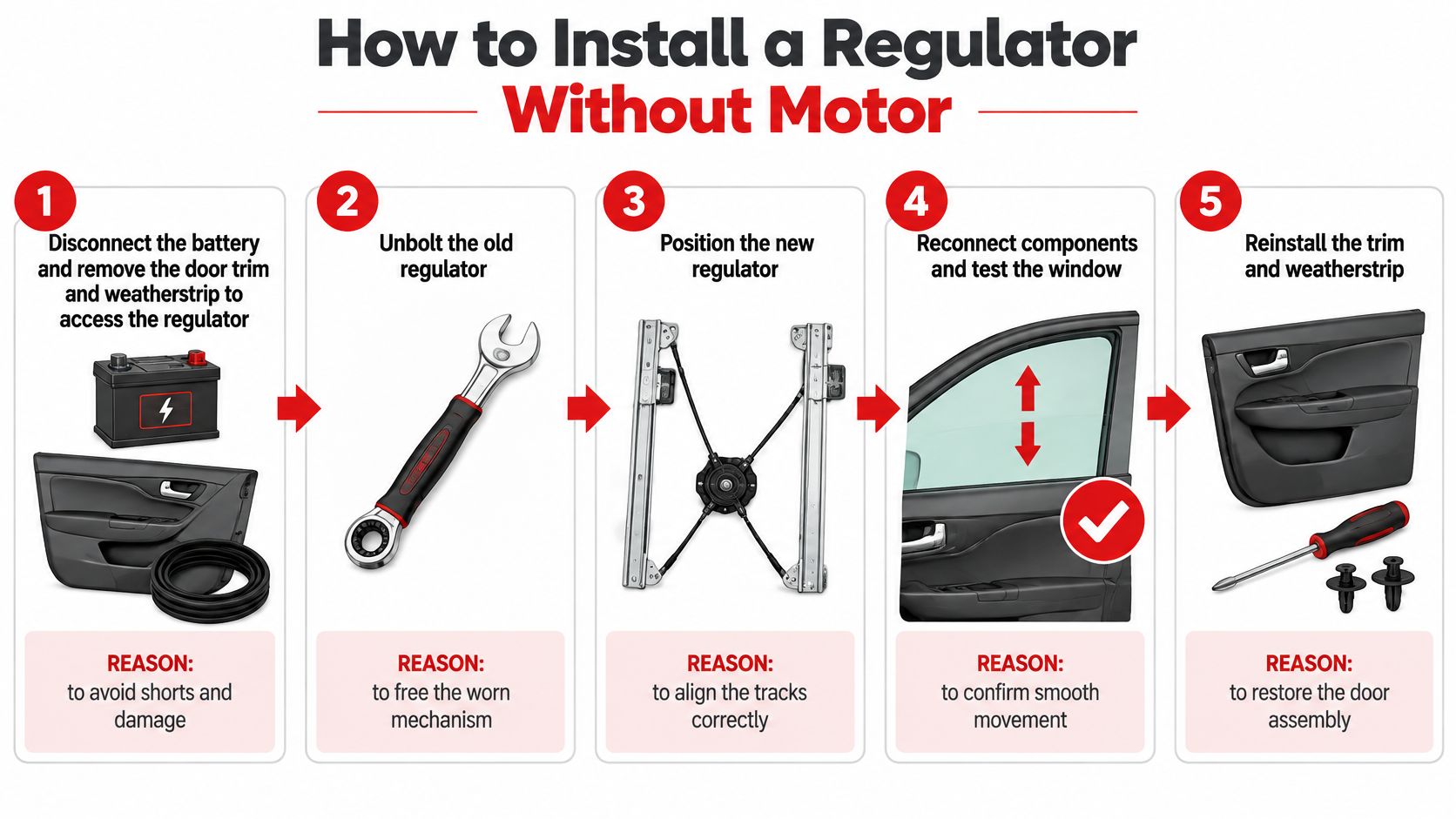
Have a socket set, a trim tool, a glass clamp or wedge, a multimeter, and light grease ready.
- Disconnect the battery, then remove the door trim and the weatherstrip. You avoid a short, and you avoid cracking the panel clips.
- Support the glass with a clamp or wedge before any regulator bolt comes out. Unsupported glass can drop into the door.
- Unbolt the old regulator and work it out through the access hole. Note how the arms or cables sit so the new unit goes back the same way.
- Leave the glass carrier bolts loose. The pane has to shift while you align it.
- Set the new regulator, engage the motor or the crank shaft, and start the mounting bolts by hand so you do not cross-thread them.
- Cycle the window slowly through full travel. You are hunting for binding, not for speed.
- Tighten the carrier and regulator bolts to the service spec only after the glass runs freely.
- Check the top seat and the weatherstrip. The seal should touch the whole perimeter, not just the corners.
Grease on the pivots and the glass-run channels cuts drag. Grease will not straighten a twisted rail or a pane that is sitting crooked. Support the glass independently, keep the carrier bolts loose during the first alignment, and cycle gradually.
Common Pitfalls and Troubleshooting
Check the first full up-and-down cycle after install. If the glass binds, jumps, or stops short, match the symptom to the likely cause before you order another part.
| Symptom | Likely cause | First check |
|---|---|---|
| Glass sits crooked or jumps the channel | Carrier tightened before the pane was seated | Loosen the carrier bolts, settle the glass in both runs, cycle once, then retighten |
| Weatherstrip touches in spots and gaps in others | Glass run out of line, or a channel is bent | Reseat the run before adding force at the crank |
| Crank effort spikes near the top | Contaminated channels, swollen seals, or a binding arm | Clean the run, then inspect the arm for distortion |
| Chatter after reusing the motor | Loose mounting bolts or a worn motor gear | Recheck power, ground, spline engagement, and axle-guide condition before replacing the new hardware |
| Auto-reverse or anti-pinch acts up after a powered install | A late-model door needs initialization or scan-tool calibration | Follow the repair information for that VIN before swapping the part again |
| Glass type or orientation changed during the repair | The regulator does not set the pane's seating or travel limits by itself | Keep the original glass type, orientation, carrier attachment, travel limits, and channel engagement |
The last row deserves a slow check. A pane that was swapped, flipped, or reattached at a different carrier height can look correct at rest and still tilt out of the front or rear channel once the door shuts. Confirm the glass stays seated with the door closed, then cycle it again before you call the repair finished.
Frequently Asked Questions for DIYers, Shops and Fleets
Can I fit a regulator without a motor on a powered window? Only when the existing motor tests good and the design lets you transfer it. Confirm the original configuration, connector, and spline before you buy a motorless unit.
How much does a power-window repair cost? In 2024–2025, a U.S. replacement power-window repair typically cost USD 200–600 at an independent shop and USD 350–800 at a dealership, according to T&P Auto Repair. Parts are only one part of that bill.
Does a shop need a scan tool? Usually only on late-model powered systems whose repair information lists a calibration step. Older cable manual regulators normally need none.
What should a fleet stock? Keep complete modules for trucks with several failed parts and a same-day turnaround. Stock regulator-only parts where motors have been tested and can be reused. Write the VIN, door side, and original part number on each vehicle's service record so the next repair and any warranty claim stay simple.
T1A Auto carries powered and manual window regulators, including metal upgrades that replace worn lift hardware on trucks and cars. Match the failed symptom, the door, and the build, then order the regulator-only or regulator-with-motor assembly that the checks support. Visit T1A Auto to look up the regulator for your vehicle.
