


You pulled the door card to swap a speaker, and now one clip is sitting on the floor in two pieces while the panel edge ticks against the metal every time you hit a seam in the road. That tick is not a mystery rattle. It is a fastener that no longer holds the trim at the right tension, and grabbing the stiffest clip in the drawer can crack the hole you still need.
Automotive trim fasteners are the small parts that keep moldings, door cards, bumper covers, fender liners, and underbody shields on the body. The useful way to judge a replacement is controlled release and the condition of the panel afterward, not the highest pull-out number on a spec sheet. A clip that will not let go without tearing plastic has failed the repair even if it never falls out on the highway.
Table of Contents
- Trim Fastener Types and Where Each One Sits
- When a Loose Trim Clip Starts to Rattle
- How to Identify the Right Replacement Fastener
- Matching Fasteners to Panel Material and Load
- Reusing Fasteners Without Damaging Panels
- Recycled-Content Clips and Lifecycle Trade-Offs
- Order a Matching Set and Keep a Spare
Trim Fastener Types and Where Each One Sits
Trim fasteners hold interior and exterior trim to the vehicle. They are not structural bolts. They locate a panel, keep it from buzzing, and let a technician get the panel off again. Treat them like snap buttons on a jacket. The head and the hole have to match, or the snap either will not close or it will rip the fabric.
Five shapes cover most of what you will find on a car or truck.
| Fastener type | Typical locations | Material | Reuse after removal |
|---|---|---|---|
| Push-pin (two-piece) clip | Door cards, wheel arches, underbody shields | Plastic | Often reusable; the center pin is usually replaced |
| Christmas-tree (fir-tree) clip | Door panels, interior trim | Plastic | Usually replaced after removal |
| Screw-and-grommet assembly | Bumpers, fender liners, grilles | Screw with plastic grommet | Screw and grommet often reusable |
| Metal spring or retainer clip | Exterior moldings, some trim pieces | Spring steel | Reusable if undamaged |
| Rivet or expansion fastener | Fenders, underbody parts | Plastic or metal | Usually single-use |
How each shape actually holds
A push-pin is usually two plastic pieces. You push the center pin to spread the legs in the hole. On a door card or wheel-arch liner, the outer body often survives and only the center pin needs a new mate. A Christmas-tree clip is one piece with barbed flanges. Those barbs bite on the way in and usually shear or take a set on the way out, so plan on a new one after the first removal.
A screw-and-grommet is the friendliest service fastener. The screw draws a plastic grommet tight in a bumper, fender liner, or grille hole, and both pieces often go back in if the threads and the grommet collar are intact. A metal spring clip grips exterior moldings. If the spring still snaps back and the paint under it is not gouged, it can stay. A rivet or expansion fastener on a fender or underbody shield is built to stay put. Once you drill or pry it, it is done.
Read the head before you pry
Look at the head while the clip is still in the car. A round head with a smaller center button is a push-pin. A low ribbed stem with no separate pin is a fir-tree. A Phillips or hex recess in a collar is a screw-and-grommet. A bright steel edge under a molding is a spring retainer. A flush mushroom with no release slot is usually a rivet.
Practical rule: Name the type from the head, then pick the tool. A forked plastic trim tool fits under a push-pin. A screwdriver under that same head is how door-card paint gets a crescent scar.
If the panel plastic is chalky gray, clean and treat it before you judge cracks around the holes. A restore faded plastic car trim step makes hairline splits around clip bosses easier to see, so you do not press a new fastener into plastic that is already done.
When a Loose Trim Clip Starts to Rattle
A clip that looks seated can still be the noise. Plastic clips do not have one fixed stiffness. Molding tolerances change how hard the legs spring, and preload, panel contact, and how the mount is constrained change the assembled part even more. Measurements of small interior clips show that those boundary conditions move stiffness and damping as much as the resin itself, which is why a loose connection rattles and a fuller mount preload can stop it, as described in this UCL conference paper on clip connections.
That is a service problem at real volume. Body and exterior systems represented 45.56% of automotive fastener application demand in a 2025 estimate, and modern electronic modules can add about 30–50 micro-fasteners per vehicle, according to Mordor Intelligence. Cameras, sensors, and radar sit on the same bumper covers and liners that already use push-pins. One lazy clip in that stack is enough for a tick over broken pavement.
Four checks before you blame the panel
- Throw out a dead clip: If it is cracked, permanently bent, or the legs no longer spring back, it cannot rebuild preload. A new clip of the original stiffness is the fix, not tape under the edge.
- Line up every hole first: If the panel is shifted, one fastener carries the edge. Press only after each hole sits over its mount.
- Stop at flush: Seat the head until it is flush with the trim. An over-stiff substitute that needs a hammer blow is how paint chips and aged plastic splits.
- Press and listen: After the panel is on, push along the edge with your palm. Movement or a tick means that clip never reached preload.
Door cards, wheel-arch liners, and bumper covers are the usual culprits. A window-belt rattle often starts the same way, and a car window trim repair is worth doing only after the retainers under that molding hold firm. Leave the loose fastener in place and the noise comes back on the next cold morning, when the plastic is stiffer and the gap is louder.
A rattle is a retention problem first. Restore the original preload with the correct clip.
How to Identify the Right Replacement Fastener
Guessing from a photo on your phone is how a "close" clip ovalizes a hole. Work from the vehicle, then the clip in your hand, then the hole it came out of.
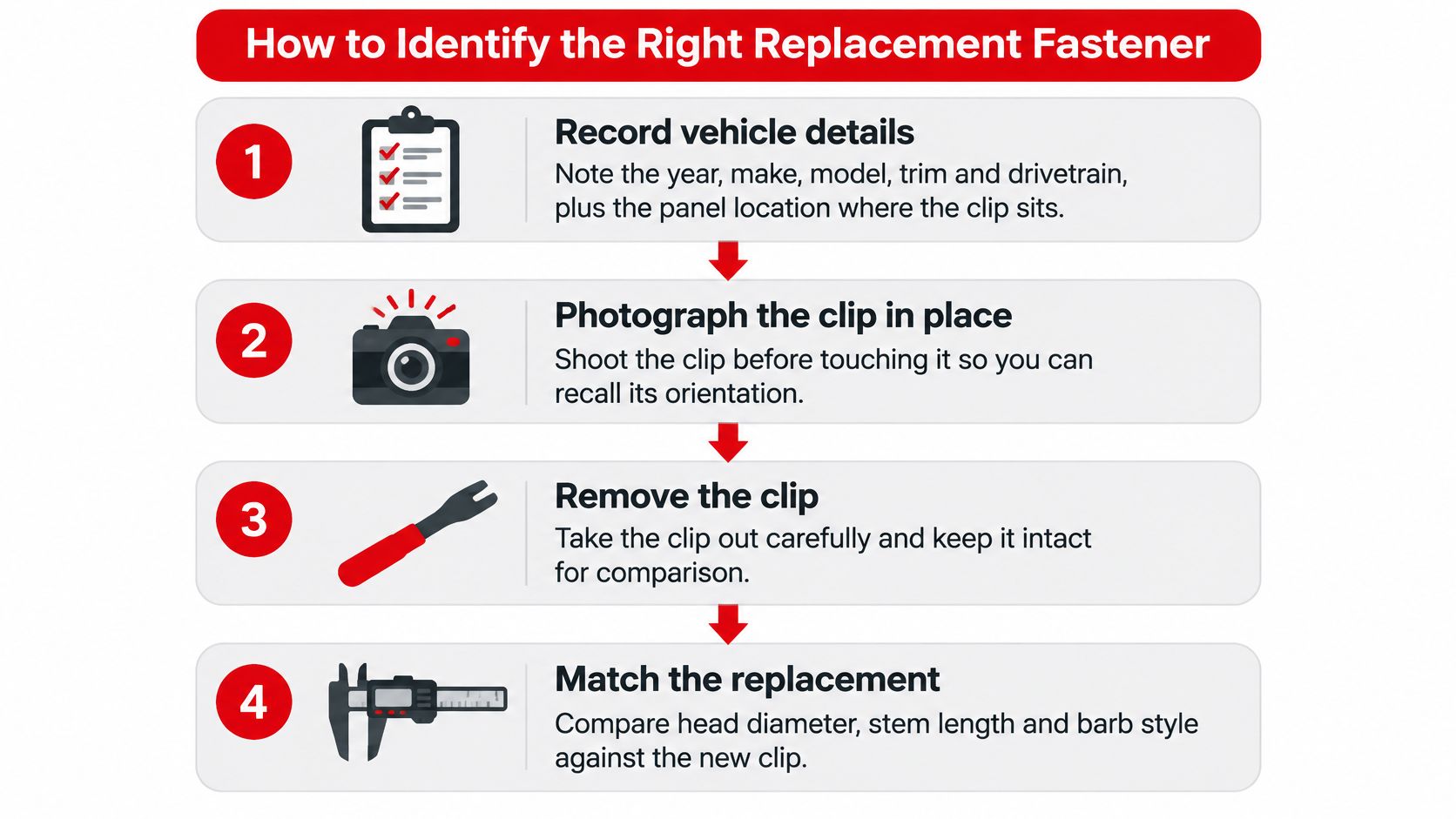
- Write down the year, make, model, trim, and drivetrain, and name the panel. A fender-liner clip and a door-card clip from the same truck are not interchangeable just because both are black.
- Photograph the clip in place before you touch it, including which face points outward. Orientation is the detail people forget once the part is in a cupholder.
- Lift it with a plastic trim tool, not a flat screwdriver, and sort it into push-pin, Christmas-tree, screw-and-grommet, metal spring, or rivet. The tool choice is what keeps the head intact for measuring.
- Measure hole diameter, shaft or stud length, and head shape, and note how thick the panel stack is. Nominal "large push-pin" labels skip the stack-up, and that is the dimension that sets preload.
- Look for cracks, bent legs, and a stem that stays collapsed. Any of those means the old part is a sample, not a reusable fastener.
- Match material to the panel. Plastic clips belong on plastic trim. Metal retainers belong where the load or the painted edge needs a spring that will not creep.
- Search by vehicle on our site, or read any part number molded into the old clip. You can search for parts by vehicle on the T1A Auto website, which narrows the list before you compare shapes.
- If two candidates still look alike, contact our parts specialists with the vehicle details. The team will help confirm compatibility before you order a box that does not match the hole.
Dry-fit the new clip in the bare hole, then with the panel. The head should seat flush without a second hard shove. Write the orientation and the hole condition on a piece of tape and stick it in the glove box. The next time that panel comes off, you will not be starting from a mystery stem.
The short version of that removal is easier to follow on video if you have not popped a door card before.
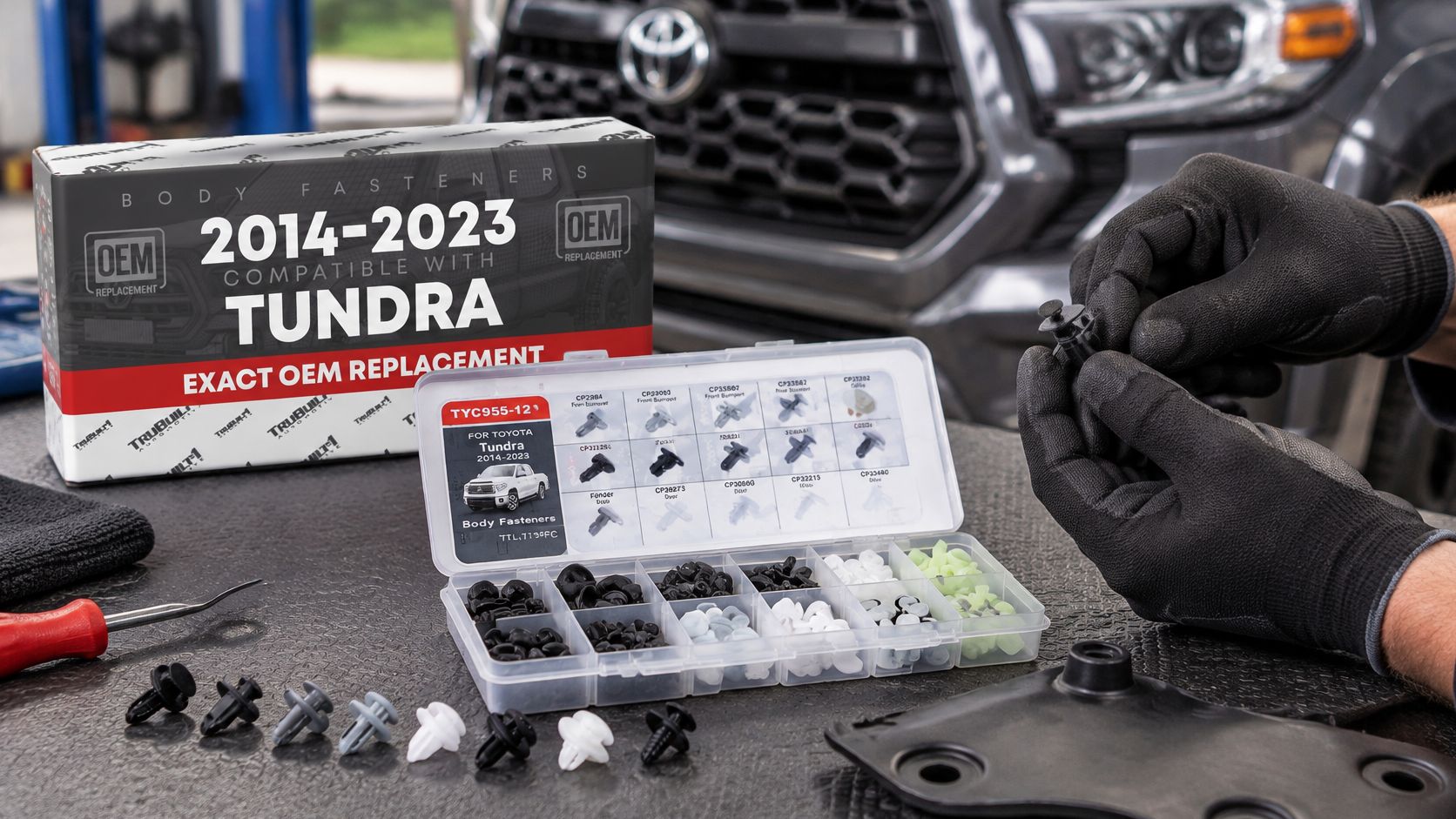
On a 2014–2023 Toyota Tundra, a mixed set such as the 120 pcs Body Fastener Kit - Compatible with 2014-2023 Toyota Tundra - Suitable for Bumper, Grille, Fender, Door Trim, Wheel Opening, More - Plastic and Metal includes plastic and metal pieces for the front bumper, fender, grille, wheel opening, door trim panel, and seal strip. Pull the one that matches the clip in your hand. Do not assume every piece in the box belongs in every hole.
Matching Fasteners to Panel Material and Load
Size is the wrong first question. Clip engagement behaves like a spring-loaded door latch: the head may line up with the hole, but the stem, waist, and flange decide whether the panel stays quiet and comes apart cleanly. Insertion force often rises first from friction, then again as the clip waist compresses. Pull-out depends on friction, hole shape, panel thickness, and the direction of the load. A Chalmers analysis of clip engagement explains why a replacement should match hole diameter, panel stack-up, engagement depth, and clip stiffness rather than relying on a nominal length printed on a bag.
That is the controlled-release idea. A trim fastener has two jobs that pull against each other. It must hold the panel firmly enough to stop movement, and it must let go before the panel, paint, or mounting boss gives up. A clip that is too stiff can chip painted sheet metal or crack aged plastic on the way in. One with too little preload lets the panel walk, squeak, and eventually separate at the attachment point. Controlled seating force, followed by a firm tug that proves retention, tells you more than a head that merely looks flush.
| Panel material | Fastener approach | Main risk |
|---|---|---|
| Polypropylene or ABS trim | Match original clip stiffness and hole size | Cracking, especially in cold weather or on aged plastic |
| Painted sheet metal | Use a clip that seats without over-preloading | Paint chips and scratches from an overly stiff clip |
| Carpet or fabric-backed panel | Use a clip with a wider flange or washer | Panel sag if the flange is too small |
| Thin mounting boss | Inspect the boss before replacing the clip | Breaking the boss, the failure point that matters most |
That last row is easy to miss because the clip can look perfect while the tower it plugs into is already white at the root. Pressing a fresh fastener into a tired boss finishes the break. Then the repair is no longer a quiet rattle fix. It becomes a panel repair.
Seat the clip with steady thumb pressure. If it needs a mallet, it is the wrong stiffness for that stack.
Mixed plastic-and-metal kits exist because one vehicle can use both families in different trim areas. For a 2015 to 2023 Ford Transit, the Body Fastener Kit - Compatible with 2015-2023 Ford Transit covers bumper, grille, fender, and door trim pieces in plastic and metal. Sort them by the hole you measured, not by color. If you want a closer look at how those dimensions are listed, the notes on fastener specifications are the checklist to keep next to the calipers.
Reusing Fasteners Without Damaging Panels
Maximum holding strength is a bad quality score for a service clip. Tight enough to kill a rattle can also oval a door-card hole, snap a thin boss, or turn into trash the moment you remove it. A reusable clip can go the other way and lose grip once the road vibrates it for a year. You want the release force that lets the panel come off intact.
ITW Automotive's fastening guidance starts from the lifecycle you want, then picks the hardware. Decide whether this job is a repair, a reuse, a remanufacture, or material recovery. After that, choose the access method, the release force, how much damage you will accept, and how you will check the result. "OEM-style" is not a specification. A push-pin, a screw-and-grommet, a Christmas-tree, a rivet, and a metal spring clip are five different answers.
When the boss is the failure
Say the lower door-card clip comes out clean the first time you pull the panel for a window motor. You press it home. Six months later the same clip splits on the way out, and the hole is now egg-shaped. The clip was the symptom. The boss took a permanent set on the first removal, and the second pull finished it. Replacing only the clip leaves a loose hole that will tick again.
Before you commit to reuse, run a short check:
- Photograph the orientation: Shoot the clip and the hole so the barbs face the same way on the way back in.
- Inspect the hole and the boss: Look for whitening, a flared lip, or a tower that rocks. That is panel damage, not a fastener problem.
- Retire anything deformed: A leg that stays bent, a pin that will not stand proud, or a grommet with a split collar does not go back on the car.
Detachable fasteners represented 77.81% of the automotive fasteners market in 2025, in the same ITW Automotive estimate. Most of what a shop pulls is meant to come off again. Judge the service clip by whether it lets go without wrecking the hole, not by the peak pull-out force. A door panel removal goes faster when you already know which clips you will sacrifice and which bosses you must protect.
Recycled-Content Clips and Lifecycle Trade-Offs
A recycled-content stamp on the bag is not a strength rating. Mechanically recycled neat polypropylene taken from disassembled end-of-life vehicles lost 15–20% of stiffness and tensile strength, while talc-filled polypropylene and glass- or mineral-filled nylon kept more than 90% of key mechanical and heat-deflection properties versus virgin controls, in research indexed by the Office of Scientific and Technical Information.
Four questions before you buy the "green" clip
That split matters in the parking lot. A neat recycled polypropylene clip can be fine on a low-load interior cover that never sees sun soak or stone spray. The same resin in a bumper cover above a hot exhaust path, or in a fender liner that lives in spray and vibration, needs a known filler package and a retention check. If the seller cannot tell you the resin, you do not have a match. You have a color.
Ask these before the clip goes in the cart:
- Can it leave the panel cleanly? If removal destroys the boss, the recycled resin never gets a second life anyway.
- Is the polymer identifiable? A mold mark or a stated resin beats a generic "eco plastic" line on the packaging.
- Does it match the original resin and temperature rating? Interior ABS duty and under-hood heat are not the same job.
- Will the shape survive another removal? Barbs that shear on the first pull make the next repair a panel replacement.
Reversible clips, single-material parts, and a written material callout are the designs that help a dismantler. Recyclability still is not durability. A clip that survives the second and third service visit usually beats a theoretically recyclable one that snaps on the first door-card job and forces you to buy the whole trim panel.
Order a Matching Set and Keep a Spare
Once the clip in your hand matches a listing on type, head, hole, and panel thickness, stop shopping by the badge on the tailgate. The measurements already did that work. Buy the multi-piece set. Clips break while you are learning the angle, and one fastener is cheap next to a door card, a bumper cover, or a fender liner. A spare from the same set means the panel does not sit in the garage overnight.
We guarantee that parts will fit your vehicle, and standard parts come with a 12-month warranty. Read that coverage before you install, so a wrong or failed clip is a warranty question instead of a second guess. If two listings still look alike after you have compared the removed part, send our parts specialists the year, make, model, trim, panel location, and a photo that includes any molded number.
- Search by vehicle on the T1A Auto site and open the fastener set for that truck or car.
- Hold one clip from the set against the fastener you removed and check head, stem, and barb style.
- Dry-fit until the panel sits flush and a palm push along the edge is silent.
- Leave one unused clip in a labeled bag for the next time that panel comes off.
T1A Auto carries vehicle-specific fastener sets and the surrounding trim hardware those clips hold on, from bumper and fender pieces to door trim retainers. If you are matching a push-pin, a fir-tree, or a screw-and-grommet and you want the set tied to your year and model, search by vehicle at T1A Auto and keep a spare clip with the panel screws.
