


When you're searching for the best online auto parts store, it's easy to get lost in a sea of options, all screaming about low prices. But the real measure of a great supplier isn't just the price tag. It's about getting the right part that actually fits, backed by a solid warranty, and made from materials you can trust.
Simply put, the best stores are the ones that prioritize reliability and support, ensuring your project goes smoothly from the first click to the final turn of the wrench.
How to Find an Online Auto Parts Store You Can Trust
Shopping for car parts online can feel like a gamble. We've all been there: you spend hours researching, find what you think is the perfect part, and when it arrives... it's wrong. For a DIYer, that means a lost weekend. For a professional shop, it means an unhappy customer and a car tying up a valuable lift.
The good news is you don’t have to rely on guesswork. Finding a dependable supplier is a skill you can learn, and it starts with looking beyond the price. While it's part of the massive e-commerce industry, buying auto parts has higher stakes than ordering a new t-shirt. It requires a different mindset—one focused on the core pillars that define a truly reliable retailer.
The Four Pillars of a Dependable Parts Retailer
Think of your online auto parts store as a partner in your project. You need someone you can count on, and a great one will always build their business on these four promises.
- Guaranteed Fitment: This is non-negotiable. The store must promise that the part you're buying is the correct one for your vehicle's specific year, make, and model. No exceptions.
- Proven Quality: A reputable seller is transparent about what they’re selling. Look for verifiable certifications (like CAPA for body parts) and clear details about material quality and durability.
- Clear Warranties: Your purchase is an investment, and it should be protected. A straightforward warranty and a fair, hassle-free return policy are your safety net if things don't go as planned.
- Accessible Support: What happens when you hit a snag? You need to be able to reach a real person—someone knowledgeable who can actually help you solve the problem.
The online auto parts world is bigger than ever. In fact, the global market is projected to swell to USD 238.12 billion by 2030. With so many vendors popping up, it's more important than ever to know how to spot the truly reliable ones.
When you learn to evaluate a store based on these four pillars, you stop being a price-shopper and become a smart buyer. You can dive deeper into making informed choices by checking out our guide to auto parts reviews.
To make this even easier, here's a quick checklist summarizing what every top-tier online store should offer.
Quick Checklist for Top-Tier Online Auto Parts Stores
| Evaluation Criterion | Why It Matters | What to Look For |
|---|---|---|
| Fitment Guarantee | Avoids costly returns, project delays, and frustration. | A clear, upfront promise that the part will fit your specific vehicle, often verified with a VIN checker. |
| Quality & Certifications | Ensures the part is durable, safe, and performs like the original. | Mentions of certifications (CAPA, NSF), details on materials (e.g., OE-grade plastic), and manufacturing standards. |
| Warranty & Returns | Protects your investment if a part is defective or incorrect. | Easy-to-find, clearly written warranty terms and a simple, customer-friendly return process. |
| Customer Support | Provides expert help when you have questions or problems. | Multiple contact options (phone, email, chat) with responsive, knowledgeable staff based in the U.S. |
| Shipping & Logistics | Gets your part to you quickly and affordably so you can finish the job. | Transparent shipping costs, multiple speed options, and reliable carrier partnerships. |
| Helpful Resources | Empowers you with the knowledge to complete the installation correctly. | Installation guides, how-to videos, and detailed product descriptions. |
Keep this checklist handy the next time you're shopping. It’s a simple but powerful tool for filtering out the noise and finding a supplier you can truly depend on for the long haul.
What Separates a Great Online Parts Store from the Rest?
Trying to find the right auto parts online can feel like a shot in the dark. With countless stores all claiming to be the best, how do you cut through the noise? It really boils down to four key areas that separate a truly top-tier retailer from a basic parts reseller.
Think of it like this: anyone can sell you a box with a part in it. But a great store becomes a partner in your project. They build their business on a foundation that guarantees you get the right part, the first time, and with total confidence.
Let's break down what that foundation looks like.
Pillar 1: Guaranteed Fitment
The number one headache when buying parts online? Getting something that doesn't fit. Guaranteed fitment is the retailer's promise that this won't be your problem. It's their way of saying, "We've done the homework to make sure this part is an exact match for your vehicle."
A solid fitment guarantee goes way beyond a simple year-make-model search. The best stores offer powerful tools like a VIN (Vehicle Identification Number) lookup. Since your car's VIN is like its fingerprint—totally unique—using it to find a part removes all the guesswork.
A fitment guarantee turns a potentially risky online purchase into a confident one. It shifts the burden of getting it right from your shoulders to theirs, saving you from the frustration and cost of return shipping and project delays.
Pillar 2: Proven Quality and Certifications
Let's be honest, not all aftermarket parts are made the same. The second pillar is an unwavering commitment to quality and transparency. This means the store is upfront about what their parts are made of, how they're tested, and what standards they meet. It’s about ensuring you get long-term value and safety, not just the lowest price tag.
This is where you'll see official certifications, which are a big deal. They're independent proof that a part meets or even exceeds industry standards for how it performs, how long it lasts, and how well it fits.
- CAPA (Certified Automotive Parts Association): Look for this seal on cosmetic or collision parts like bumpers, mirrors, and headlights. A CAPA certification is the gold standard, confirming a part is functionally identical to the one that came from the original factory.
- ISO 9001: This one is about the manufacturing process itself. It tells you the factory has a strict quality control system in place, which means you get consistent, well-made products every time.
Pillar 3: A Fair Shake on Warranties and Returns
Even with a perfect part, sometimes things just don't go as planned. That’s where the third pillar—strong warranties and returns—comes in as your safety net. A retailer you can trust will always stand behind their products with a policy that’s comprehensive, clear, and easy to use.
A robust warranty protects you from manufacturing defects and gives you real peace of mind. The best online auto parts stores offer clear terms, spelling out the length of the coverage and what you need to do to get a replacement. A lifetime warranty, for instance, shows incredible confidence in a part's durability.
Just as crucial is a no-nonsense return policy. If a part arrives damaged or you simply made a mistake and ordered the wrong one, the process for sending it back should be simple. The good guys offer generous return windows and crystal-clear instructions to make it a painless experience.
Pillar 4: Real Support from Real People
Finally, top-notch service shouldn't stop the moment your credit card is charged. The fourth pillar is knowledgeable and accessible support. When you hit a snag during installation or have a question, you need to talk to a real person who actually knows their way around a car.
Excellent support is more than a dusty FAQ page. It means having options—a phone number, an email address, or a live chat—staffed by experts who can solve problems, not just read from a script. This human touch is what turns a one-time sale into a long-term relationship.
A Practical Framework for Evaluating Online Stores
Alright, you know what makes a good auto parts store in theory. But how do you actually put that knowledge to work when you’re staring at a dozen different websites? You need a solid game plan. This is your hands-on guide to vetting an online retailer, so you can move from just browsing to buying with total confidence.
Think of it like doing a pre-purchase inspection on a used car. You wouldn't just kick the tires and hand over the cash, right? You’d look under the hood, check the fluids, and listen for weird noises. We're going to do the same thing, but for the store itself. A few minutes of upfront digging can save you a world of hurt later on.
This simple process boils down to checking four key areas—the same pillars we've been talking about: Fitment, Quality, Warranty, and Support.
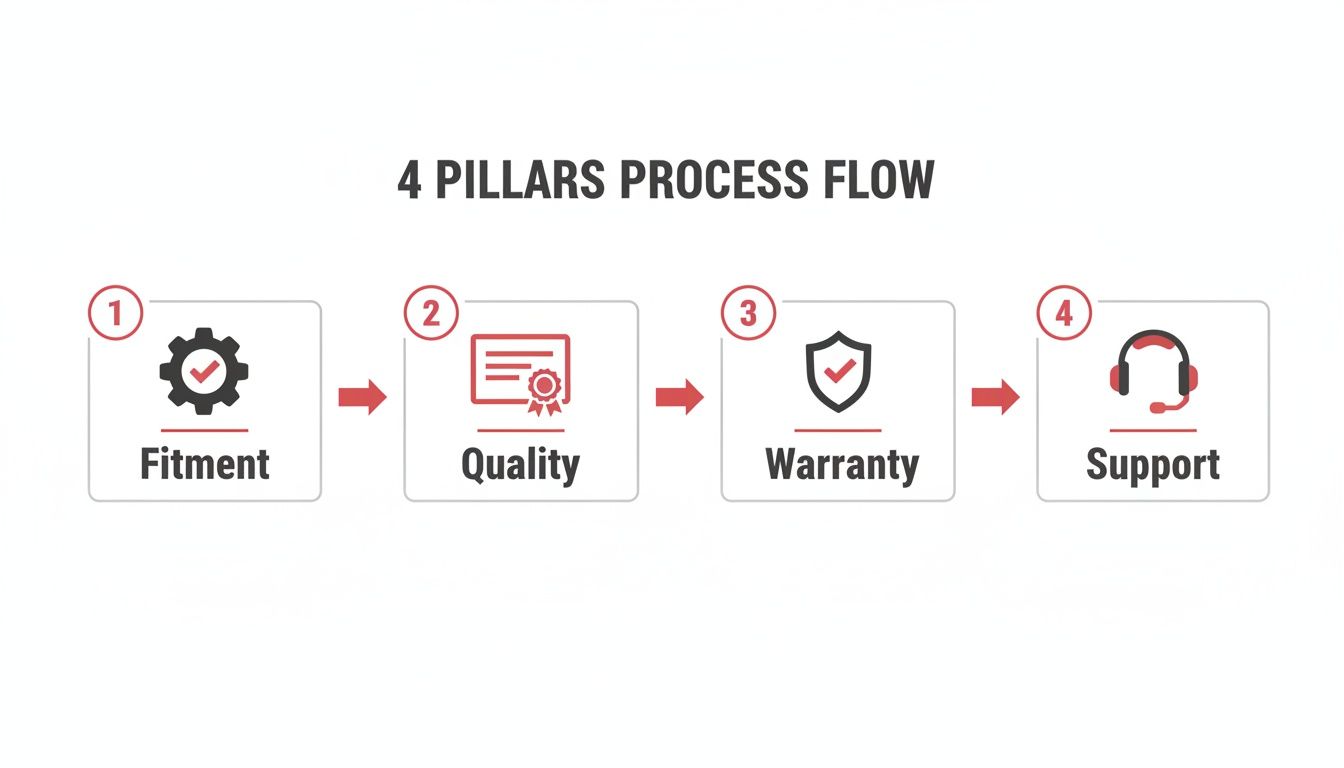
Following this roadmap ensures you're not missing a critical step. A great part from a terrible store is still a bad experience. Let’s make sure all the boxes are checked.
Test the Fitment Tools
First things first: kick the tires on their vehicle lookup tool. A clunky, vague, or slow tool is your first major red flag.
Go ahead and plug in your car’s year, make, and model. Don't just stop there, though. A good tool will let you drill down further by trim level (like LX, Sport, or EX-L) or engine size. The more specific, the better.
The absolute gold standard here is a VIN (Vehicle Identification Number) lookup. If a store has one, use it. Your VIN is like your car’s fingerprint—it removes all guesswork and is the most foolproof way to guarantee you’re looking at the right part.
Scrutinize the Product Pages
Once you've found a potential part, it's time to play detective on the product page. A trustworthy store will give you way more than a single, grainy stock photo and a price.
Here's what to hunt for:
- High-Quality Images: Look for multiple, crystal-clear photos from every angle. Bonus points if they show the part installed on a vehicle.
- Detailed Specs: The page should clearly list what the part is made of (e.g., OE-grade plastic vs. upgraded steel), its dimensions, and any relevant part numbers.
- Certifications Mentioned: If a part is CAPA or NSF certified, the store should be shouting it from the rooftops. This is a massive stamp of approval, especially for collision parts like bumpers and fenders. Understanding what you're buying is crucial, and learning more about aftermarket parts vs. OEM can give you a real edge.
- Real-World Reviews: Skim past the reviews that just say "fast shipping." Look for verified buyers who talk about the actual installation, how the part fit, and how it’s holding up months later.
Read the Fine Print
This is the step everyone wants to skip, but it’s where a good deal can turn into a nightmare. Before you even think about clicking "Add to Cart," find the store's warranty and return policies. Vague language is not your friend.
A store's warranty is a direct reflection of its confidence in the products it sells. A lifetime warranty on a metal component, for example, tells you the retailer expects that part to last.
Look for a clearly stated warranty period—3 years, lifetime, etc.—and an easy-to-understand process for making a claim. On the returns side, check the return window (is it 30 days or a more generous 90?) and see if they hit you with restocking fees. The best stores stand behind their products with a hassle-free guarantee.
To make this even easier, here’s a simple checklist you can use to size up any online auto parts store you're considering.
Online Auto Parts Store Comparison Checklist
| Feature/Criterion | Store A (e.g., T1A Auto) | Store B (Generic Example) | Store C (Marketplace) |
|---|---|---|---|
| Fitment Verification | VIN Lookup & YMM w/ Trim | YMM Only | Relies on Seller Listings |
| Product Photos | Multiple High-Res Angles | One Stock Photo | Varies by Seller |
| Material/Quality Specs | Clearly Listed | Vague or Missing | Hit or Miss |
| Certifications (CAPA/NSF) | Clearly Stated on Parts | Not Mentioned | Rarely Listed |
| Warranty Term | Lifetime on Many Parts | 30-90 Days | Seller-Specific, Often None |
| Return Policy | 90+ Days, No Restocking | 30 Days, 15% Restocking Fee | Complex, Varies by Seller |
| Customer Support | Phone, Email, Chat (US-Based) | Email Only, Offshore | Marketplace-Mediated |
Using a quick comparison like this can instantly reveal which store is truly committed to quality and customer satisfaction, and which ones are just trying to move boxes.
Choosing the Right Store for Your Specific Needs
Let’s be honest: not everyone shopping for car parts is on the same mission. The "best" online auto parts store for a weekend DIYer is going to be very different from the one a professional body shop or a fleet manager relies on.
Think of it like buying tools. You might grab an adjustable wrench for a quick fix at home, but a pro mechanic needs a full set of calibrated torque wrenches. The right tool depends on the job, and the same goes for your parts supplier.
Let's break down how to pick a winner based on three real-world scenarios.
The Weekend DIY Mechanic
If you're the person spending your Saturday under the hood, the project is as much about the satisfaction of doing it yourself as it is about the repair. Your needs are pretty straightforward: you want the right part at a fair price, and you don’t want any headaches.
For the DIYer, two things are king:
- Guaranteed Fitment: There is nothing more frustrating than getting halfway through a job only to find out the new part doesn't fit. A simple, accurate vehicle lookup tool—especially one that lets you search by VIN—is a must. It’s the difference between a successful project and a wasted afternoon.
- Accessible Support: Ever get stuck on a stubborn bolt or a tricky electrical connector? This is where how-to videos and clear installation guides become your best friend. It’s like having an experienced mechanic looking over your shoulder.
Of course, quality is important, but the goal is a solid, reliable fix that doesn't empty your wallet. A solid three-year warranty is usually more than enough protection for a personal car.
The Independent Body Shop Owner
For a professional body shop, time is quite literally money. Every minute a car is stuck on a lift waiting for a part, you're losing revenue. Your focus is laser-sharp: you need precision, speed, and zero guesswork. Your reputation is on the line with every repair.
The pillars that matter most here are:
- Proven Quality and Certifications: Body shop repairs are often reviewed by insurance adjusters. Using CAPA-certified parts isn't just a good idea; it's often a requirement. This certification guarantees the part will look, fit, and perform just like the original from the factory.
- Warranties and Returns: Fast, reliable shipping is non-negotiable. A supplier who gets parts to your door quickly minimizes vehicle downtime and keeps your workflow moving. A no-nonsense return policy is also crucial for those rare times when the wrong part gets ordered.
For a professional, the best online auto parts stores act as an extension of their own inventory. They need a partner who understands that a $50 part arriving a day late can cost them hundreds in lost labor and bay time.
The Small Fleet Manager
Now, picture someone managing a small fleet of commercial vehicles—think delivery vans or work trucks. Their entire job is to keep those vehicles on the road and minimize costs. For them, it's all about durability and consistency.
Key priorities for the fleet manager include:
- Proven Quality: Fleet vehicles take a beating. Parts made from upgraded materials, like a metal component designed to replace a failure-prone plastic original, are a smart investment. It’s about preventing the next breakdown, not just fixing the current one.
- Clear Warranties: A lifetime warranty on a frequently replaced part is a huge plus. It provides long-term budget predictability and simplifies maintenance planning, knowing that part is covered for the entire life of the vehicle.
While these examples cover most bases, some vehicles have totally different needs. If you’re working on an RV, for example, you’ll want a specialized supplier. Great resources that review the 7 Best Online RV Upgrades & Parts Stores can point you in the right direction for those unique needs.
By first understanding your own role, you can figure out what really matters and find the absolute best place to buy auto parts online for your specific job.
Common Red Flags to Avoid When Shopping Online

Knowing what a good online parts store looks like is half the battle. The other half is knowing how to spot a bad one before you hand over your credit card information. It's a lot like inspecting a used car—you're not just admiring the shiny paint; you're actively looking for signs of rust and hidden damage that could cause major headaches down the road.
The online market is crowded, and even big marketplaces can host some questionable third-party sellers. The entire U.S. retail scene is dominated by a mix of national chains and massive online platforms, but that convenience can sometimes make it harder to see the warning signs of a specific seller. For a deeper dive into how the big players operate, the 2025 Joint E-commerce Trends & Outlook Forecast report offers some great insights.
With that in mind, here are the big red flags to watch for when you're vetting an online auto parts store.
Vague or Hidden Policies
A good company is proud of its warranty and return policy. A shady one treats it like a state secret. If you have to dig through five pages of fine print or the language is so confusing it feels like it was written by a lawyer trying to win a bet, run the other way.
Look for simple, direct terms. A store that actually stands behind its parts will put its policies front and center, often right on the product page itself. If it feels like they’re trying to hide the details, it’s because they are.
Key Takeaway: A confusing or buried warranty isn’t a warranty at all—it's a liability waiting to happen. The best online stores make their promises clear and give you a straightforward path to take if a part fails.
Generic Photos and Thin Descriptions
The product page tells you everything you need to know about a seller's commitment. See a single, blurry stock photo that looks like it’s been used on ten other websites? That’s a massive red flag. It often means the seller doesn't even have the part in their warehouse; they're just a middleman.
- What you want to see: Multiple, sharp images showing the part from every angle.
- What to avoid: Pixelated, generic photos that show zero detail.
The same rule applies to descriptions. A one-liner full of acronyms is just lazy and shows a lack of real expertise. A great retailer gives you detailed specs, what materials it’s made from, and clear compatibility notes to help you be confident in your purchase.
Missing or Hard-to-Find Contact Information
Think about what happens if something goes wrong. If the only contact method is a generic "contact us" form with no phone number, no live chat, and no physical address, you should be very skeptical. This is a classic move by fly-by-night operations that want to make it impossible for you to get help.
A legitimate business gives you multiple ways to get in touch, including a phone number answered by an actual human being. That accessibility proves they're ready to stand by their products after the sale. When a store makes it hard to talk to them, it's usually because they have no intention of listening.
Answering Your Top Questions About Buying Car Parts Online
Even with a checklist in hand, it's natural to have a few nagging questions before you click "buy." When it comes to your vehicle, a healthy dose of caution is a good thing. Let's walk through some of the most common concerns so you can navigate the online marketplace like a pro.
How Can I Be 100% Sure This Part Will Fit My Car?
This is the big one, isn't it? It's the number one fear for anyone buying parts online, and for good reason. The single best way to kill that doubt is by using your VIN (Vehicle Identification Number).
Think of it this way: your car's year, make, and model are like its street address. The VIN, however, is the exact GPS coordinate. A truly great online store will have a VIN lookup tool built right into their site. When you pop in that unique 17-digit code, their system checks it against the manufacturer's master database. This instantly filters out anything that isn't an exact match for your car's specific trim, engine, and factory options. It's the closest thing you'll get to a 100% fitment guarantee and takes all the guesswork out of the equation.
What's the Difference Between OEM, Aftermarket, and Remanufactured?
Getting a handle on these terms is crucial for making a smart buy. Each one has its place, and the right choice really comes down to your budget and what you're trying to accomplish.
- OEM (Original Equipment Manufacturer): This is the very same part your car was built with at the factory. It’s made by (or for) the car company, so you know the fit is perfect. The trade-off? It almost always comes with the highest price tag.
- Aftermarket: These parts are produced by companies other than the original manufacturer. They're designed to do the same job, and top-quality aftermarket parts often meet or even beat the original specs. They’re usually much more affordable and sometimes even feature clever design improvements.
- Remanufactured: These are essentially recycled OEM parts. A used component is taken, completely disassembled, cleaned, and then rebuilt with new or restored components to bring it back to factory standards. It's a great eco-friendly and budget-conscious choice, especially for complex assemblies like alternators or transmissions.
Is It Really Safe to Buy from an Online-Only Store?
Absolutely, provided you do a little homework first. Because they don't have the massive overhead of physical storefronts, online-only retailers can often offer much better pricing and a far wider selection. The trick is just to confirm they're the real deal.
Look for the signs of a legitimate business: a professional website, clear and easy-to-find contact info (a phone number is a great sign), and transparent warranty and return policies. Dig into their customer reviews—are they detailed and authentic? A store that openly invests in these things is showing you they care about their customers and can be just as trustworthy as the shop down the street.
What Do I Do If They Send the Wrong Part or It Arrives Damaged?
Hey, even with the best systems in place, mix-ups can happen. If a box shows up with the wrong part or something's been damaged in transit, your first move is to contact the store’s customer service right away.
Whatever you do, don't try to install a part that's damaged or clearly incorrect. You could end up voiding the warranty, not to mention making the return a whole lot messier.
Any retailer worth your business will have a clear, simple process for this. They should quickly provide you with a prepaid return shipping label and clear instructions. The best stores know that a fast, no-hassle resolution—whether it's rushing the correct part out to you or issuing a quick refund—is the key to keeping you as a happy customer.
At T1A Auto, we eliminate the guesswork by offering guaranteed fitment, clear product specs, and a robust lifetime warranty on our upgraded parts. Find the exact-fit components you need to get the job done right at https://t1aauto.com.
