


Is a sagging or noisy car door driving you crazy? You’re not alone, and the fix might be more affordable than you think. The typical car door hinge repair cost lands somewhere between $150 and $600 per door.
This range is pretty wide because it covers everything from a quick pin and bushing fix on a Honda Civic to a full hinge replacement on a hefty Ford F-150.
What Is the Real Car Door Hinge Repair Cost
So, you see that $150 to $600 range and wonder, "Where will my bill fall?" The final number always comes down to two things: parts and labor. Getting a handle on how these two play off each other is the key to understanding what you'll actually pay.
Breaking Down the Main Expenses
Let's be honest—labor is usually the biggest chunk of the bill. It's not just about bolting on a new hinge. A good mechanic has to carefully take off the interior door panel, safely support the door's full weight, disconnect any wiring for speakers or windows, and then meticulously realign everything. A misaligned door won't seal properly, leading to wind noise or water leaks.
The parts themselves can be all over the map. A simple pin and bushing kit—often the culprit for that annoying sag—might only set you back $20 to $50. But a complete hinge assembly, especially one straight from the original manufacturer (OEM), could easily run $100 or more.
Industry Insight: Independent repair shops in the U.S. typically charge between $75 and $150 per hour for labor. A full hinge replacement can take anywhere from 1.5 to 3.0 hours, putting the labor cost alone in the $110–$450 ballpark.
How Different Scenarios Impact Your Wallet
The repair’s complexity is what really drives the cost up or down. Replacing a worn-out pin on a standard sedan is a relatively simple job. But if you’re dealing with a welded-on hinge, often found on luxury SUVs or older cars, the game changes. That job requires cutting the old hinge off, welding a new one in place, and then painting to match. It’s a lot more time and skill-intensive.
The table below breaks down a few common scenarios to give you a clearer picture of what to expect.
Estimated Car Door Hinge Repair Cost Scenarios
This table breaks down estimated costs for different types of car door hinge repairs, from simple DIY fixes to professional replacements on complex vehicles.
| Repair Type | Vehicle Type | Estimated Parts Cost (DIY) | Estimated Labor Cost (Pro) | Total Estimated Cost (Pro) |
|---|---|---|---|---|
| Pin & Bushing Kit | Standard Sedan (e.g., Honda Civic) | $20 - $40 | $100 - $200 | $120 - $240 |
| Full Hinge Replacement | Standard Sedan (e.g., Honda Civic) | $60 - $120 | $150 - $300 | $210 - $420 |
| Full Hinge Replacement | SUV/Truck (e.g., Ford F-150) | $80 - $150 | $200 - $450 | $280 - $600 |
| Welded Hinge Repair | Luxury/Older Vehicle | $100 - $200+ | $300 - $500+ | $400 - $700+ |
As you can see, the vehicle type and the specific repair needed make a huge difference.
Your final bill is a direct result of your car’s specific needs. A trusted independent shop will almost always have better rates than a dealership. Market research shows that while good aftermarket hinges cost about $40–$150, their OEM counterparts can be 20–40% pricier, especially for trucks and SUVs with heavy doors needing beefier parts. For a deep dive, you can explore detailed market insights about automotive door hinges from Future Market Insights.
What Goes Into Your Repair Bill?
When you get a quote for a car door hinge repair, it's more than just a simple parts-and-labor calculation. Several factors can swing that final number up or down. Getting a handle on these variables will help you understand the estimate and make the best call for your car and your budget.
Think about it this way: not all doors are the same. The beefy, reinforced door on a Ford F-150 is a world away from the lightweight door on a Honda Civic. That difference in weight and engineering means the F-150's hinges have to be much stronger, which directly affects the cost of the parts and the time it takes to do the job.
Your Vehicle Make and Model
The biggest single factor driving the cost is, without a doubt, the car you drive. Parts for luxury brands and heavy-duty trucks are almost always more expensive, and their door systems can be a lot more complicated.
- Luxury Vehicles (e.g., Mercedes-Benz, BMW): These cars often have fancy hinges with built-in electronics or soft-close features. Swapping those out is a pricier affair.
- Trucks and SUVs (e.g., Chevy Silverado, Jeep Wrangler): Their massive, heavy doors need seriously robust hinges, which naturally cost more than the ones on a standard sedan.
- Economy Cars (e.g., Toyota Corolla, Hyundai Elantra): These models typically have simpler, mass-produced hinge designs, which keeps the repair bill on the lower side.
The Extent of the Damage
What exactly is wrong with the hinge is the next big question. Are we talking about a minor squeak or a complete structural failure?
A worn-out little pin or bushing is usually a straightforward and relatively cheap fix. But if the hinge itself is bent from a collision, or worse, has torn the metal on the door or the car’s frame, things get complicated fast. That kind of damage often requires welding and professional bodywork, pushing the cost up considerably.
Your geographic location also plays a surprisingly big role. Labor rates vary widely from place to place. For the exact same car and repair, a job that costs $250–$400 in the U.S. could easily run $350–$600 in Western Europe, almost entirely because of the difference in what mechanics charge per hour.
OEM vs. Aftermarket Parts
When it's time to buy the parts, you've got a choice that directly hits your wallet. Deciding between Original Equipment Manufacturer (OEM) and aftermarket parts is a lot like choosing between a brand-name medication and its generic version—both get the job done, but one costs a whole lot more.
OEM parts are made by your car’s manufacturer. They're guaranteed to be a perfect fit, but you definitely pay a premium for that brand name. On the other hand, high-quality aftermarket parts, like the ones we offer at T1A Auto, are engineered to meet or even exceed OEM specifications. They provide a durable, reliable fix for a fraction of the cost. A big part of your final bill will come down to this choice between OEM vs Aftermarket parts. If you need a hand deciding, take a look at our guide on the key differences between OEM and aftermarket parts.
Deciding Between DIY Repair and Professional Service
When your car door starts to sag or groan, you’ve hit a classic fork in the road: do you roll up your sleeves and tackle it yourself, or do you hand the keys over to a pro? There’s no single right answer. It really boils down to your own skills, how much time you have, and whether you prefer saving money or saving yourself a potential headache.
The DIY path is always tempting, and for good reason—you can sidestep labor costs entirely. If you know your way around a toolbox and have an afternoon to spare, replacing a door hinge is definitely within reach. But be realistic. This isn't a quick five-minute job. If it's your first time, you should probably block out 2 to 5 hours to get it done without rushing. You'll also need more than just a screwdriver; a good socket set, a torque wrench for proper tightening, and maybe even a special door alignment tool are must-haves.
This flowchart can help you map out your decision based on your specific situation.
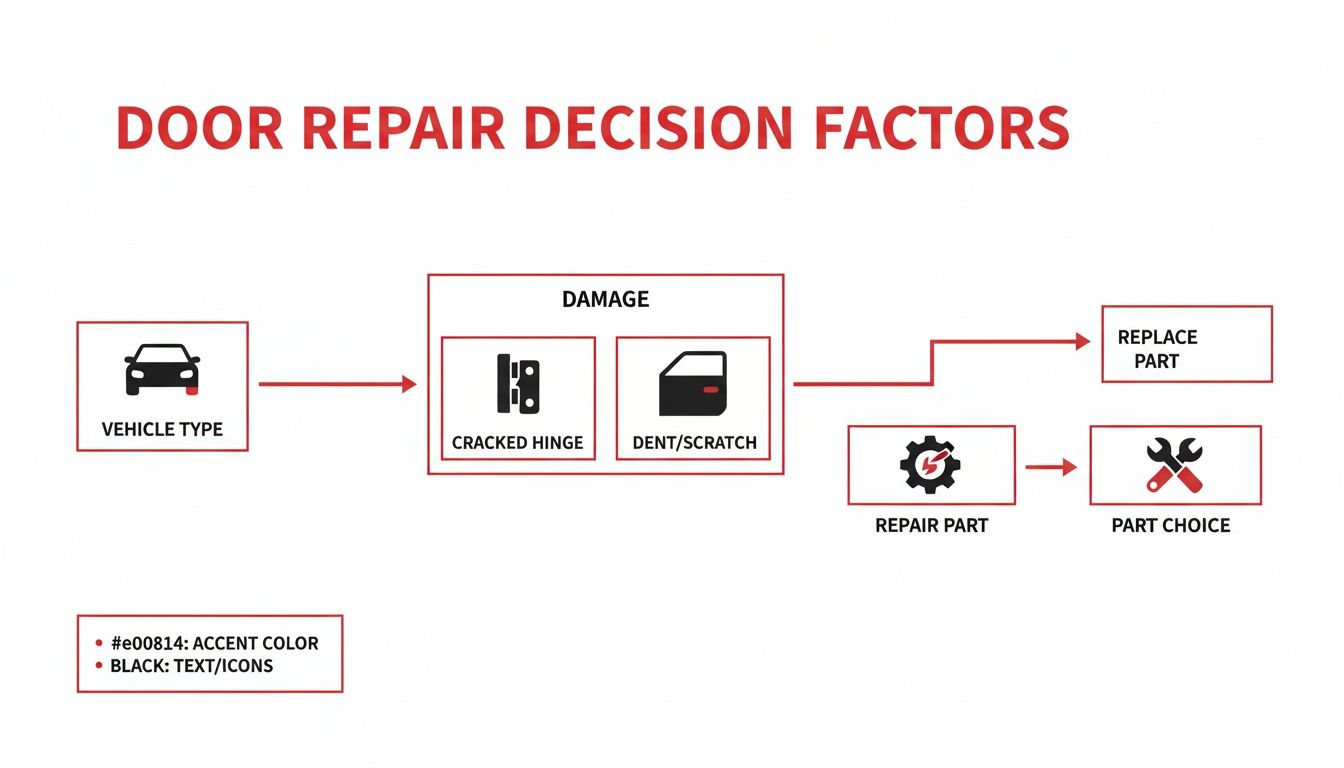
As you can see, things like wrestling with a heavy truck door or deciding between OEM and aftermarket parts can quickly push the needle toward calling in a professional.
The Value of Professional Expertise
Hiring a mechanic isn't just about paying for labor; it’s about paying for experience. The trickiest part of this whole job is achieving perfect door alignment. We're not just talking about getting the door to close without slamming it.
Get the alignment wrong, and you've compromised the weather seal. That means you could be dealing with that annoying wind whistle on the highway or, far worse, a water leak that damages your car's interior. A pro has the specialized tools and, more importantly, the practiced eye to get that door hung perfectly in a fraction of the time. They also carry the responsibility if something doesn't go right.
If you’re working on a big truck with a hefty door or a modern luxury car packed with electronics in the door panel, the case for professional help gets a lot stronger. For a better sense of what the process looks like, our guide on how to replace a door hinge gives a solid step-by-step overview.
DIY vs. Professional Hinge Repair A Head-to-Head Comparison
To help you weigh your options, let’s put the two approaches side-by-side. This table breaks down the key trade-offs so you can decide what makes the most sense for your wallet, your schedule, and your confidence level.
| Factor | DIY Repair | Professional Repair |
|---|---|---|
| Total Cost | Low (Parts only, $40 - $150) | Higher (Parts + Labor, $150 - $600+) |
| Time Investment | High (2 - 5 hours for beginners) | Low (Drop off and pick up) |
| Required Skill | Moderate mechanical skill needed | None required from you |
| Tools Needed | Socket set, torque wrench, alignment tool | Provided by the shop |
| Biggest Risk | Misalignment causing wind/water leaks | Paying for potentially unnecessary work |
| Best For | Budget-conscious owners with some mechanical experience and free time. | Those who value convenience, perfect results, or have complex vehicles. |
Ultimately, going the DIY route can be incredibly rewarding and save you a nice chunk of change. But if you’re short on time or the thought of wrestling with a misaligned door gives you anxiety, there's no shame in letting an expert handle it.
How to Diagnose Your Door Hinge Damage
Before you can get a handle on the car door hinge repair cost, you have to put on your detective hat. Getting a real sense of the problem's severity is the key to deciding between a quick DIY fix and calling in a pro. This way, you avoid overpaying for a simple job or, worse, underestimating a serious one.
The good news is you don't need a professional toolbox for a basic diagnosis. A few simple checks right in your driveway can tell you a lot, giving you the information you need to talk intelligently with a mechanic or order the right parts with confidence.
The Three-Step Driveway Diagnosis
Use this quick checklist to zero in on the most common hinge problems. It’ll give you a much clearer picture of what's really going on with that troublesome door.
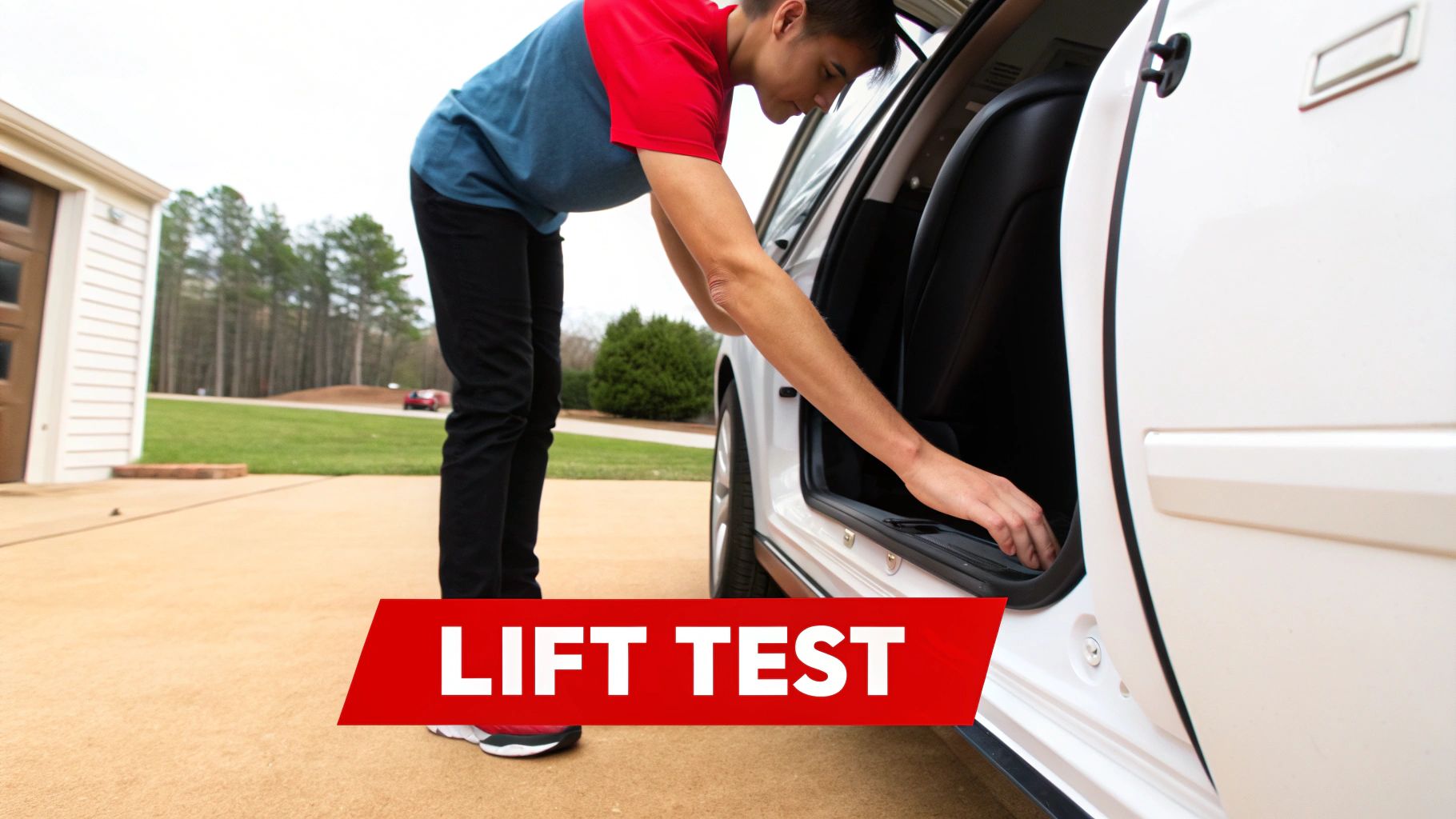
- Perform the Lift Test: This is the absolute best test for worn-out pins and bushings. Open the door about halfway, get a firm grip on the bottom edge with both hands, and gently try to lift the door straight up. If you feel any vertical play or hear a distinct "clunk," you've found the culprit. That slop is the classic sign of worn hinge pins, meaning the door is no longer securely anchored.
-
Listen for the Telltale Sounds: Bad hinges will often tell you exactly what's wrong—you just have to listen. Slowly open and close the door a few times and pay close attention.
- Popping or Clicking: This usually points to a problem with the door check (the little arm that holds the door open), not the hinge itself.
- Groaning or Squeaking: Your first move should be to lubricate it. But if the noise doesn't go away after using a good penetrating lubricant, you're likely hearing metal-on-metal friction from advanced wear.
- Grinding: This is a bad one. A grinding noise suggests severe wear inside the hinge, where the metal parts are actively eating away at each other.
- Conduct a Visual Inspection: Now, get your eyes on the hinges. Look for obvious signs of distress like rust, visible cracks in the metal, or pinholes that look oval-shaped instead of round. A warped pinhole means the pin has been wobbling around and wearing away the surrounding metal. Also, check the door's alignment. As you slowly close it, does it meet the body perfectly, or does it sag and have to be lifted slightly to latch?
Key Takeaway: The "lift test" is your most reliable friend here. Any noticeable up-and-down movement is a dead giveaway that the pins and bushings are shot and need to be replaced. This is the root cause of almost every sagging car door.
Walking through these steps gives you a solid idea of what you're up against. Armed with this knowledge, you can more accurately estimate the repair cost and discuss the problem clearly, whether you're at the auto parts counter or explaining the symptoms to your mechanic.
Cost Breakdowns for Popular Trucks and SUVs
It’s no secret that trucks and SUVs can take a beating. Their doors are bigger, heavier, and often get slammed shut on job sites or during family adventures. All that extra weight and hard use puts a ton of stress on the door hinges, which means they wear out faster than they would on your average sedan.
If you own a workhorse like a Ford F-Series, Chevy Silverado, or a rugged SUV, there’s a good chance you’ll run into a sagging door at some point. Knowing the typical car door hinge repair cost for these models helps you know what to expect and avoid overpaying. The parts are beefier, and handling those heavy doors takes more effort, so both parts and labor costs are naturally higher.
Ford F-Series (F-150, F-250)
The Ford F-Series has been the king of trucks for ages, and its doors are built to match. But that heavy-duty construction is also why hinge failure is such a common headache, especially for trucks that are used for work day in and day out.
- Professional Repair Cost: A shop will likely charge you between $300 and $650 per door. The higher end of that estimate usually covers replacing both hinges (top and bottom) and realigning the door so it closes perfectly again.
- DIY Repair Cost: If you're doing it yourself, you can find a solid aftermarket hinge kit for about $90 to $160. Don't cheap out here—getting a quality kit with stronger metal components is the key to making sure you don't have to do this job again anytime soon.
Chevy Silverado and GMC Sierra
Just like the Fords, GM trucks have massive doors. That tell-tale door sag, where you have to lift the handle just to get it to latch, is a classic sign that the hinge pins and bushings are shot.
- Professional Repair Cost: For a Silverado or Sierra, a professional repair will typically run from $280 to $600 per door. A big chunk of that is labor, since a mechanic needs the right tools (and sometimes a second person) to safely remove and reinstall a heavy truck door without damaging it.
- DIY Repair Cost: You can find high-quality aftermarket parts for these trucks in the $80 to $150 range. This is a fantastic way to save a few hundred bucks on labor, as long as you have the tools and an extra set of hands to help you out.
A Pro Tip for Long-Term Savings: When you're fixing a hinge on a truck or SUV, always replace both the upper and lower hinges at the same time. Even if only one looks bad, the other isn't far behind. The labor is virtually the same, and it saves you from paying a mechanic for the exact same job a year later.
For a permanent fix, your best bet is to find upgraded metal hinge components from a reputable aftermarket brand. The original factory parts are often the weak link; investing in a superior replacement is just smart money that keeps your truck on the road and out of the shop.
Smart Ways to Reduce Your Repair Costs
A car door hinge repair doesn't have to break the bank. With a few smart moves, you can keep the car door hinge repair cost down without cutting corners on a solid, lasting fix. It’s all about thinking strategically.
One of the biggest money-savers is opting for high-quality aftermarket parts. Dealership OEM parts almost always carry a premium price tag, but well-made aftermarket hinges can offer the exact same performance and fit for a fraction of the cost. Making this one switch can often slash your parts bill by 20-40% right off the bat.
Be Proactive with Replacements and Warranties
Here's a tip from experience: if one hinge on a door is worn out, the other one is probably not far behind. A huge chunk of the labor cost comes from taking the door panel off and realigning everything. It makes a ton of sense to replace both the upper and lower hinges at the same time. This little bit of foresight can save you from paying for the exact same labor-intensive job again a year or two down the road.
Also, never buy a replacement part without checking the warranty. It's a non-negotiable for me.
- Lifetime Warranties: The best brands often back their upgraded metal components with a lifetime warranty. This is your signal that you're making a one-time investment.
- Standard Warranties: Even a solid multi-year warranty gives you essential protection against a faulty part.
- No Warranty: If a part has no warranty, just walk away. It's often a red flag for cheap materials that are bound to fail sooner rather than later.
Always confirm the warranty details before you buy. It’s the easiest way to protect your wallet from future headaches.
The Power of Preventative Maintenance
You know what they say: the cheapest repair is the one you never have to make. Getting into a routine of simple, proactive car maintenance can head off a lot of common problems, and door hinges are a perfect example. A little preventative care goes a surprisingly long way.
A little lubrication goes a long way. The most common cause of premature hinge wear is friction from a lack of lubrication, which causes metal components to grind against each other.
Regularly spraying your hinges with a quality lubricant is the single best thing you can do for them. It keeps all the moving parts gliding smoothly, cuts down on friction, and stops the grinding that eventually leads to a sagging door. For a full walkthrough, check out our guide on how to properly lubricate your car door hinges and keep them working like new.
Your Car Door Hinge Repair Questions, Answered
Even after breaking it all down, a few questions about car door hinge repair costs and the actual process probably come to mind. Let's tackle some of the most common ones we hear from car owners.
Can I Just Keep Driving With a Bad Door Hinge?
Technically, yes, the car will still move. But you absolutely shouldn't. It's a huge safety risk.
A worn-out hinge puts a ton of extra stress on the door latch and even the car's frame. If it fails completely, the door could swing wide open while you're driving. It’s a dangerous situation for you, your passengers, and everyone else on the road.
How Long Does a Hinge Repair Usually Take?
The time commitment really depends on how deep the problem goes. For a simple pin and bushing replacement on a regular sedan, a decent mechanic can knock it out in about 1.5 to 2 hours.
But if you're looking at a full hinge replacement, especially on a heavy truck door, or a job that requires welding, you could easily be looking at 3 to 5 hours of labor, sometimes even more.
Is a Bad Hinge Going to Drain My Car Battery?
It might seem unrelated, but yes, a sagging door can definitely kill your battery. When the door doesn't line up correctly, it often won't press the door jamb switch all the way in.
The car's computer thinks the door is still ajar, leaving your dome lights, dashboard warnings, or other electronics on. Come morning, you've got a dead battery.
A Quick Word of Advice: Putting off a hinge repair is a classic case of "pay me now or pay me a lot more later." A sagging door doesn't just drain the battery; it grinds away at the door latch and can even damage the door frame, turning a small fix into a major, expensive headache. Fixing the hinge problem right away is always the smarter, cheaper move in the long run.
Getting a worn hinge fixed is one of those satisfying repairs that makes a huge difference in your car's safety and daily use. Now that you know what's involved, you can make the right call for your vehicle and your wallet.
For durable, high-quality aftermarket parts that are engineered to last, explore the selection at T1A Auto. Find the exact-fit components you need and get back on the road with confidence. https://t1aauto.com