


A tailgate that's stuck shut or just won't stay closed is one of those nagging problems that can really get under your skin. More often than not, the issue lies with the latch mechanism. For anyone with a Ford F150, fixing a broken tailgate latch is usually a pretty straightforward job that you can tackle with some basic tools right in your own driveway.
Understanding Why Your F150 Tailgate Fails
When your tailgate refuses to open, won't latch properly, or makes a rattling noise on the road, it’s not just an inconvenience—it's your truck telling you that some key parts are on their last legs. For a lot of F-150 owners, it's not a question of if this will happen, but when. The real culprit is often the small, easily overlooked components hidden inside the tailgate itself.
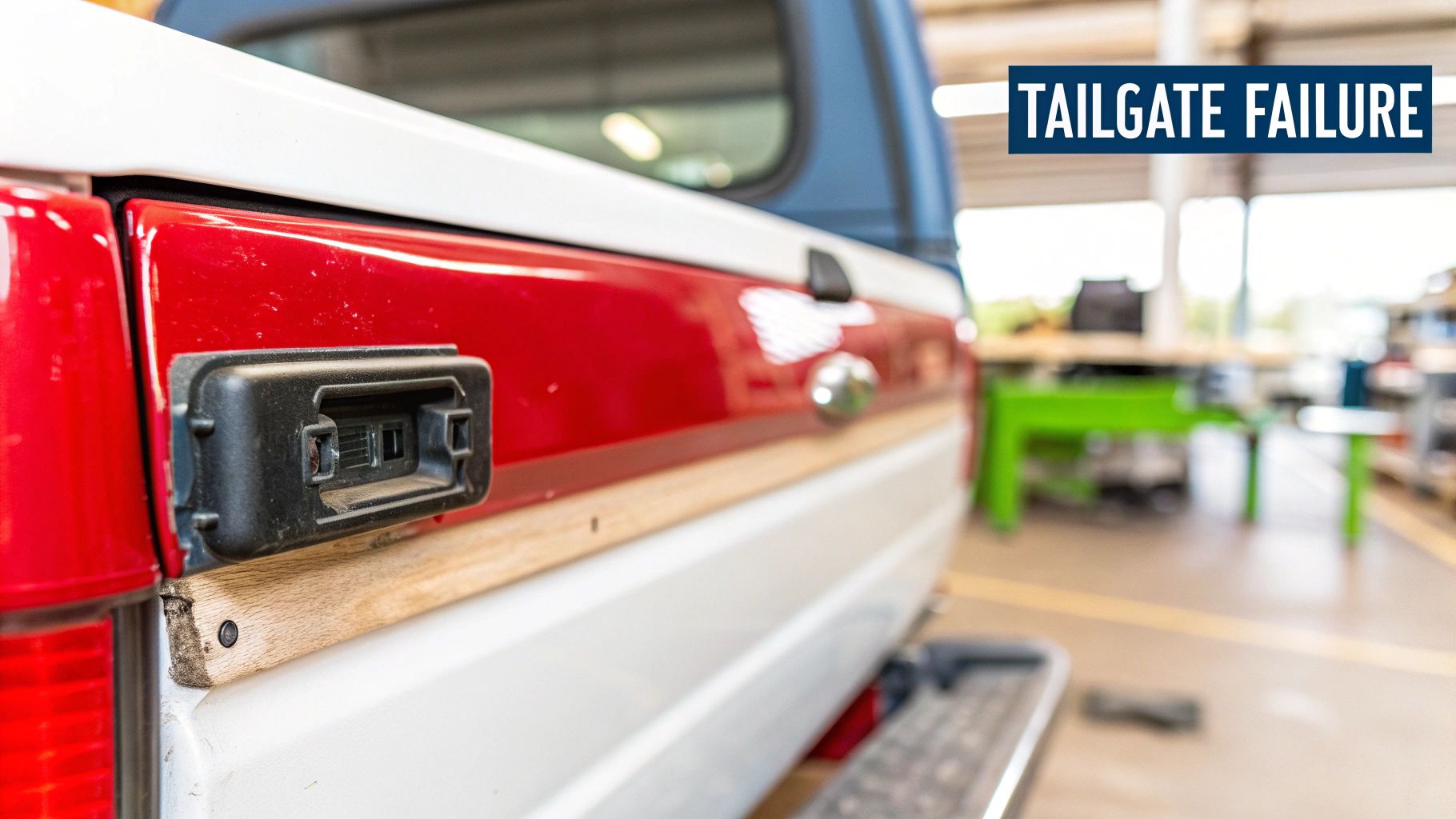
The whole system operates on a pretty simple setup of rods and plastic clips. The problem is, those plastic bits get brittle over time thanks to constant temperature swings and the stress of daily use. Sooner or later, they crack or just shatter, and suddenly the handle is no longer connected to the latches.
The Most Common Failure Points
Lifting the handle is supposed to pull on two metal rods, which in turn retract the latches on both sides of the tailgate, allowing it to open. When one of those little plastic clips gives up, its rod gets disconnected, and that side of the tailgate stays locked. You'll probably feel it right away—the handle might seem loose, or maybe only one side of the tailgate pops open.
But the clips aren't the only weak link. Other parts can cause headaches too:
- The Latch Mechanism: The springs inside can get weak, or the entire mechanism can seize up from rust and grime.
- The Handle Assembly: The plastic handle housing can crack, especially in the cold, making it feel flimsy or even causing it to snap off in your hand.
- Electronic Actuators: If your truck has a power release, the electronic actuator can burn out, leaving you with a button that does absolutely nothing.
The vulnerability of these factory parts isn't just a theory. In December 2021, Ford had to recall 57,591 F-150 trucks from the 2021 model year because the tailgates could fly open while driving. It was a stark reminder of how quickly these plastic parts can fail and create a serious hazard on the road.
Key Takeaway: The vast majority of F-150 tailgate issues trace back to the premature failure of OEM plastic components. Switching to aftermarket parts with reinforced metal construction is the best way to get a more durable, long-term fix.
Common F150 Tailgate Problems and Their Root Causes
To help you zero in on what's wrong, this table connects common symptoms to their likely causes. Use it to diagnose the problem quickly and figure out what to tackle first.
| Symptom | Common Cause | Recommended Action |
|---|---|---|
| Handle feels loose or pulls up with no resistance | Broken plastic rod clip(s) | Open the access panel and replace the broken clips. |
| Only one side of the tailgate unlatches | A broken clip or disconnected rod on one side | Inspect the rods and clips for the side that won't open. |
| Tailgate won't close or pops open | Seized or misaligned latch mechanism | Clean and lubricate the latches; check alignment. |
| Rattling noise from inside the tailgate | Disconnected rod or loose components | Secure or replace loose/broken parts inside the access panel. |
| Handle is physically broken or cracked | Plastic fatigue, often from cold weather | Replace the entire handle assembly. |
| Power release button doesn't work | Failed electronic actuator or wiring issue | Test the actuator and check for power at the connection. |
Once you've pinpointed the likely issue, you can move on to the repair with a lot more confidence.
Spotting the Early Warning Signs
Long before the tailgate gives out completely, your truck will usually drop a few hints. Catching these early can save you from being stranded with a tailgate that’s stuck shut. Learning to spot the signs is the first step, and you can dive deeper into the components with our guide on tailgate parts for Ford F-150 models. Keep an ear out for rattling sounds from inside the tailgate, pay attention if the handle feels mushy, or notice if you have to slam it harder than usual to get it to close.
How to Figure Out What's Really Wrong with Your Tailgate Latch
Before you even think about ordering parts for a ford f150 tailgate latch repair, you have to know exactly what broke. Guessing is a surefire way to waste an afternoon and throw money away on parts you don't need. Let's walk through a systematic way to find the real culprit, whether it's a simple mechanical failure or something electrical.
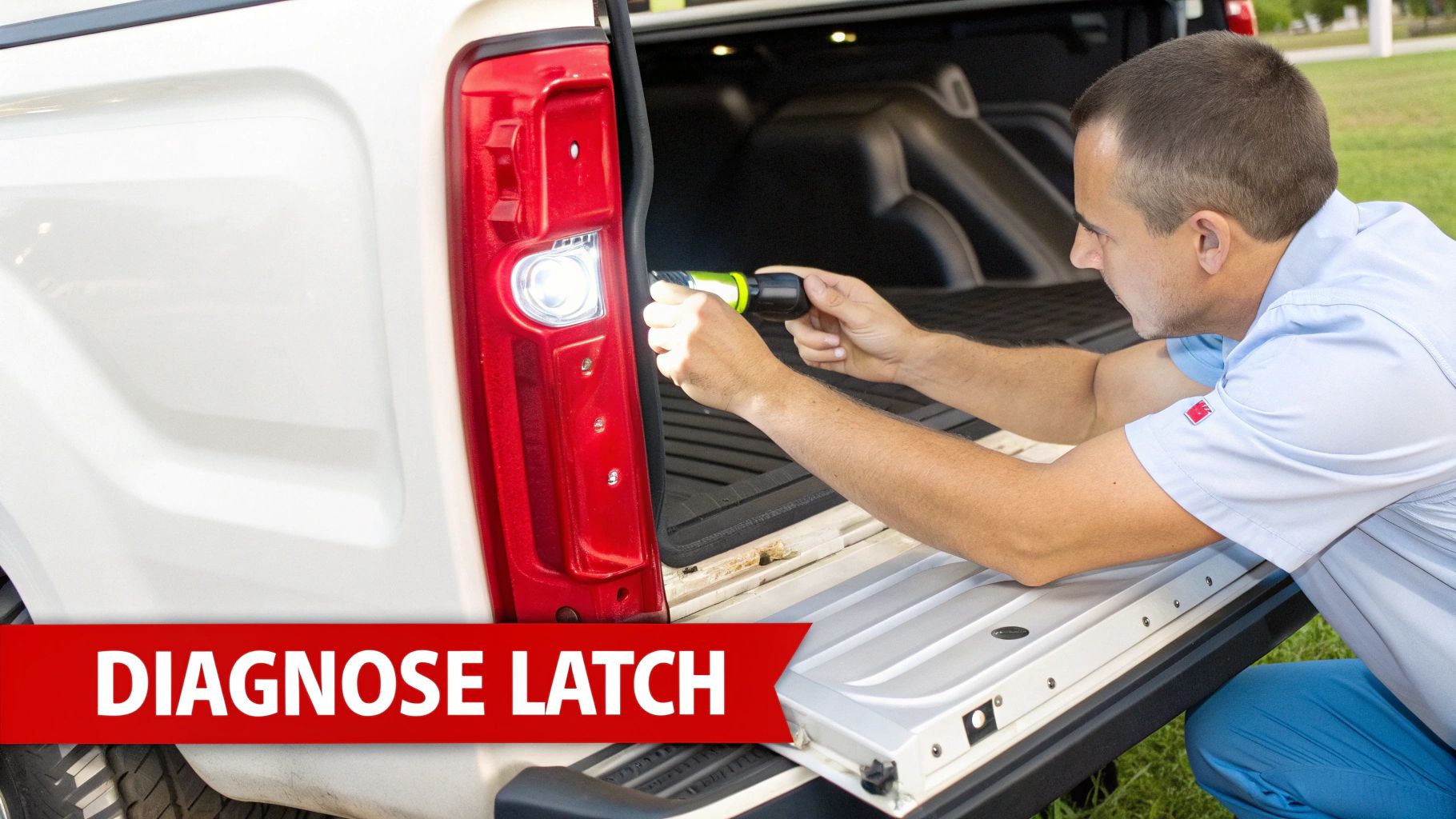
Put the tools down for a minute. Your best diagnostic instruments, to begin with, are your hands, eyes, and ears. We're trying to figure out if the problem lies with the handle, the internal rods and clips, the latches themselves, or—on newer trucks—the electronic actuator.
Start with the Handle—What Does It Feel Like?
The first thing to do is simply pull the handle like you always do. But this time, pay close attention to the feedback it gives you. The feel of the handle is your biggest clue.
- Totally Limp and Floppy? If the handle lifts with zero resistance, it's almost guaranteed to be disconnected from the internal latch rods. This is the textbook symptom of broken plastic rod clips, an incredibly common point of failure.
- Feels Normal, But Nothing Happens? When the handle has its usual tension but the tailgate won't budge, the problem is deeper inside. The rods are probably connected, but the latch mechanisms on the sides are likely seized up with rust or packed with dirt.
- Does One Side Pop Open? If you see one side of the tailgate release while the other stays locked tight, you've already isolated the issue. The problem is on the side that won't let go—either a disconnected rod or a failed latch on that side only.
This simple test does half the diagnostic work for you. A floppy handle means you're going to be popping off the access panel, while a seized latch might just need a good cleaning and some lubricant.
A handle that feels completely disconnected is your clearest signal that the small plastic clips holding the latch rods have failed. I'd say over 90% of manual tailgate failures I've seen on F-150s trace back to these cheap, brittle little parts.
What About the Power Release?
For trucks with an electronic power release, we have to add another layer to our diagnosis. If your key fob or the button on the tailgate isn't working, we need to know if it's an electrical or mechanical issue.
The easiest way to check is to stand right by the tailgate and have a friend press the release button on the remote. Listen very carefully for a 'click' or a 'whir' from inside the tailgate.
- You Hear a Click: If you hear the actuator trying to engage, the electronics are probably working just fine. The problem is mechanical. The actuator is getting the signal, but it's not managing to pull the latches. This could be a broken link inside or, again, a seized latch mechanism.
- You Hear Absolute Silence: No sound at all points directly to an electrical fault. This could mean a dead actuator, a blown fuse, or a break somewhere in the wiring harness. Always check the fuse box for the tailgate release first—it's a quick, free check before you assume the expensive actuator is toast.
This quick sound check is critical. It keeps you from replacing a perfectly good actuator when the real problem is a simple mechanical jam, and vice-versa.
Time for a Look Inside
If your initial checks point to an internal issue, it's time to get a direct look at the mechanism. Taking off the tailgate's inner access panel will lay everything bare.
Once the panel is off, you'll see the metal rods running from the central handle assembly out to the latches on either side. Look closely at the small plastic clips where these rods connect. Are they cracked, snapped, or just plain gone? Give the rods a gentle tug—are they loose or completely disconnected?
This visual confirmation ends the guesswork. You'll know exactly which parts have failed, ensuring your ford f150 tailgate latch repair gets done right the first time.
Gearing Up: Your F-150 Tailgate Repair Toolkit
Nothing's more frustrating than getting halfway through a job only to realize you're missing the one specific tool you need. A successful F150 tailgate latch repair starts before you ever touch the truck. It starts with having everything you need laid out and ready to go.
Taking a few minutes to gather your tools and double-check your parts turns a potential headache into a smooth, straightforward fix. Think of it as mise en place for your garage—everything in its place, ready for action.
Before you start, let's run through a quick checklist. Having these items on hand will save you a ton of time and prevent the dreaded mid-repair run to the auto parts store.
Tool and Part Checklist for F150 Tailgate Latch Repair
A quick-reference list to ensure you have all the necessary tools and the correct parts before you start working on your truck.
| Item Category | Specific Tool/Part | Pro Tip |
|---|---|---|
| Wrenches & Sockets | Socket Wrench with Extension | An extension is key for reaching the bolts recessed deep inside the tailgate. |
| 8mm and 10mm Sockets | These are your go-to sizes for the access panel and handle assembly bolts. | |
| Torx Bit Set (T27 or T30) | Ford loves Torx bolts. The latch mechanisms almost always use one of these two sizes. | |
| Prying & Pliers | Plastic Trim Removal Tools | Don't risk scratching your paint with a screwdriver. These are purpose-built and cheap. |
| Needle-Nose Pliers | Essential for popping off the little plastic clips on the latch rods without breaking them. | |
| Flathead Screwdriver | Good for gently releasing tension on certain components, but use it carefully. | |
| Replacement Parts | Correct Tailgate Handle/Latch | Verify your truck's year, trim, and features (power lock, camera, step) before ordering. |
| Latch Rods and Clips (Optional) | It's smart to have a few extra clips on hand, as the old ones can get brittle and break. |
Nailing Down the Right Replacement Parts
Now for the most important part of the prep work: getting the right components. An F-150 tailgate from 2012 is a different beast than one from a 2020. A manual latch simply won’t work on a truck equipped with a power release, so precision is key.
Before you add anything to your cart, pin down these details about your truck:
- Exact Model Year: Designs can change dramatically between generations.
- Tailgate Features: Do you have a power release, backup camera, or the "man step"? These features all dictate which handle and latch assembly you need.
- Trim Level: An XL, XLT, and a Lariat can have different tailgate hardware. Know what you've got.
Once you've got your truck's profile, you'll see a choice between standard replacement parts and beefier aftermarket options. The standard plastic stuff works, but you’re often just replacing a failure-prone part with another one just like it.
My two cents: I always recommend upgrading to high-quality aftermarket parts with reinforced metal construction. It's a smart move for long-term durability.
To get a better handle on the pros and cons, our guide on OEM versus aftermarket parts breaks it all down. These premium parts often come with a lifetime warranty, which means this is probably the last time you'll ever have to do this repair.
A Step-by-Step Guide to Replacing Your Tailgate Latch
Alright, you've got your tools laid out and the new parts are ready to go. Now for the fun part: the actual Ford F150 tailgate latch repair. This is where the magic happens, but it pays to be methodical. We'll walk through this one stage at a time, so you can do the job right and avoid those frustrating little mistakes.
From popping the access panel without scratching your paint to getting the new hardware hooked up correctly, we've got you covered. Let's dive in.
This quick flowchart sums up the entire workflow. It’s a simple process: get ready, get the parts, and get it done.
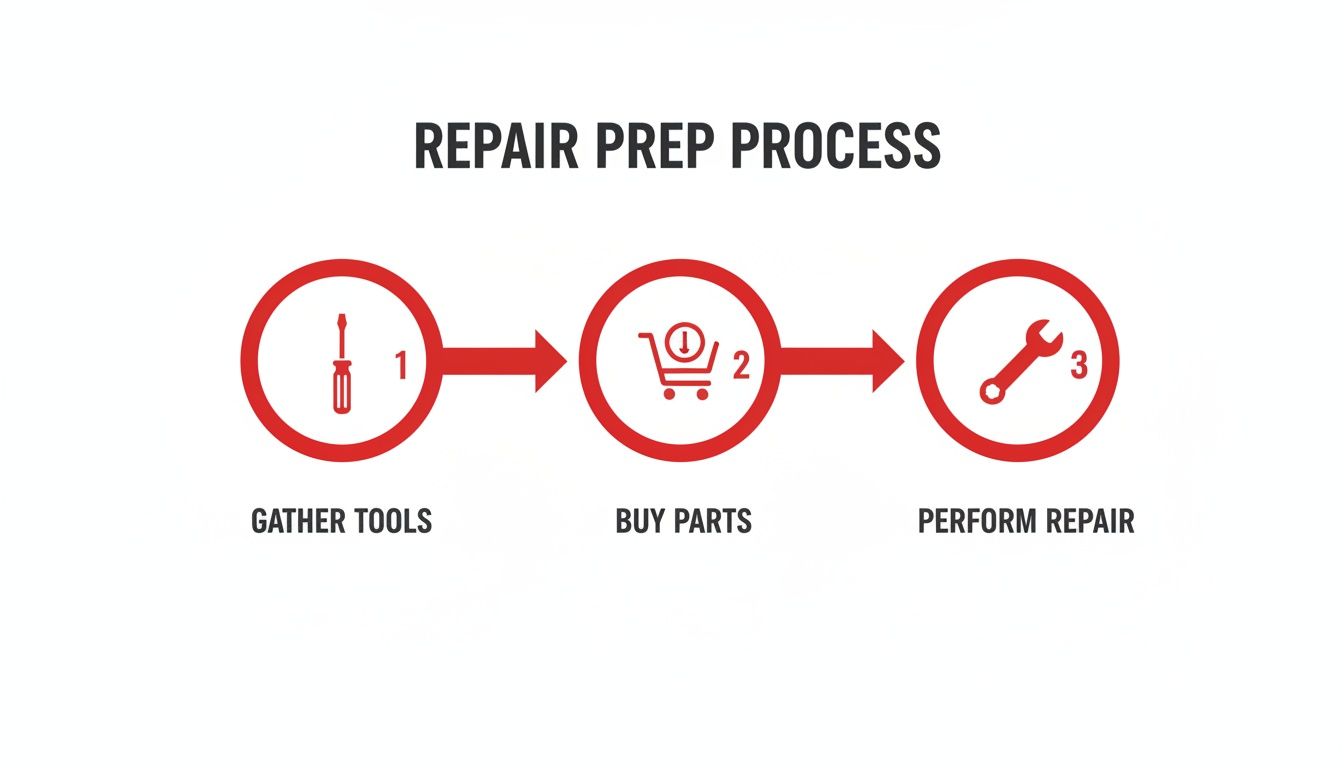
As you can see, a successful repair is just a logical sequence of steps.
Gaining Access to the Tailgate Internals
First things first, you need to get inside the tailgate. Grab your socket wrench and an 8mm socket, maybe with a short extension, and zip out all the bolts holding the large access panel in place.
With the bolts removed, the panel still won't just fall off. Carmakers love using hidden plastic clips, and Ford is no exception. Grab a plastic trim removal tool—seriously, don't use a screwdriver—and gently pry around the edges until it pops free. Your paint job will thank you.
A Word of Warning: If your tailgate is stuck shut, you can't get this panel off. Your only option is to go in through the much smaller hole behind the handle bezel. It's a tight squeeze and requires a lot of patience, needle-nose pliers, and maybe a few choice words to manually release the latches.
Disconnecting the Old Hardware
Once the panel is off, you'll see the guts of the tailgate mechanism. If your truck has a backup camera or a power lock, the first step is to disconnect the wiring harnesses. Look for the small release tabs on the connectors; press them down and pull the plugs apart. Never, ever yank on the wires.
Next, turn your attention to the metal rods linking the handle to the latches on either side. Each rod is secured by a small plastic clip. I find that needle-nose pliers or a small flathead screwdriver work best here. Carefully pop the clips open to free the rods. Be gentle—that old plastic gets brittle over time and can easily shatter.
Removing the Old Latch and Handle
Time to unbolt the old assembly. The main handle is held on by two 10mm nuts you'll access from inside the tailgate. Once they're off, you can wiggle the handle out from the outside.
The side latches are typically held in by Torx bolts, so you'll need a T27 or T30 bit. Remove those, and the latch mechanisms will come loose. With everything unbolted and disconnected, you can lift the whole assembly out. If you're just swapping the handle, our other guide on how to replace a tailgate handle has some extra pointers just for that job.
Installing the New Components
Putting it all back together is just the reverse of taking it apart, but a few tips will make it go a lot smoother.
- Install Latches First: Start by positioning the new side latches. Thread the Torx bolts in but leave them a little loose for now. This gives you some wiggle room for alignment later.
- Mount the Handle: Slide the new handle into place from the outside and tighten down the two 10mm nuts from the inside until they're snug.
- Connect the Rods: This is the most critical part. Clip the rods onto the new handle mechanism first, making sure the plastic clips snap shut securely. Then, run the rods out to the side latches and clip them in. Check that the rods have a clear, straight path—any bends or twists will make the handle feel stiff and cause problems.
Before you even think about putting the access panel back on, do a quick function test. Lift the handle. Do both latches retract all the way? Do they move smoothly? If one is hanging up, double-check that its rod isn't caught on anything.
It's also worth knowing that for many 2015-2022 F-150s with power release, Ford has a Customer Satisfaction Program covering these repairs for 10 years or 150,000 miles. However, with a compliance rate of only 68%, many owners are left looking for other options. For them, a durable aftermarket part is often a faster and more permanent fix.
Reassembly and Final Checks
The finish line is in sight. Before reinstalling the big access panel, don't forget to reconnect the wiring harnesses for your camera and power lock. Listen for a solid "click" to confirm they're seated properly.
Now, line up the access panel with the tailgate, align the plastic clips, and give it a firm press to snap it back into place. Reinstall all the 8mm perimeter bolts, tightening them until they're just snug. There's no need to crank down on them.
With everything buttoned up, give it a final test. Open and close the tailgate a few times. It should latch securely and release without a fight. If you have a power tailgate, test the fob and any interior buttons. That's it—your Ford F150 tailgate latch repair is done, and your tailgate should work good as new.
Fine-Tuning and Testing Your New Tailgate Latch
Getting the new parts installed is a huge win, but don't close up that toolbox just yet. The last part of a successful Ford F150 tailgate latch repair is all about the fine details—dialing in the alignment and running through a few tests to make sure everything is perfect. This is what separates a good repair from a great one that will last for years.
It's tempting to skip these final checks, but that's a common mistake. A misaligned latch can wear out your new parts prematurely, create annoying rattles, and make the tailgate a pain to open and close. A few extra minutes now will ensure all your hard work pays off with smooth, reliable operation.
Dialing in the Perfect Alignment
If your new latch isn't catching cleanly, or if you find yourself having to slam the tailgate shut, the culprit is almost always alignment. The fix is in the striker bolts—those U-shaped metal loops on the truck's bed that the latches grab. Thankfully, they're designed to be adjusted.
To get started, you’ll need a large Torx bit, typically a T50 or T55, but double-check what your specific model year requires. Just crack the bolts on both striker pins loose—enough that you can move them with a bit of muscle, but not so loose that they flop around.
- Move them inward if the tailgate closes but feels loose or rattles.
- Move them outward if you have to slam the tailgate to get it to latch.
- Adjust them up or down to make the top edge of the tailgate sit perfectly flush with the bed rails.
The trick here is to make tiny adjustments, moving one striker at a time. Nudge it, tighten the bolt, and gently close the tailgate to check the fit. This can be a bit of a back-and-forth process, but you're aiming for a tailgate that closes with a firm push and a solid, satisfying click.
The mark of a professional-quality repair is feeling both latches engage at the same time with minimal effort. It should sound and feel secure, with absolutely no play or movement in the tailgate once it's closed.
Comprehensive Functional Testing
With the alignment spot-on, it's time to run through a full system check. Don't just check one function; test everything to ensure all the components are playing nicely together. Think of it as your own final quality control inspection.
Here’s a quick checklist to run through:
- Manual Handle Operation: Give the handle a pull. Does it feel smooth and consistent? You don't want it to feel stiff, gritty, or too floppy.
- Latch Engagement and Release: Open and close the tailgate at least 5-10 times. You want to confirm both latches catch and release cleanly every single time, without fail.
- Electronic Lock Test: If you have power locks, use your key fob to lock and unlock the truck. You should hear the tailgate actuator engage. With it locked, try the handle to make sure it's secure.
- Power Release Test: For models with a power release, test it with both the key fob and any button on the tailgate itself. It should unlatch smoothly without any hesitation.
This kind of thorough testing is critical, especially when you consider the history of electronic issues on these trucks. A major recall in late 2023 affected nearly 262,000 F-150s due to electric tailgate release failures from corroded wiring. By testing your repair thoroughly, you're making sure you won't be dealing with a similar problem. You can learn more about the Ford tailgate recall findings and their impact on owners for context.
Troubleshooting Common Post-Repair Snags
If something isn't working quite right, don't panic—the fix is usually simple. If the handle feels stiff, take a peek inside and check that the internal rods aren't bent or rubbing against something. A small dab of white lithium grease on the latch's moving parts can also work wonders for a smooth feel.
Backup camera not working? The most likely cause is a connector that wasn't fully seated during reassembly. Just pop the access panel back off and give all the wiring harnesses a firm push to make sure they're securely clicked into place. By tackling these little snags now, you ensure your repair is not just done, but done right.
Common F150 Tailgate Repair Questions
Even a seemingly simple job like fixing an F150 tailgate latch can leave you scratching your head. Following a guide is one thing, but running into a specific snag in your own garage is another. Let's walk through some of the most common questions that pop up, so you can finish the job with confidence.
Handle or Latches: Which Part Is Actually Broken?
This is probably the number one question I hear. How do you know if you need a new handle, new latches, or both? The answer is almost always in how the handle feels when you pull it. A quick diagnosis here can save you a lot of time and money.
If you lift the handle and it feels totally limp, is cracked, or offers zero resistance, the handle assembly itself is almost certainly toast. But what if the handle feels like it has normal tension, yet one side of the tailgate just won't budge? That tells you to look at the latch mechanism on that specific side. It could be a seized latch, but more often than not, it's one of the tiny plastic clips that connect the rod to the latch that has finally surrendered.
Honestly, getting a complete kit with the handle, both latches, and the connecting rods is usually the smartest move. This way, you're replacing all the common weak points at once for a repair that's built to last.
Is the Backup Camera a Pain to Work Around?
Working around the backup camera isn’t hard, but it definitely requires a gentle touch. It’s connected by a small wiring harness and a plastic clip, and rushing this part is a great way to create a whole new headache for yourself.
Before you pull the tailgate’s access panel all the way off, find that connector. I always recommend snapping a quick photo with your phone so you remember exactly how the wire is routed. To unplug it, just gently press the small release tab and pull the two halves of the connector apart.
Pro Tip: Whatever you do, don't yank on the wires themselves. Always grip the plastic connector body. When you're putting it all back together, listen for that satisfying "click" to know the harness is securely seated. A loose connection is the top reason cameras don't work after a repair.
Does My F150's Model Year Really Matter?
Yes, it absolutely matters. Ford has tweaked the F150 tailgate design dozens of times over the years. With the introduction of things like the power-release function, the integrated tailgate step, and different camera systems, there's no such thing as a "one-size-fits-all" part.
For instance, a handle assembly from a 2012 truck won't physically fit or electrically plug into a 2018 F150. You have to use a part that is guaranteed to be compatible with your specific model year and trim. Reputable suppliers make this easy by letting you filter parts specifically for your truck's configuration, which takes all the guesswork out of buying the right component.
Why Is My Tailgate So Hard to Close Now?
If you just replaced the latches and now your tailgate is a beast to close, the problem is almost always the alignment of the striker bolts. These are those U-shaped bolts on the truck bed that the latches grab onto. Good news is, they're designed to be adjustable for this exact reason.
Grab a large Torx bit and loosen the bolts holding the strikers—just enough so you can move them, not so much that you remove them.
- If the tailgate feels loose or rattles when shut, nudge the strikers slightly inward, toward the center of the bed.
- If you have to slam the tailgate to get it to close, move the strikers slightly outward.
Make tiny adjustments, tighten the strikers back down, and test the fit. It might take a couple of tries to get it perfect, but a well-aligned tailgate closes smoothly and protects your new parts from unnecessary strain.
For a fix that lasts, you need parts you can rely on. At T1A Auto, we specialize in premium aftermarket components, often with upgraded metal construction and backed by a lifetime warranty. We want this to be the last time you ever have to do this repair. Find the guaranteed-fit parts for your truck at https://t1aauto.com.