


We've all been there. You pull up to a drive-thru, toll booth, or just want some fresh air on a hot day, press the button, and... nothing. The window is stuck. That feeling of frustration is universal, and it’s almost always caused by a failed power window motor, the hardworking little engine tucked away inside your door.
This guide is here to pull back the curtain on this critical part and show you that fixing it is well within your reach.
The Unsung Hero in Your Car Door
So, what is the power window motor, really? It’s the muscle behind the switch. When you hit that button, you’re not manually cranking anything; you're just sending an electrical signal. The motor receives that signal and instantly converts it into the mechanical power needed to raise or lower a surprisingly heavy piece of glass.
Whether you're driving a daily commuter or a heavy-duty truck, the principle is the same. Our mission here is to help you understand what's going on inside that door panel, figure out exactly what’s wrong, and feel confident enough to tackle the repair yourself.
A broken window motor is more than just a minor annoyance. Think about it:
- Security: A window stuck open is an open invitation for theft or weather damage.
- Safety: In an emergency situation, a window that works could be a critical escape route.
- Convenience: Simple things like paying for gas or grabbing your morning coffee become a hassle.
This component has become so essential that what was once a luxury feature is now standard in nearly every vehicle. The global market for these motors was valued at around $9.4 billion in 2023 and is expected to climb to $15.6 billion by 2033. That explosive growth shows just how indispensable they've become.
Consider this your complete roadmap—from diagnosis to a smooth, one-touch fix. By understanding the whole system, from the motor itself to all the other crucial car window parts, you’ll be set up to choose the right components and get the job done right the first time.
How Your Power Window System Actually Works
Ever wondered what's really going on inside your car door when you press the window switch? The best way to picture it is like a small, powerful elevator built just for your window glass. Getting a handle on how this system works—both the mechanical and electrical parts—makes it a whole lot easier to figure out what’s wrong when it eventually breaks.
At the center of the whole operation is the power window motor. It's the engine of the system, a compact but strong component that provides all the muscle needed to move that heavy pane of glass. But the motor can't do the job on its own; it’s part of a small team where every part has to work in perfect sync.
The Key Players Inside Your Door
Pushing the window switch is like flipping a light switch—you're completing a circuit. That simple action kicks off a chain reaction, sending an electrical signal that gets the motor moving. Think of it like a relay race, where the electrical signal is the baton being passed from one part to the next.
Let's break down the core components of your power window system and the role each one plays.
| Component | Primary Function | Common Analogy |
|---|---|---|
| Window Switch | The user interface; sends a low-voltage signal to start the process. | The "command center" or the "go button." |
| Power Window Motor | Converts electrical energy into the rotational force needed for movement. | The "engine" or the "muscle" of the system. |
| Window Regulator | The mechanical assembly that lifts and lowers the window glass. | The "lift mechanism" or the "crane." |
| Fuse/Circuit Breaker | A safety device that protects the system from electrical overloads. | The "safety net" or the "guardian." |
Each of these parts needs to be in good working order for the window to move smoothly. A problem with any one of them can bring the whole system to a halt.
To keep everything safe, the system relies on a fuse or, in some modern vehicles, miniature circuit breaker technology to protect the motor and wiring from power surges. If that fuse blows, the window—and sometimes more than one—will stop working completely.
Key Takeaway: A window that won't budge isn't automatically a sign of a dead motor. The culprit could just as easily be a bad switch, a blown fuse, or even a busted regulator. Understanding how these parts work together is the first step in tracking down the real problem.
The Power Couple: Motor and Regulator
The relationship between the power window motor and the regulator is everything. The motor creates the spinning force, but it's the regulator's job to turn that rotation into the straight up-and-down motion that moves the glass. You'll typically find one of two main regulator designs in most cars today.
-
Scissor-Type Regulator: This classic design uses crisscrossing metal arms that expand and retract, kind of like a pair of scissors. The motor turns a gear that meshes with the regulator, pushing the arms apart to raise the window or pulling them together to lower it. They're known for being tough and reliable.
-
Cable-Type Regulator: This is what you'll find in most newer cars. It works a lot like a little ski lift. The motor spins a pulley, which pulls a cable attached to the bottom of the window glass, sliding it up or down its track. This design is usually lighter and more compact, making it a better fit for the tight spaces inside modern doors.
While both designs get the job done, they have different moving parts and, therefore, different things that can go wrong. As the visual below shows, the motor is central to the comfort and security your power windows provide, but it's also a part that will eventually wear out.
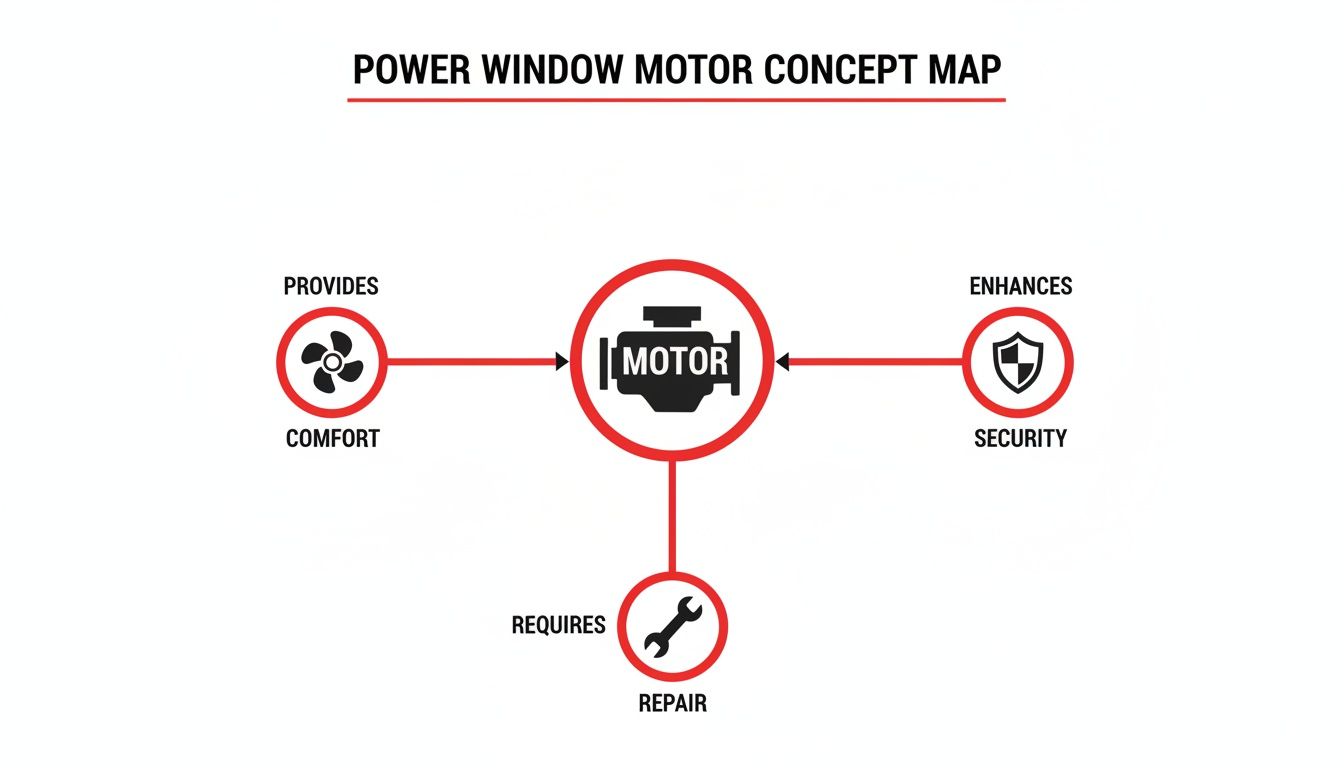
This really drives home the point: a power window motor is a convenience we take for granted, but it's a mechanical part that won't last forever. The technology inside matters, too. For years, the market has been dominated by DC brushed motors, which made up over 65% of the market share in 2023. They're workhorses, but they're slowly being replaced by more efficient, longer-lasting brushless motors, especially in high-end and electric vehicles.
Diagnosing a Failing Power Window Motor
When your power window gives up the ghost, it’s tempting to point the finger straight at the power window motor. But hold on before you start pulling that door panel off. A little detective work can save you a world of hurt. The motor is just one suspect in a lineup that could include a bad switch, a blown fuse, or a jam in the window regulator itself. Nailing down the real problem from the start saves you time, money, and the classic frustration of replacing a part that was working just fine.
The good news is that a motor on its way out usually sends up some pretty clear distress signals before it completely dies. Paying attention to these clues is your first, and most important, step in getting the diagnosis right. Think of it like a patient telling a doctor where it hurts—the strange behaviors and sounds are your best leads.
Listening for Clues From Inside the Door
Weird noises coming from inside the door are one of the most reliable signs that something's wrong. Don't just turn up the radio and ignore them; these sounds are your window’s cry for help. Different noises often point to very different problems, which helps you narrow things down.
Here’s what you should be listening for when you hit that switch:
-
Grinding or Clicking Noises: If you hear a nasty grinding sound or a series of clicks but the glass doesn't budge, you're likely dealing with stripped or broken gears inside the motor or regulator. The motor is trying to do its job, but its teeth can't grab onto anything to move the window. That's a surefire sign the assembly needs to be replaced.
-
A Faint Whirring or Humming: Hear a soft, electric whirring sound but see no action? This typically means the motor is getting power and is spinning, but it’s no longer connected to the regulator. It’s like an engine revving in neutral—plenty of power, but no connection to the wheels.
-
Complete Silence: If you get absolutely nothing—no click, no hum, nada—your problem is almost certainly electrical. The power isn't even making it to the motor. This could be a dead switch, a popped fuse, or a break in the wiring.
Pro Tip: Grab a friend and have them press the window switch while you press your ear to the door panel. This makes it much easier to hear those faint motor sounds and tell them apart from the simple click of the switch itself.
Simple Diagnostic Tests You Can Do Yourself
After you’ve done your listening, a few simple tests can help you zero in on the problem. You won’t need any special tools for these, and they can often give you a definitive answer without ever having to get inside the door.
-
Check the Fuses First: Always, always start here. Your owner's manual will show you where the fuse box is and which fuse protects the power windows. A blown fuse is a cheap and easy fix. If you pop in a new one and it blows immediately, though, you have a bigger electrical short to track down.
-
Use the Master Switch: The driver's door has the command center for all the windows. Try to operate the window that's giving you trouble from there. If it works from the master switch but not its own switch on the door, you’ve just diagnosed a bad local switch, not a bad motor. Easy peasy.
-
The "Slam Test": It might sound a little rough, but this trick can be surprisingly effective on an old, dying motor. While holding the window switch down (or up), give the car door a firm slam. The jolt can sometimes be just enough to knock a worn-out motor's internal connections back into place for a moment. If the window suddenly moves, it’s a strong sign the motor is on its last legs and needs replacing.
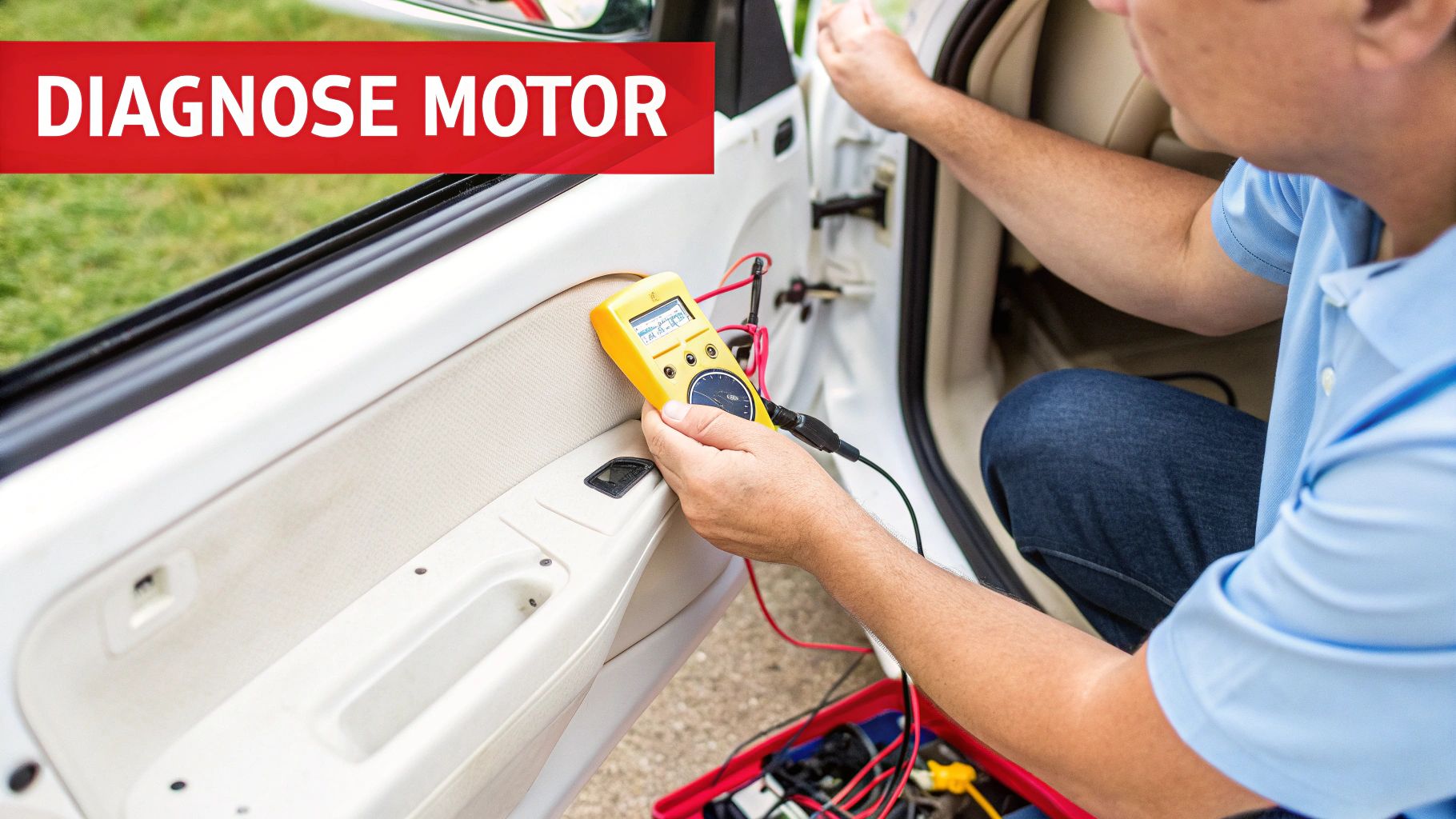
By working through these clues and tests methodically, you can stop guessing and make a confident diagnosis. For those who want to dig even deeper, our detailed guide on how to test a window motor with a multimeter will walk you through more advanced steps. This way, you can be sure you're replacing the right part, the first time.
Your Step-by-Step Motor Replacement Guide
Alright, you’ve done the detective work and confirmed your power window motor is the culprit. Now for the satisfying part: the fix. Don’t be intimidated by the idea of working inside your door panel. Replacing a power window motor and regulator assembly is one of those jobs that looks harder than it is, and it’s a perfect weekend project that will save you a ton of cash on labor costs.
With the right tools and a little patience, you can absolutely do this yourself. We'll break down the entire process, from getting your tools ready to that final, satisfying click of a fully functional window switch.
Preparing for the Replacement Job
Trust me on this one: good prep is half the battle. Taking a few minutes to gather your tools and set up a decent workspace will save you a lot of headaches later. There’s nothing worse than having to stop mid-job with a door panel hanging off to go hunt for the right socket.
While every car is a little different, the toolkit for this job is pretty standard. Getting these items laid out before you start will make everything go much more smoothly.
Essential Tools for Power Window Motor Replacement
Here's a quick checklist of what you'll want to have on hand. Having these tools ready to go will make the replacement a breeze.
| Tool Category | Specific Tools | Why You Need It |
|---|---|---|
| Panel Removal | Trim removal tool kit, Phillips and flathead screwdrivers | To safely pry off the interior door panel without snapping those delicate plastic clips. |
| Fastener Removal | Socket set (metric and/or standard), ratchet, and extensions | To unbolt the regulator, motor, and any other hardware tucked away inside the door. |
| Glass Support | Painter's tape or duct tape | This is your third hand—it securely holds the window glass up once you've disconnected it. |
| Safety Gear | Gloves and safety glasses | To protect your hands from sharp sheet metal edges inside the door and keep your eyes safe from debris. |
Once you've got your tools, park the car on a flat surface. It's also a good idea to disconnect the negative battery terminal. This is a simple safety step that prevents any accidental shorts while you're messing with wiring.
Removing the Interior Door Panel
First things first, we need to get that door panel off to access the window assembly. The process is similar for most vehicles, but the trick is knowing where the hidden screws are. They’re often tucked away behind small plastic covers in places like the door handle recess or the armrest.
- Locate and Remove Fasteners: Use a small flathead or your trim tool to pop off any little covers hiding the screws. Check behind the interior door handle and inside the door pull cup—those are common spots.
- Disconnect Switches: The main window switch panel has to come out. Gently pry it up with a trim tool and you'll see the wiring harnesses clipped into the back. Unplug them.
- Pry the Panel Free: Start at the bottom of the door and work your way around with a trim tool. You'll hear a series of "pops" as the plastic clips release from the door frame.
- Lift and Remove: With the clips free, the panel usually hangs on the top lip of the door by the window channel. Lift it straight up and it should come right off.
Behind the panel, you'll find a plastic or foam sheet called a vapor barrier. Carefully peel this back just enough to get to the components. Try not to rip it, as you’ll want to stick it back on later to keep moisture out of your car.
Uninstalling the Old Assembly
With the door opened up, you can now see the power window motor and regulator. The next step is absolutely crucial: securing the window glass before you unbolt anything.
Critical Safety Tip: Do not skip this. If you unbolt the regulator without taping the glass up, it will drop like a rock into the door. Best case, it's a huge pain; worst case, it shatters or injures you.
Temporarily reconnect your window switch and roll the window up or down until you can see the bolts holding the glass to the regulator through the access holes in the door. Now, grab your painter's tape and run a few strong strips from the outside of the glass, over the top of the door frame, and stick them to the inside. Make sure it's secure.
With the glass safely taped up, you can get the old unit out:
- Disconnect the Motor: Find the electrical connector going to the motor and unplug it.
- Unbolt the Glass: Loosen and remove the bolts clamping the glass to the regulator. The glass won't go anywhere because it's held by your tape.
- Unbolt the Regulator: Now, find the bolts holding the entire regulator assembly to the inner door frame and remove them. Be ready to support the assembly as you take out the last bolt.
- Remove the Assembly: This can feel a bit like a game of Tetris. You'll need to carefully angle and maneuver the old motor and regulator out through one of the larger openings in the door. Just take your time and you'll find the right way out.
Installing the New Motor and Testing
You're on the home stretch! With the old part out, installation is just doing everything in reverse. This is where using a quality part that's guaranteed to fit, like one from T1A Auto, really pays off. You won't have to fight with misaligned bolt holes or weird fitment issues.
Slide the new assembly into the door and get the mounting bolts started by hand to hold it in place. Next, reattach the bolts that connect the regulator to the window glass, but leave them a little loose for now.
Before you button everything up, you have to test it. Plug the new motor in, temporarily reconnect the window switch, and reconnect the battery if you disconnected it. Run the window up and down a few times. This not only confirms the part works, but it also helps the glass settle perfectly into its tracks.
Once you’re happy with how it moves, go ahead and tighten all the regulator and glass bolts. Stick the vapor barrier back on, reconnect any remaining wiring, and carefully clip the door panel back on. Put the screws and covers back in, and you're done. Your window should now glide up and down just like it did from the factory.
How to Choose the Right Replacement Motor
You’ve done the diagnostic work and muscled your way through the replacement. The very last thing you want is to be tearing that door panel off again in a year. When it comes to replacement parts, they're definitely not all created equal, and picking the right power window motor is a choice that will determine how long your fix actually lasts. It’s about more than just finding a cheap part; it’s about investing in a reliable solution.
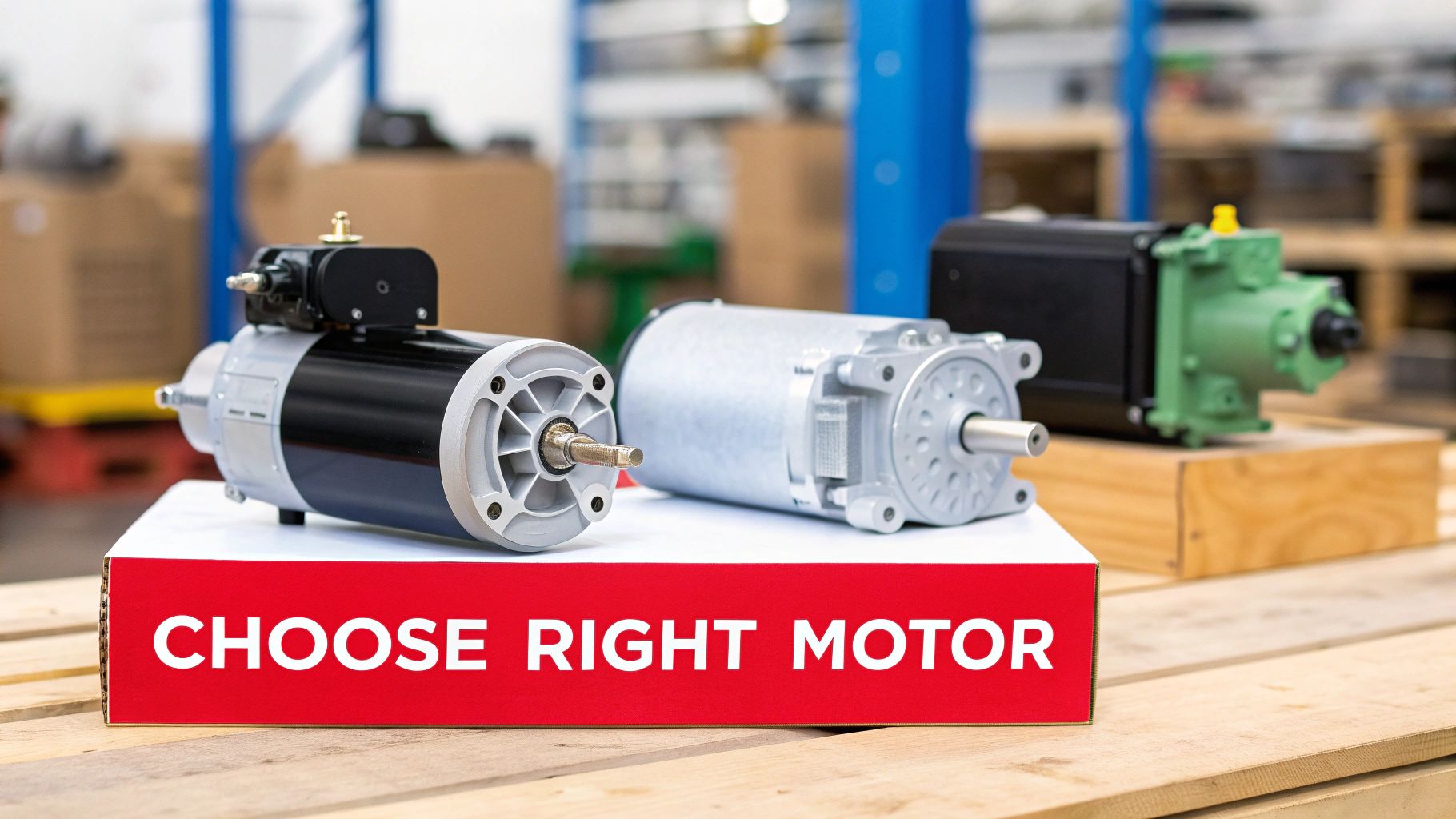
The first and most critical step is confirming the part actually fits your vehicle. Nothing's more frustrating than discovering the bolt holes don't line up or the electrical connector is wrong mid-installation. Always use a fitment tool to check compatibility with your vehicle's specific year, make, and model. It’s a simple step that takes the guesswork out of the equation.
Look Beyond the Price Tag at Quality
Once you've confirmed it fits, it’s time to think about the quality of the part itself. The market is flooded with options, but a cheap part often means you're just buying the same failure-prone design that came from the factory. This is where a premium aftermarket part can really make a difference. Many original motors fail because their plastic internal gears get brittle and strip out over time.
Good aftermarket manufacturers know this and tackle those weak points head-on.
- Engineered Improvements: Keep an eye out for parts with upgraded components, like tough metal gears instead of the original plastic ones. This one change targets the most common point of failure, giving you a much more durable and long-lasting motor.
- Material Strength: The quality of the metals and plastics used in the housing and regulator matters, too. Better materials will resist rust and wear, helping the whole unit hold up to years of daily use.
This focus on improving the original design is what sets great parts apart from the rest. If you want to dive deeper into this topic, our article on OEM vs. aftermarket parts breaks it all down. By choosing a part with these kinds of upgrades, you’re not just replacing a broken component—you’re installing a better one.
The Importance of a Strong Warranty
A warranty is much more than just a piece of paper. It’s a direct statement from the manufacturer about how much they believe in their own product. A flimsy 90-day warranty might as well be a red flag, suggesting the company doesn't expect the part to last. On the other hand, a long-term or lifetime warranty shows the company is willing to stand behind its engineering and materials.
A strong warranty is your assurance against premature failure. It protects your investment and gives you a clear path forward if something goes wrong, saving you from the headache and cost of buying the same part twice.
Think of it as built-in insurance for your repair. By focusing on guaranteed fitment, looking for parts with smart design improvements, and choosing a brand that backs its products with a solid warranty, you can buy with total confidence. This approach ensures your new power window motor will work perfectly not just for today, but for many years to come.
Common Questions About Power Window Motors
So, you've wrapped up the repair, but a few questions are still bouncing around in your head. That's totally normal. Getting your hands dirty on a project like this always brings up some "what ifs" and "whys." We've been there, so we put together a list of the most common questions we hear to give you clear, straight-up answers.
Think of this as a quick chat with a seasoned mechanic after the job is done. We'll clear up any lingering doubts and make sure you walk away feeling like an expert on your own power window system.
Can I Replace Just the Motor or Do I Need the Whole Assembly?
This is the big one, probably the most common question DIYers ask, and for good reason. It seems logical to just replace the one part that failed to save a few bucks. The real answer, though, depends on how your vehicle was built and how much of a headache you're willing to endure.
On most modern cars, the factory bolts the power window motor and the regulator together as a single unit. It's a matched set, designed to work perfectly right out of the box, which makes the installation a whole lot easier. For the vast majority of people, just buying the complete motor and regulator assembly is the smartest move.
The Bottom Line: Grabbing the full motor and regulator assembly is the best way to ensure a solid, long-lasting fix. It saves you from the nightmare of trying to separate the old motor from the regulator, a task that often involves special tools and a lot of frustration. It turns a potentially miserable job into a straightforward swap.
Now, some older models do let you replace just the motor. But you should only even think about going this route if you are 100% certain the regulator's cables, pulleys, and tracks are in pristine condition. If there's any wear on those parts, you're just setting yourself up for another failure down the road, meaning you'll be tearing that door panel off all over again.
My Window Goes Down But Not Up—Is That a Bad Motor?
This is a classic symptom, but nine times out of ten, the motor isn't the problem. The real culprit is usually the window switch. It's a common mistake to assume the motor is half-dead, but it all comes down to simple electronics. A power window motor is just a basic DC motor; it spins one way to raise the glass and reverses direction to lower it.
The switch sends one electrical signal to make it spin up and a different one to make it spin down. Inside that switch are two separate sets of tiny contacts. Over time, the "up" contacts—which have to fight gravity and friction—get worn out or corroded, while the "down" contacts are still working just fine. Before you even grab a screwdriver to pull the door panel, try this simple test:
- Go to the master switch cluster on the driver's door.
- Try to operate the window that's giving you trouble. If it goes up and down perfectly from the master switch, you've just proven the problem is the individual switch on that specific door.
- If it still only goes down, then you can start suspecting the motor or the wiring.
This two-minute check can save you hours of work and the cost of a part you never needed.
How Long Does a Power Window Motor Typically Last?
An original factory motor is usually built to last the main service life of the vehicle. In real-world terms, that often means somewhere between 100,000 and 150,000 miles, or roughly 7 to 10 years of typical driving.
Of course, "typical" varies a lot, and several things can shorten that lifespan:
- Heavy Use: It's no surprise that the driver's side window, which goes up and down constantly, will fail long before a rear passenger window that's barely ever used.
- Harsh Climates: Extreme heat can make window tracks gummy, while freezing temps can add a ton of resistance. Both scenarios force the motor to work much harder.
- Water Damage: If the weather stripping or vapor barrier inside the door fails, moisture gets in. That leads to rust and corrosion, which will seize up a motor in a hurry.
Another common weak point is the plastic gears used in many factory motors. Over the years, they get brittle and eventually strip out or crack. This is exactly why a lot of high-quality aftermarket replacements are designed with tougher, more durable materials to fix these known flaws and outlast the original part.
Is It Safe to Use a Window Making a Grinding Noise?
You might be tempted to ignore that awful grinding or clicking sound as long as the window still moves, but please don't. That noise is the sound of a mechanical part screaming for help. It’s a dead giveaway that the gears inside the motor or the regulator assembly are stripped, broken, or way out of alignment.
Every time you hit the switch, you're forcing those damaged parts to grind against each other, putting them under incredible stress. Eventually, they will fail completely and without warning. When that happens, there's nothing left holding the heavy window glass up.
The glass can suddenly drop into the door, where it can get jammed or, even worse, shatter if it falls at a weird angle. This immediately creates a security risk and can turn what should have been a simple repair into a much bigger, more expensive mess. The second you hear that grinding, stop using the window and plan to replace the assembly.
At T1A Auto, we're here to help you get the job done right with parts you can trust. Our power window motor and regulator assemblies are built for durability, often using upgraded materials to prevent the common failures we just talked about. Find the guaranteed-fit part for your vehicle and fix it once by visiting https://t1aauto.com.
