


When your car window decides to stop working, the first thought that pops into your head is usually, "How much is this going to cost me?" Generally, you can expect the power window regulator repair cost to be somewhere between $250 and $900. Of course, that's a pretty wide range, and the final bill really depends on what kind of car you drive and who you trust to fix it.
Understanding Your Power Window Regulator Repair Cost
A window stuck open or closed isn't just a minor annoyance. It leaves your car vulnerable to theft and the weather. Before you jump into a fix, it’s smart to get a handle on what you might be paying. The total cost really boils down to two things: the price of the new part and the mechanic's labor charge.
Several factors will nudge the final price up or down. Interestingly, repair costs have been creeping up over the years, and you'll almost always pay more to fix a front window than a rear one. These days, a front window regulator replacement averages between $420 and $900, while a rear window repair is a bit more wallet-friendly at $250 to $450. You can learn more about these automotive repair cost trends to see how the numbers have shifted.
Where You Get It Repaired Matters
Who you choose to do the work—a dealership or an independent shop—will make a huge difference in your final bill. Dealerships stick to Original Equipment Manufacturer (OEM) parts and tend to have higher labor rates, so you’ll pay a premium for their service. An independent shop, on the other hand, can often give you a much more competitive price by using high-quality aftermarket parts and having lower overhead.
Choosing an independent mechanic can often save you 15-30% compared to dealership prices without sacrificing quality, especially when they use reliable aftermarket parts backed by a solid warranty.
To help you get a clearer idea of what to expect, here’s a quick breakdown of typical costs based on different vehicle types and where you take it for repair.
Estimated Power Window Regulator Repair Costs
This table provides a quick summary of expected repair costs, comparing different scenarios to help car owners budget accordingly.
| Vehicle Type | Independent Shop (Avg. Cost) | Dealership (Avg. Cost) |
|---|---|---|
| Standard Sedan | $275 - $450 | $400 - $600 |
| SUV / Truck | $350 - $550 | $500 - $750 |
| Luxury Vehicle | $500 - $800+ | $700 - $1,200+ |
As you can see, the difference adds up quickly, especially when you're driving a bigger or more high-end vehicle.
Decoding Your Repair Bill: Parts vs. Labor
When you get a repair quote for your power window, it’s helpful to think of it like a bill from a restaurant. You’re not just paying for the ingredients (the parts), but also for the chef's expertise and time to put it all together (the labor). Understanding how these two costs are broken down is the first step to knowing exactly what you're paying for.
The first major chunk of the bill is the parts cost. This is the price of the new window regulator assembly itself. But here's the thing: not all replacement parts are the same, and the one you choose will have a big impact on your final cost.
Choosing the Right Replacement Part
The part you select is easily one of the biggest factors in what you'll spend. Each option has its own pros and cons when it comes to price, quality, and your own peace of mind.
- OEM (Original Equipment Manufacturer) Parts: These are the exact same parts your car rolled off the assembly line with. You’re guaranteed a perfect fit and function, but they're also the most expensive option, usually coming straight from the dealership's parts counter.
- Aftermarket Parts: These are made by companies other than the original car manufacturer. They're designed to work just like the factory parts but are almost always more affordable. In fact, many high-quality aftermarket suppliers will actually improve on the original designs, swapping out flimsy plastic components for stronger metal ones. Want to go deeper? Check out our guide on OEM vs. aftermarket parts.
- Used or Salvaged Parts: You can find these at a junkyard, pulled from wrecked cars. They're definitely the cheapest route, but it’s a gamble. They come with a higher risk of failing early and rarely include any kind of meaningful warranty.
For most drivers, a premium aftermarket part really hits the sweet spot. You get quality and reliability that meets or even beats the original, often with smarter design features, for way less than you'd pay at the dealership.
Calculating the Labor Cost
The other half of your invoice is the labor cost. This is what you pay the mechanic for their time, skill, and experience. Most shops don’t just start a timer; they use a standardized guide often called "book time."
Book time is an industry-wide estimate that says how long a certain job should take on a specific make and model. For a power window regulator replacement, the book time is usually somewhere between one and three hours.
What makes the time vary so much? It really comes down to how complex your car's door is. Popping the door panel off an older pickup truck is a quick job. But doing the same on a modern luxury car means navigating a maze of extra wiring, airbags, sensors, and sound-dampening materials.
The more stuff a mechanic has to carefully work around, the more book time gets added to the job. That’s why the power window regulator repair cost is so tied to how much work it takes just to get to the broken part inside the door.
How Your Car Model Impacts the Final Cost
When you're trying to budget for a power window regulator repair cost, one of the biggest wildcards is the car you drive. Not all vehicles are built the same, and the difference in repair bills can be shocking. It's a lot like buying new tires—a set for a Honda Civic will always be a fraction of the cost of tires for a Porsche or a big F-350. The same logic holds true for the parts inside your door.
So, why the huge price swing? A few key things are at play.
First, think about luxury and European cars. Their doors are often packed with complex electronics, extra sound-dampening materials, and sophisticated anti-theft sensors. A mechanic has to carefully navigate this maze just to get to the broken regulator, which means more time on the clock and higher labor costs for you.
Then there's the price of the part itself. An official OEM (Original Equipment Manufacturer) regulator for a Mercedes-Benz or BMW simply costs more than one for a Toyota. Part of that is branding, but it's also due to more intricate designs and manufacturing standards.
Cost Differences Across Popular Vehicles
If you drive something common like a Honda Accord or a Ford F-150, you're in luck. Because there are millions of these vehicles on the road, there's a huge, competitive market for quality aftermarket parts. This competition is great for consumers, as it helps keep the power window regulator repair cost down to earth.
The data backs this up. Looking at repair estimates from across the country, you see a clear pattern. For example, replacing a regulator on a Toyota Camry might run you $251 to $334. But the same job on a Honda Accord could be surprisingly higher, ranging from $736 to $932. A popular truck like the Chevrolet Silverado 1500 often lands somewhere in the middle, typically from $476 to $636. You can dig into more vehicle-specific cost estimates and comparisons to see how your own car stacks up.
The bottom line is this: the complexity of your door's design and the cost to source the part are what drive the final bill. A simple, mass-produced car will almost always be cheaper to fix than a low-volume or luxury model.
To give you a clearer picture, let's look at a few common vehicles side-by-side. The table below really shows how the numbers can shift depending on what's parked in your driveway.
Repair Cost Comparison for Popular Vehicle Models
This table illustrates how the make and model of a vehicle dramatically affect the total cost of a power window regulator replacement.
| Vehicle Model | Average Parts Cost | Average Labor Cost | Total Estimated Cost Range |
|---|---|---|---|
| Honda Civic | $100 - $180 | $100 - $130 | $200 - $310 |
| Ford F-150 | $150 - $250 | $120 - $160 | $270 - $410 |
| BMW 3 Series | $250 - $400 | $200 - $280 | $450 - $680 |
| Toyota RAV4 | $120 - $200 | $110 - $140 | $230 - $340 |
As you can see, the jump from an everyday sedan or SUV to a European luxury model is significant, with both parts and labor costs climbing steeply. This is why getting a quote specific to your vehicle's VIN is always the best first step.
Choosing Your Path: DIY Repair vs. Professional Service
So, your power window is stuck. Now you've hit a fork in the road: do you roll up your sleeves and tackle this yourself, or do you hand the keys over to a pro? The right answer really comes down to your budget, your confidence with a wrench, and what your time is worth. Making a smart choice here is the single biggest factor in your final power window regulator repair cost.
Deciding to fix it yourself can be a huge win. The most obvious perk is saving a ton of cash—you’re only on the hook for the part, completely sidestepping the $100 to $280 in labor fees a shop will charge. Plus, there's a genuine sense of satisfaction that comes from fixing your own car.
But let's be real, the DIY route has its pitfalls. This isn't like changing a lightbulb; you'll be working in the cramped, tricky space inside your door panel. You'll need a decent set of basic tools, like a socket set, screwdrivers, and definitely a trim removal tool if you don't want to scratch up your interior. The biggest headache for first-timers? Those little plastic clips holding the door panel on. They become brittle over time and are incredibly easy to snap.
To get a feel for what you'd be getting into, our detailed guide on how to replace a window regulator gives you a complete, step-by-step walkthrough of the entire job.
The Professional Service Advantage
Going with a professional mechanic offers a different kind of value: pure peace of mind. Sure, the upfront bill is higher, but you're paying for experience and speed. A seasoned tech has probably done this exact job hundreds of times. They can knock out the replacement in just one to three hours, which could easily be a whole afternoon for someone doing it for the first time.
This chart shows what you can expect to pay for just the regulator part on a few common vehicles. This is your baseline cost, whether you do it yourself or have a shop do the work.
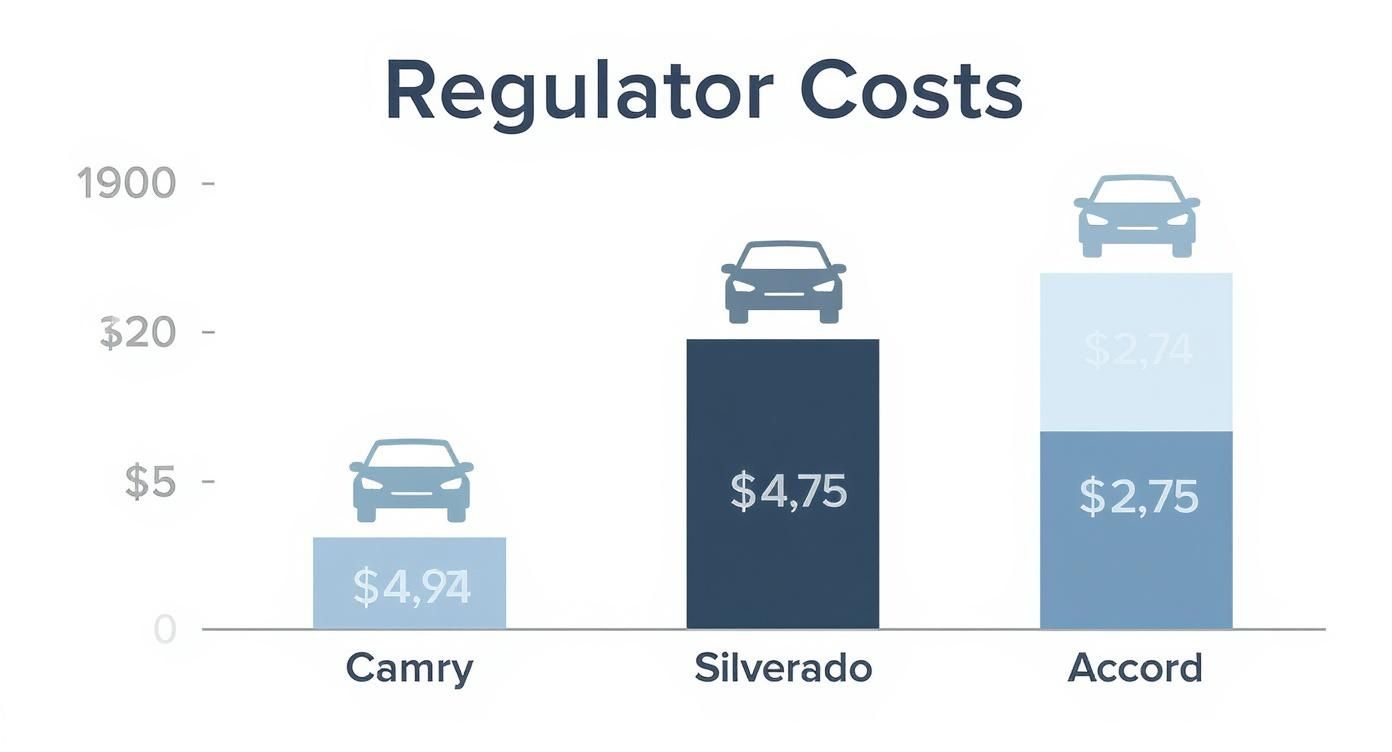
As you can see, the part cost itself can vary quite a bit, and this is before a mechanic even touches your car.
Maybe the best reason to go pro is the warranty. Any reputable shop will stand behind its work, giving you a guarantee on both the part and the labor. If that new regulator fails in a few months, the fix is their problem, not yours.
Choosing professional service is like buying an insurance policy for your repair. You pay a premium for the assurance that the job is done right, done fast, and is protected if anything goes wrong down the road.
Making the Right Call for You
So, how do you decide? It all comes down to an honest self-assessment.
- Go the DIY route if: You're comfortable around tools, enjoy figuring things out, and your main goal is to save as much money as possible.
- Head to a professional if: You're short on time, don't have the tools or confidence to tear into your door panel, or you simply want the security of a warranty.
At the end of the day, both paths get your window working again. The trick is to balance the money you can save against the time, effort, and potential frustration of doing it yourself.
Signs of a Failing Window Regulator
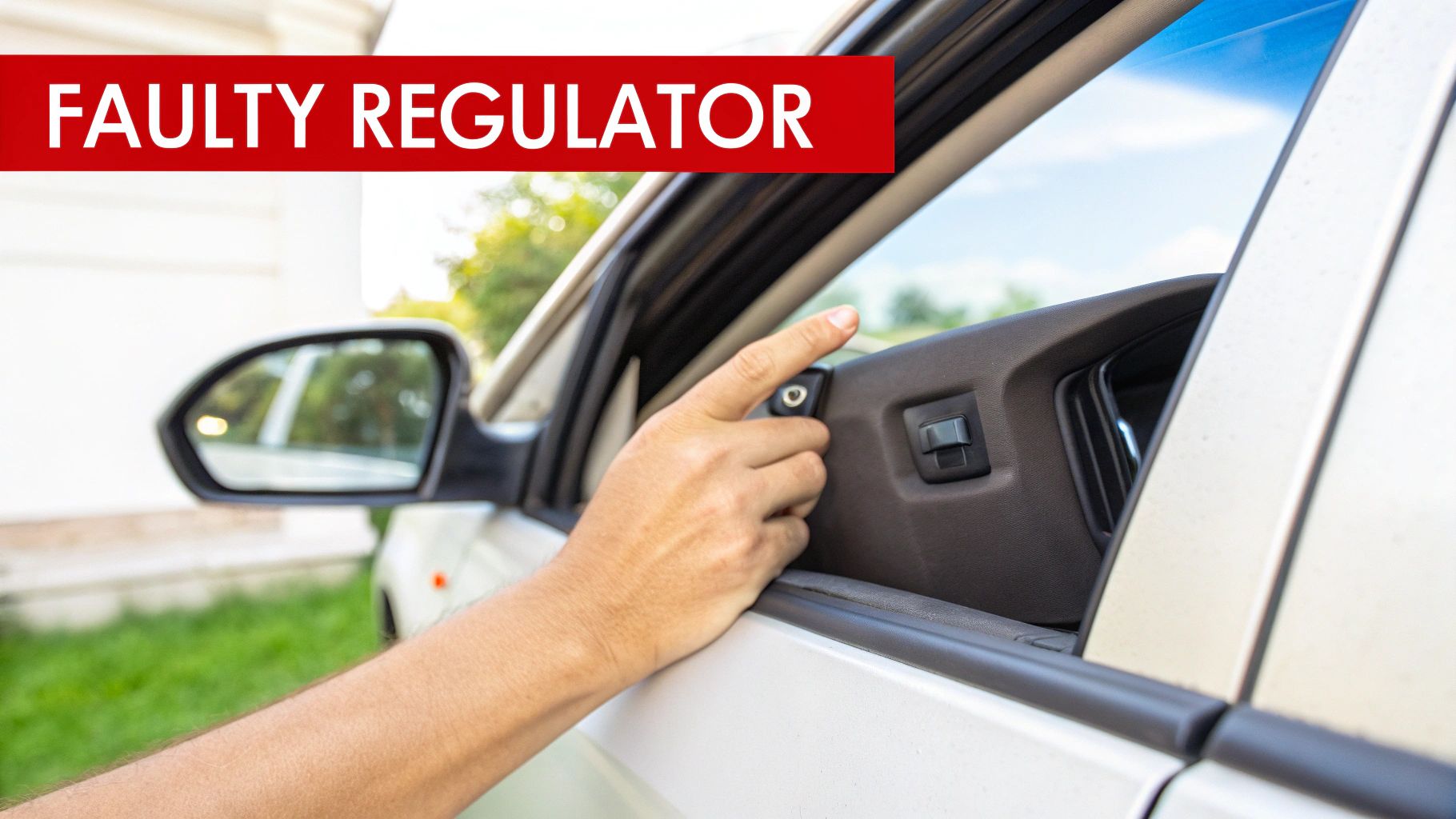
Before you start pricing out parts, you need to be sure the regulator is actually the problem. It's a classic mistake to jump to conclusions, and you don't want to get hit with a power window regulator repair cost you didn't need to pay. A bad regulator gives off some pretty classic symptoms that are hard to miss once you know what to look—and listen—for.
Think of the regulator as the muscle doing the heavy lifting for your window glass. When that muscle starts to give out, you'll see some obvious signs of weakness or outright failure. The good news is these signs are usually very different from a simple electrical problem like a bad switch or a blown fuse.
Common Symptoms of a Bad Regulator
A dying regulator almost always makes its presence known with strange sounds or funky window movements. If you're dealing with any of these, the regulator is your prime suspect.
- Strange Noises From Inside the Door: Are you hearing a grinding, clicking, or chattering sound when you hit the button? That's a dead giveaway. It often means the regulator's cable has snapped or its little plastic gears have been chewed up and stripped.
- The Window Falls Into the Door: This one is impossible to ignore. If the glass suddenly drops down into the door panel on its own, the mechanism holding it up has completely let go.
- Slow, Stuttering, or Crooked Movement: A window that struggles to go up, moves in jerky motions, or travels at a weird angle is a clear sign the regulator is binding up or has lost its lifting power.
A huge diagnostic clue is hearing the motor run but seeing no window movement. If you press the switch and hear that familiar whirring from inside the door, but the glass doesn't budge, the motor is almost certainly fine. It's just spinning uselessly because the regulator it's attached to is broken.
Distinguishing Regulator Failure From Other Issues
It’s easy to assume the worst, but taking a minute to rule out the simple stuff can save you a ton of time and cash.
A blown fuse is a super cheap fix, and a faulty switch is a much easier job than tearing the door apart to replace the whole regulator assembly. If you're hearing absolutely nothing when you press the button—no click from the switch, no hum from the motor—your problem is almost definitely electrical.
To be sure, check out our guide on how to test a window motor. Once you've confirmed the motor and switch are getting power and doing their jobs, you can point the finger at the regulator with confidence.
Actionable Tips to Lower Your Repair Bill
https://www.youtube.com/embed/CmSqt7P9-YQ
Nobody likes an unexpected repair bill, but the good news is you have more control over the final power window regulator repair cost than you might realize. A few smart moves can shave a significant amount off the total, whether you're hiring a mechanic or just buying the parts yourself.
The most powerful strategy is also the simplest: get multiple quotes. Never just settle for the first shop you call. Reach out to at least three different independent mechanics in your area to get a feel for the going rate. This one step will give you a clear baseline for what’s fair and often uncovers some surprisingly big price differences for the exact same job.
Source Your Own Parts
Here’s another great way to cut costs: buy the replacement part yourself. Many independent shops are perfectly happy to install customer-supplied parts, which means you’re only paying them for their time and labor.
This approach lets you shop around online for a quality aftermarket regulator, which is almost always cheaper than what a repair shop would charge for the same component. Plus, when you buy your own part, you're in control. You get to pick the brand and the warranty that comes with it, putting you in the driver's seat.
Always ask about warranties—for both the part and the labor. A good shop will stand by its work, and a quality part from a supplier like T1A Auto will come with its own warranty. That’s double the peace of mind.
Consider All Your Options
Don't forget to think outside the box, especially if you're driving an older car. A used regulator from a reputable salvage yard can be a fantastic, budget-friendly solution. While it might not have the same guarantee as a brand-new part, it's a solid way to keep an older vehicle running without breaking the bank.
At the end of the day, being an informed car owner is your best tool. By comparing prices, sourcing your own parts, and asking smart questions about warranties, you can take charge of the repair process and keep more money in your wallet.
Common Questions About Window Regulator Repair
When your car window stops working, a lot of questions pop up. Let's walk through some of the most common ones so you know exactly what to expect and can make a smart decision for your car.
How Long Does This Job Usually Take?
For a seasoned mechanic, swapping out a window regulator is usually a one to three-hour job. The time really depends on the car; some door panels are a straightforward affair, while others are packed with complex wiring and extra components that require more careful navigation.
If you're planning to tackle this yourself for the first time, give yourself a good window of time. I'd block out anywhere from two to five hours to get it done right without feeling rushed.
Is It Really Worth Fixing a Broken Power Window?
Absolutely. This isn't just a minor annoyance. A window that's stuck open is a huge security risk, practically inviting theft or water damage from the next rainstorm. One that's stuck closed is a daily headache you don't need.
Plus, depending on where you live, a window that doesn't work can actually cause you to fail your state's safety inspection. The power window regulator repair cost is a small price to pay to get your car's security and basic function back.
Fixing a broken power window is not just about convenience. It’s a crucial repair for maintaining your vehicle's security, preventing water damage inside the door, and preserving its resale value.
Can I Just Replace the Motor and Not the Whole Thing?
This is a common question, but on most cars built in the last couple of decades, the answer is no. The window motor and the regulator itself are designed and sold as a single, pre-assembled unit.
While you could sometimes buy them separately on older cars, it’s rarely practical or even possible anymore. It’s far simpler and more reliable to just replace the complete assembly. This way, you know all the moving parts are fresh and designed to work together, which helps prevent another breakdown in the near future.
For reliable, long-lasting replacement parts backed by an industry-leading warranty, explore the selection at T1A Auto. Find the guaranteed-fit regulator for your vehicle at https://t1aauto.com.
