


Getting the right replacement parts for toyota tacoma is the difference between a fix that lasts and a headache that keeps coming back. Whether it’s something as simple as a door handle or a more involved part like a window regulator, the quality of what you install determines how long you can count on your truck.
Think of this as your field guide to making smarter repair choices for your Tacoma.
Why Finding the Right Tacoma Parts Matters
We all know Toyota Tacomas are built tough, but even the most rugged trucks have parts that wear out. When a component finally gives up, you’re at a crossroads. The choice you make doesn't just affect your wallet today; it impacts your truck's reliability for years to come. It’s not about just finding a part that fits—it’s about finding one that won’t leave you stranded again.
A lot of the original parts, especially in older Tacos, were made from plastic to save a few bucks on the assembly line. They work fine for a while, but years of sun, rain, and daily use make them brittle. That's exactly why you see so many Tacomas with busted exterior door handles or windows that won't roll up anymore. The original part just couldn't handle the long-term stress.
The Growing Need for Quality Parts
It's no secret that the demand for reliable replacement parts for Toyota Tacoma models is huge. With roughly 3.2 million of these trucks on the road, the Tacoma has become one of the most popular and customized pickups in North America. According to a SEMA report on accessory opportunities, models from 2016 onward alone account for nearly 800,000 trucks still running—and wearing out parts.
This guide is here to walk you through the repair process so you can tackle it with confidence. We’ll cover:
- Common Failure Points: Pinpointing the parts that are most likely to break.
- Material Matters: Why upgraded metal components are often a smarter choice than OEM plastic.
- Fitment Guarantee: How to make sure you’re ordering the exact part for your year and model.
- Smart Savings: Discovering how top-tier aftermarket parts can offer better value without the dealership markup.
A broken part isn’t just an inconvenience; it’s an opportunity to upgrade. Choosing a replacement made from better materials isn't just a repair—it’s an investment in your truck's future.
The real goal here is to get you out of the cycle of temporary fixes. By understanding what’s available and putting quality first, you can get your truck back to 100% and keep it that way. A little know-how can turn a frustrating repair into a lasting improvement. To learn more about keeping your truck running strong, take a look at our guide on the recommended Toyota Tacoma maintenance schedule.
How to Spot a Failing Part on Your Tacoma
Look, even the toughest trucks have their weak spots. The Toyota Tacoma is legendary for its reliability, but after years on the road, some parts are just bound to give out. Knowing what to look for is the single most important step in finding the right replacement parts for Toyota Tacoma models. Get this part right, and you’ll save yourself a ton of headaches, time, and money.
Think of it this way: your truck is talking to you. That wobbly door handle or a window that groans its way up isn't just a minor annoyance; it's a dead giveaway that a specific component is on its last legs. Usually, it's just a case of simple wear and tear—plastic gets brittle, and mechanical parts get tired after thousands of cycles.
You don’t need to be a seasoned mechanic to figure this out. All it takes is a little bit of observation. Once you connect a symptom to the likely culprit, you’ve turned a fuzzy problem into a straightforward fix.
Common Problems on the Outside
It’s often the parts you touch every day that fail first. Think about your exterior door handles, side mirrors, and everything on the tailgate. These components take a constant beating from both you and the elements, so it’s no surprise they’re common failure points.
The exterior door handle is a classic. You might start to notice it feels a little loose or you have to give it a good yank to get the door open. One day, it just might snap right off in your hand. That’s a sure sign the plastic mechanism inside has finally cracked under the strain.
Same goes for a shaky side mirror that refuses to hold its position. It’s not just irritating; it’s a real safety issue. Road vibrations can weaken the internal mounts over time, causing the mirror to flop around or, worst-case, fall off entirely.
It’s not just Tacomas, either. The need for these kinds of parts is a huge driver behind the automotive aftermarket. The global market was valued at USD 502.61 billion back in 2025 and is expected to climb to USD 756.25 billion by 2032. This growth is fueled by people like you keeping their trusted vehicles running, so you can explore more data on this market growth to see the industry trends for yourself.
Telltale Signs from Inside the Cab and at the Tailgate
Once you hop inside, the power window regulator is another common part to go. That's the motor and track system that moves your window up and down. If you hear a grinding sound, see the window moving slowly or at an angle, or it suddenly drops inside the door, your regulator is shot.
The tailgate is another workhorse area with several small parts that can fail. If it slams down hard instead of lowering gently, the support cables are probably frayed or the struts have lost their charge. A handle that feels limp and won't unlatch the tailgate is pointing you straight to a busted latch mechanism.
To make things even easier, here’s a quick-glance table to help you connect symptoms with the problem part.
Common Toyota Tacoma Failure Points and Symptoms
This table is a handy reference guide to help you quickly diagnose some of the most frequent issues Tacoma owners run into with high-wear components.
| Failing Component | Common Symptoms | Typical Cause of Failure |
|---|---|---|
| Exterior Door Handle | Feels loose, requires a hard pull, or breaks off completely. | Internal plastic mechanism cracking from repeated stress and UV exposure. |
| Power Window Regulator | Grinding noises, slow or crooked window movement, window dropping. | Worn or snapped cables, or a failing motor within the regulator assembly. |
| Side View Mirror | Mirror glass wobbles, housing is loose, or power functions fail. | Weakened internal plastic mounts or corrosion in electrical connections. |
| Tailgate Handle/Latch | Handle feels disconnected, tailgate won't open or close securely. | Broken plastic clips or worn metal components in the latch assembly. |
When you know these common failure points like the back of your hand, you can diagnose your Tacoma’s issues quickly and with confidence. This puts you in the driver's seat, making sure you find the exact replacement parts for Toyota Tacoma you need and get the job done right the first time.
OEM vs. Aftermarket Parts: The Big Decision
Alright, you've figured out what's broken on your Tacoma. Now comes the real fork in the road, a decision that hits both your wallet and your truck's future reliability: Do you go with an OEM part from the dealer or dive into the world of aftermarket replacement parts for Toyota Tacoma?
It's not as simple as one being "good" and the other "bad." They serve different purposes, and honestly, one often makes more sense than the other.
Think of an OEM (Original Equipment Manufacturer) part as the exact same component that just broke on your truck. It's a perfect match, guaranteed to fit. The catch? It also has the same built-in flaws—like that brittle plastic piece that snapped in the first place—and you'll pay a premium for the Toyota logo on the box.
A quality aftermarket part, however, is a different beast. The best brands don't just copy the original. They look at why it failed and build a better version. They see a plastic handle that cracks in the cold and replace the failure-prone guts with durable metal. You're not just replacing the part; you're upgrading it.
This little decision tree can help you trace a symptom back to the likely culprit, pointing you in the right direction.
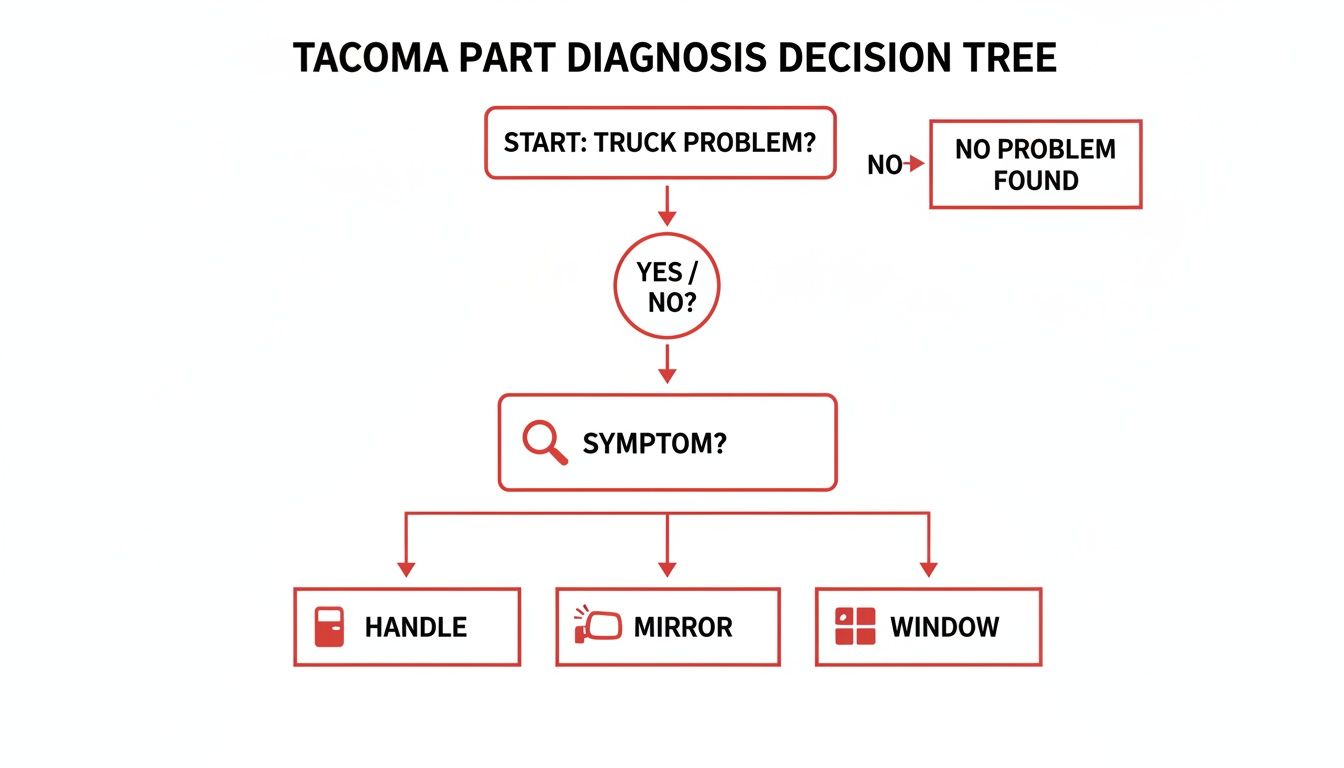
As you can see, a few simple "yes" or "no" questions about what's happening (or not happening) with your door, mirror, or window can quickly narrow down the problem.
The Real-World Value of Upgraded Aftermarket Parts
For many of us, the biggest draw to premium aftermarket parts is getting a better-than-factory component for less money. You're not just saving a few bucks; you're getting a smarter, more durable solution.
Let’s break down the real-world wins:
- Smarter Materials: Instead of paying for another plastic door handle that's destined to fail, you can get one reinforced with metal. It's a common-sense fix for a well-known problem.
- Serious Cost Savings: High-quality aftermarket parts skip the dealership markup. That means you can often get a stronger, redesigned part for a fraction of what the OEM version costs.
- Warranties That Mean Business: Many top aftermarket suppliers, like us here at T1A Auto, stand behind our upgraded parts with a lifetime warranty. That’s a level of confidence in durability you simply won’t get from the OEM side.
The goal shouldn't be just to replace a broken part, but to upgrade it. When you choose an aftermarket part with improved materials, you're actively preventing the same headache from happening again down the line.
Of course, the aftermarket world is huge, and not every brand is worth your time. Quality varies wildly. That’s why knowing what to look for is so important. We go into a lot more detail in our guide comparing OEM vs. aftermarket parts.
How to Find Aftermarket Parts You Can Trust
So, how do you sort the good from the bad? When you're shopping, keep an eye out for quality seals of approval. One of the biggest ones is CAPA certification.
CAPA stands for the Certified Automotive Parts Association. It's an independent, non-profit watchdog that puts aftermarket parts through a battery of tests. They check for fit, performance, durability, and safety to ensure the part is every bit as good as the original. If you see the CAPA seal, you know you aren't compromising on quality to save money. It's a trusted benchmark in the industry.
By sticking with certified parts, or at least well-reviewed components with clear material upgrades and a solid warranty, you’re making a smart investment in your Tacoma. You get a tougher truck without paying the dealer tax.
How to Guarantee You Get the Right Part
We’ve all been there. You get the box, tear it open, and that sinking feeling hits you—it’s the wrong part. It’s more than just an annoyance; it kills your weekend project, costs you money in return shipping, and leaves your Tacoma stuck in the garage.
But ordering the right replacement parts for Toyota Tacoma models doesn’t have to be a gamble. It's about taking a minute to match the part to your truck's unique DNA. A little prep work now saves a massive headache later.
Think of your truck's Vehicle Identification Number (VIN) as its fingerprint. This 17-digit code tells you everything: the exact day it rolled off the line, the engine it has, the factory options it came with, and more. It's the ultimate source of truth for finding parts that fit perfectly.
Start With Your VIN
Before you even click "add to cart," go find your VIN. It’s in a few easy-to-spot places:
- Driver-Side Dashboard: Just look through the windshield at the base of the driver's side.
- Driver's Door Jamb: You'll see a sticker with the VIN and other manufacturing info.
- Vehicle Paperwork: Your registration and insurance cards will always have it.
Once you have it, punch that number into the fitment tool on a site like T1A Auto. This is your secret weapon. The system automatically weeds out anything that won't work, showing you only the parts guaranteed to fit your specific Tacoma. No more guesswork.
Why Tacoma Generations and Trim Levels Matter
Toyota has built three generations of the Tacoma, and the parts are almost never interchangeable. A door handle for a 2nd Gen (2005-2015) might look identical to one for a 3rd Gen (2016-Present), but the mounting points and internal bits will be completely different. Always, always confirm your truck’s model year.
But it gets deeper than that. Your truck's trim level—SR, SR5, TRD, Limited—is hugely important, especially for anything with wires. A base model SR might have plain, manual side mirrors, while a top-tier Limited could have mirrors packed with tech like turn signals, heaters, and blind-spot monitors.
A part description that just says "fits 2018 Toyota Tacoma" is only half the story. You have to make sure it also matches your TRD Off-Road package or SR5 features, or you'll end up with a mirror that doesn't heat up or a handle without the right camera connection.
This is where you need to be a detective. A good product page will clearly list every feature a part supports so you can match it to what’s already on your truck.
Common Part Mix-Ups and How to Avoid Them
Even with a VIN, some parts are notorious for causing mix-ups. Side view mirrors are public enemy number one. Before you buy, go out to your truck and double-check what you have:
- Heated Glass? Look for the little defrost icon on the mirror itself.
- Turn Signal? Does an arrow light up in the housing or on the glass?
- Power Folding? Is there a button inside to fold the mirrors in?
It's the same story with replacement parts for Toyota Tacoma tailgates. Does your current handle have a backup camera built into it? Does the tailgate lock with your power locks? Answering these simple questions ensures the new part will have the right plugs and connections, making the install go smoothly. By being methodical and using your VIN, you guarantee the part that shows up is the part that fits.
A Realistic Look at DIY Tacoma Repairs
So, you’ve diagnosed the issue and have the perfect part in your hands. Now for the big question: do you roll up your sleeves and tackle this yourself, or is it time to call a pro? The fantastic news is that a surprising number of common replacement parts for Toyota Tacoma trucks are incredibly DIY-friendly.
You don't need a four-post lift in your garage or a master mechanic certification to handle a lot of these jobs. Many components were designed for straightforward access. With a little patience and the right video tutorial, you can save a hefty sum on labor costs.
But it’s not just about the money. There’s a real sense of satisfaction that comes from fixing your own truck. It puts you in the driver's seat—literally and figuratively—and deepens the connection you have with the machine you depend on.
Getting Started with Beginner-Friendly Fixes
Some repairs are so simple they're almost begging you to do them yourself. These are the jobs you can knock out in under an hour with basic hand tools you probably already own, like a socket set, some screwdrivers, and maybe a cheap trim removal kit. They make a perfect entry point for getting your hands dirty.
A perfect example is swapping out an exterior door handle. Typically, this just means removing a couple of screws inside the door, carefully unhooking a linkage rod, and snapping the new handle into place. It’s a purely mechanical process without much complexity.
The same goes for tailgate parts like support cables or the main handle. These are often held on by just a few bolts and can be replaced in your driveway in about 15 minutes. These quick wins are fantastic for building confidence and showing you what you're capable of.
Moving on to Intermediate-Level Repairs
Ready to level up? Some jobs require a bit more disassembly but are still completely doable for a determined DIYer. These intermediate repairs might take a couple of hours and demand a more methodical approach, but the sense of accomplishment is huge.
Replacing a power window regulator is a classic example. This job involves taking off the interior door panel to get to the regulator assembly. It might sound intimidating, but it's really just a logical sequence of prying off clips and unplugging a few connectors. Once you're inside, the regulator itself is only held in by a handful of bolts.
Don't let the thought of taking off a door panel stop you. With a YouTube guide on your phone and a set of plastic trim tools to avoid scratches, it's way less scary than it sounds. The real trick is just to take your time and keep your screws organized.
To give you a better idea of what to expect, we put together a simple guide for some of the most common Tacoma repairs.
Tacoma DIY Repair Difficulty Guide
| Replacement Part | DIY Difficulty Level | Estimated Time | Essential Tools |
|---|---|---|---|
| Tailgate Handle | Easy | 15-30 Minutes | Socket Set, Screwdriver |
| Door Handle (Exterior) | Easy | 30-60 Minutes | Socket Set, Trim Tools |
| Mirror Assembly | Easy | 30-60 Minutes | Socket Set, Trim Tools |
| Power Window Regulator | Intermediate | 1-2 Hours | Socket Set, Trim Tools, Pliers |
| Bumper Reinforcement | Intermediate | 2-3 Hours | Socket Set, Jack Stands, Wrenches |
| Headlight Assembly | Easy to Intermediate | 1-2 Hours | Socket Set, Screwdriver, Trim Tools |
This chart is just a ballpark—your first time might take a little longer, and that's perfectly fine. The goal is to do the job right, not fast.
Gauging Your Comfort Zone
Ultimately, the choice to DIY boils down to three things: your comfort level, your tools, and your time. The demand for truck parts is booming, especially for light commercial vehicles like the Tacoma. In fact, this market segment is expected to grow at a 7.05% compound annual rate through 2031 here in the U.S. aftermarket. This means owners are increasingly looking for suppliers with fast shipping and no-hassle warranties, making it easier than ever to get what you need.
Before you start unbolting anything, just ask yourself:
- Do I have the basic tools for this specific repair?
- Have I watched a good tutorial video to see all the steps?
- Can I set aside a few hours to work without being rushed?
If you can answer "yes," you're probably good to go. For many of these jobs, like the common door handle swap, we've created detailed walkthroughs to help you out. To see exactly what a beginner-friendly repair looks like, check out our guide on how to replace a door handle on a Toyota Tacoma. Fixing your own truck is an empowering experience, and with a Tacoma, many of the most common jobs are well within your reach.
Why Smart Tacoma Owners Choose Upgraded Parts
Picking the right **replacement parts for Toyota Tacoma** models goes beyond just patching up a problem. It’s about making a strategic investment in your truck’s future reliability. You bought a Tacoma because you count on it to perform, day in and day out, whether you're on the job or on the trail.The smart move is to think past the quick fix and look at the total value of the repair. That means considering how long the new part will last, what kind of warranty protects it, and the support you'll get if you run into a snag. It's about making sure the repair you do today is the last one you'll ever have to do for that part.
Durability That Lasts a Lifetime
If you've followed along with this guide, you've probably noticed a recurring theme: factory plastic parts have a shelf life. They get brittle from sun exposure, they get stressed from constant use, and eventually, they crack. Experienced Tacoma owners know this all too well and choose to break that cycle by upgrading to parts that are engineered to fix the original flaw.
That’s where the real value comes in. When you install a door handle with a reinforced metal pull or a window regulator built with beefier components, you're not just making a repair—you're installing a permanent solution. You're proactively stopping the same weak point from failing again a few years down the line.
The choice to upgrade is a vote of confidence in your truck's future. It’s an investment in peace of mind, knowing a common point of failure has been completely eliminated with better materials and smarter design.
The Confidence of Guaranteed Fit and Support
Of course, even the toughest part in the world is useless if it doesn't bolt up correctly. This is why a guaranteed fit is an absolute must-have. By using your truck’s VIN and clear, detailed product info, you can be sure the part you order is the part you need, which makes the actual installation a straightforward and painless job.
But the part itself is only one piece of the puzzle. The best experience comes from a company that supports you from start to finish. This includes the things that really matter:
- Lifetime Warranty: When a company offers a lifetime warranty on upgraded metal parts, it’s a powerful statement. It tells you they believe in their product, and it guarantees your investment is protected for the entire time you own your Tacoma.
- Hassle-Free Returns: A fair return policy lets you buy without worry. If for any reason something isn't perfect, you should be able to send it back without jumping through hoops.
- Responsive Support: Got a question during installation? Getting a fast, clear answer from a knowledgeable person can make all the difference. Great customer service is just as important as a great part.
At the end of the day, opting for upgraded replacement parts for your Toyota Tacoma is about more than just the nuts and bolts. It's about building a tougher, more dependable truck, backed by a company that's in it for the long haul. It's the smartest way to keep your Tacoma ready for whatever comes next.
Got Questions? We've Got Answers
Digging into replacement parts for your Tacoma can stir up a few questions. Let's clear the air and tackle some of the most common ones we hear from truck owners just like you.
Will Aftermarket Parts Void My Tacoma's Warranty?
This is a big one, but the short answer is no. Putting an aftermarket part on your truck will not automatically kill your warranty.
There’s a federal law called the Magnuson-Moss Warranty Act that has your back. It says a manufacturer can't force you to use their own branded parts to keep your warranty intact. For a dealer to deny a warranty claim, they have to prove that the specific aftermarket part you installed was the direct cause of the failure. Stick with high-quality, direct-fit parts from a trusted source, and you'll be just fine.
What's the Deal with "CAPA Certified" Parts?
Think of CAPA—the Certified Automotive Parts Association—as an independent stamp of approval. It’s a third-party group that puts aftermarket parts through the wringer to make sure they're up to snuff.
When you see a part that's CAPA certified, you know it's been tested to fit, perform, and hold up just like the original factory part. This is especially crucial for components tied to safety or electronics, like a backup camera or a parking sensor.
The CAPA seal is your guarantee that you aren't trading quality for a lower price. It's proof that the part meets tough standards for safety, durability, and function, so your truck works exactly as it’s supposed to.
Are Those Upgraded Metal Parts a Pain to Install?
Not at all. It's a common myth that upgrading from plastic to metal means a more complicated job, but it's just not true. Our upgraded metal parts are engineered as direct-fit, bolt-on replacements.
That means they use the exact same mounting holes and connections as the flimsy plastic piece you're taking off. No special tools, no custom fabrication, no headaches. The installation process is identical—the only difference is you’re left with a part made of a far more durable material. It’s an easy win for any DIYer or professional mechanic.
How Can I Get a Part to Match My Truck's Paint?
Most exterior pieces you'll buy—like mirror caps or door handles—come with what's called a "paint-to-match" finish. This is the standard way to get a perfect color match.
The part will show up with a neutral, prepped surface, usually a matte black or gray primer. This gives you (or a local body shop) the perfect canvas to spray your truck's exact factory paint code on. The result is a seamless finish that looks like it came straight from the factory. Just check the product description, which will always tell you if a part is paint-to-match.
For guaranteed-fit, upgraded replacement parts for Toyota Tacoma, trust T1A Auto to deliver durability and performance you can count on. Shop our complete collection of Tacoma parts today!
