


So, you've got a busted side mirror. It's a common problem, but the fix isn't always cheap. On average, you can expect the side mirror replacement cost to be somewhere between $150 and $870. If you're handy and go the DIY route with a basic mirror, you might get away with spending under $100.
However, if you're driving a luxury car loaded with tech, that price can quickly climb past $1,000.
Understanding the True Cost of a New Side Mirror
How I Picked These Numbers
Before you trust any cost range, you deserve to know where it came from. The figures in this guide reflect average US retail parts prices and regional labor rates for 2024–2025. Luxury and ADAS-equipped vehicles skew toward the top of every range, sometimes past it entirely. On a common vehicle, a complete side-mirror assembly typically costs about $150 to $500, with install time around 0.5 to 1.5 hours at $75 to $150 per hour — those are the anchors used throughout this mirror replacement cost analysis.
A broken side mirror is more than just an eyesore—it's a major safety blind spot that makes changing lanes a guessing game. In most states, you're legally required to have at least two working mirrors, which is worth keeping in mind: Florida's traffic laws, for example, spell out mirror requirements on Ticket Shield, PLLC's site, and most states follow similar rules. When you're looking at a replacement, the final bill is a mix of a few key things, and the mirror glass itself is just the start.
The biggest factor? Your car's technology. A simple, manually adjusted mirror from an older car is worlds apart from a modern one packed with high-tech features.
What Drives the Price Up?
A few key elements really influence the final invoice:
- Integrated Tech: Does your mirror have heating elements for frosty mornings, auto-dimming glass to fight glare, or built-in turn signals? Each one of these adds to the cost of the part.
- Advanced Safety Features: Many new cars come with mirrors that house sensors for blind-spot monitoring or cameras for a 360-degree view. These are complex, expensive components that often need special calibration after installation.
- DIY vs. Pro Installation: The path you choose here makes a huge difference. Doing it yourself saves you entirely on labor costs, while hiring a professional ensures it's done right but adds to the total bill.
At the end of the day, the side mirror replacement cost really boils down to two things: parts and labor. You might find a basic mirror part for as little as $40, but professional labor can easily tack on another $50 to $200.
For a deeper dive into how these costs add up, you can get some great expert insights on side mirror costs.
To give you a clearer picture, here's a quick breakdown of what you might expect to pay.
Estimated Side Mirror Replacement Cost Breakdown
This table gives you a ballpark idea of the costs for different types of side mirrors, factoring in both the part itself and the labor to get it installed professionally.
| Mirror Type | Estimated Parts Cost | Estimated Labor Cost | Estimated Total Cost |
|---|---|---|---|
| Manual Mirror | $40 - $120 | $50 - $100 | $90 - $220 |
| Power Mirror (Basic) | $80 - $250 | $75 - $125 | $155 - $375 |
| Heated/Turn Signal Mirror | $150 - $450 | $100 - $150 | $250 - $600 |
| Advanced (Sensors/Camera) | $300 - $800+ | $125 - $250+ | $425 - $1,050+ |
As you can see, the more features packed into that mirror housing, the more you should budget for the repair. The good news is that you have options, from basic replacements to sourcing the parts yourself.
Why Do Side Mirror Costs Vary So Much?

Ever get a quote for a side mirror replacement and wonder why it's so much higher than what your friend paid? One person might pay $50, while another gets a bill closer to $500. The difference comes down to complexity.
Think about the gap between a basic flip phone and a brand-new smartphone. They both make calls, but that's where the similarities end. The cost and capabilities are worlds apart. It's the same story with side mirrors.
A simple, manual mirror on an older car is the "flip phone" in this scenario. It's just a piece of glass in a plastic housing—cheap to make and easy to swap out. Today's mirrors, however, are the "smartphones," packed with advanced tech that significantly drives up the side mirror replacement cost.
The Technology Factor
Modern side mirrors are far more than just reflective surfaces. Each new feature adds another layer of wiring, sensors, and, of course, cost. Current 2026 analysis still projects the market for advanced side mirrors reaching nearly $11.77 billion by 2029. If you want to dive deeper, you can find more insights on the evolution of advanced side mirrors.
Here are a few common features that add to the price tag:
- Heating Elements: Tiny wires that clear away frost and fog need their own power and circuitry.
- Integrated Turn Signals: Those LED lights in the mirror housing give other drivers a clearer signal, but they're another electronic part to replace.
- Power Adjustment Motors: The little motors that let you aim the mirror from your seat add to the internal complexity.
- Auto-Dimming Glass: This smart glass uses sensors to detect headlight glare and automatically darkens, making the glass itself a high-tech component.
Advanced Safety Systems and Vehicle Type
The biggest price hikes, however, come from mirrors tied into a car's advanced driver-assistance systems (ADAS). In these vehicles, the side mirror acts as a vital command center for safety features.
A side mirror isn't just a mirror anymore; it's a sensor hub. If it houses a camera for your car's 360-degree view system or a sensor for blind-spot monitoring, you're not just replacing glass—you're replacing a piece of your car's brain.
From an editorial perspective, the scale of these expenses stands out. AAA research published in 2023 found that replacing ADAS components associated with a side-mirror repair represents a substantial majority of the total repair estimate, illustrating how sensor-related work can quickly exceed the cost of a conventional mirror assembly. You can read the full breakdown in the AAA ADAS repair cost report.
This integration means you can't just grab any old part off the shelf. You need the specific component designed for your make and model. Whether you choose a factory original or an aftermarket part will also play a role in the final bill. Our guide on OEM vs. aftermarket parts can help you weigh the pros and cons.
Ultimately, the cost difference between a basic mirror for a standard sedan and a fully-loaded one for a luxury SUV can easily be hundreds of dollars.
Breaking Down Your Repair Bill: Parts vs. Labor
When you look at a quote for a side mirror replacement, the final number can be a bit of a shock. But really, every repair bill breaks down into just two things: the cost of the actual parts and the cost for the mechanic's time to put them on. Getting a handle on this split is the first step to understanding what you're paying for.
It's a lot like buying a new grill. You have the price of the grill itself in the box (the parts), and then you might pay an extra fee for the store's "expert assembly" service (the labor). One is the physical item, the other is the expertise to get it working right.
The Cost of the Mirror Itself
The "parts" section of your bill can swing wildly, because what's broken isn't always the same. The good news is, you don't always have to replace the entire unit, which can save you a serious chunk of change.
Here's what you might be looking at:
- Just the Glass: If it's only the mirror glass that's cracked and the rest of the unit is fine, you're in luck. This is the cheapest fix by far. In many cases, you can even tackle replacing the side view mirror glass on your own.
- The Mirror Housing: This is the painted plastic shell on the outside. If it got scuffed or cracked in a parking lot mishap but the glass and internal motors are okay, you might get away with just replacing the housing.
- The Full Assembly: This is the whole shebang—glass, housing, motors, and all the wiring. It's the priciest option, but it's necessary when the entire mirror has been knocked off or smashed to bits.
The Cost of a Pro's Time
The labor charge on your invoice is all about paying for the technician's time, skill, and tools. Popping a new mirror on an older, basic car might take under an hour. But on a newer vehicle packed with tech, it's a completely different story, and the labor costs reflect that.
A mechanic's job is more than just bolting on a part. It often means carefully taking off the interior door panel, unplugging sensitive wiring without breaking any fragile plastic clips, and then correctly installing and connecting everything on the new mirror.
If your mirror has features like blind-spot monitoring or a 360-degree camera, the work doesn't stop once it's attached. The technician then has to calibrate the new sensors so they talk to your car's computer correctly. This is a critical safety step that requires special diagnostic tools and adds to the total labor time, which is why those jobs cost more.
Labor Cost to Replace a Side Mirror
Labor deserves its own line item, because it's the part of the bill you have the most control over. Most shops charge between $75 and $150 per hour for this kind of work. How many hours you're billed for depends almost entirely on what's inside your mirror:
| Mirror Type | Typical Job Time | Labor at $75–$150/hr |
|---|---|---|
| Manual mirror | 0.5 – 1 hour | $38 – $150 |
| Power/heated mirror | 1 – 2 hours | $75 – $300 |
| ADAS mirror (sensors/camera) | 2 – 4 hours (incl. calibration) | $150 – $600+ |
Two things are worth knowing before you book the job. First, the cost to replace passenger side mirror assemblies is often lower: the mirror sits farther from the driver's door wiring and electronics, so access can be easier and faster. Second, always ask whether sensor calibration is quoted separately or bundled into the labor estimate, because that single question can explain a significant price difference between two shops.
Deciding Your Repair Path: DIY or Pro?
So, your side mirror is busted. Now you're at a classic fork in the road: do you roll up your sleeves and tackle this yourself, or do you hand the keys over to a pro? The right answer really depends on how complicated your mirror is and how comfortable you are getting your hands dirty.
The biggest reason to go the DIY route? The side mirror replacement cost, of course. You'll sidestep labor fees entirely, which could easily save you anywhere from $50 to over $200. If you're driving an older car with a simple, manual mirror, this can be a surprisingly fast and satisfying weekend project.
But it's not always that simple. Modern cars are packed with delicate plastic clips and intricate wiring harnesses that can be a real headache.
Assessing the Risks and Rewards
If you try to pop off an interior door panel without the right pry tools, you can easily snap a few of those brittle fasteners or crack the panel itself. What's even more nerve-wracking is the risk of damaging the tiny electrical connectors for the power adjustments, heating elements, or—worst of all—the advanced safety sensors. One wrong move could turn a relatively cheap fix into a much bigger, more expensive problem.
This infographic can help you pinpoint what part of your mirror is damaged, which is a great first step in deciding how to proceed.
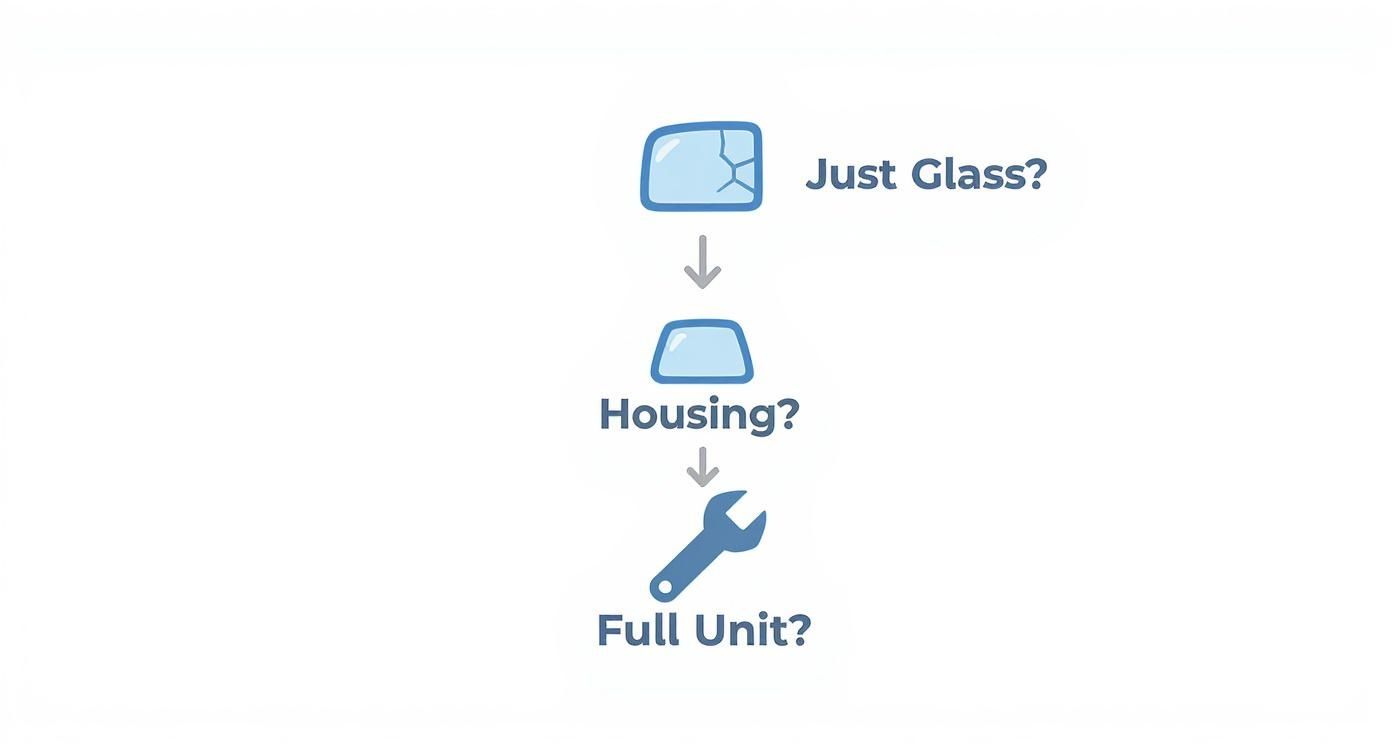
As you can see, just replacing the mirror glass is usually pretty straightforward. But once you get into a cracked housing or a completely busted unit, things get more involved.
DIY vs. Professional Repair: Cost Comparison
From an editorial standpoint, a basic manual mirror offers meaningful DIY savings, but for a heated mirror with blind-spot sensors, the risk of error may outweigh the money saved. Here's how the math shakes out by mirror type:
| Mirror Type | DIY Parts Cost | Professional Total Cost | Verdict |
|---|---|---|---|
| Manual mirror | $40 – $120 | $90 – $220 (0.5–1 hr job) | Worth it. Easy weekend job with basic hand tools. |
| Heated mirror | $150 – $450 | $250 – $600 (1–2 hr job) | Marginal. Worth it only if you're comfortable with wiring connectors. |
| ADAS mirror (blind-spot/camera) | $300 – $800+ | $425 – $1,050+ (2–4 hrs incl. calibration) | Not worth it. Without a shop's calibration equipment, the sensor may not work at all. |
Choosing a professional mechanic offers peace of mind. You're paying not just for their time, but for their experience, specialized tools, and often a warranty on both the part and the labor. This is especially important for mirrors with advanced sensors that need careful calibration to work correctly.
This DIY-vs-pro debate comes up with almost every car repair. It's a bit like knowing when to call a certified automotive professional for battery replacement versus just swapping it yourself. If your mirror is loaded with tech or the thought of prying open your door panel makes you nervous, hiring a professional is the safest bet.
For a deeper dive into the actual steps, you can follow our complete guide to side mirror replacement.
Where You Get It Fixed Makes a Big Difference
The final side mirror replacement cost isn't just about the part; a huge chunk of your bill comes from who you pay to install it. It's a bit like buying a coffee—the same latte costs way more in a fancy downtown cafe than it does at a small-town diner. Auto repair is no different.
A big, flashy dealership in the middle of the city has massive overhead costs compared to a small, independent garage on a side street. That rent, those salaries, and all that fancy equipment? It all gets baked into their labor rates and, ultimately, your final invoice.
When you start comparing the different types of shops, you'll see their pricing models are worlds apart, even for the exact same job.
Dealerships vs. Independent Shops
You've really got two main paths for a professional repair: heading back to the dealership or finding a trusted independent mechanic. While both can get your mirror back on, the impact on your wallet can be significant.
- Dealerships: This is the premium option. They'll use Original Equipment Manufacturer (OEM) parts straight from the factory and have all the specialized tools. You're guaranteed a perfect, brand-specific fit, but you'll pay top dollar for both the parts and the labor.
- Independent Shops: Your local mechanic is often the budget-friendly choice. They have lower overhead, which means more competitive labor rates. Plus, they can find high-quality aftermarket parts that do the same job for a fraction of the cost.
It's not just a small difference, either. For the very same repair, a dealership might quote you a price that seems miles apart from what your local garage offers. That's why shopping around is so important.
This isn't just a hunch; the numbers back it up. Data from the UK shows that franchised main dealers typically charge about 45% more than independent shops for identical work. For a standard mirror replacement, you might pay anywhere from £131 to £313 at an indie garage. At a main dealer, that same job could run between £187 and £462.
To get a better feel for how prices vary, you can check out more details on regional repair costs on Bumper.co. The takeaway is clear: always get a few quotes before you commit. It's the easiest way to make sure you're getting a fair deal.
Frequently Asked Questions About Side Mirror Replacement Cost
When you're suddenly dealing with a busted side mirror, a few questions immediately pop into your head. Getting clear answers can make a world of difference, helping you save a bit of cash and a lot of hassle. Let's walk through some of the most common things people ask.
How Much to Replace Side Mirror on Car?
Figuring out how much to replace side mirror on car assemblies depends heavily on the mirror type. As outlined in our cost breakdown table, a basic manual mirror replacement generally ranges from $90 to $220 including labor, while advanced mirrors with sensors or cameras can push the total well past $1,000. The labor cost to replace side mirror units is often the largest variable, ranging from roughly $38 for a quick manual swap to over $600 for complex ADAS calibrations.
Can I Just Replace the Mirror Glass?
Yes, you often can! If the plastic housing and all the little motors inside are still working perfectly, you can absolutely just swap out the broken glass. This is the cheapest and fastest way to fix the problem.
Replacement glass itself typically runs between $20 and $70. This makes it a great weekend DIY project for anyone looking to keep costs down. Just be aware that mirrors with special features like heating elements or auto-dimming functions have more complex wiring, so you'll need a steady hand to get everything reconnected correctly.
Does AutoZone Do Side Mirror Replacements?
AutoZone and similar parts stores sell replacement mirrors and mirror glass, but they primarily focus on parts sales rather than performing installations. You can buy the part there (or from us at T1A Auto, where our door side mirrors come in both powered and manual versions, and most parts include installation instructions), then either install it yourself or take it to a local mechanic. For a simple manual mirror, buying the part and doing the swap yourself is the cheapest path by far.
Will Insurance Cover a Broken Side Mirror?
This is the big "it depends" question. Your specific policy is what matters here. Generally, collision coverage would handle a mirror broken in an accident, while damage from something like a falling branch or vandalism may be covered under a different part of your policy. If the damage wasn't from a crash, it's worth understanding comprehensive auto insurance to see if you're covered.
But there's another factor: your deductible.
Let's be realistic—most side mirror repairs cost less than a standard $500 or $1,000 insurance deductible. Because of this, it almost always makes more sense to pay for the repair yourself. Filing a claim could end up raising your rates, costing you more in the long run.
What Is the Broken Side Mirror Repair Cost?
The broken side mirror repair cost varies based on what exactly is damaged. If only the glass is broken, you might spend under $100. However, if the entire assembly is destroyed, you are looking at the full replacement costs detailed in our tables above. Always assess the extent of the damage before deciding whether to replace just the glass, the housing, or the entire unit.
Can I Legally Drive with a Broken Side Mirror?
The laws can differ from state to state, but the general rule is that you need at least two mirrors giving you a clear view of what's behind you. This typically means you need your driver-side mirror and your main rearview mirror.
So, while a cracked passenger-side mirror might not get you pulled over right away, it creates a massive blind spot that's a serious safety hazard. It could also cause you to fail your next vehicle safety inspection. For your own safety and to stay on the right side of the law, it's smart to get any broken mirror fixed promptly.
Can I Replace a Side View Mirror Myself?
For a manual or basic power mirror on an older vehicle, yes — it's usually a 30-to-60-minute job with a socket set and a trim removal tool. For mirrors with heating, signal lights, or ADAS sensors, it is best to leave it to professionals: beyond the fragile wiring connectors, the sensor calibration alone requires equipment most DIYers don't have. Match the job to your skill level, and when in doubt, let a shop handle the electronic side.
For reliable, OEM-quality parts that ensure a perfect fit without the dealership price tag, T1A Auto has you covered. Find the exact side mirror for your vehicle and get back on the road safely.
| Factor | DIY Replacement | Professional Replacement |
|---|---|---|
| Cost | Significantly lower. You only pay for the part. | Higher. You pay for the part plus labor, which can range from $50-$200+. |
| Time | Can be quick (under an hour) for simple mirrors, but much longer for complex ones. | Typically fast. An experienced mechanic can often do it in under an hour. |
| Complexity | Best for basic, manual, or heated-only mirrors on older vehicles. | Recommended for mirrors with advanced features like cameras, sensors, and auto-dimming. |
| Tools | Requires basic hand tools, but sometimes specialized trim removal tools are needed. | No tools required from you. The shop has everything, including diagnostic tools. |
| Risk | You risk damaging the door panel, wiring, or the new part with no warranty on your work. | Minimal risk. The shop is liable for any damage and their work is usually guaranteed. |
| Convenience | You work on your own schedule but have to source the part and do the labor yourself. | Very convenient. You just drop the car off and pick it up when it's done. |
