


Modern cars are absolutely jam-packed with different types of automotive sensors, and they're the unsung heroes that keep everything from your engine to your safety systems running smoothly. These little components are broadly grouped into three main areas: powertrain, safety and chassis, and driver assistance. They all have to work together perfectly for your car to operate as it should.
Understanding Your Car's Nervous System
The best way to think about this web of sensors is to see it as your car's nervous system. Each sensor is like a nerve ending, constantly picking up specific information—temperature, pressure, speed, you name it—and reporting back to the central brain.
That "brain" is the Engine Control Unit (ECU), a powerful little computer that crunches billions of data points every second.
It works just like your own body. Your senses tell your brain it’s cold, so you shiver. In a car, a coolant temperature sensor might tell the ECU the engine is running a little hot. The ECU immediately responds by turning on the cooling fan or tweaking the fuel mixture to bring the temperature down. It's this non-stop feedback loop that allows your vehicle to make tiny, critical adjustments on the fly.
The Core Sensor Categories
Every sensor has its own job, but we can organize them into a few key groups based on what they do. Getting a handle on these categories makes it much easier to understand how your car functions as a single, cohesive machine.
- Powertrain Sensors: These are the workhorses responsible for engine and transmission performance. They’re constantly watching things like air intake, fuel-to-air ratio, engine speed, and temperature to get the most power and efficiency out of every drop of fuel.
- Safety and Chassis Sensors: This group is all about keeping you safe. It includes critical components like the wheel speed sensors that make your anti-lock braking system (ABS) work and the tire pressure monitoring system (TPMS) sensors that warn you of a flat.
- Driver Assistance and Visibility Sensors: These are the modern sensors that act as an extra set of eyes. Think parking sensors that beep when you get too close to the curb or backup cameras that help you see what’s behind you.
This diagram shows how the central ECU acts as the command center, connecting these three systems and managing the constant flow of information.
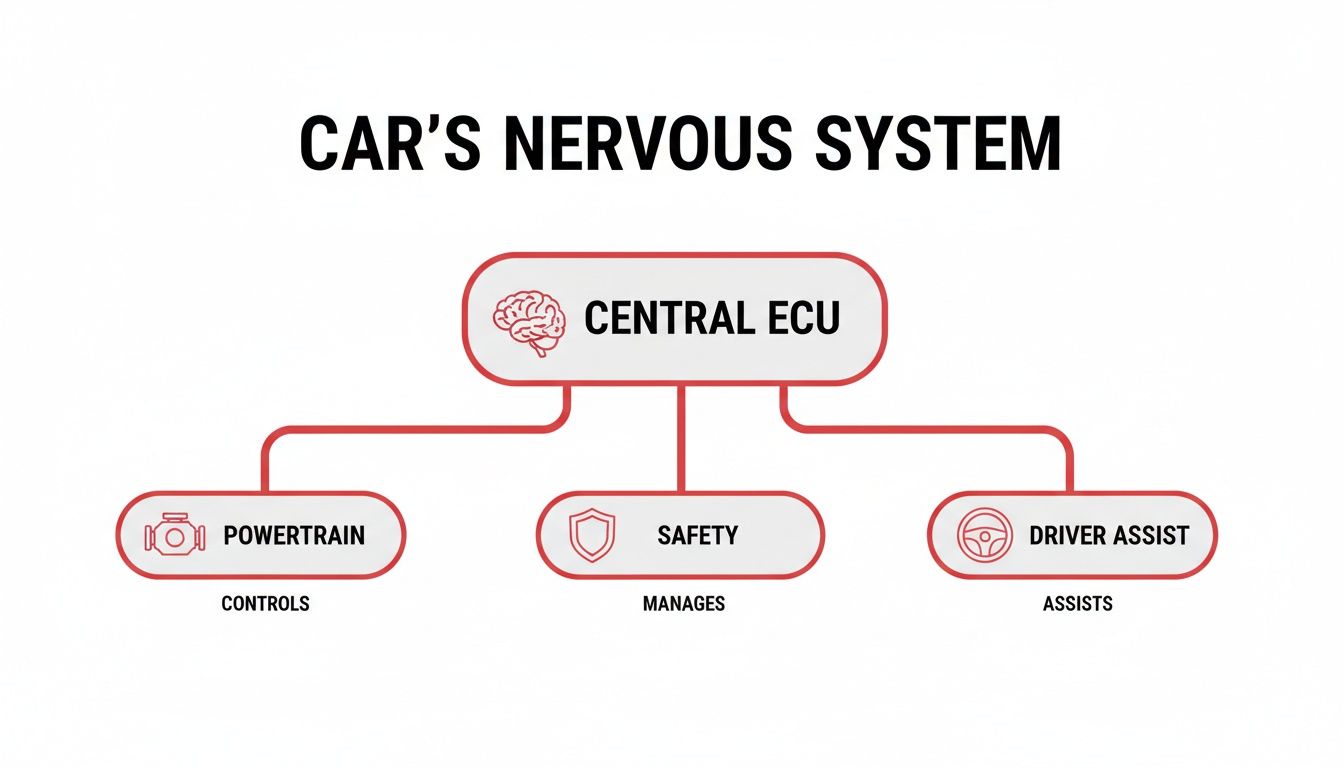
As you can see, everything is interconnected. Smooth engine performance, advanced safety features, and driver aids all depend on getting good, clean data from their specific sensors. Without that constant communication, the complex electrical systems in today's cars simply wouldn't work. To dive deeper, you can learn more about how to diagnose car electrical problems in our detailed guide.
Key Takeaway: Automotive sensors aren't just isolated parts; they're vital nodes in a sophisticated data network. When one small sensor fails, it can set off a chain reaction that impacts your car's performance, fuel economy, and even its ability to keep you safe.
The Engine and Powertrain Sensors That Run Your Car
At the heart of your car is the powertrain—the collection of parts that actually makes it go. This whole system is a mechanical ballet, and a network of incredibly precise sensors are the choreographers, telling the ECU (the car's main computer) what to do.
These powertrain sensors are constantly reporting back, feeding the ECU a live stream of data. This allows it to make thousands of tiny adjustments every minute, fine-tuning everything from how much fuel to spray into the cylinders to the exact moment a spark plug should fire. When one of these sensors starts giving bad info, or goes completely silent, the whole system can stumble. That's when you'll notice problems like terrible gas mileage, a rough idle, or the dreaded check engine light.
The sheer scale of this technology is staggering. The global market for these parts was valued at around $35.3 billion in 2025 and is expected to hit $38.5 billion in 2026. Powertrain sensors are the biggest slice of that pie, bringing in $11.7 billion in 2025 alone. It just goes to show how fundamental these little gadgets are to modern vehicles. You can discover additional insights on the global automotive sensors market to see just how fast this industry is growing.
Mass Air Flow (MAF) Sensor
Think of your engine as a world-class sprinter. To perform at its peak, it needs to breathe in the perfect amount of air. The Mass Air Flow (MAF) sensor is what measures exactly how much air is coming into the engine, kind of like a high-tech breathalyzer.
You'll find the MAF sensor tucked into the air intake tube, right between the air filter and the throttle body. It works by heating a tiny wire or film. As air rushes past, it cools the element down, and the sensor measures how much electricity it takes to keep it hot. That measurement tells the ECU the precise mass of incoming air, which is critical for calculating how much fuel to inject.
When a MAF sensor gets caked with grime or just flat-out fails, it starts sending the wrong airflow numbers. This completely throws off the air-fuel ratio, leading to some classic symptoms:
- Poor Fuel Economy: The ECU might be dumping in too much fuel, which just gets wasted.
- Rough Idle or Stalling: An unbalanced air-fuel mix can make the engine sputter and cough at low speeds.
- Hesitation During Acceleration: The engine struggles to get the right fuel mixture when you step on the gas.
Manifold Absolute Pressure (MAP) Sensor
While the MAF measures airflow, the Manifold Absolute Pressure (MAP) sensor keeps tabs on engine load by monitoring the pressure (or vacuum) inside the intake manifold. It’s another key piece of the puzzle that the ECU needs to see the full picture.
A good way to think of the MAP sensor is as an altitude meter for your engine. When you're flooring it, the pressure in the manifold is high (meaning low vacuum), which tells the ECU the engine is under a heavy load. When you're just idling, the pressure is low (high vacuum), signaling a light load. This data helps the ECU adjust ignition timing and fuel delivery to give you the best power and efficiency for whatever you're doing.
Pro Tip: On many cars, the MAF and MAP sensors work as a team. If one of them dies, the other can often feed the ECU just enough data to keep the engine running in a "limp mode," though you'll definitely notice a big drop in performance.
Crankshaft and Camshaft Position Sensors
If the ECU is the brain of the operation, then the Crankshaft Position Sensor (CKP) and Camshaft Position Sensor (CMP) are its eyes, watching the engine's internal rhythm. You could argue these are the two most important sensors for keeping the engine running at all.
The CKP sensor watches the crankshaft, tracking its rotational speed and exact position. This is the master clock for the whole engine, telling the ECU precisely when each piston hits the top of its compression stroke. The ECU absolutely depends on this signal to time the fuel injection and spark plug firing.
The CMP sensor does a very similar job, but it watches the camshaft, which is what opens and closes the engine's valves. By comparing the signals from both the CKP and CMP sensors, the ECU knows the exact state of the entire combustion cycle in real-time. Want to dig deeper? We have a detailed guide about the location of the crankshaft position sensor that can help you find it on different vehicles.
A failure in either of these sensors can bring everything to a screeching halt. The symptoms are usually severe:
- Engine Cranks but Won't Start: If the ECU can't see the crankshaft's position, it simply won't fire the spark plugs.
- Misfires and Rough Running: Bad timing data from a failing sensor will cause chaotic, inefficient combustion.
- Sudden Stalling: The engine can just shut off while you're driving if the signal cuts out.
Throttle Position Sensor (TPS)
The Throttle Position Sensor (TPS) is a straightforward but essential part that tells the ECU one simple thing: how hard you're pushing the gas pedal. It’s mounted right on the throttle body and measures the angle of the throttle plate as it opens and closes to let air in.
Basically, it’s a direct line from your foot to the computer. When you press the accelerator, the TPS sends a voltage signal that says, "Go faster!" The ECU takes that input, combines it with data from the MAF/MAP sensors, and immediately increases the fuel supply and tells the transmission when to shift.
A faulty TPS sends garbled messages, which can lead to some really frustrating problems:
- Unintended Acceleration or Hesitation: The ECU gets confusing signals about what you want the car to do.
- Poor Shifting in Automatic Transmissions: The transmission can't gauge engine load correctly, so it doesn't know when to shift gears.
- Inability to Accelerate: The sensor might get stuck in the "closed" position, fooling the ECU into thinking your foot is off the pedal.
Engine Coolant Temperature (ECT) Sensor
Last but not least, the Engine Coolant Temperature (ECT) sensor is the engine's personal thermometer. It constantly measures the temperature of the coolant and reports back to the ECU, which uses this info to control a whole host of functions.
For instance, when the engine is cold, the ECT tells the ECU to run a "richer" fuel mixture to help it start and warm up smoothly. As the engine heats up, the ECU leans out the mixture to improve fuel economy and reduce emissions. This sensor also controls when the electric cooling fans kick on and what temperature the gauge on your dashboard displays.
When an ECT sensor starts to go bad, it can fool the ECU into thinking the engine is always cold or always hot, creating issues like:
- Difficulty Starting a Warm Engine: The ECU might be dumping in too much fuel, effectively flooding the engine.
- Overheating or Running Too Cool: The cooling fans might not turn on when they're needed, or they might just run all the time.
- Black Smoke from Exhaust: This is a dead giveaway of a rich fuel mixture, often because the ECU thinks the engine is still cold.
Beyond the sensors that keep your engine purring, there's a whole other team working behind the scenes to keep you on the road and out of trouble. These are your safety and chassis sensors—the unsung heroes monitoring everything from wheel spin and tire pressure to the lifeblood of your engine.
Think of them as your car's built-in reflexes. They don't just send data for the engine computer to ponder; they provide instant feedback that triggers life-saving systems like anti-lock brakes and stability control. When a warning light related to one of these systems pops up, it’s a big deal. It means a critical part of your car's safety net is down.
Wheel Speed Sensors for ABS and Stability Control
The Anti-lock Braking System (ABS) is arguably one of the most important safety inventions in automotive history, and it couldn't exist without Wheel Speed Sensors. You'll find one at each wheel hub, and its only job is to constantly report back on how fast that individual wheel is spinning.
Picture this: you have to slam on the brakes to avoid hitting something. In an older car, your wheels would lock up, sending you into an uncontrolled skid. Wheel speed sensors prevent this. They feed rotation data to the ABS control module hundreds of times a second. If the module sees one wheel slowing down dramatically faster than the others—the classic sign of a lock-up—it instantly starts pulsing the brake pressure to that specific wheel. This allows the wheel to keep turning just enough to maintain grip, letting you steer around the danger instead of sliding right into it.
These sensors are the foundation for a whole suite of other safety features, too:
- Traction Control System (TCS): If a sensor reports one wheel is spinning way faster than the others (think hitting a patch of ice), the system cuts engine power or applies the brake to that wheel to help you regain traction.
- Electronic Stability Control (ESC): This is an even smarter system. It takes data from the wheel speed sensors, along with steering angle and yaw sensors, to figure out if you're starting to slide. If it detects a skid, it strategically applies individual brakes to help straighten the car out and keep you on your intended path.
When a wheel speed sensor goes bad, your car usually tells you pretty clearly. The most obvious sign is an ABS or traction control light glowing on the dash. You might also feel the ABS kicking in at low speeds when it shouldn't be, or worse, not kicking in at all during a hard stop.
Tire Pressure Monitoring System (TPMS)
The Tire Pressure Monitoring System (TPMS) is a simple but incredibly important safety feature. It's designed to do one thing: warn you when a tire's air pressure drops to an unsafe level. This is critical because low tire pressure ruins your car's handling, increases how far you need to stop, and drastically raises the risk of a dangerous blowout.
You'll find two main types of TPMS out there:
- Indirect TPMS: This clever system doesn't actually measure pressure. Instead, it piggybacks on the wheel speed sensors. The logic is that an under-inflated tire has a slightly smaller diameter, so it has to spin a little faster to keep up with the others. When the system notices one wheel consistently spinning faster, it flags it and turns on the warning light.
- Direct TPMS: This is the more common and more accurate setup. Each wheel has a small, battery-powered sensor mounted inside that directly measures air pressure and temperature. It then wirelessly sends that information to a receiver in the car, giving you real-time data and a warning the moment any tire drops below the safe threshold.
If a TPMS sensor itself fails, the warning light will usually flash for about a minute when you start the car before staying on solid. That's your car's way of telling you the system is faulty, which is different from the light just coming on and staying on, which simply means you have a low tire.
Key Insight: Many safety systems are interconnected. A single bad wheel speed sensor can disable your ABS, traction control, and stability control all at once, significantly compromising your vehicle's safety features.
Oil Pressure Sensor
While it's not a chassis sensor, the Oil Pressure Sensor is absolutely a critical safety device for the health of your engine. This sensor does exactly what its name implies: it monitors the pressure of the engine oil being pumped through the motor, making sure it's reaching all the fast-moving parts that need it.
Think of it as the engine's blood pressure cuff. If oil pressure drops, metal parts start grinding against each other with nothing to cushion them. That leads to catastrophic engine failure—and fast. The oil pressure sensor is your first and often only warning before things get that bad.
If the sensor detects a dangerous drop in pressure, it triggers the oil pressure warning light (the little icon that looks like an oil can). This is one of the most serious warnings you can see on your dashboard. If it comes on while you're driving, your immediate goal should be to pull over and shut the engine off as soon as it's safe. A faulty sensor can cause the light to flicker or stay on even when everything's fine, but you can't afford to assume it's a false alarm.
The web of these safety systems is only getting more complex. Inertial measurement units, which include accelerometers and gyroscopes, now hold a dominant 28.13% market share as of 2025 because they are so fundamental to modern stability control and rollover detection. As advanced driver-assistance systems (ADAS) become standard, the demand for sensors has exploded, with features like emergency brake assist relying on multiple sensors working together. You can learn more about the trends in the automotive sensors market to see just how quickly this technology is evolving.
How Parking and Visibility Sensors See the World
Beyond the sensors that keep your engine running smoothly and your wheels turning safely, a whole other group acts as your extra set of eyes and ears in tight spots. These are your parking and visibility sensors, and their entire job is to take the stress out of low-speed maneuvering. They're the unsung heroes of crowded parking lots and tricky driveways.
This family of sensors mostly consists of ultrasonic parking sensors and backup camera modules. They work in tandem to paint a clear picture of what's happening around you. When one of them goes on the fritz, a simple task like backing out of a parking space suddenly becomes a whole lot riskier.
Ultrasonic Parking Sensors: Your Car's Built-In Bat Sonar
Ever wonder how your car magically knows you're about to kiss a curb? You can thank the ultrasonic parking sensors, those small, round discs you see embedded in your bumpers. The technology is surprisingly simple and elegant—it's basically the same echolocation that bats use to navigate in total darkness.
Just like a bat sends out a high-frequency chirp, each sensor emits a pulse of ultrasonic sound. That sound wave travels until it hits something—a wall, another car, a rogue shopping cart—and bounces back. The car's computer measures the time it takes for that echo to return and instantly calculates the distance. As you get closer, the beeping gets faster, giving you a clear, audible warning of your proximity. It's an intuitive system that works wonders.
Here’s how you know a parking sensor might be on its way out:
- You get a constant, solid tone the moment you shift into reverse, even if there’s nothing behind you.
- The system doesn't activate at all—no beeps, no warning, nothing.
- You get random, erratic beeps that have no connection to actual objects nearby.
Backup Cameras: Your Window to the World Behind You
While parking sensors give you the sound, backup cameras give you the sight. This little camera, usually tucked away near the trunk handle or license plate, provides a wide-angle view of the area directly behind your vehicle. This is a huge deal, as it completely eliminates the dangerous blind spot responsible for so many low-speed accidents.
The second you shift into reverse, the camera springs to life, sending a live video feed right to your dashboard screen. Most modern systems even overlay dynamic guidelines that curve as you turn the steering wheel, showing you exactly where you're headed. This tech has become a non-negotiable safety feature for a reason. If you're looking to install or replace one, our guide on how to properly install a backup camera walks you through the whole process.
A Critical Distinction: Think of them as a team. Ultrasonic sensors detect obstacles you might not see, like a low concrete parking stop. The backup camera shows you what’s visually there. Together, they provide total awareness.
Why Quality Matters for Replacement Sensors
When a parking sensor or backup camera fails, it’s tempting to just grab the cheapest replacement you can find online. But for components directly tied to your safety, that's a risky bet. The market is a minefield of options, from pricey OEM parts to questionable no-name brands.
This is exactly why something like CAPA certification is so important.
The Certified Automotive Parts Association (CAPA) is a non-profit, third-party organization that puts aftermarket parts through the wringer. They test them to make sure they meet or even exceed the original manufacturer's standards for fit, function, and durability. A CAPA-certified part isn't just a copy; it's a verified equivalent.
Choosing Your Replacement Sensor: OEM vs CAPA vs Aftermarket
Deciding between OEM, CAPA-certified, and standard aftermarket parts can be confusing. This table breaks down the key differences to help you make the right call for your vehicle and your wallet.
| Quality Tier | Key Characteristics | Best For | T1A Auto Focus |
|---|---|---|---|
| OEM (Original Equipment) | Made by the vehicle manufacturer. Guaranteed fit and function, but comes with the highest price tag. | Dealership repairs, warranty work, or when an exact factory part is non-negotiable. | We benchmark our parts against OEM standards to ensure equivalent performance. |
| CAPA Certified | Independently tested and certified to meet or exceed OEM standards for fit, performance, and safety. The gold standard for aftermarket quality. | Body shops, insurance repairs, and DIYers who want OEM quality without the OEM price. | This is our sweet spot. We specialize in providing CAPA-certified parts that offer the best balance of quality and value. |
| Standard Aftermarket | Varies widely in quality. Can be a cost-effective option, but may suffer from poor fitment, lower-quality materials, and a shorter lifespan. | Budget-conscious repairs where perfect fit and long-term durability are less critical. | We avoid the low-end of the market, focusing instead on reliable parts that won't fail prematurely. |
Ultimately, choosing a CAPA-certified part gives mechanics and DIYers peace of mind. You know it’s going to fit right, work correctly, and restore your vehicle’s safety features without cutting corners or breaking the bank.
The Future of Automotive Sensor Technology
The world of automotive sensors is moving incredibly fast. If you think the sensors we've already covered are complex, hang on—we're just getting started. Three huge shifts are fundamentally changing the game: the switch to Electric Vehicles (EVs), the rise of Advanced Driver-Assistance Systems (ADAS), and the steady push toward fully self-driving cars.
For anyone who owns or works on modern vehicles, getting a handle on these trends isn't just a good idea; it's essential for staying relevant.
This evolution is creating a need for sensors that were purely science fiction just a decade ago. The collection of sensors needed for a car to drive itself is light-years beyond what you'd find in a typical car today.
The Rise of New Sensor Technologies
As cars start taking on more of the driving themselves, their ability to "see" and understand the world has to become razor-sharp. This has kicked off a rapid adoption of new sensor hardware that makes a simple ultrasonic parking sensor look like a relic.
Here’s a look at what's hitting the streets:
- LiDAR (Light Detection and Ranging): This is the real heavy hitter for self-driving tech. LiDAR units spin around, shooting out laser beams to create a live, incredibly detailed 3D map of everything around the car. It provides an unmatched level of accuracy for spotting objects.
- Advanced Imaging RADAR: We’ve had RADAR in cars for a while (think adaptive cruise control), but the new stuff is on another level. High-resolution RADAR can see with so much more detail that it can tell the difference between a pedestrian and a cyclist, tracking their exact speed and direction.
- Battery Thermal and Current Sensors: These are unique to EVs and absolutely vital. They act as the nervous system for the high-voltage battery pack, constantly monitoring temperature and current to keep it healthy, optimize charging, and extend its lifespan.
This explosion in sensor tech isn't just a niche market; it's a massive global industry. The Asia-Pacific region has become the clear leader, making up a massive 53.38% of the global automotive sensors market in 2023. That growth is fueled by huge consumer demand and major manufacturing power, especially with China dominating both overall vehicle and EV production.
What This Means for You: As these technologies move from luxury options to standard features, knowing how to diagnose and replace things like a LiDAR module or a battery management system (BMS) sensor will become a core skill for any good technician.
Paving the Road to Autonomy
The end goal for many automakers is a car that can handle everything on its own. To get there, a vehicle needs a suite of sensors that can perceive the world better than a human can. The real magic happens when data from cameras, RADAR, and LiDAR are fused together. This creates a powerful, redundant system that keeps the vehicle safe, no matter the weather or lighting conditions.
When you see news about Stellantis partnering with Nvidia and Uber to push forward driverless taxi technology, you're seeing this sensor fusion in action. This journey from simple driver aids to full autonomy will keep driving innovation, making our cars smarter and, ultimately, much safer.
Common Questions About Automotive Sensors
Even after you get a handle on how all these sensors work, the real-world questions always start to pop up. Let's tackle some of the most common ones we hear from both seasoned pros in the shop and weekend warriors in their driveways. Think of this as your quick-reference guide for making smart decisions when that check engine light comes on.
Can I Drive My Car with a Bad Sensor?
Look, while your car might still technically run with certain sensors on the fritz, it's a really bad idea. A critical sensor failure, like the crankshaft position sensor going out, can kill your engine instantly, leaving you stranded with zero warning.
Other failing sensors create a slow-burn problem. A bad oxygen or MAF sensor, for example, will tank your fuel economy and spike your emissions. Before you know it, you could be looking at a much more expensive repair, like a fried catalytic converter.
And most importantly, never ignore a safety-related warning light. If your ABS or TPMS light is on, your car's ability to protect you in an emergency is compromised. That check engine light is there for a reason—addressing it quickly can stop a small problem from turning into a massive headache.
How Do I Know if a Sensor Is Actually Bad?
Diagnosing a sensor is all about methodical testing, not just throwing parts at a problem. The absolute first step is to grab an OBD-II scanner and read the Diagnostic Trouble Code (DTC) that’s causing the check engine light.
But here’s the key: that code points you to the circuit or system with the issue, not necessarily the sensor itself. The root cause could easily be something else entirely—think damaged wiring, a split vacuum hose, or a problem with a connected component.
So before you run out and buy a replacement, do a thorough visual inspection. Check the sensor's wiring harness and connectors for any obvious damage, corrosion, or a loose fit. For some parts, like a MAF sensor, a simple cleaning with the right spray might be all it needs. Only after you've ruled out the simple stuff should you move on to replacing the sensor.
Are Cheap Aftermarket Sensors a Good Investment?
That rock-bottom price on a no-name sensor from a random online marketplace can be tempting, but it’s often a classic case of "you get what you pay for." These parts are notorious for poor build quality, inaccurate readings, and a very short lifespan.
This means you could be right back where you started, chasing the same problem just a few months later. Even worse, a cheap sensor might send data that's just a little off—not bad enough to trigger a new trouble code, but enough to hurt your performance and gas mileage, leaving you scratching your head.
For the critical stuff—anything that manages your engine or safety systems—it's always smarter to invest in a premium aftermarket sensor from a reputable brand or stick with an OEM part. These are built to meet or exceed the original specs for fit, performance, and durability, so you can trust the repair will last.
What Does CAPA Certified Mean for a Replacement Part?
CAPA stands for the Certified Automotive Parts Association. It’s a non-profit, independent organization that sets incredibly high quality standards for aftermarket collision repair parts.
When you see a part like a backup camera or parking sensor with a CAPA certification, it means that component has been through a grueling series of tests. These tests are designed to confirm it fits, performs, and holds up just like the original part from the factory. They check everything from image quality and weather resistance to its electronic communication with the car's computer systems.
For any serious DIYer or professional shop, choosing a CAPA-certified part is a powerful guarantee. You know it’s going to install without a fight and restore the vehicle's original safety functions perfectly. In an era of Advanced Driver-Assistance Systems (ADAS) that depend on hyper-accurate sensor data, this is absolutely crucial. Choosing CAPA means choosing confidence in your repair.
When it's time for a replacement, don't settle for parts that might fail you. At T1A Auto, we specialize in premium, CAPA-certified, and OEM-grade aftermarket parts that are engineered for a perfect fit and built to last. From parking sensors and backup cameras to door handles and window regulators, we provide the reliable components you need to get the job done right. Explore our full catalog and find the exact part for your vehicle.
