


Rear parking sensors are short-range ultrasonic or radar devices mounted in the rear bumper that alert you to nearby obstacles when reverse is engaged, and IIHS/HLDI records them on vehicles as early as the 1995 model year. In real-world studies, sensors used alone were associated with a 28% reduction in backing crash involvement, although they still can't replace looking behind the vehicle.
You're backing into a crowded strip-mall space, watching the painted lines and checking both mirrors. A child's bicycle sits low behind the SUV, partly hidden by the bumper. The first beep sounds, then the pauses between beeps become shorter, and you stop before the rear bumper reaches the obstacle. That simple warning is what rear parking sensors are designed to provide.
The system doesn't give you a complete view. It measures proximity in a limited area, then turns that measurement into sound, lights, or an image on the vehicle display. Some systems use ultrasonic transducers, while others combine them with radar or additional parking-assistance hardware. Understanding the difference helps you diagnose a fault, choose a replacement, and use the warning correctly.
Table of Contents
- Rear Parking Sensors Explained for Everyday Drivers
- How Ultrasonic, Electromagnetic, and Radar Sensors Work
- Inside a Rear Parking Sensor System
- The Real Safety Benefits of Rear Parking Sensors
- What Rear Parking Sensors Cannot Do
- Why Rear Parking Sensors Fail and How to Diagnose Them
- Choosing Replacement Rear Parking Sensors for Your Vehicle
- Putting It All Together on Your Vehicle
Rear Parking Sensors Explained for Everyday Drivers
A rear parking sensor is a short-range obstacle detector installed in or near the rear bumper. It sends out a signal, receives the reflected response, estimates how far away an object is, and warns the driver when the vehicle is reversing or maneuvering at low speed.
Most traditional systems use ultrasonic transducers. These small round components are easy to recognize on a bumper because they look like painted discs. When reverse is selected, the vehicle activates the parking-assistance system and the sensors monitor the area behind the bumper.
The warning usually starts as widely spaced tones. As the vehicle gets closer to a detected obstacle, the tones become more frequent. Some vehicles also show colored distance zones on the instrument panel or infotainment screen. A continuous tone generally means the system considers the gap very small, but the precise behavior varies by vehicle.
Practical rule: Treat the first beep as a prompt to investigate, not as permission to continue reversing.
From premium feature to common equipment
Rear parking sensors appeared on 1995 model-year vehicles, according to the IIHS and HLDI collision-avoidance research compendium. By the 2004 model year, they were standard on 6% of vehicles and optional on 18%, showing how the feature moved beyond premium vehicles.
A later estimate placed rear parking sensors in about 17% of the U.S. vehicle fleet in 2016, with projections of 39% by 2021 and more than 50% after 2025, according to the same IIHS/HLDI material. The progression reflects a wider shift toward bundled driver-assistance systems that can include cameras and rear automatic braking.
That history explains why replacement work can be confusing. A basic bumper kit and a factory-integrated parking-assist network may both be called “rear parking sensors,” but they don't necessarily use the same wiring, control module, warning logic, or calibration process.
Sensors are an aid, not autopilot. You still need to use the mirrors, check the camera, look over your shoulder, and control the vehicle slowly enough to stop when something seems wrong.
How Ultrasonic, Electromagnetic, and Radar Sensors Work
The easiest way to understand a parking sensor is to think of an echo in a room. The system sends out a signal, waits for the signal to bounce off an object, measures the round-trip time, and uses that timing to estimate distance.
Ultrasonic sensors send high-frequency sound pulses. The sensor doesn't need to recognize the object by name. It primarily asks, “Did something reflect a signal, and how far away is it?” The Škoda rear parking sensor documentation describes the system as using reflected echoes to estimate the distance to nearby obstacles.
The audible warning is a user-friendly translation of that calculation. One documented system uses intermittent warnings at about 1 meter and a continuous tone at roughly 30 centimeters, while some systems are designed to detect obstacles up to about 3.5 meters in reverse, as described in the same documentation. Those values aren't universal. Bumper design, software settings, object shape, and sensor placement all affect the result.
Other sensing approaches
Electromagnetic parking sensors use a sensing field associated with the bumper or a conductive strip. Instead of waiting for a conventional sound echo, the system detects changes caused by an object entering that field. Because the sensor can be integrated differently from visible ultrasonic pucks, these systems may appeal to owners who want a less noticeable installation.
Radar sensors transmit radio waves and interpret the returned signal. Radar can support broader driver-assistance functions, including detecting movement and helping with rear cross-traffic warnings. In many vehicles, radar isn't a direct replacement for the close-range ultrasonic array. It may be part of a larger system that gives the driver additional information.
The technology choice matters less than the complete vehicle design. A sensor's performance depends on its mounting position, the control module, the bumper material, the software, and whether the vehicle also uses a camera or automatic braking.
Rear parking sensor technologies compared
| Technology | Detection Range | Weather Robustness | Typical Mount | Relative Cost |
|---|---|---|---|---|
| Ultrasonic | Close-range, distance depends on target and system | Can be affected by dirt, ice, water, and target surface | Round transducers in the bumper | Lower to moderate |
| Electromagnetic | Close-range field around an integrated strip or bumper area | Less dependent on a visible sensor face, but installation quality matters | Behind or integrated into bumper material | Moderate |
| Radar | Can support broader detection and moving-object information | Generally more tolerant of some target and weather conditions, subject to system design | Dedicated radar module behind a bumper area | Moderate to higher |
For most DIY repairs, the important question isn't just which technology sounds more advanced. It's whether the replacement matches the vehicle's original system and whether the bumper position allows the sensor to work as designed.
Inside a Rear Parking Sensor System
A parking sensor is only one part of the system. The visible puck in the bumper connects to wiring, a control module, the vehicle network, and the warning device inside the cabin.
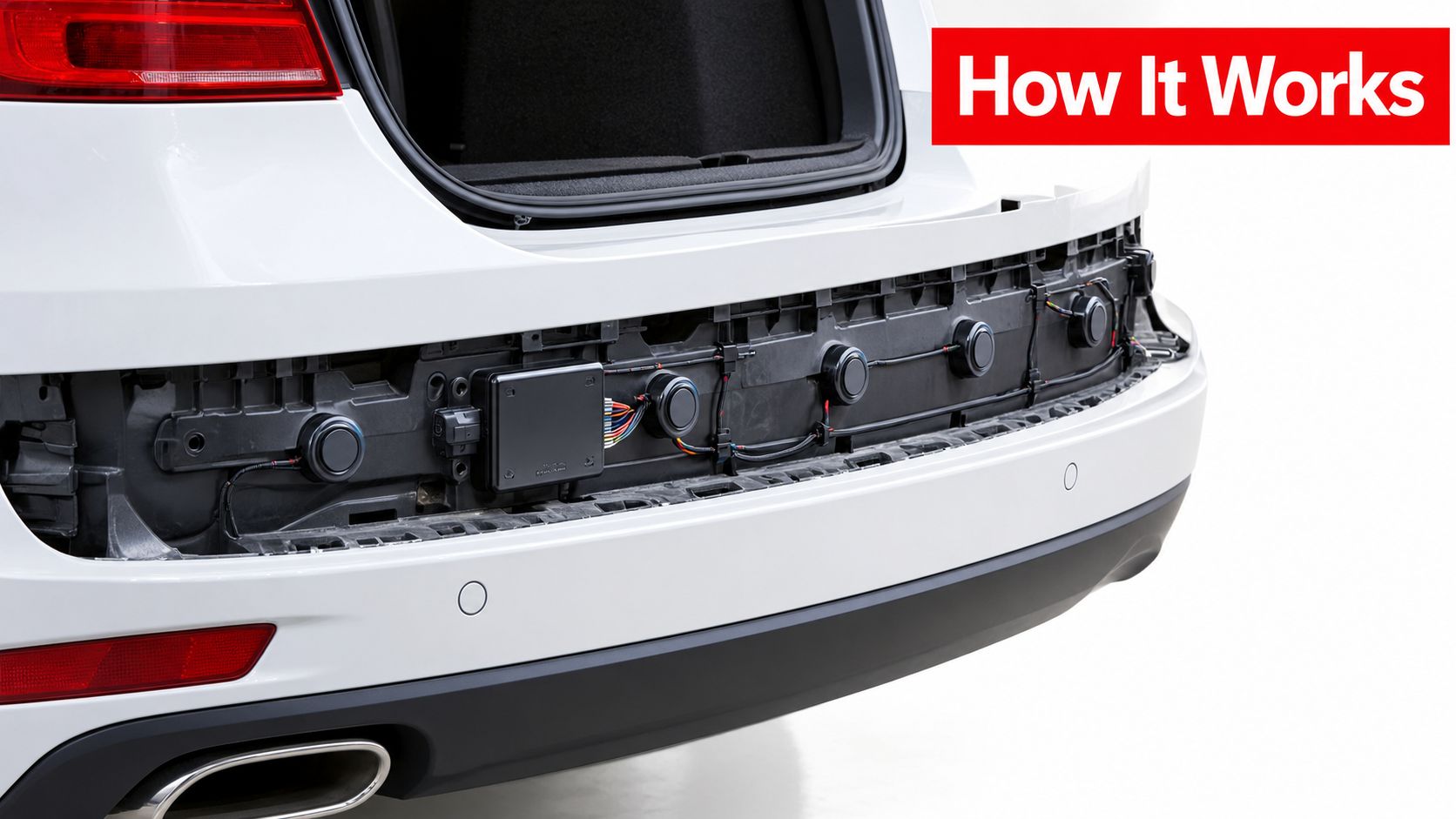
Here's the signal path in practical terms:
- Reverse activates the system. A reverse-light switch or vehicle network message tells the parking-assist module that the driver has selected reverse.
- The module energizes the sensors. It controls when each transducer sends a pulse so the signals don't interfere with one another.
- The sensor receives the echo. The module measures the return time and converts it into an estimated distance.
- The vehicle interprets the result. Software decides whether to produce a tone, illuminate a display, or show a graphic on the infotainment screen.
- The driver receives the warning. A buzzer, speaker, dashboard display, or screen communicates the result.
The wiring harness normally runs through the rear bumper and trunk or cargo-area structure. Depending on the vehicle, communication may pass through the body control module or a dedicated parking-assist module using the vehicle's data network. A loose connector can therefore cause a system-wide warning even when the sensor itself looks undamaged.
Why the beeps change
A nearby flat object produces a stronger and more consistent reflection than a soft or sharply angled object. When the module calculates a shorter distance, it shortens the pause between tones. The driver hears that change as a rising sense of urgency.
That logic is useful in a parking garage, driveway, or loading area, but it isn't a measurement you should treat as exact to the inch. The tone tells you that the system sees a risk in its detection zone. It doesn't tell you whether the object is a curb, a hitch, a bicycle, or a person.
The following video shows the kind of bumper-mounted hardware and parking-assistance layout owners may encounter during inspection:
If a warning appears immediately after selecting reverse, don't assume every sensor has failed. The problem may be a single sensor, a damaged connector, a fuse, or the control module refusing to trust incomplete data.
The Real Safety Benefits of Rear Parking Sensors
Rear parking sensors provide a real safety benefit, but the benefit is limited to the situations the system can detect. IIHS and HLDI analyzed 1,044 police-reported backing crashes across 25 states during 2012 to 2015. In that analysis, parking sensors alone were associated with a 28% reduction in backing crash-involvement rates. A rearview camera combined with parking sensors was associated with a 42% reduction, and adding rear automatic braking raised the reduction to 78%. The figures come from the IIHS and HLDI backing-crash research.
The same research found a significant 5.4% reduction in property-damage-liability claim frequency associated with parking sensors across several vehicle makes. Combined analyses also found significant reductions of 5.5% in medical-payments claim frequency and 4.5% in personal-injury-protection claim frequency. These are measured associations, not a promise that every driver will avoid a collision.
What the numbers mean in daily driving
Consider three ordinary obstacles:
- A low concrete parking block may sit below the rear window and disappear from the driver's direct view.
- A bicycle behind an SUV may have a narrow frame that reflects the signal inconsistently.
- A tow hitch or trailer component may be close to the bumper but difficult to judge from the driver's seat.
In each case, the sensor can add useful information. It gives you another warning channel while you use the camera, mirrors, and visual checks to identify the object.
| System Type | Approximate Reduction in Reverse Claim Damage | Best Use Case |
|---|---|---|
| Parking sensors alone | 28% reduction in backing crash involvement | Close-range warnings during parking and reversing |
| Rearview camera plus parking sensors | 42% reduction in backing crash involvement | Combining visual context with proximity alerts |
| Rear automatic braking added | 78% reduction in backing crash involvement | Helping prevent or reduce a collision when the driver doesn't stop in time |
| Parking sensors and property-damage claims | 5.4% reduction in claim frequency | Reducing some low-speed vehicle damage events |
For broader maintenance and inspection guidance, a resource on local brake service and safety can help you treat parking assistance as one part of the vehicle's overall safety condition.
The lesson is straightforward. Sensors can reduce risk, but they don't make reversing safe by themselves. The strongest results occur when proximity alerts work alongside a camera and automatic braking, while a careful driver remains responsible for the maneuver.
What Rear Parking Sensors Cannot Do
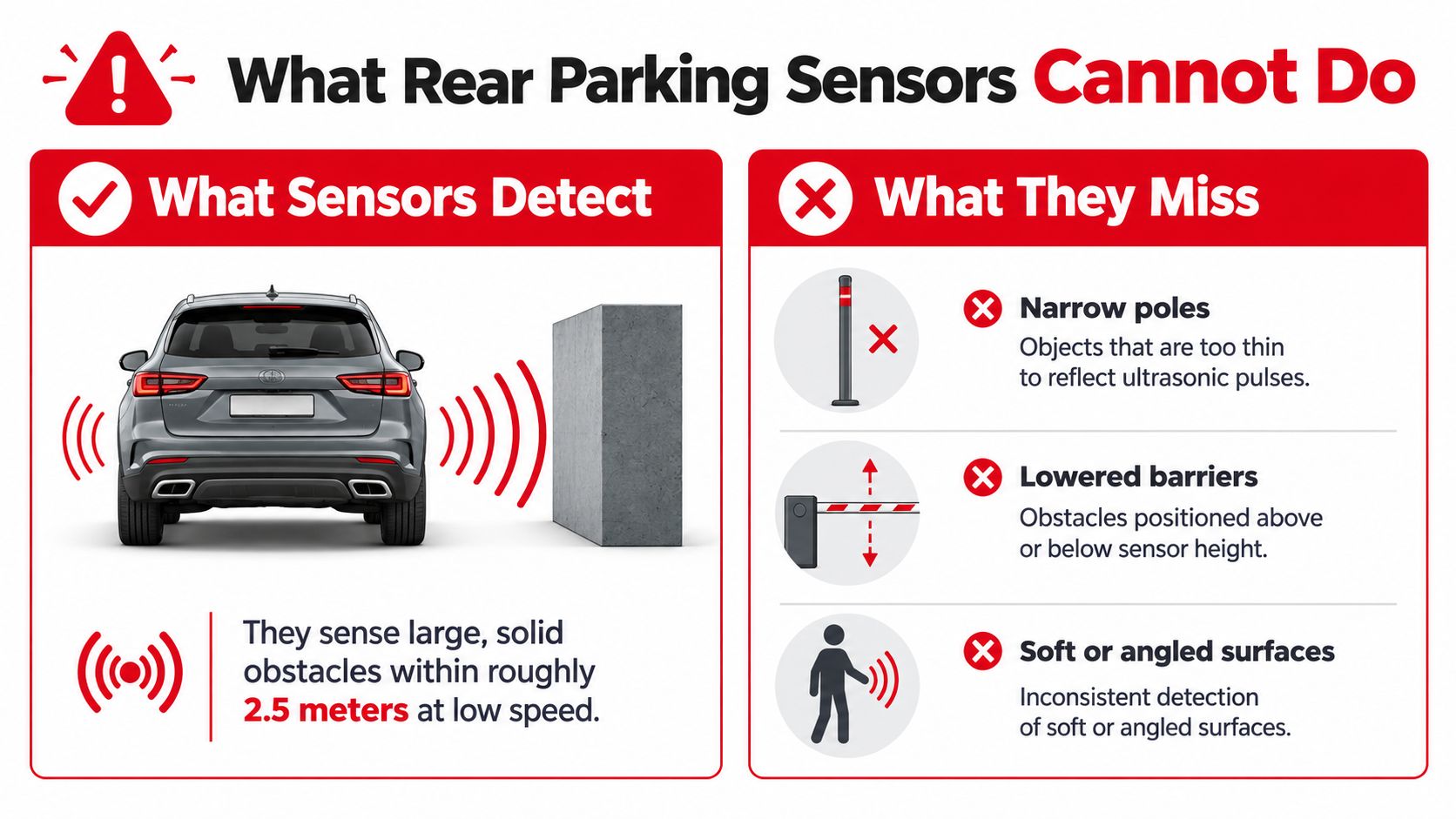
A rear parking sensor doesn't see the way a person sees. It detects reflected signals within a limited area, and its estimate depends on the shape, angle, size, and material of the target.
That distinction becomes critical around children. The SAE parking-assistance research summary reports that a child-shaped target produced center-sensor detection distances 50% to 84% shorter than those for a pipe when facing the sensor, and 32% to 64% shorter when positioned side-on. The SAE parking-assistance research topic explains why target presentation affects detection.
A soft person-shaped target, a thin pole, and a broad concrete wall don't return the same signal. A child may also be below the strongest part of the sensor pattern or hidden by the bumper's geometry. That's why a quiet system doesn't prove that the space behind the vehicle is clear.
Common blind spots and false warnings
A sensor may miss or inconsistently detect:
- Thin or angled objects, such as poles, wires, or bicycle components.
- Objects outside the sensor pattern, including obstacles positioned high above or low below the bumper.
- Equipment added later, such as tow hitches, bike racks, spare-tire carriers, or bumper guards.
- Soft, irregular, or absorbent surfaces, which may not return a strong echo.
- Contamination on the sensor face, including mud, ice, snow, or thick residue from road treatment.
Weather can also change the warning behavior. Water, packed snow, and ice may scatter or absorb part of the signal, causing false alerts or reducing consistency. If the system starts beeping continuously after a storm or wash, inspect and gently clean the sensor faces before assuming an electronic failure.
A backup camera provides a different kind of information. It shows visual context, but it also has blind areas and can distort distance. Learn how that system works in this guide to backup camera operation.
The safe routine is layered: stop, check the mirrors, inspect the camera, turn to look when possible, and move slowly. Never use a silent sensor array as proof that a small person is not behind the vehicle.
Why Rear Parking Sensors Fail and How to Diagnose Them
A parking sensor can fail because of the sensor itself, the bumper, the wiring, or the control electronics. Replacing the visible puck without checking the rest of the circuit can leave the original problem untouched.
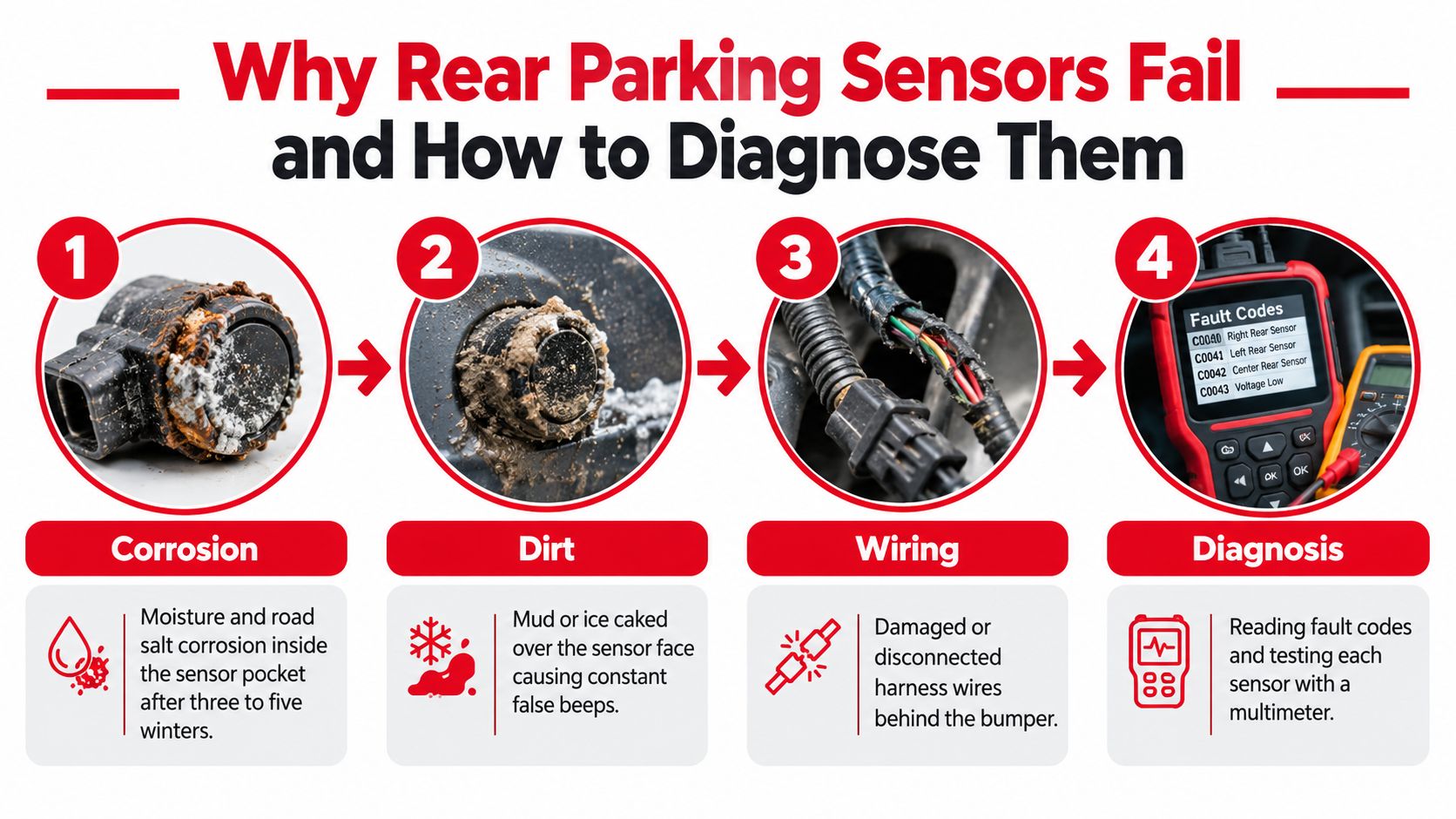
Start with the simplest causes. Dirt, road salt, ice, and moisture can collect around the sensor face or inside the connector. A small bumper impact can crack the holder, loosen the mounting clips, or change the sensor's orientation enough to point part of the detection pattern toward the ground or the bumper.
A practical diagnostic sequence
- Select reverse carefully. Listen for the normal activation sound or watch for the parking-assist display. A long warning tone or a system that stays silent can indicate a stored fault.
- Inspect every sensor. Look for a damaged face, a pushed-in puck, broken paint, moisture, or a gap around the mounting ring.
- Clean before testing again. Use a soft cloth and suitable mild cleaner. Don't scrape the sensor face or coat it with thick paint.
- Check the connectors. Look for bent pins, green corrosion, loose locks, and water inside the plug. Inspect the harness where it passes through the bumper and cargo-area openings.
- Compare sensor activity. Depending on the vehicle, a healthy sensor may produce a faint clicking or vibration when the system is active. Use caution around moving vehicles and follow the manufacturer's testing procedure.
- Swap only when appropriate. If the connectors and part numbers match, moving a suspect sensor to another position can help show whether the fault follows the component or stays with the wiring.
- Scan the body electronics. An OBD-II scanner with body-control or parking-assist coverage can identify stored codes that a basic engine-code reader won't display.
What a fault pattern tells you
If only one position reports a problem, inspect that sensor and its local wiring first. If all sensors stop working together, check the fuse, power supply, ground, communication wiring, and control module before buying a full set.
A harness can break where it flexes near the trunk hinge or tailgate. A bumper impact can damage a connector even when the outside of the bumper looks acceptable. The control module is less accessible and more expensive, so it should be considered after basic cleaning, connector inspection, power checks, and code reading.
For a focused troubleshooting reference, see this guide to a parking sensor that isn't working. The useful principle is the same for a sedan, SUV, or pickup: diagnose the circuit before you order parts.
Choosing Replacement Rear Parking Sensors for Your Vehicle
The correct replacement sensor is the one that matches the vehicle's electrical system, bumper geometry, connector, and software expectations. A cheap part that physically fits the hole may still produce false alerts, fail to communicate, or trigger a permanent parking-assist warning.
Start by identifying the failed component. Remove the sensor only if the vehicle's service procedure allows it, then photograph the connector, mounting clips, orientation, and part number. Don't rely on a generic description such as “rear bumper sensor” when the vehicle uses different sensors for front, rear, center, and corner positions.
Compare the replacement categories
OEM sensors are designed for the original vehicle network and mounting system. They're usually the safest choice when exact compatibility matters, particularly on a vehicle with integrated screen graphics or advanced parking functions.
Generic aftermarket sensors can be less expensive and may work well when the specifications genuinely match. Quality varies, however, especially in connector construction, sealing, paint compatibility, and warning-tone behavior.
Certified aftermarket components can offer another route for owners who want documented fit and construction without automatically choosing a dealership part. Verify the certification and the exact application rather than assuming every aftermarket sensor meets the same standard.
| Option | Typical Price | Fitment Accuracy | Sealing/IP Rating | Warranty | Best For |
|---|---|---|---|---|---|
| OEM | Higher | Designed for the original application | Confirm vehicle specification | Check manufacturer terms | Integrated systems and exact restoration |
| Generic aftermarket | Lower to moderate | Varies by supplier and application | Verify before purchase | Varies by seller | Cost-conscious repairs with confirmed compatibility |
| Certified aftermarket | Moderate | Intended to meet documented application requirements | Verify product documentation | Check seller terms | Owners balancing fitment and replacement cost |
Buyer's checklist
- Match the vehicle exactly. Filter by year, make, model, engine, trim, bumper style, and sensor position.
- Compare the connector. Check the pin layout, wire position, locking tab, and housing shape.
- Confirm the housing finish. Some sensors are paintable or supplied in a finish intended for the original bumper.
- Inspect the mounting method. Clips, bezels, brackets, and sensor orientation must match the bumper.
- Check network compatibility. A CAN-bus vehicle may require coding, initialization, or fault-code clearing after replacement.
- Read the warranty conditions. Confirm what happens if the sensor arrives damaged, fails after installation, or proves incompatible.
- Consider the complete kit. On a truck or large SUV, verify whether you need a single sensor, a corner sensor, a center sensor, a bezel, or a full bumper harness.
The aftermarket parking sensor guide can help you compare replacement approaches, but the final decision should come from confirmed vehicle fitment. A supplier that lets you search by vehicle and offers OEM-grade rear parking-assist sensors may be more useful than a marketplace listing built around a universal description.
Don't assume a sensor is plug-and-play just because its connector appears similar. If the part doesn't communicate with the vehicle, bypassing the coding requirement can leave warning messages on the dashboard and make the original parking function unavailable.
Putting It All Together on Your Vehicle
Rear parking sensors are bumper-mounted transducers that convert reflected signal timing into distance warnings. Their value is clearest during slow reversing, when a low obstacle, bicycle, hitch, or wall may be difficult to judge from the driver's seat.
The safety evidence supports using them, but it also defines their limits. Parking sensors alone were associated with a 28% reduction in backing crash involvement, while combining them with a rearview camera was associated with a 42% reduction, according to the IIHS/HLDI research cited earlier. Those results describe risk reduction across studied vehicles and crashes, not guaranteed protection for every maneuver.
Use three practical checks before ordering parts or trusting the system:
- Test the warning behavior safely. With another adult supervising, reverse very slowly toward a large cardboard box in an open area and listen for the warning pattern. Stop immediately if the tones don't behave as expected.
- Identify the failed part. Record the sensor position, connector, mounting style, and part number before placing an order.
- Buy for exact fitment. Choose an OEM or properly documented aftermarket replacement that matches the vehicle's year, make, model, trim, bumper, wiring, and coding requirements.
A sensor array is not a substitute for mirrors, a camera, head checks, or getting out to inspect the space. The child-target findings discussed above show why a quiet system can't certify that the area behind the bumper is safe.
If your rear parking sensor has failed, T1A Auto offers vehicle-matched parking and bumper sensors for DIY owners and repair professionals. Search by your vehicle, compare the connector and fitment details, and choose the replacement that matches the original system before beginning the installation.
