


A window that drops into the door usually picks a bad moment. You're at a drive-through, or in a parking lot at dusk, and you press the switch, hear a soft clunk, and watch the glass disappear into the door cavity. The switch still clicks. The motor may still hum. The frame is now an open hole with a pane lying somewhere against the door's inner skin.
That classic window fell into door moment sends most owners straight to a parts order, and the order is often wrong. A drop like this isn't one failure. It's at least three: the glass let go of its carrier, the regulator's arm or cable broke, or the electronics that run the window lost their calibration. Each has a different fix and a different price.
The order that works is diagnosis first, then making the glass safe, then a recall check, then parts. Reversed, you buy a regulator you didn't need and you still have a misaligned pane.
Table of Contents
- Diagnose Where the Window Failed
- Secure the Glass Before You Touch the Door
- Check Recalls and Match the Right Part
- How to Reseat the Glass or Replace the Regulator
- Torque, Alignment and Seal Checks That Prevent a Repeat
- Relearn and Test the Repair
Diagnose Where the Window Failed
Watch the glass before you touch the switch. A pane that drops straight down and disappears has usually lost its grip on the regulator: an arm, a clip or the cable let go, or the glass slid out of its carrier. A pane that leans, sits crooked or drops on one side points to loosened glass bolts or a worn carrier. A driver hears the same clunk either way. A technician sees different parts and a different bill.
Match the symptom to a row before you spend anything. The table below is the diagnostic path.
| Symptom | Likely cause | First check |
|---|---|---|
| Glass drops straight into the door | Regulator arm, clip or cable has failed, or the glass detached from its carrier | Open the door trim and inspect the clips, cable and carrier |
| Glass tilts or sits crooked | Loose glass bolts or a worn carrier | Check the glass bolts and carrier for play before realigning |
| Window moves slowly, stops halfway or works only on some presses | Weak motor, loose wiring, failing switch or a blown fuse | Test the fuse and switch, then check the connector and wiring |
| Motor runs but the glass does not move | Broken regulator cable or a binding track | Inspect the cable ends and the run channels for debris or bends |
| Window does not reverse when blocked | Anti-pinch calibration fault or a module problem | Check for a recall and reinitialize before using auto-up |
The mechanism behind every row is short. The regulator is the elevator; the clips, bolts and carrier are what attach the pane to it. When the glass loses that support, it falls inside the door cavity instead of staying in the run channels, and the switch keeps working the whole time because nothing electrical has failed. An electronic fault looks different. The glass stays put while the window stops halfway, answers only some presses, or refuses to reverse against an obstruction. That behavior points at the fuse, switch, connector or anti-pinch calibration, which is why reinitialization belongs in the diagnosis ahead of any parts order.
Why a loose bolt can look exactly like a broken regulator
Toyota and GM documented the bolt failure path. Insufficient retention force at the bolts connecting the front side glass to the power-window regulator can allow a bolt to loosen, and continued window operation then misaligns the glass and, in the worst case, shatters it. Reports of front power-window glass shattering on 2003 and 2004 Pontiac Vibe vehicles pushed the agency to open Preliminary Evaluation PE07-049, and the resulting campaign, which also covers certain Corolla and Corolla Matrix vehicles, is described in the NHTSA recall document for the Vibe and Corolla glass retention campaign.
A loose glass bolt produces the same symptom as a snapped cable. Checking bolts costs nothing once the trim is off, so inspect regulator bolts, glass clamps, mounting points and alignment before you condemn a switch or a motor.
The hand test that settles most arguments
Lower the window with the switch and watch the glass. If it lifts freely by hand, it has separated from its carrier. If it drags or binds on the way up, the run channel or track is the problem. If it drops the instant you let go, support is gone and the regulator has to come out. Run this test before you order anything, because the reseat-or-replace decision hangs on it, and a detached clip is visible at the carrier once the trim panel is off.
If you want the vocabulary straight before you start, this overview of car window parts labels the regulator, carrier, run channel and clips you will be inspecting.
Secure the Glass Before You Touch the Door
Nothing you do with a socket set matters until the glass stops moving. A pane sitting loose in its run channel can shift, catch a frame edge and break while your hand is beside it. Stop the movement first, then plan the repair.
Park on level ground, switch the ignition off, and keep fingers clear of the opening. Put on eye protection and gloves before you touch fragments, because tempered side glass breaks into pebbles that travel further than you expect.
The driving question has a plain answer. A short trip is reasonable only if the glass sits still under light hand pressure, doesn't tilt, and the door latch holds. If the glass shifts, or the window won't reverse when blocked, have the vehicle towed. A pane that drops further at speed leaves you with an open hole, glass in the door cavity and no way to close it.
Practical rule: if one hand can move the glass, the vehicle shouldn't move with you in it.
Don't wedge tape, wood or cardboard into the glass path to prop it up. Improvised support can jam the pane, crack it against the frame, or create the exact pinch point you're trying to avoid. Heavy plastic and tape over the opening keeps rain out of the cabin and does nothing for occupant safety, so treat it as weather protection and no more.
That distinction matters more on newer vehicles than most how-to content admits. NHTSA documentation identifies excessive closing force and failure to reverse as injury risks, including on relatively recent 2024 and 2025 models, per this NHTSA recall report on window reversal. Loose glass isn't confined to old trucks with a visibly broken regulator.
Run this two-minute check before you decide anything:
- Glass position: does it stay put under light pressure, or shift and tilt when you nudge it?
- Latch status: does the door close and stay closed with the glass where it is?
- Reversal: with the key on and hands clear, does the window stop and back off when it meets an obstruction? If you can't test it safely, don't use auto-up at all.
- Water exposure: is the cabin open to rain right now? Cover it, and accept that the cover solves nothing mechanical.
Four answers in two minutes. That's the difference between driving to the parts store and calling a tow.
Check Recalls and Match the Right Part
Recall lookup comes before the parts order. Put the VIN into the NHTSA recall search and read any open power-window campaign before you spend a dollar on hardware, because some window faults are software faults wearing a mechanical costume. A 2025 Ford recall covered windows that could apply excessive force before reversing, a violation of FMVSS 118, according to the NHTSA acknowledgment for the 2025 window force campaign. The same filing describes incorrect software installation that could leave front and rear windows unable to reverse properly in some scenarios.
If a window fails to reverse, or closes hard on a hand, suspect calibration and the module before the regulator. Swapping parts on a vehicle with an open recall or a failed initialization just moves the fault downstream.
Matching the part is step two, and it's where most returns come from. Regulators differ in mounting points, connector shape and cable routing, sometimes within a single model year. This VIN-based parts lookup narrows fitment before you pay. Lay the old part beside the new one and compare mounting feet, the electrical connector and the cable path before the trim goes back on.
One policy note worth reading before checkout: our extended warranty excludes damage from accidents, collisions and environmental conditions such as rain, snow, hail, salt or flooding. A regulator broken in a collision or drowned by a leaking seal is a different conversation from a failed part.
How to Reseat the Glass or Replace the Regulator
Plenty of windows that "need a regulator" only need the glass put back in its carrier. The manufacturer sequence is short, and it works because it tests the glass before condemning the part.
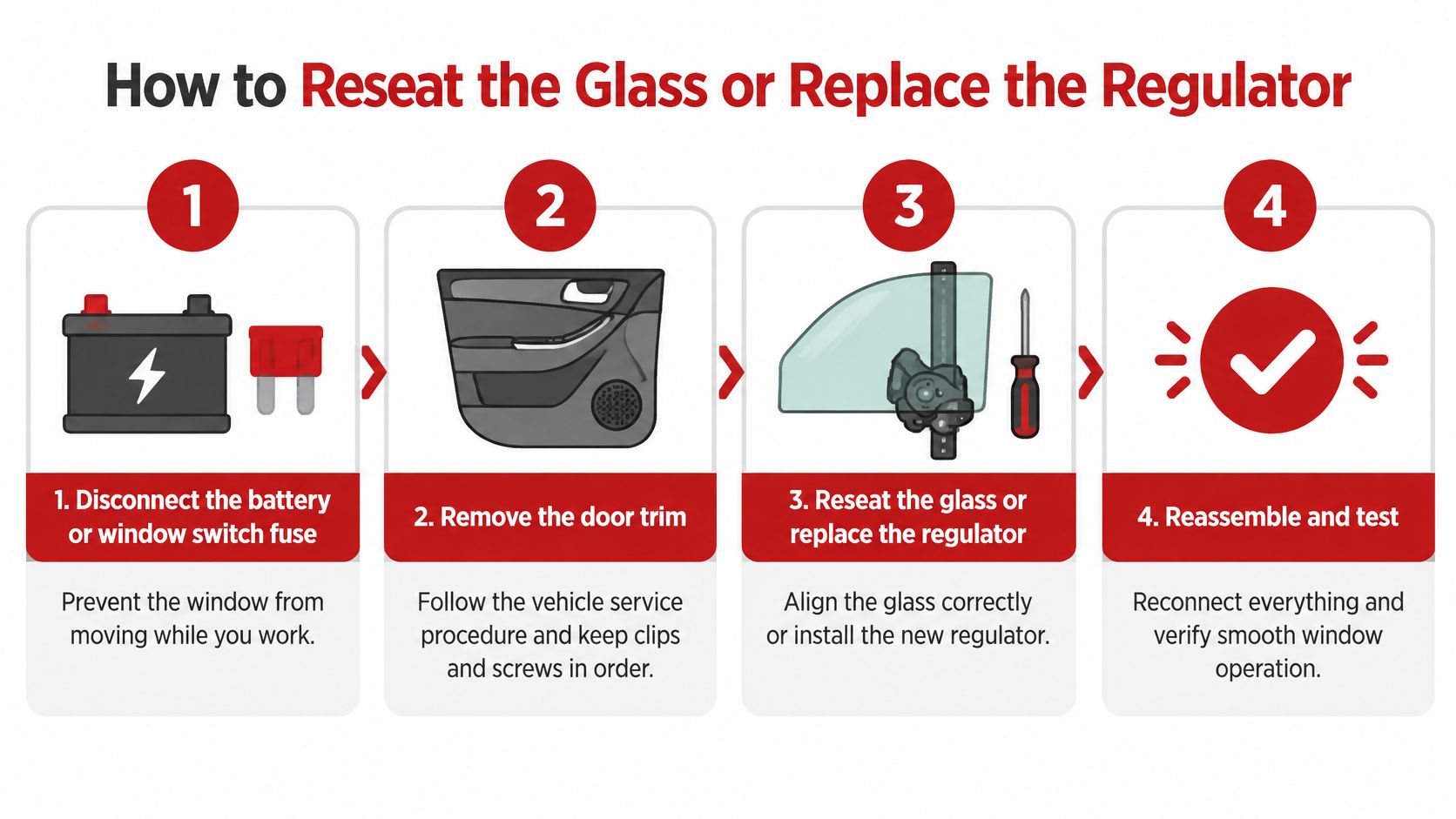
- Disconnect the battery or pull the window switch fuse. With the circuit dead, the window can't move while your arm is inside the cavity, and you won't trigger a motor that's half unbolted.
- Remove the door trim by the vehicle's own procedure. Screws hide behind switch panels, armrests and reflector lenses, and plastic clips get brittle in cold weather. Keep fasteners in a tray in the order they came out. A door panel removal walkthrough shows the common clip layouts if this panel is new to you.
- Support the glass before you loosen anything. A wood block under the pane or a second pair of hands keeps the glass off the regulator arm and the door sill. Skip this and a reseat turns into a glass replacement.
- Lower the glass about six inches. That height puts the clamp or carrier within reach through the access opening without forcing your hand past the regulator arm.
- Make the reseat-versus-replace call. The hand test from the diagnosis stage gives the answer: glass that lifted free of its carrier separated from the regulator, per this manufacturer service bulletin on window regulator diagnosis. A pane that stayed put points to a carrier or clamp problem instead.
- Reseat the glass in the clamp and check it square. The pane should sit evenly between the front and rear run channels, not cocked toward one weatherstrip. Hold it in position while you confirm the carrier is gripping, then tighten.
- Replace the regulator when the glass won't stay seated. A stretched cable, a cracked slider or a bent arm won't hold alignment no matter how carefully you reseat it. A cracked, heavily chipped or unsupportable pane needs new glass, not a reseat.
- Cycle the window fully up and down. Watch for smooth travel, full seal contact and abnormal noise, then complete pinch protection or express-up calibration where the vehicle has it.
Replacing a regulator because the glass slipped out of its carrier buys a part you didn't need and leaves the alignment problem exactly where it was.
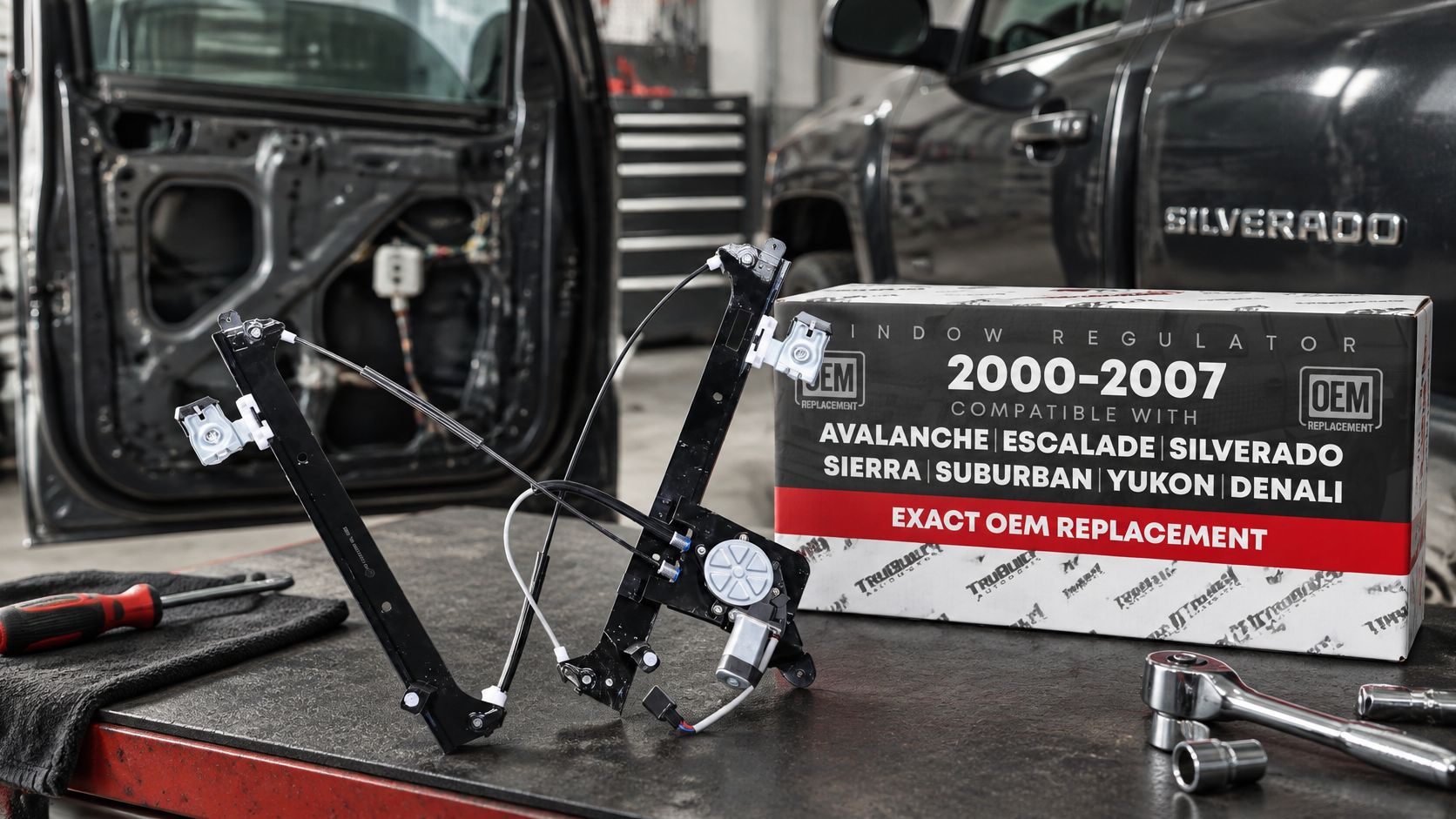
Say the diagnosis does land on a failed rear regulator on a 2001 to 2007 Chevrolet Silverado or GMC Sierra. The Power Window Regulator, Rear Left, for the Silverado and Sierra is a rear driver side assembly cross-referenced to OEM 15077722. Compare its mounting feet and connector against the old unit before installation, since a mismatch there means the part won't seat square in the door.
Torque, Alignment and Seal Checks That Prevent a Repeat
The door is a sealed structure with an air pressure path running through it, and a regulator swap disturbs both. Fasteners hold the glass square and the vapor barrier keeps water away from the motor, the latch and the wiring. Get either wrong and the window works right up until the first hard rain or the first cold snap.
Torque values are vehicle-specific, which is why a spec pulled from a forum is a bad bet. One OEM service manual for a modern sedan lists 10 Nm at the upper and lower regulator mounts, 2.4 Nm at the motor fasteners and 4 Nm at the door access plate, per the Model S service manual regulator procedure. Other applications call for considerably more torque across the same class of fastener, so a number that held a door together on one vehicle can crack glass or strip threads on another.
| Fastener | Torque |
|---|---|
| Upper and lower regulator mounts | 10 Nm |
| Motor fasteners | 2.4 Nm |
| Door access plate | 4 Nm |
The values above come from the Tesla Model S service manual's regulator procedure and apply to that vehicle only. Confirm every number against the service manual for the exact vehicle before tightening.
What the door loses when a plug goes missing
The same procedure warns that missing plugs or waterproof tape create additional air escape paths, which reduces the door pressure sensor's ability to detect a side impact and can affect airbag deployment. A grommet left out costs more than a rattle. Reinstall every vapor barrier, plug and strip of waterproof tape you removed, and replace the tape where it tore.
Alignment comes next. Use the alignment marks, set the glass against the front and rear weatherstrips, and tighten the regulator fasteners only after the glass sits correctly. Overtightening a glass fastener cracks the pane, and tightening before the glass is square gives you wind noise, water leaks, binding and a repeat regulator failure. Some systems won't run the motor until the door latch is closed, so a dead switch after reassembly can be a normal interlock rather than a wiring fault.
Finish with water. Run a garden hose along the top of the glass for a couple of minutes and look inside the door cavity and on the cabin floor. Water where it shouldn't be means a seal or vapor barrier is wrong, and it will find the motor next winter.
Relearn and Test the Repair
Once a regulator or module is replaced, check whether the vehicle needs an initialization or relearn step. The procedure varies by make and lives in the service information, and skipping it leaves express-up and anti-pinch calibration wrong even though the glass moves.
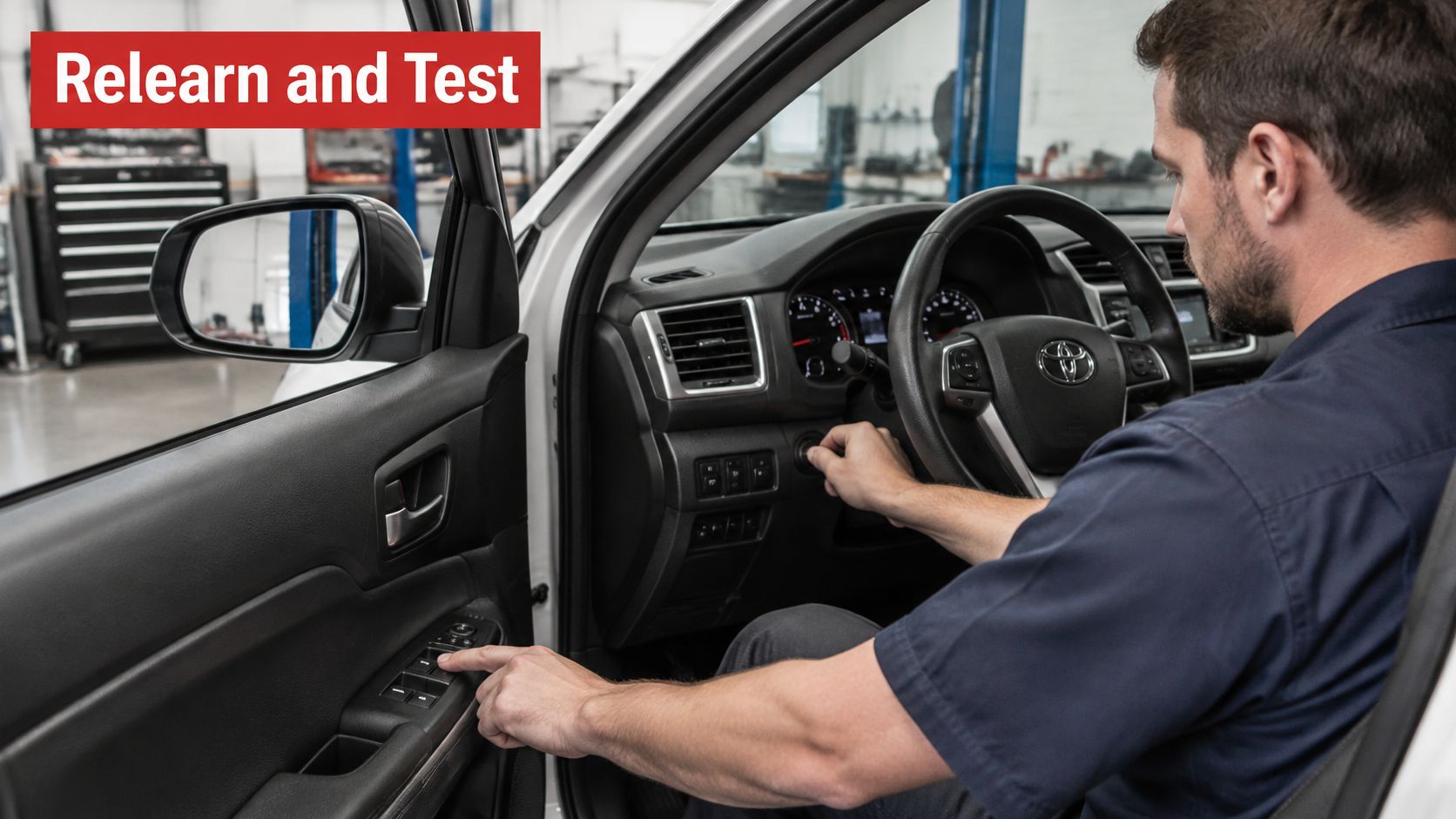
Close the door latch, cycle the window fully up and down with the switch, and watch for binding or grinding. Test reversal against a soft obstruction with your hands clear. A window that reverses late or not at all is a safety defect, and auto-up stays unused until it's fixed.
Pinch injuries are why that check isn't optional. In a survey of 1,001 respondents described in a 2011 NHTSA review, 33 people reported a lifetime power-window-related injury and only 3 of those 33 said they sought medical attention, per the NHTSA analysis of power-window injuries. Most were minor, and the agency noted that exact annual totals couldn't be reliably calculated because finger-pinch injuries weren't consistently captured in existing data systems. A mechanism that closes on a hand still counts as a fault.
The switch test and the travel check, shown in sequence:
The repair is done when the window reverses, seals and holds its position.
If your window dropped and the diagnosis points to a failed regulator, T1A Auto stocks powered and manual window regulators, along with the door handles, latches, hinges, cables and sensors that live in the same panel. Every part is searched by vehicle so the mounting points and connector match what's on your truck, and our GMC and Chevrolet coverage includes the rear driver side regulator assemblies that fail most often on older Silverado and Sierra trucks. Visit T1A Auto with your VIN in hand and get the right part the first time.
