


Ever wondered what happens inside your car door when you hit the window switch? Hidden behind that interior panel is a clever piece of engineering called a window regulator.
Think of it as a miniature elevator for your window glass. It's the mechanism responsible for converting your command—whether from a button press or the turn of a crank—into the smooth, steady motion that raises and lowers the window.
What a Window Regulator Does Inside Your Car Door
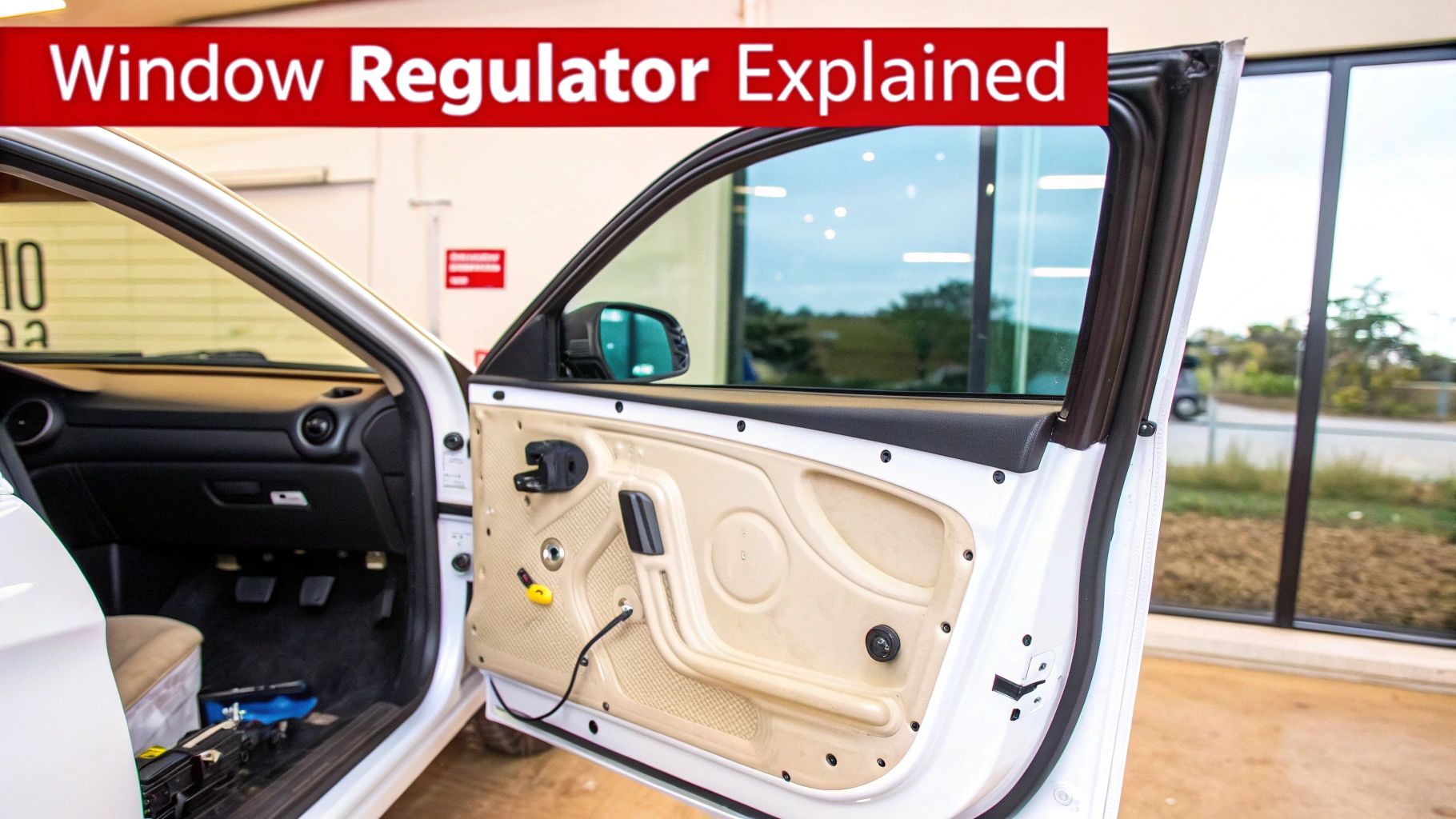
At its heart, the window regulator’s job is simple but crucial: move a heavy piece of glass up and down, over and over again. Without it, you couldn’t crack the window for a little fresh air or seal it shut against a sudden downpour. It’s the invisible workhorse connecting your action to the window's reaction.
This entire assembly is bolted directly to the inner door frame, where it guides the glass along a set track. This is what keeps the window from tilting, rattling around, or getting jammed halfway. It’s all about smooth, controlled movement every single time.
To give you a quick overview, here's a simple breakdown of the window regulator's role.
Window Regulator at a Glance
| Aspect | Description |
|---|---|
| Core Function | Lifts and lowers the car's window glass. |
| Location | Mounted inside the vehicle's door panel, hidden from view. |
| Types | Comes in two main versions: Manual (hand crank) and Power (electric motor). |
| Importance | Essential for convenience, ventilation, and vehicle security. |
This table sums it up nicely: the regulator is a fundamental part of your vehicle's daily operation.
The Basic Function Explained
Trying to lift your car's heavy window glass by hand would be tough. A window regulator acts like a pulley system, giving you the mechanical advantage to make it feel effortless. It takes the small rotational motion from the hand crank or electric motor and transforms it into the strong, linear force needed to push the window up or guide it down.
Key Takeaway: A window regulator is essentially a force multiplier. It turns a small, easy input from you into enough power to move the heavy window glass against gravity and friction.
A regulator that works right is key for both convenience and safety. It lets you get your ticket at a parking garage or quickly seal the cabin from rain. It’s also a security feature, making sure your window stays firmly shut when you lock up. Our guide to https://www.t1aauto.com/blogs/t1-auto-blogs/car-window-parts breaks down how all these parts work together.
The Evolution of Window Control
We pretty much take power windows for granted today, but they have a fascinating backstory. The journey started with the first-ever automotive window regulator, invented by Max Brose way back in 1935. Things got a bit fancier when the 1941 Packard 180 rolled out with hydroelectric windows.
By the 1980s, the switch to fully electric systems was nearly complete, becoming standard in over 95% of vehicles in major markets. While our guide focuses on the regulator itself, sometimes car door issues can be more complex. If your problems involve locks or keys, you might need professional automotive locksmith services.
Exploring the Different Types of Window Regulators
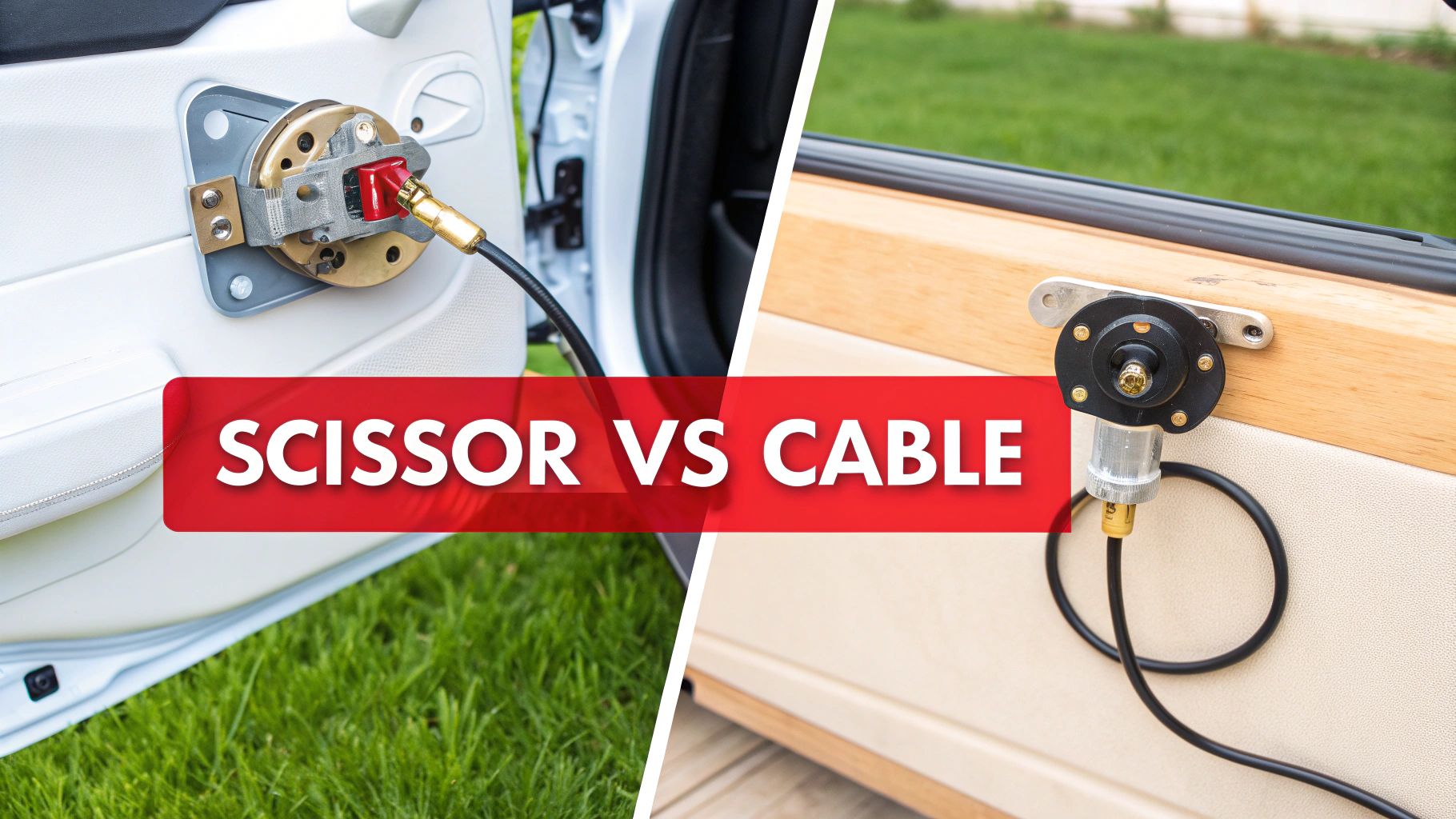
Just like the cars themselves, the mechanisms that raise and lower our windows have come a long way. To really get a handle on what a window regulator is, you have to look at the different forms it's taken over the years. The story starts with the old-school hand crank and brings us all the way to the power systems we see in just about every car on the road today.
At its core, any window regulator falls into one of two main camps: manual or power.
- Manual Regulators: These are the originals, the ones you operate with a good old-fashioned hand crank on the door panel. When you turn that crank, you’re physically turning a set of gears that move the lifting mechanism. They’re beautifully simple, which makes them incredibly reliable and dead easy to diagnose when something goes wrong.
- Power Regulators: Here, the hand crank is swapped out for a small but surprisingly strong electric motor. Pushing the window switch sends a signal to that motor, which does all the heavy lifting for you.
You might still find a manual crank in a base-model work truck or a classic car, but power windows have become the standard for a reason—they're just plain convenient. Digging a little deeper into power regulators, you'll find two designs that have really dominated the auto industry: the scissor-type and the cable-type.
The Robust Scissor-Type Regulator
Picture a scissor-type regulator as a heavy-duty, accordion-like device made of solid steel. It’s built around a set of crossing metal arms that pivot in the middle, just like a pair of scissors. The motor turns a gear that forces these arms to either spread apart, pushing the window up, or contract, letting it slide down.
For decades, this was the go-to design because it was incredibly strong and built to last. That all-metal construction meant it could take a real beating without wearing out.
Key Feature: The scissor-type regulator is all about direct, powerful action. Those metal arms create a solid, rigid link to the window glass, giving it a very stable and forceful movement.
This design was a perfect fit for older cars and trucks, where door panels had plenty of space and a little extra weight wasn't a big deal. But as cars got more sophisticated, its bulkiness pushed engineers to find a sleeker, more modern solution.
The Modern Cable-Type Regulator
The cable-type regulator is what you'll find in most cars today, and it represents a big shift in automotive design. Think of it as a tiny winch system inside your door. It uses a spool, a couple of flexible steel cables, and vertical tracks that guide the window up and down.
When you hit the switch, the motor spins the spool, winding up the cable on one side while letting it out on the other. This pulls a small bracket, which is attached to the bottom of the window, smoothly along the tracks. The whole setup is way lighter and more compact than the old scissor style.
That weight savings is a huge deal. In an industry where every ounce counts for better fuel economy, shaving off 1.5 to 2.5 kg per door by using a cable system is a massive win. Its smaller size also frees up precious real estate inside the door for things like bigger speakers, side-impact sensors, and other modern tech.
Comparing Scissor and Cable Designs
Each regulator style has its own pros and cons, which is why they were popular in different eras of car manufacturing.
| Feature | Scissor-Type Regulator | Cable-Type Regulator |
|---|---|---|
| Primary Design | Intersecting metal arms | Spool and flexible steel cables |
| Key Advantage | Extreme durability and strength | Lightweight and space-saving |
| Common Failure | Worn out gear teeth or motor | Frayed cables or broken plastic pulleys |
| Typical Era | Older vehicles and heavy-duty trucks | Modern cars, trucks, and SUVs |
In the end, while the scissor design rightly earned its reputation for being tough as nails, the cable-type regulator's efficiency and compact design made it the undisputed champion for the modern vehicle.
How Your Power Window System Really Works
When a car window gets stuck, it's natural to point the finger at the window regulator. And often, you'd be right. But the regulator isn't working alone; it's part of a small, sophisticated team tucked away inside your car door. To get to the root of the problem, you need to understand how all the parts talk to each other.
A dead window isn't always a sign of a busted mechanical part. Sometimes, the fix is purely electrical and a lot less of a headache. The key is seeing the whole system, from the button you push to the glass that (hopefully) moves.
The Chain of Command Inside Your Door
Pushing the power window button kicks off a lightning-fast chain reaction. It feels instantaneous, but a precise sequence of events unfolds every single time. It's a surprisingly elegant process that turns a simple touch into serious mechanical force.
This entire operation relies on four key players working in sync:
- The Window Switch
- The Control Module
- The Electric Motor
- The Regulator Assembly
Let’s pull back the curtain and see what each one actually does.
The Window Switch: Your Starting Pistol
The switch on your door panel is the trigger for the whole show. When you press or pull it, you aren't directly moving the window. You're simply closing a circuit and sending a low-voltage electrical signal to the system's brain.
Think of it like ringing a doorbell. You push the button, which sends a signal that tells something else to make a noise. In this case, that "something else" is the control module.
The Body Control Module: The System's Brain
That little signal from the switch zips over to a computer, usually the Body Control Module (BCM) or a specific door control unit. This module is the central processor. It interprets your command, figuring out which window you want to move and whether you mean up or down.
Once it has its orders, the BCM sends a much stronger, high-amperage current straight to the window motor. It’s the crucial middleman that translates your gentle push into real power.
Key Insight: The control module makes the decisions. It takes your request, processes it, and then sends the heavy-duty power where it needs to go. This is exactly why a bad switch or a faulty module can look and feel just like a dead motor.
The Electric Motor: The Muscle
Once the electric motor gets the go-ahead from the BCM, it jumps to life. This small but powerful component is the muscle of the operation. Its one and only job is to convert electrical energy into the spinning force needed to get the regulator moving.
Inside a window motor, a set of gears multiplies its torque, giving it plenty of grunt to lift a heavy pane of glass against gravity and the friction of the window channels. If you want to dive deeper into this component, check out our detailed guide on power window motors. A classic diagnostic tip: if you hear a whirring sound but the window stays put, the motor is probably doing its job, which means the mechanical regulator is likely the problem.
The Regulator Assembly: The Lifter
All that force generated by the motor is finally handed off to the window regulator assembly. The motor's gear meshes with the regulator, which drives the cables or scissor-like arms that actually lift and lower the window glass along its track. The regulator does all the heavy lifting, making sure the glass moves smoothly and stays level.
This whole sequence—from your finger on the switch to the module, the motor, and finally the regulator—happens in the blink of an eye. Understanding this flow is your secret weapon for diagnosis. For instance, if you hit the switch and get dead silence, your problem is almost certainly electrical (a fuse, the switch, or the module). But if you can hear the motor trying to work, you can be pretty sure the electrical side is fine and the mechanical regulator has given up the ghost.
Diagnosing Common Window Regulator Problems
When your car window suddenly refuses to budge, it's easy to jump to conclusions. But before you start pricing out parts, a little bit of diagnostic work can save you a lot of time and money. Figuring out what's wrong often comes down to just listening and observing. Your car is usually telling you exactly what’s broken inside the door panel.
Is the window making a nasty grinding sound? Did it drop into the door with a loud thud, or does it now move slower than a glacier? These aren't random quirks; they're classic symptoms that point directly to specific failures in the window regulator assembly.
The First and Most Important Diagnostic Test
The best place to start is with your ears. It’s that simple. Find a quiet spot, roll down the other windows so you can hear clearly, and then press the switch for the broken window. The sound it makes—or the lack of sound—is your single biggest clue.
This simple process can help you figure out if you're dealing with a mechanical problem (the regulator) or an electrical one (the motor, switch, or fuse).
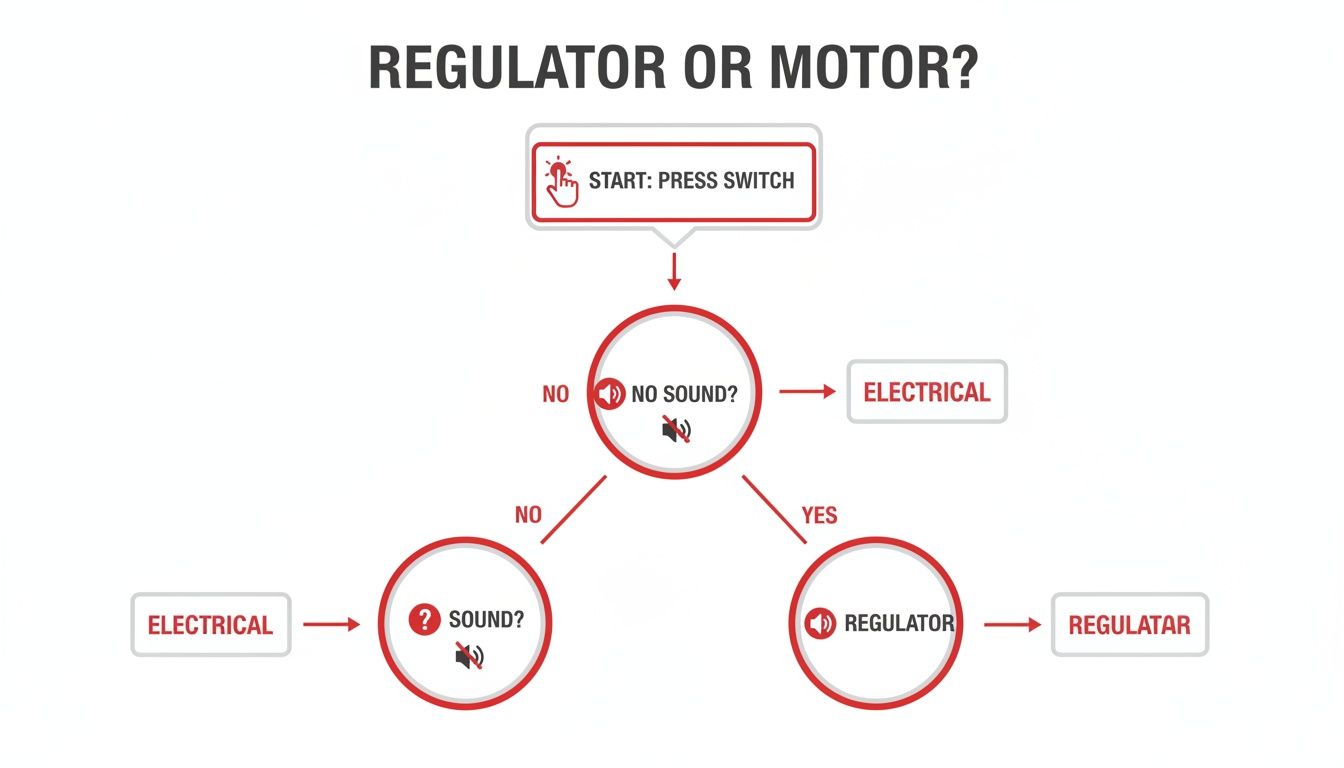
As you can see from the chart, hearing any noise from inside the door when you hit the switch is a pretty sure sign the motor has power and is trying to do its job. That means the regulator itself is the likely culprit. If you hear absolute silence, you'll want to start looking at the electrical side of things.
If you suspect an electrical fault, the next logical steps are checking the fuse, the switch, and the motor itself. Our guide explains in detail how to test a window motor to see if it's getting the juice it needs. But if you heard a noise, let's figure out what that sound is telling you.
Matching Sounds to Specific Failures
Okay, so you heard something. The specific type of noise is the key to pinpointing what broke. Each sound tells a different story about what's going on behind the door panel.
- Grinding or Popping Sounds: This almost always means a frayed or snapped cable in a cable-style regulator. The motor is spinning, but the broken cable is getting tangled up or grinding against the pulleys instead of lifting the window.
- A Loud Clunk or Thud: That's the unmistakable sound of the window glass falling off the regulator's lift bracket. It has completely detached and is now resting at the bottom of the door.
- Clicking or Ratcheting Noises: A repetitive click-click-click usually points to stripped gears. Either the teeth on the motor's gear or the regulator's gear sector are worn down, and they're slipping past each other instead of meshing.
Key Diagnostic Tip: Noise almost always means a bad regulator. Silence typically points to an electrical problem. Trust your ears—they'll guide you to the right repair and keep you from buying parts you don't need.
Visual Clues of a Failing Regulator
Sometimes, you don't even need to listen. The way the window is behaving (or misbehaving) can be just as telling. A visual inspection can quickly confirm a mechanical failure.
Keep an eye out for these tell-tale signs:
- Crooked Window: If the glass tilts forward or backward as it goes up or down, it's a dead giveaway that one of the plastic clips holding it to the track has broken. The window is no longer supported evenly on both sides.
- Slow or Jerky Movement: A window that struggles, stutters, or moves in jerky motions often points to a dying motor or a damaged regulator cable causing too much friction in the system.
- Window Drops When You Close the Door: If the window slides down on its own, especially with the vibration of shutting the door, the mechanism designed to hold it in place has failed completely.
These problems are the result of everyday wear and tear, but sometimes, they stem from questionable design choices. Back in the 1980s, for example, some automakers switched to "tape-drive" regulators to save weight and boost fuel economy. The trade-off was a disaster for reliability, with failure rates jumping to 20-30% within 100,000 miles—a huge leap from the under 1% failure rate of older, all-steel designs.
How to Choose the Right Replacement Regulator
So, you've diagnosed the problem and confirmed your window regulator is the culprit. Now comes the important part: picking a replacement. This isn't just about finding something that fits; it’s about choosing a part that won't have you tearing your door panel off again in a year or two. The goal here is a perfect fit and long-term reliability.
The first and most critical step is nailing down the exact part for your car. You have to match the regulator to your vehicle's specific year, make, and model. Automotive parts are notoriously specific, and a regulator for a 2015 model might be just different enough to not work on a 2016, even if the car looks identical.
Start with Guaranteed Fitment
The absolute number one rule when shopping for a replacement is to ensure it has guaranteed fitment. Trust me, there’s nothing worse than spending an afternoon with your door in pieces only to find out the new regulator’s mounting holes are off by a millimeter or the electrical plug doesn’t match.
Always use a reliable parts finder tool where you can plug in your vehicle's details. This confirms the part you're buying is engineered to the original factory specs. A perfect fit makes the installation go smoothly, but more importantly, it ensures the regulator works correctly without putting unnecessary stress on the motor or the window glass itself.
Why Material Quality Is Everything
Once you’ve locked in the fit, the next thing to scrutinize is what the regulator is made of. The dirty little secret of many factory (OEM) regulators is that they use plastic parts in high-stress areas. The pulleys that guide the cable and the clips that hold the glass are often the first to go. Over time, that plastic gets brittle and cracks under constant tension, and snap—you're right back where you started.
This is where a good aftermarket part can really shine. Look for replacements that specifically advertise upgraded all-metal components.
- Metal Pulleys: They simply don’t wear out, crack, or warp like plastic ones do. This keeps the cable gliding smoothly for the long haul.
- Reinforced Clips: Stronger clips grip the window glass securely, preventing that annoying tilting or the window falling completely off its track.
- Upgraded Cable Sheathing: A tough outer sleeve protects the inner steel cable from moisture and grime, stopping rust and fraying before they start.
Choosing a regulator with these upgrades isn't just about replacing a broken part—it's about installing a permanent fix designed to outlast the original.
Expert Insight: The difference between a regulator that lasts two years and one that lasts ten often comes down to the quality of its smallest components. Investing in a part with upgraded metal pieces is one of the smartest ways to ensure a long-term, reliable repair.
Understand the Modern Regulator Market
Window regulator design has come a long way, mostly driven by the auto industry's obsession with shedding weight for better fuel economy. Today, cable-driven regulators dominate, holding 60-70% of the market share. Why? Because they can save up to 2.5 kg of weight per door compared to old-school steel scissor-lift designs. As the global market for these parts saw a 2.5% CAGR from 2020-2024, new features like anti-pinch safety and express-up/down functions became common. You can explore more about these industry shifts in reports from analysts like Future Market Insights.
This evolution means you have a choice: you can buy a direct OEM-style replacement (with the same potential weak points) or an aftermarket version that’s been re-engineered to fix those common flaws.
To help you decide, let's break down the key differences between a standard OEM part and a high-quality aftermarket alternative.
Comparing OEM vs. Quality Aftermarket Regulators
| Feature | OEM Regulator | Quality Aftermarket (e.g., T1A Auto) |
|---|---|---|
| Fitment | Guaranteed for the specific vehicle. | Guaranteed fitment, engineered to match or exceed OEM specs. |
| Material Quality | Often uses plastic in critical areas (pulleys, clips) to save cost. | Features upgraded, all-metal components to prevent common failures. |
| Durability | Prone to the same failures as the original part. | Designed to be a long-term solution by reinforcing weak points. |
| Cost | Typically the most expensive option, purchased from a dealership. | Offers significant cost savings without sacrificing quality. |
| Warranty | Usually comes with a limited 1-2 year warranty. | Often backed by a lifetime warranty, especially on metal parts. |
In the end, a premium aftermarket regulator gives you the best of both worlds: the perfect fit of an OEM part combined with superior materials that provide lasting reliability, all at a more reasonable price.
Decode Warranties and Certifications
A warranty is more than just fine print; it's a manufacturer's vote of confidence in its own product. A short, 12-month warranty might tell you the part is built with cheaper materials that aren’t expected to last. On the other hand, a lifetime warranty on metal components is a powerful statement about quality and durability.
For some auto parts, you might also see a CAPA certification. While less common for regulators, this seal means a third-party organization has rigorously tested the part for quality, fit, and safety. Choosing brands that stand by their products with strong warranties and certifications gives you peace of mind that you’re making a smart, protected investment.
Frequently Asked Questions About Window Regulators
When a car window suddenly gives up, you're left with a lot of questions. Is this something I can fix myself? What's this going to set me back? How do I even know what’s broken? Don't worry, we've got you covered.
This section tackles the most common questions we hear from drivers dealing with a busted window regulator. We’ll give you the straightforward answers you need, whether you're a weekend wrench-turner or just trying to make sense of your mechanic's quote.
Can I Replace a Window Regulator Myself?
Yes, you absolutely can. For most people comfortable with basic hand tools, replacing a window regulator is a totally doable Saturday project. The job boils down to taking off the interior door panel, carefully unbolting the window glass from the old regulator, and then swapping the entire assembly out for the new one.
Of course, some cars are easier than others. A simple door panel on a domestic truck is a different beast than the complex, tight-fitting panel on a European luxury sedan.
Pro Tip: Before you even buy the part, find a video tutorial for your exact car. Watching someone else go through the steps is the best way to gauge if you're up for it. If you get nervous about handling a large piece of glass or fiddling with delicate plastic clips, there's no shame in calling a pro.
How Much Does It Cost to Replace a Window Regulator?
The final bill really depends on who's doing the work—you or a mechanic.
- DIY Cost: If you're doing it yourself, your only cost is the part. A quality aftermarket regulator usually runs between $75 and $150. It's easily the most affordable route.
- Professional Repair Cost: Headed to a shop? You're looking at a total of $250 to $500 for both the part and the labor. The exact price tag will depend on your local shop's hourly rate and the car you drive.
Luxury brands or vehicles with tricky door designs will always push that cost toward the higher end. A shop will typically charge for 1.5 to 3 hours of labor to get the job done.
Is It the Regulator or the Motor That Is Broken?
This is the big question, but thankfully, your ears can usually give you the answer. Just roll down your working window a bit (to reduce pressure), close the door, and hit the switch for the broken window. Now, listen closely.
If you hear a whirring, grinding, or humming sound, the motor is getting power and trying to work. That's a classic sign that the regulator has failed mechanically—a cable has snapped, or a plastic guide has broken.
If you hit the switch and get dead silence, the problem is electrical. It could be the motor itself, the switch on your door, a blown fuse, or a break in the wiring.
Why Did My New Window Regulator Fail So Quickly?
It’s a huge letdown when a brand-new part dies within months, and it almost always comes down to one of three things. The most common culprit is a low-quality part. Cheap regulators use brittle plastic pieces that just can't stand up to the daily stress of lifting and lowering heavy window glass.
Another possibility is an improper installation. If the regulator isn't perfectly aligned, it puts a ton of extra strain on the motor and cables, causing them to wear out fast. Finally, don't forget the window channels. If the tracks the glass slides in are dirty or sticky, the new regulator is forced to work way too hard, leading to a premature death. Always clean and lubricate the window channels before installing a new part.
At T1A Auto, we build our regulators to last. We identified the weak plastic components that always break and replaced them with durable, all-metal parts. With a lifetime warranty and a guaranteed fit, you can be confident it's the last time you'll have to do this job. Find the right regulator for your ride at https://t1aauto.com.
